On this page
How to identify it
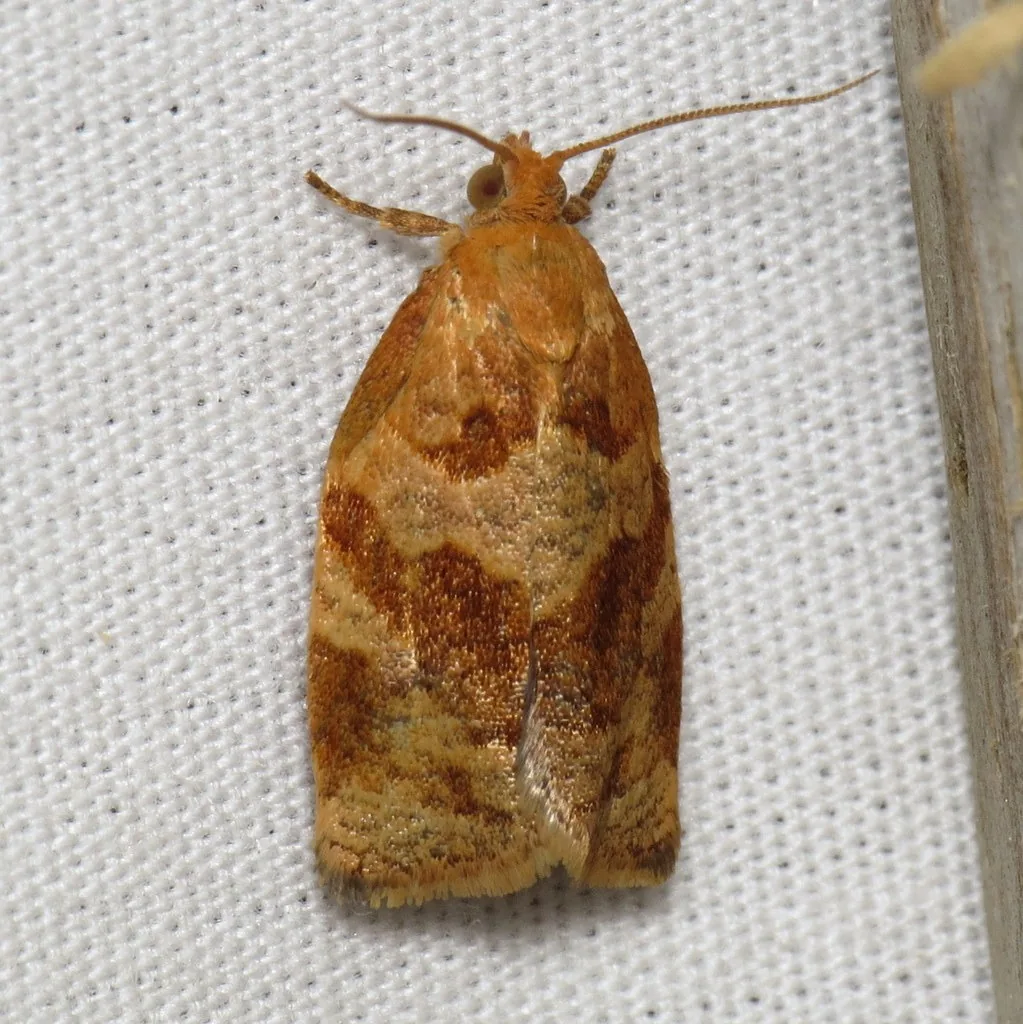
- The moth is about 0.5 to 0.75 inch long, with brown forewings crossed by darker lines; the markings vary, and in most individuals they are more subdued than in similar Archips moths. The hindwings are grayish brown with yellowish-orange shading near the tip.[1][2]
- The caterpillars are green, from dull pale green to dark olive, with a light to dark brown or reddish-brown head and brown to black legs. Full-grown caterpillars are 15 to 20 mm long.[1][2]
- Eggs are laid in irregular, flat masses on twigs, branches, bark and trunks, and the masses look grayish by spring; USDA TortAI says about 60 eggs per mass, Oregon State about 50.[1][2][4]
Look-alikes
| Look-alike | How to tell them apart |
|---|---|
| Obliquebanded leafroller | Its caterpillars are similar to those of the obliquebanded leafroller, the other leafroller in US hazelnut orchards; the obliquebanded leafroller is native and spends the winter as a partly grown caterpillar in bark cracks, not as an egg mass.[2][4] |
Where it lives
It is native to the Palearctic region and now occurs in the Northeast and the Pacific Northwest; in the Pacific Northwest it is a pest of hazelnuts (filberts), fruit trees and other plants in the rose family.[2][1][4]
Biology and life cycle
There is one generation a year. The moths fly from late June to August, live only 2 to 4 weeks, and lay the eggs that spend the winter on twigs, branches and trunks.[2][1][4]
The eggs hatch in spring, from the time buds open until petal fall (late March or early April in Oregon). The caterpillars feed on leaves, buds, flowers and small fruits, rolling leaves as they grow, and then pupate inside the rolled leaves, usually in late May or early June in the Willamette Valley.[1][2][4]
The caterpillars feed on plants in more than 15 families. Apple, currant, hawthorn, pear and privet may be its main hosts.[2]
Very low winter temperatures greatly reduce the overwintering population, and spiders, parasitic wasps and predators such as brown lacewings greatly reduce leafroller numbers through the year.[1]
Fun fact: a genetic study of leafrollers found that in A. rosana, variation in a mitochondrial gene was tied to where the moths live geographically.[5]
Damage and signs
Health risk
The Pacific Northwest handbook, Oregon State and the USDA fact sheet discuss it only as a plant pest; none mentions any risk to people.[1][4][2]
Control
Prevention
To decide whether to act, check shoot tips in spring for tightly rolled leaves; Oregon State and the PNW handbook use the same 20 to 25% infested-shoot threshold for both orchard leafrollers.[4][1]
Traps and physical control
Home orchardists can hand-pick and destroy rolled leaves that contain caterpillars or pupae.[1]
Biological control
Natural enemies usually keep it in check: biological control is typically enough, and chemical control is rarely necessary. Many parasitic wasps attack the older caterpillars.[1]
Pesticides
If spraying is needed, do it in spring after the overwintering eggs hatch, when leaves are about 0.75 to 1 inch long and the caterpillars are small. Avoid treating once caterpillars are mature: the damage is already done, and natural enemies would be harmed. Home options listed include azadirachtin (neem oil), Bacillus thuringiensis var. kurstaki, carbaryl and pyrethrins.[1]
Monitoring hazelnut orchards
From about mid-March, check three shoot tips per tree and three leaf clusters per shoot for tightly rolled leaves and feeding on new growth. Treatment is suggested when 20 to 25% of shoots are infested.[1][4]
For moths, hang one pheromone trap per 5 acres, about 6 ft high in the canopy, starting in mid-May. The suggested threshold is 40 moths per week.[1]
Where sources disagree
When it arrived: USDA TortAI says it was introduced into North America before 1890; Oregon State says it was introduced accidentally to the United States in 1915.[2][4]
Egg mass size and feeding time: TortAI says about 60 eggs per mass and the PNW handbook says caterpillars feed 4 to 6 weeks; Oregon State says about 50 eggs and 4 to 8 weeks.[2][1][4]
Common questions
- Is the filbert leafroller the same as the rose tortrix?
- Yes. Archips rosana is called the filbert leafroller in hazelnut orchards and is also known as the rose tortrix.[1][3]
- Do I need to spray for filbert leafroller?
- Usually not. Natural enemies normally keep it under control, and in recent years it has not reached levels that require management in Pacific Northwest hazelnuts.[1]
- Where does the filbert leafroller spend the winter?
- As eggs, in flat masses on twigs, branches, trunks and bark. The masses turn grayish by spring and hatch as the buds open.[1][2][4]
Sources
- Pacific Northwest Pest Management Handbooks (Oregon State, Washington State and University of Idaho Extension), “Hazelnut: Filbert leafroller (Pacific Northwest Insect Management Handbook).” pnwhandbooks.org/insect/nut/hazelnut/hazelnut-filbert-leafroller (accessed 2026-11-12)
- USDA APHIS PPQ Center for Plant Health Science and Technology, with Colorado State University, “Archips rosana fact sheet, Tortricids of Agricultural Importance (T. M. Gilligan and M. E. Epstein; last updated August 2014).” idtools.org/id/leps/tortai/Archips_rosana.htm (accessed 2026-11-12)
- iNaturalist, “Archips rosana taxon page (order and family).” www.inaturalist.org/taxa/214086 (accessed 2026-11-12)
- Oregon State University Extension Service, “Growing Hazelnuts in the Pacific Northwest: Integrated Pest Management (EM 9081).” extension.oregonstate.edu/sites/default/files/documents/em9081.pdf (accessed 2026-11-12)
- Genetika (2008), via PubMed, “Pheromone composition, the mtDNA COI locus variation, and phylogenetic relationships in leafrollers of the tribe Archipini (Lepidoptera: Tortricidae).” pubmed.ncbi.nlm.nih.gov/18666551/ (accessed 2026-11-12). Article in Russian; cited from the English PubMed abstract.