On this page
How to identify it
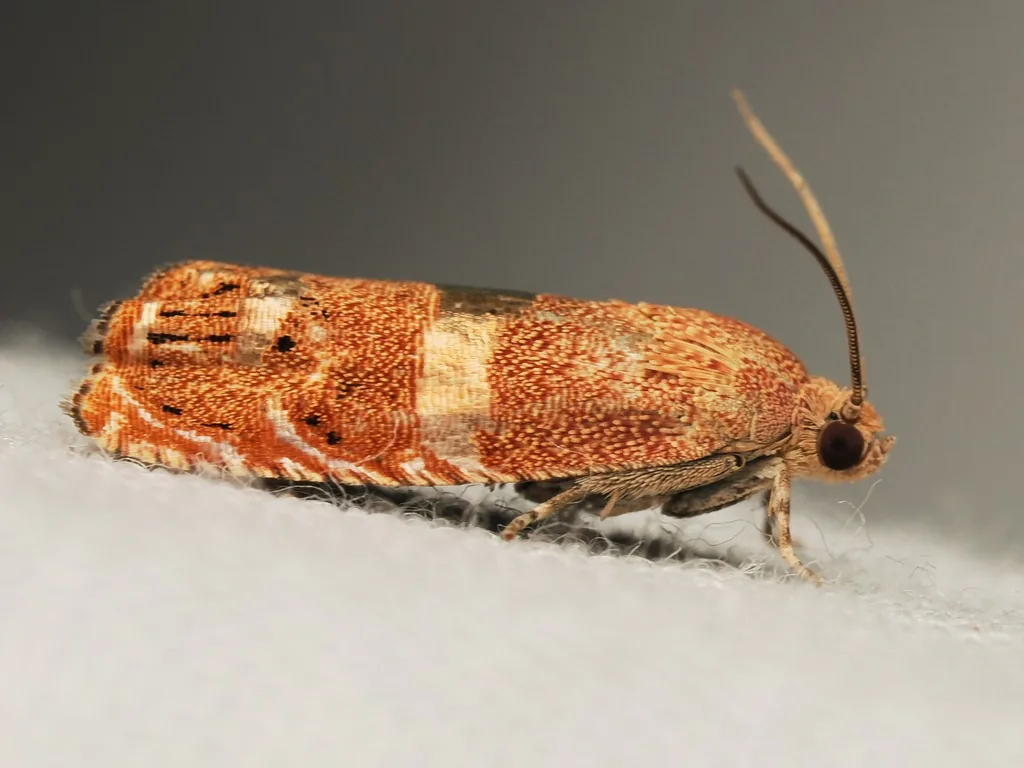
- Adult moths are gray to reddish with golden bands of scales across each forewing. The USDA Forest Service's eastern manual describes the adult as reddish-brown with a wingspread of 11 to 20 mm; its western manual says the color varies but is generally brownish with shining coppery bands across the wings.[1][11][12]
- Grown larvae are whitish with a brown or black head and about 1/2 inch long.[1]
- Infested nuts hold only frass and mold where the kernel should be.[1]
- Young larvae get into hazelnuts through the micropyle, the thinnest point of the shell at the center of the basal scar where the nut was attached.[1]
Look-alikes
| Look-alike | How to tell them apart |
|---|---|
| Codling moth | A close relative; filbertworm adults are gray to reddish with golden bands across each forewing.[1] |
Where it lives
The PNW handbook says it is found with many wild and cultivated fruits and nuts in North America, is particularly common in acorns and chinkapin in the Pacific Northwest, and in California can be a pest of commercial pomegranates. GBIF holds about 11,600 U.S. records since 1990 from 48 state-level areas, the most from Texas (3,352), California (1,198) and Massachusetts (962). The USDA Forest Service says it occurs throughout most of the United States and in southern Canada, and its western manual calls it transcontinental, occurring extensively in the Western States and British Columbia in oak acorns and galls.[1][2][11][12]
Biology and life cycle
Mature larvae overwinter in silk cocoons under leaves and debris, 1 to 2 inches beneath the soil surface, or in cracks in tree trunks, and pupate in spring.[1][3]
Moths are first caught in late May and fly through October. The flight now starts earlier than it used to (historically it began in mid-June), so traps should be up by mid to late May.[1]
Eggs hatch after several days and the tiny larvae search out nut clusters. Larvae feed on the kernel for 2 to 4 weeks, then bore an exit hole, drop to the soil and spin a cocoon.[1][3]
Besides hazelnuts (filberts), the larvae feed in acorns, beechnuts, chestnuts and oak galls, the USDA Forest Service says. Its western manual adds the fruit of Castanopsis, Lithocarpus and Prunus among many other hosts, and says the moth has become an important pest of cultivated filberts.[11][12]
The western manual says the larvae overwinter in cocoons beneath or on the surface of the ground, or in the damaged nut or acorn, and that the adults' emergence seems timed to the forming of nuts or acorns.[12]
Damage and signs
- Early feeding on young nut clusters can make nuts abort, and later larvae infest nuts and destroy the kernel.[1]
- Infested nuts are a major cause of price deductions from nut processors, and OSU calls it the insect with the greatest economic impact on Oregon hazelnut production.[1][3]
- In oaks, the USDA Forest Service says high percentages of the acorn crop may be destroyed in poor seed years.[11]
Health risk
It feeds on nuts. The PNW handbook, OSU Extension and the USDA Forest Service's eastern and western forest insect manuals don't mention any risk to people or pets.[1][3][11][12]
Control
Prevention
Hazelnut varieties differ; those with thicker shells at the basal scar, such as 'Lewis', 'Jefferson', 'Dorris' and 'Barcelona', are less susceptible.[1]
Pheromone traps hung in the upper third of the canopy show when moths are flying. The action threshold is an average of 2 to 3 moths per trap per week, or 5 moths in any one trap.[1][3]
Sanitation
The first nuts to drop are more often infested; flailing them before harvest, and fallen acorns from nearby oaks, can reduce pressure.[1]
Biological control
Predators, parasitic wasps such as Trichogramma minutum, and bats kill eggs, larvae and moths.[1]
Insect-killing nematodes can reach the larvae overwintering on the ground. In Oregon lab tests, three nematode species infected 73 to 100% of filbertworm larvae; in field plots treated with Steinernema carpocapsae, mortality was 50 to 78% in May but only 2 to 11% in October.[4][5]
Pesticides
The PNW handbook's home-use list includes spinosad, carbaryl, esfenvalerate and azadirachtin, and EPA's product search lists products of each with active registrations. Pheromone traps help time the sprays, which target eggs and wandering larvae before they get into the nuts. Follow the label.[1][6][7][8][9]
Where the sources disagree
Generations: the PNW handbook says there are two generations a year; OSU Extension says that in Oregon it usually completes one full generation a year, with a partial second in warm years. The USDA Forest Service western manual agrees with OSU: one and a partial second generation a year in the Pacific Northwest.[1][3][12]
Egg sites: the PNW handbook says females lay eggs on the upper surface of leaves; OSU says on or near the developing hazelnut husks.[1][3]
Larval head: the PNW handbook describes grown larvae as whitish with a brown or black head; the USDA Forest Service western manual says whitish with red heads, up to 15 mm long.[1][12]
Adult color: the PNW handbook says gray to reddish with golden bands; the Forest Service's eastern manual says reddish-brown, and its western manual generally brownish with shining coppery bands. Both Forest Service manuals use the older name Melissopus latiferreanus.[1][11][12]
Mating disruption in orchards
It is the insect with the greatest economic impact on Oregon hazelnut production, and commercial growers can release synthetic pheromones that confuse the males and disrupt mating.[3]
In OSU field trials, mating disruption cut moth catches in monitoring traps by 40 to 88 percent. It works best in orchards of 30 acres or more, and nearby oaks or untreated hazelnuts weaken it.[3]
Common questions
- What hollowed out my hazelnuts?
- Likely filbertworm larvae, which bore into the nut and destroy the kernel.[1]
- Do filbertworms live in acorns too?
- Yes. They're particularly common in acorns and chinkapin in the Pacific Northwest.[1]
- Do beneficial nematodes work on filbertworm?
- They can help. Oregon trials found high infection rates in the lab and 50 to 78% mortality of overwintering larvae in a May field application, but much lower kill in October.[5][4]
- Do filbertworms hurt oak trees?
- Not the trees themselves: the larvae feed inside acorns and oak galls. The USDA Forest Service says that in poor seed years they may destroy a high percentage of the acorn crop.[11][12]
Sources
- Pacific Northwest Pest Management Handbooks (OSU, WSU, University of Idaho), “Hazelnut: Filbertworm (Insect Management Handbook).” pnwhandbooks.org/insect/nut/hazelnut/hazelnut-filbertworm (accessed 2026-11-14)
- Global Biodiversity Information Facility (GBIF), “Cydia latiferreana: U.S. occurrence records since 1990 by state (GBIF occurrence API).” api.gbif.org/v1/occurrence/search?taxonKey=1737964&country=US&hasGeospatialIssue=false&occurrenceStatus=PRESENT&year=1990%2C2026&facet=stateProvince&facetLimit=400&limit=0 (accessed 2026-11-13). 11,634 records from 48 state-level areas; Texas 3,352, California 1,198, Massachusetts 962; fetched 2026-11-13.
- Oregon State University Extension, “Sustainable Hazelnut Production: Filbertworm Control by Mating Disruption.” extension.oregonstate.edu/catalog/em-9198-sustainable-hazelnut-production-filbertworm-control-mating-disruption (accessed 2026-11-14)
- Journal of Invertebrate Pathology, via PubMed, “Susceptibility of the filbertworm and filbert weevil to entomopathogenic nematodes (Bruck and Walton, 2007).” pubmed.ncbi.nlm.nih.gov/17434523/ (accessed 2026-11-13). Cited from the abstract, read through NCBI E-utilities. USDA ARS Corvallis authors.
- Journal of Economic Entomology, via PubMed, “Control of overwintering filbertworm larvae with Steinernema carpocapsae (Chambers, Bruck, Olsen and Walton, 2010).” pubmed.ncbi.nlm.nih.gov/20429457/ (accessed 2026-11-13). Cited from the abstract, read through NCBI E-utilities. Oregon State University and USDA ARS authors.
- U.S. EPA Pesticide Product Label System, “Pesticide Product Label System: product-name search 'Spinosad'.” ordspub.epa.gov/ords/pesticides/cswu/ProductSearch/partialprodsearch/v2/riname/Spinosad (accessed 2026-11-13). 41 product-name rows, 39 Active, including 62719-314-829 SA-50 SPINOSAD LAWN & GARDEN INSECTICIDE; saved 2026-11-13.
- U.S. EPA Pesticide Product Label System, “Pesticide Product Label System: product-name search 'Carbaryl'.” ordspub.epa.gov/ords/pesticides/cswu/ProductSearch/partialprodsearch/v2/riname/Carbaryl (accessed 2026-11-13). 546 product-name rows, 36 Active, including 61842-38 SEVIN BRAND 4F CARBARYL INSECTICIDE; saved 2026-11-13.
- U.S. EPA Pesticide Product Label System, “Pesticide Product Label System: product-name search 'Esfenvalerate'.” ordspub.epa.gov/ords/pesticides/cswu/ProductSearch/partialprodsearch/v2/riname/Esfenvalerate (accessed 2026-11-13). 31 rows, 15 Active, including 2517-123 ZEMA ESFENVALERATE LAWN SPRAY CONCENTRATE; saved 2026-11-13.
- U.S. EPA Pesticide Product Label System, “Pesticide Product Label System: product-name search 'Azadirachtin'.” ordspub.epa.gov/ords/pesticides/cswu/ProductSearch/partialprodsearch/v2/riname/Azadirachtin (accessed 2026-11-13). 8 rows, 6 Active, including 70051-104-54705 MONTEREY AZADIRACHTIN; saved 2026-11-13.
- Global Biodiversity Information Facility (GBIF), “Cydia latiferreana (Walsingham, 1879) (GBIF Backbone Taxonomy).” api.gbif.org/v1/species/1737964 (accessed 2026-11-13). ACCEPTED; order Lepidoptera, family Tortricidae
- USDA Forest Service (scan at Internet Archive), “Eastern Forest Insects, Miscellaneous Publication 1175 (W. L. Baker, 1972).” archive.org/details/easternforestins1175bake (accessed 2026-11-14)
- USDA Forest Service (scan at Internet Archive), “Western Forest Insects (R. L. Furniss and V. M. Carolin, issued November 1977).” archive.org/details/CAT78702369 (accessed 2026-11-14)