On this page
How to identify it
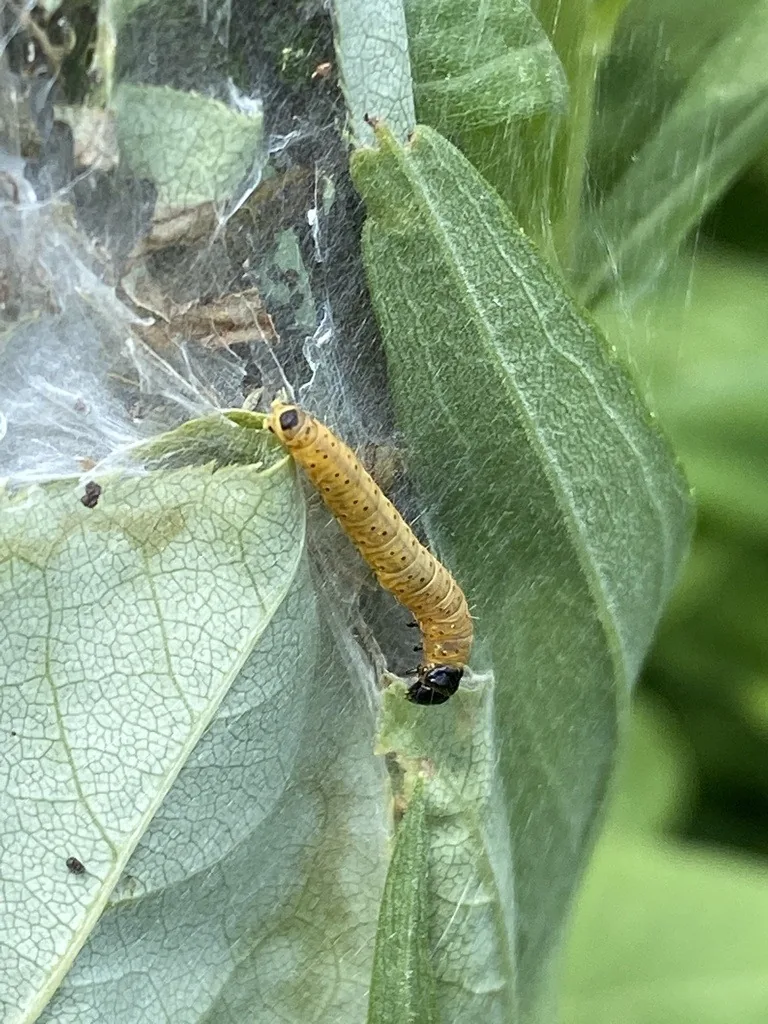
- Nests are dense webs of silk that pull leaves and branch tips together and fill with bits of foliage and frass, often at the top of the plant.[1][2][3]
- Caterpillars are yellow (UVM) to yellowish-green (Illinois) with a black head, and reach about 3/4 inch (22 mm, per Manitoba) before pupating inside the nest.[1][3][2]
- Adult moths are dull orange to yellowish-orange; Natural Resources Canada adds irregular brownish spots and bluish cross bands on the forewings. Wingspan figures differ: about 22 mm (7/8 inch) per Manitoba, about 25 mm per Natural Resources Canada, and about 1 inch per Illinois.[2][5][3]
Look-alikes
| Look-alike | How to tell them apart |
|---|---|
| Fall webworm | Manitoba Agriculture says its nests are difficult to tell from fall webworm nests, and that both are handled the same way, by pruning out and destroying the nests.[2] |
Where it lives
Natural Resources Canada calls it a native species found throughout Canada and the northeastern United States, and Manitoba says across Canada and the northern United States. UVM reports it throughout Vermont, and Illinois Extension says it is most common there on pyracantha.[5][2][1][3]
Biology and life cycle
Sources disagree on the overwintering stage. Manitoba and Natural Resources Canada say the eggs overwinter and hatch in spring, as chokecherry leaves flush (Manitoba) or in late May or early June (Natural Resources Canada); Illinois Extension says the eggs hatch and the larvae overwinter.[2][5][3][1]
UVM and Manitoba say larvae feed inside their nest from May to September and pupate there; Natural Resources Canada says most pupate in the first two weeks of July, and the pupae work their way to the outer wall of the web before the adults emerge. There is one generation a year.[1][2][5]
Adult flight periods differ by source: late June to September (UVM, Manitoba), late July to the end of August (Natural Resources Canada) and midsummer to early fall (Illinois). Eggs are laid in masses on the bark of host plants, near the ground on shrubs and young trees according to Natural Resources Canada.[1][2][5][3]
Chokecherry is the main host, followed by pin cherry, black cherry and other hardwood trees and shrubs. Natural Resources Canada adds roses and hawthorn as favorite hosts and says it often feeds on trembling aspen, poplars and birches during outbreaks.[2][1][5]
Damage and signs
Health risk
It feeds on plants, and no cited source describes any risk to people or pets.[1][2][5]
Control
Prevention
If a tree has been heavily stripped, UVM suggests reducing other stress on it, such as watering thoroughly during drought, and watching for new nests when the leaves flush the next year.[1]
Traps and physical control
With only a few nests, pull them out with the caterpillars and drop them into soapy water, or prune out or crush new nests; this works best while the caterpillars are small. UVM says that once they near 3/4 inch they are hard to reach inside the nest, but they are close to pupating and won't cause much more damage.[1][3][2][5]
Biological control
Natural Resources Canada says natural enemies can normally be relied on to control its occasional outbreaks.[5]
Pesticides
Insecticides are usually unnecessary since the damage is mostly cosmetic, and they only work if they penetrate the webbing.[3][1]
Common questions
- What are the dirty silk nests on my chokecherry?
- Likely uglynest caterpillar nests, dense webs of silk, leaves and frass with yellow, black-headed caterpillars inside.[1][2]
- Do I need to spray uglynest caterpillars?
- Usually not; the nests are ugly but cause little lasting harm, and removing a few nests by hand is enough.[1][3]
Sources
- University of Vermont Extension, “Beware the uglynest caterpillar (A. Hazelrigg).” www.uvm.edu/extension/news/beware-uglynest-caterpillar (accessed 2026-11-13)
- Manitoba Agriculture, “Ugly Nest Caterpillar (Archips cerasivorana).” www.gov.mb.ca/agriculture/crops/insects/ugly-nest-caterpillar.html (accessed 2026-11-13)
- University of Illinois Extension, “Uglynest Caterpillar (plant problem selector).” selectors.extension.illinois.edu/pathogen/uglynest-caterpillar (accessed 2026-11-13)
- Global Biodiversity Information Facility (GBIF), “Archips cerasivorana (Fitch, 1856) (GBIF Backbone Taxonomy).” api.gbif.org/v1/species/1746763 (accessed 2026-11-13)
- Natural Resources Canada, Canadian Forest Service, “Uglynest caterpillar, Archips cerasivorana (Trees, insects and diseases of Canada's forests).” tidcf.nrcan.gc.ca/en/insects/factsheet/11968 (accessed 2026-11-13)