On this page
How to identify it
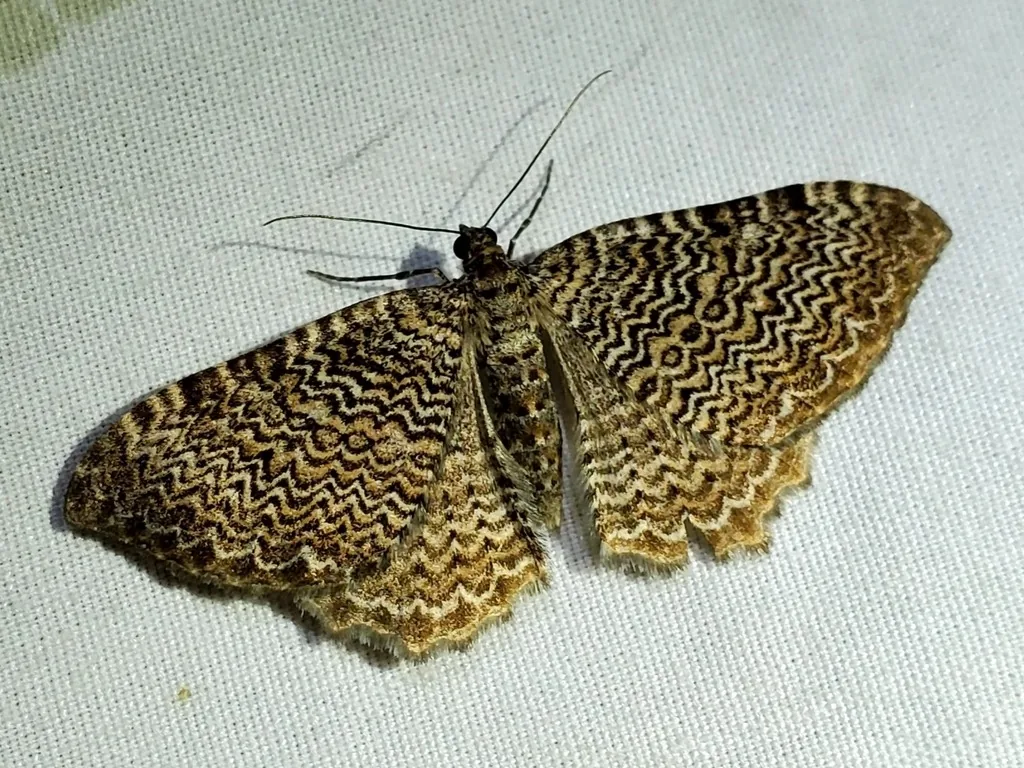
- The adult moth has alternating light and dark scalloped lines across its wings and a wingspan of about 1.45 inches.[1]
- Full-grown caterpillars are inchworms about 0.8 inch long, pale yellow with four brown stripes down the back and an orange-brown head.[1]
- The caterpillars feed in groups inside shelters of leaves tied together with webbing, and the webbed leaves turn brown; the Forest Service study describes the nest as tube-like.[2][3]
Where it lives
GBIF holds about 1,100 records, 860 from the US and 240 from Canada; its US records since 1990 come from 37 states, most from North Carolina, Pennsylvania and Alabama. The Forest Service study records outbreaks from Michigan and Wisconsin to New York and Pennsylvania.[5][6][3]
Biology and life cycle
Adults fly through the summer, roughly May to August, with a peak in June. Females lay eggs on the undersides of leaves in masses one to four layers thick.[1]
The eggs hatch from July through early August. The caterpillars feed together on the leaf surface inside their silk-tied nests, and when a leaf is stripped they move on and build a new nest.[1]
UMass Extension and a USDA Forest Service study on the Allegheny National Forest both report one generation a year. In that study, females laid eggs about 23 to 26 days after emerging, the eggs began hatching 4 to 6 days later, and the caterpillars went through four instars.[1][3]
Mature caterpillars drop to the ground, crawling down the trunk or spinning down on silk, to pupate and spend the winter in the leaf litter or soil. UMass Extension adds that some pupate inside their leaf nests.[1][2][3]
Damage and signs
- It can be an occasional, serious pest of cherry. Heavily infested trees may be completely defoliated, and dieback and decline may follow an outbreak. In 2018 Wisconsin DNR reported many black cherry trees completely defoliated in southeastern Jefferson County, the third year of damage in a row.[1][2]
- A USDA Forest Service study of black cherry found dark rings in 12 of 20 cross-sections that were associated with a growth reduction of 50 percent or more during the 1982-84 outbreak, and dark rings in 48 to 68 percent of recently cut stumps in a long-term stand on the Kane Experimental Forest; dark rings are considered a defect for veneer.[3]
- The same study records outbreaks in Michigan and Wisconsin in the 1950s and in New York and Pennsylvania in the 1970s, with outbreaks on the Allegheny National Forest in 1971-73, 1982-84 and 1994-96.[3]
Health risk
The sources describe it only as a leaf-feeding pest of cherry trees; no cited source describes any risk to people or pets.[1][2]
Control
Prevention
Wisconsin DNR says management typically isn't needed and that keeping trees healthy is usually the only practical solution.[2]
Traps and physical control
Look for groups of caterpillars tying cherry leaves together with silk, especially in July and August. Remove the nests before the defoliation gets extensive and drop them in a bucket of soapy water or destroy them another way.[1]
Wisconsin DNR adds that collecting caterpillars or pupae and crushing them or placing them in soapy water may lower numbers.[2]
Biological control
Native parasites, predators and diseases usually keep it under control. A small Telenomus wasp that parasitizes the eggs has helped bring down outbreak populations.[1]
Pesticides
UMass Extension lists Bacillus thuringiensis (subspecies kurstaki and aizawai) among the active ingredients for this insect, but notes that contact sprays may not work well on caterpillars hidden inside their silk nests.[1]
Where the sources disagree
Adult emergence: UMass Extension gives adults from May to August with a peak in June; the Forest Service study gives peak emergence in late May and early June on the Allegheny National Forest; Wisconsin DNR says the moths typically emerge in June.[1][3][2]
Where it pupates: UMass Extension says some pupate inside their leaf nests; Wisconsin DNR and the Forest Service study describe mature caterpillars dropping to the ground to pupate.[1][2][3]
Name: GBIF's backbone taxonomy treats Rheumaptera prunivorata as the accepted name and Hydria prunivorata as a synonym; the Forest Service study uses Hydria prunivorata.[4][3]
Common questions
- What is making leafy nests full of small inchworms on my cherry tree?
- Groups of striped inchworms feeding inside leaves tied together with silk on black cherry in summer are typical of the cherry scallop shell moth.[1][2]
- Will the cherry scallop shell kill my tree?
- Usually not. It is an occasional pest that natural enemies keep in check, but heavy outbreaks can defoliate a tree completely, and dieback and decline may follow.[1]
Sources
- UMass Extension Landscape, Nursery and Urban Forestry Program (University of Massachusetts Amherst), “Rheumaptera (formerly Hydria) prunivorata, Landscape Insect & Mite Guide.” www.umass.edu/agriculture-food-environment/landscape/publications-resources/insect-mite-guide/rheumaptera-formerly-hydria-prunivorata (accessed 2026-11-13)
- Wisconsin Department of Natural Resources, “Defoliation of black cherry trees by cherry scallop shell moth (Forestry News, August 2018).” forestrynews.blogs.govdelivery.com/2018/08/03/defoliation-of-black-cherry-trees-by-cherry-scallop-shell-moth/ (accessed 2026-11-13)
- USDA Forest Service, Northern Research Station, “The Frequency and Anatomical Characteristics of Anomalous Dark Rings in Black Cherry, and Their Relation to Cherry Scallop Shell Moth Defoliations (R. P. Long, M. C. Wiemann and T. A. Kuster, Forest Science, 2018).” www.fs.usda.gov/nrs/pubs/jrnl/2018/nrs_2018_long_001.pdf (accessed 2026-11-13)
- Global Biodiversity Information Facility (GBIF), “Rheumaptera prunivorata (Ferguson, 1955) (GBIF Backbone Taxonomy).” api.gbif.org/v1/species/1977054 (accessed 2026-11-13)
- Global Biodiversity Information Facility (GBIF), “Rheumaptera prunivorata: occurrence records by country (GBIF occurrence search).” api.gbif.org/v1/occurrence/search?taxonKey=1977054&facet=country&facetLimit=20&limit=0 (accessed 2026-11-13)
- Global Biodiversity Information Facility (GBIF), “Rheumaptera prunivorata: U.S. occurrence records since 1990 by state (GBIF occurrence search).” api.gbif.org/v1/occurrence/search?taxonKey=1977054&country=US&hasGeospatialIssue=false&occurrenceStatus=PRESENT&year=1990%2C2026&facet=stateProvince&facetLimit=400&limit=0 (accessed 2026-11-13)