On this page
How to identify it
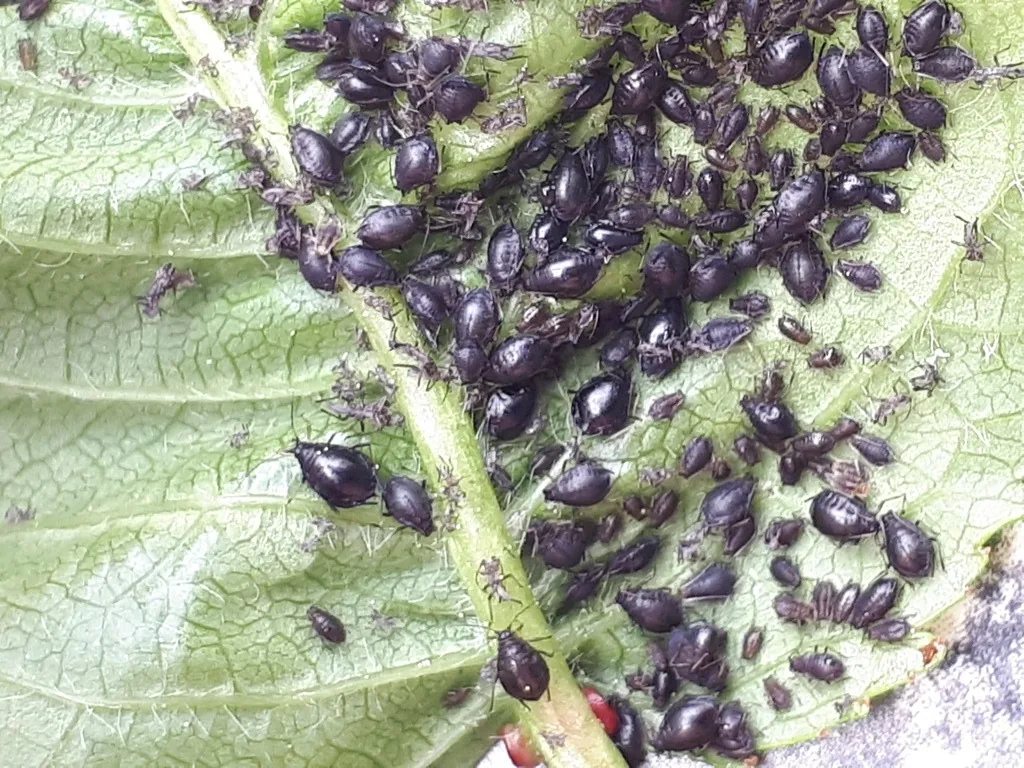
- Adults and nymphs are shiny black; UC IPM describes the aphid as large and metallic. Adults are about 1/8 inch long and may be winged or wingless.[1][2]
- Nymphs look like the adults, only smaller.[1]
- Colonies sit on actively growing shoots, where the leaves curl around them.[1]
- In early spring look for shiny black eggs at the base of buds; after bloom, small colonies form on the undersides of leaves.[3][2]
Where it lives
Penn State calls it the most common aphid on cherries in most of North America, mainly on sweet cherries; Utah State and UC IPM cover it as a pest in their states as well.[1][3][2]
Biology and life cycle
Eggs overwinter on twigs, fruit spurs and the bark of small branches and hatch in spring (see where the sources disagree on timing).[1][3][2]
Wingless stem mothers build large colonies on growing shoots within three to four weeks, and two or three generations follow by early July.[1]
Most then fly to summer weed hosts such as watercress, peppergrass and other mustard-family plants (see where the sources disagree on when), and numbers on cherry stay very low over summer. Winged aphids return in fall to mate and lay eggs; Penn State says September or October.[1][2][3]
Sweet cherries are strongly preferred; Napoleon, Black Tartarian, Schmidt and Windsor are among the most susceptible varieties.[1]
Damage and signs
Health risk
It feeds on cherry trees. Penn State, Utah State and UC IPM describe it only as a pest of cherry and don't mention any risk to people or pets.[1][3][2]
Control
Prevention
Scout in early spring for stem mothers on growing shoots and judge the infestation before leaves curl; shaking a limb over a tray or sheet of paper speeds this up. Young trees can't tolerate even low numbers, but Utah State says home orchardists can usually ignore aphids on older trees unless numbers are extremely high, young trees are being stunted or sooty mold is staining the fruit.[1][3]
Biological control
Lady beetles, lacewing larvae, syrphid fly larvae and parasitic wasps all feed on it and are often abundant enough to keep it in check, so protect them.[1][3][2]
Pesticides
A delayed-dormant oil spray, applied as buds begin to swell, usually controls it; UC IPM calls the dormant or delayed-dormant period the best time. If aphids are still a problem later, Utah State suggests insecticidal soap or horticultural oil.[3][2][1]
More from Utah State University Extension
A delayed-dormant oil applied as buds begin to swell in spring usually controls this aphid, and lady beetles, lacewing larvae and syrphid fly larvae help hold numbers down.[3]
Where the sources disagree
Egg hatch: Penn State says eggs begin to hatch as soon as cherry buds break; Utah State and UC IPM say they hatch just before or shortly before bloom.[1][3][2]
Leaving cherry: Penn State says most aphids move to alternate hosts by early July; Utah State says they form wings and migrate later in the summer, when temperatures stay hot.[1][3]
Mature trees: Penn State says heavy infestations may reduce crop quality and quantity and return bloom on mature trees; UC IPM says high populations are mainly a problem on young trees, and Utah State says home orchardists can usually ignore them unless numbers are extremely high, young trees are stunted or sooty mold stains the fruit.[1][2][3]
Common questions
- What are the shiny black bugs on my cherry tree's new leaves?
- Probably black cherry aphids, which hatch from overwintering eggs around bud break and colonize growing cherry shoots in spring.[1][3]
- Can black cherry aphids hurt a young cherry tree?
- Yes. Young trees can't tolerate even low numbers, and heavy infestations may kill them.[1]
- Where do black cherry aphids go in summer?
- Most leave cherry by early July for mustard-family weeds such as watercress and peppergrass, then winged aphids fly back to cherry in fall to lay eggs.[1][2][3]
Sources
- Penn State Extension, “Tree Fruit Insect Pest: Black Cherry Aphid.” extension.psu.edu/tree-fruit-insect-pest-black-cherry-aphid (accessed 2026-11-13)
- University of California Statewide IPM Program, “Black Cherry Aphid (UC IPM Pest Management Guidelines: Cherry).” ipm.ucanr.edu/agriculture/cherry/black-cherry-aphid/ (accessed 2026-11-13)
- Utah State University Extension, “Black Cherry Aphid.” extension.usu.edu/planthealth/ipm/notes_ag/fruit-black-cherry-aphid.php (accessed 2026-11-13)
- Global Biodiversity Information Facility (GBIF), “Myzus cerasi (Fabricius, 1775) (GBIF Backbone Taxonomy).” api.gbif.org/v1/species/2076214 (accessed 2026-11-13)
- iNaturalist, “Myzus cerasi taxon page (order and family).” www.inaturalist.org/taxa/393053 (accessed 2026-10-06)