On this page
How to identify it
- A sumac leaf rolled into a spiral and held with bands of silk, with neighboring leaves tethered to it; each caterpillar lives in a rolled leaf or between two leaves fastened together with silk.[1][5]
- The caterpillar is greenish with small, obscure white markings and a whitish head, about half an inch long when mature; some individuals have a pale brown head and a green body striped with dark green.[1]
- The 1972 USDA Forest Service manual's key describes the caterpillar on sumac as green, more or less tinged with red.[5]
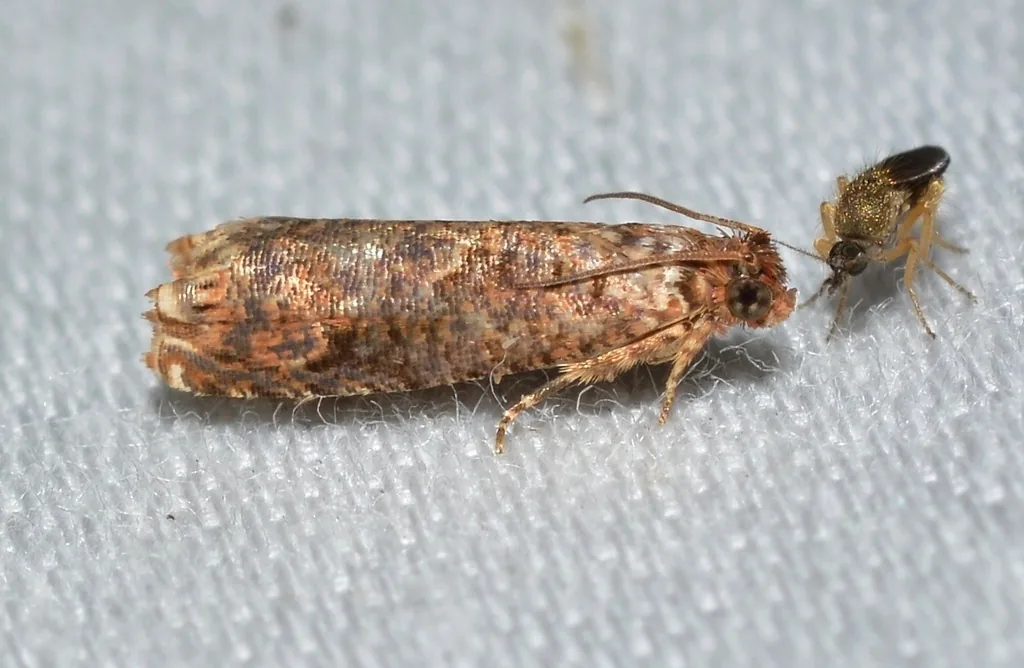
- The adult has a wing expanse of about half an inch (about 12 mm in the USDA manual) and is dull reddish or grayish brown mottled with darker patches, with fresh specimens sometimes tinged purple. Because many Episimus species look alike, the adult moth, and often its genitalia, may be needed to confirm the species.[1][5]
Look-alikes
| Look-alike | How to tell them apart |
|---|---|
| Gold-striped leaftier | Machimia tentoriferella, which the 1972 USDA manual says occurs rather commonly in the Northeastern States and southeastern Canada on hardwoods such as birch, ash, maple, oak, honey locust, mountain ash, hickory, elm and wild cherry. Its green caterpillar, with a large head and tapering body, lives and feeds inside a folded leaf rather than a spiral-rolled sumac leaf.[5] |
| Other sumac leaf feeders | UMass notes a long-standing question whether the caterpillars found on different host plants are all one species or a complex, and that adult moths are often required for identification.[1] |
Where it lives
UMass describes it as a common species distributed through North and Central America, with records from New England, parts of Canada and Pennsylvania vineyards, and the 1972 USDA manual calls it widely distributed on sumac, poison ivy, witch-hazel and various other shrubs. GBIF holds about 1,400 records, about 1,270 from the US, 140 from Canada and 3 from Mexico; its roughly 1,050 US records since 1990 come mostly from Texas, Maryland, Mississippi and Pennsylvania.[1][5][3][4]
Biology and life cycle
Craighead (1950), as cited by UMass, reported two or more generations a year in parts of New England, with moths emerging in May and June and again from July to September; in parts of Canada emergence may occur only in late May and early June. The 1972 USDA manual likewise gives two or more generations a year.[1][5]
In a 1972 Pennsylvania trapping study, spring adults became active in late May, peaked in late June and early July and were done by July 11; the next generation's adults were trapped from late July, peaked in August and September and continued into October.[1]
The caterpillar rolls a leaf in a spiral, secures the rolls with silk bands, then joins neighboring leaves to the first. Caterpillars have been reported from June through late September in New England, and the insect overwinters as a pupa. UMass puts caterpillar activity at about 300 growing degree days (base 50 F, from March 1).[1]
Damage and signs
- The caterpillars roll, tie with silk and defoliate several species of sumac and the other hosts, with injury first appearing by June in Massachusetts. The feeding is not typically considered significantly detrimental to the overall health of the plant.[1]
- Partial feeding on the berries of winged sumac (Rhus copallina) has been recorded.[1]
Health risk
UMass and the USDA manual describe it only as a leaf-rolling caterpillar of sumac and related shrubs, including poison ivy; no cited source describes any risk to people or pets.[1][5]
Control
Prevention
Management is typically not necessary. On ornamental sumacs, watch for rolled and tied leaves from June in Massachusetts; the moths are also attracted to grape berry moth pheromone and turn up in vineyard traps.[1]
Traps and physical control
Pinch tied leaves to kill the larva inside, or remove and destroy them.[1]
Biological control
Schaffner (1959) recorded tachinid flies (Actia species, Nemorilla floralis, Phorocera erecta), braconid and ichneumonid wasps (Meteorus trachynotus, Macrocentrus delicatus, Sambus hispae, Exochus pallipes, Labrorychus species) and the eulophid Dimmockia incongrua as parasitoids of this moth in New England.[1]
Pesticides
UMass says this native insect is typically not a significant pest and encourages tolerating it. Its guide lists insecticide active ingredients for the caterpillar but notes that the list reflects Massachusetts registrations as of September 27, 2024 and may not be up to date, so check current registrations with your state and confirm that the plant and pest are on the product label. Any application should be made after bloom to protect pollinators.[1]
Where the sources disagree
Name: GBIF accepts Episimus argutana (Clemens, 1860); UMass Extension spells it Episimus argutanus.[2][1]
Range: UMass describes a distribution through North and Central America, but GBIF's records are overwhelmingly from the US and Canada, with only 3 from Mexico.[1][3]
Identity: UMass notes a long-standing question whether the caterpillars on different host plants are one species or a species complex.[1]
Caterpillar color: UMass describes a greenish caterpillar with small, obscure white markings, while the 1972 USDA manual's key describes it as green, more or less tinged with red.[1][5]
Common questions
- What rolled my sumac leaves into spirals?
- The sumac leaftier caterpillar, which rolls a leaf in a spiral, binds it with silk and then ties the neighboring leaves to it while it feeds inside.[1]
- Will it hurt the sumac?
- Not meaningfully. UMass says the feeding is not typically considered significantly detrimental to the plant's health and that management is usually unnecessary.[1]
- How many generations are there?
- UMass, citing Craighead (1950), reports two or more a year in parts of New England, with moths flying in May-June and again from July into September; in parts of Canada there may be only the spring flight. The 1972 USDA manual also gives two or more generations a year.[1][5]
Sources
- UMass Extension Landscape, Nursery and Urban Forestry Program, University of Massachusetts Amherst, “Episimus argutanus, Sumac Leafroller (Sumac Leaftier), Insect & Mite Guide (Professional Guide for IPM in Trees and Shrubs).” www.umass.edu/agriculture-food-environment/landscape/publications-resources/insect-mite-guide/episimus-argutanus (accessed 2026-11-14)
- Global Biodiversity Information Facility (GBIF), “Episimus argutana (Clemens, 1860) (GBIF Backbone Taxonomy).” api.gbif.org/v1/species/1741400 (accessed 2026-11-13)
- Global Biodiversity Information Facility (GBIF), “Episimus argutana: occurrence records by country (GBIF occurrence search).” api.gbif.org/v1/occurrence/search?taxonKey=1741400&facet=country&facetLimit=20&limit=0 (accessed 2026-11-13)
- Global Biodiversity Information Facility (GBIF), “Episimus argutana: U.S. occurrence records since 1990 by state (GBIF occurrence search).” api.gbif.org/v1/occurrence/search?taxonKey=1741400&country=US&hasGeospatialIssue=false&occurrenceStatus=PRESENT&year=1990%2C2026&facet=stateProvince&facetLimit=400&limit=0 (accessed 2026-11-13)
- USDA Forest Service, “Eastern Forest Insects, Miscellaneous Publication 1175 (W. L. Baker, 1972; scanned copy).” archive.org/details/easternforestins1175bake (accessed 2026-11-14)