On this page
How to identify it
- Full-grown caterpillars are about 1/2 inch long. The Connecticut station describes them as olive green with two white stripes on the back and two on the sides; a USDA Forest Service guide calls the color extremely variable, either dark green with paired white stripes down the back or white with thick green stripes, often with black U-shaped marks on the shield behind the head.[1][3]
- They skeletonize leaves, and the Forest Service guide describes the larva in Missouri as a leaf roller.[1][3]
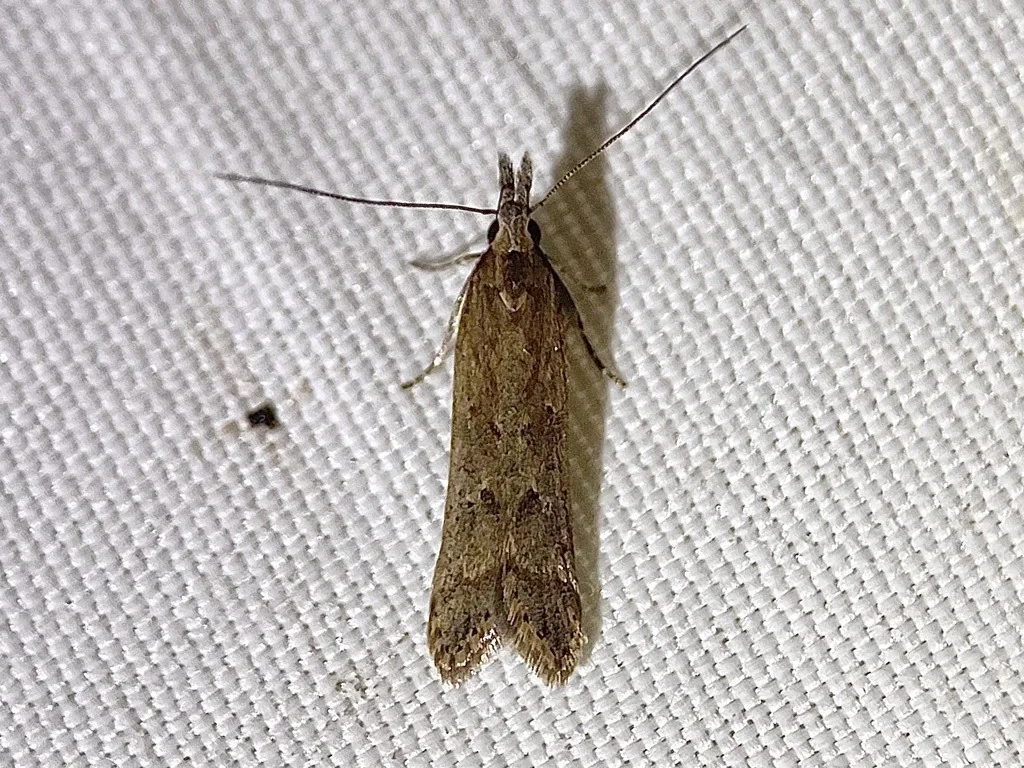
- The adult moth is the stage that spends the winter, and in midsummer it is often the most common moth of its family at blacklights.[1][3]
Where it lives
The Forest Service guide gives its range as southern Canada through the eastern United States to Virginia and Florida, and to Texas, with a recent record from Quebec. The Connecticut station lists it as a pest in Connecticut apple orchards.[3][1]
Biology and life cycle
Adult moths spend the winter; eggs are laid in early spring and the caterpillars hatch in spring.[3][1]
There is one generation a year. The Forest Service guide says caterpillars develop from May to early July, with pupae lasting about 10 days and adults emerging in late June or early July, though in Missouri the caterpillars were found mostly in April and May; the Connecticut station says the moths emerge from pupae in July.[3][1]
Oaks are its preferred food plants, but it is a generalist on trees and shrubs, recorded on maple, birch, hickory, chestnut, hazel, walnut, apple, pear, quince, poplar, basswood, sourwood, blueberry and rhododendron; the caterpillars eat leaves, fruit or oak-apple galls.[3]
Damage and signs
Health risk
It feeds on plants, and no cited source describes any risk to people or pets.[1][3]
Control
Prevention
Numbers swing widely from year to year, and the Connecticut station notes the damage usually doesn't justify an insecticide application.[1]
Common questions
- Why are my oak leaves suddenly skeletonized this spring?
- Palmerworm caterpillars are one possible cause: they roll and skeletonize oak leaves in spring, and numbers swing widely from year to year.[3][1]
- Should I spray palmerworms on my apple tree?
- Usually not; the damage is normally too small to justify spraying.[1]
Sources
- Connecticut Agricultural Experiment Station, “Plant Pest Handbook: Apple (Malus).” portal.ct.gov/caes/plant-pest-handbook/ppha/apple-malus (accessed 2026-11-13)
- Global Biodiversity Information Facility (GBIF), “Dichomeris ligulella Hübner, 1818 (GBIF Backbone Taxonomy).” api.gbif.org/v1/species/1847249 (accessed 2026-11-13)
- USDA Forest Service, Forest Health Assessment and Applied Sciences Team, “Illustrated Guide to the Immature Lepidoptera on Oaks in Missouri (FHAAST-2018-05; Marquis et al., June 2019): Dichomeris ligulella, palmer worm.” www.fs.usda.gov/foresthealth/technology/pdfs/FHAAST-2018-05_Immature_Lepidoptera_Oaks.pdf (accessed 2026-11-13)