On this page
How to identify it
Look-alikes
| Look-alike | How to tell them apart |
|---|---|
| Obliquebanded leafroller | Causes similar early-season fruit damage. NC State says it is a key apple pest in New York, Michigan and Washington but rarely found in North Carolina.[2] |
Where it lives
Which species count as green fruitworms depends on the source. Kentucky names Orthosia hibisci, Lithophane antennata and L. unimoda; NC State names O. hibisci, L. antennata and the humped green fruitworm, Amphipyra pyramidoides; UMass describes a complex of at least 10 species. O. hibisci ranges across Canada from British Columbia to Newfoundland and is common in Utah.[1][2][3][4][5]
Biology and life cycle
Sources disagree on the winter stage. Kentucky, Utah State and Natural Resources Canada say pupae in the soil, while UMass says adult moths overwinter in sheltered spots. NC State notes that the humped green fruitworm lays eggs in late fall instead.[1][5][4][3][2]
Larvae feed on leaves, then buds and blooms, and move to fruit shortly after petal fall; there's one generation a year.[1]
Egg-laying also varies. Kentucky describes single eggs on small branches near green tip, Utah State describes masses of 100 to 300 for O. hibisci, and UMass says singly or in masses.[1][5][3]
Hosts go well beyond fruit trees and include maples, oaks, ash, willows, aspen and birch.[3][4][2]
Damage and signs
Health risk
It feeds on leaves and young fruit, and no cited source describes any risk to people or pets.[1][2][3]
Control
Prevention
Check before spraying. Kentucky's method is 10 fruit clusters on each of 10 trees between pink and first cover, treating if 2 or more clusters are infested. NC State uses fresh leaf feeding on new shoots at petal fall as the cue, and Utah State uses beat samples over a tray.[1][2][5]
Biological control
Bacillus thuringiensis and spinosad give control. Kentucky finds prebloom sprays work best, while NC State favors a bee-safe product at early petal fall because fruit can be hit before all petals drop.[1][5][2]
Parasitic wasps attack fruitworms and may keep landscape trees from showing damage, but UMass says they aren't enough to matter in orchards.[3]
Why some years are worse
In North Carolina, serious damage in commercial orchards ran from 2010 to 2012 after 25 quiet years, and little has been seen since.[2]
A 2012 Henderson County survey found about 2.8 percent of fruit damaged, with roughly half of those staying on the tree to harvest.[2]
On shade trees and shrubs, UMass says low numbers can be tolerated and control is rarely needed.[3]
Where the sources disagree
Winter stage: Kentucky, Utah State and Natural Resources Canada say pupae in the soil or duff, UMass says adult moths overwinter in sheltered areas, and NC State says the humped green fruitworm lays eggs in late fall.[1][5][4][3][2]
Eggs: Kentucky says eggs are laid singly on the bark of smaller branches, Utah State describes masses of 100 to 300 for the speckled green fruitworm, and UMass says singly or in masses.[1][5][3]
Adult moth: Kentucky and UMass describe light brown moths about 1 inch long, NC State brown or gray moths with a 1 1/2 to 1 3/4 inch wingspan, and Utah State a reddish brown moth about 3/4 inch long.[1][3][2][5]
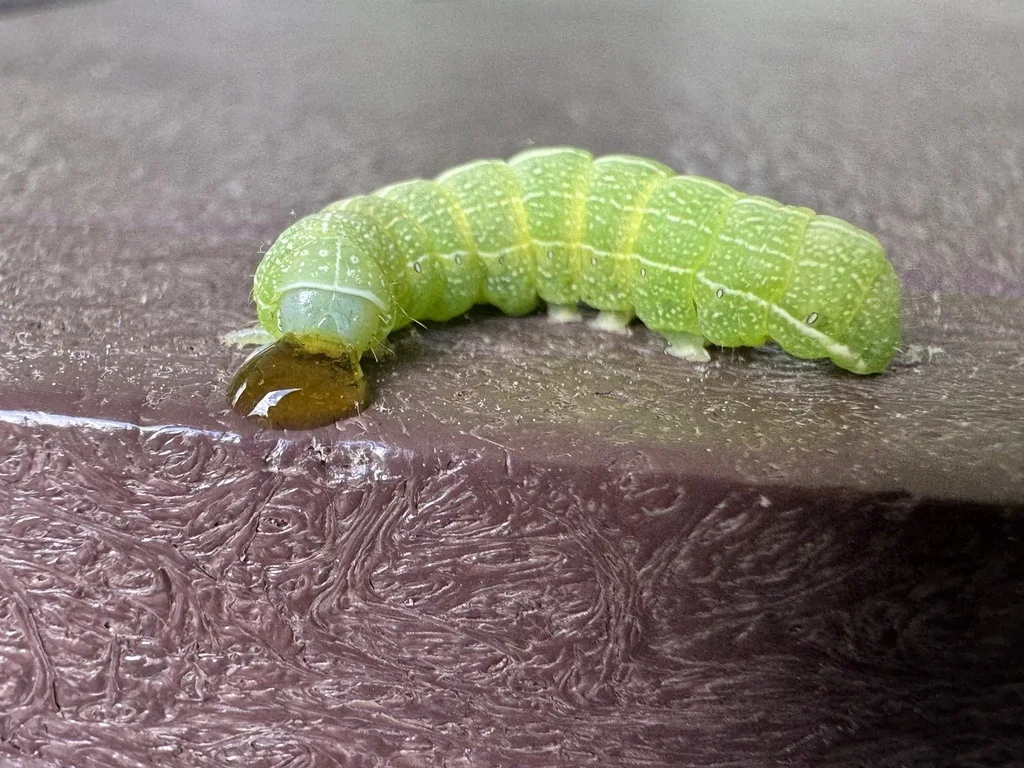
Grown larva: Kentucky and UMass give 1 1/4 to 1 1/2 inches, NC State about 1 1/2 inches, and Natural Resources Canada up to 30 mm for the speckled green fruitworm.[1][3][2][4]
Spray timing: Kentucky says prebloom sprays are most effective at preventing damage, NC State reports the lowest damage in orchards sprayed at early petal fall, and UMass says to make insecticide applications after bloom to protect pollinators.[1][2][3]
How serious: Utah State says the speckled green fruitworm generally does not cause serious damage, Natural Resources Canada calls it a common innocuous defoliator, and Kentucky says the group can cause considerable damage to apples, plums, peaches and pears.[5][4][1]
Common questions
- What caused the corky, sunken scars on my apples?
- Green fruitworm feeding on young fruit is one cause of large sunken, corky wounds at harvest.[1]
- Why do so many small apples drop in late spring?
- Fruit damaged by green fruitworms mostly falls to the ground by early June.[1]
- Are green fruitworms a problem on shade trees?
- Rarely. They feed on many hardwoods, but in landscapes the damage is usually light and doesn't need treatment.[3][4]
Sources
- University of Kentucky Entomology (ENTFACT), “Green Fruitworms (ENTFACT-214).” entomology.mgcafe.uky.edu/ef214 (accessed 2026-11-13)
- NC State Extension, “Green Fruitworm.” content.ces.ncsu.edu/green-fruitworm (accessed 2026-11-13)
- UMass Amherst Center for Agriculture, Food, and the Environment, “Fruitworms (Lithophane spp., Orthosia spp., and others) (Landscape Insect and Mite Guide).” www.umass.edu/agriculture-food-environment/landscape/publications-resources/insect-mite-guide/lithophane-spp-orthosia-spp-others (accessed 2026-11-13)
- Natural Resources Canada, Canadian Forest Service, “Speckled green fruitworm (Trees, insects and diseases of Canada's forests).” tidcf.nrcan.gc.ca/en/insects/factsheet/10296 (accessed 2026-11-13)
- Utah State University Extension, “Speckled Green Fruitworm (Orthosia hibisci) (ENT-141-05).” extension.usu.edu/planthealth/ipm/images/ezplug/uploads/pdfdocs/factsheet-pdf/fruitworms10.pdf (accessed 2026-11-13)
- Global Biodiversity Information Facility (GBIF), “Orthosia hibisci Guenée, 1852 (GBIF Backbone Taxonomy).” api.gbif.org/v1/species/5114128 (accessed 2026-11-13)
- Global Biodiversity Information Facility (GBIF), “Lithophane antennata Walker, 1858 (GBIF Backbone Taxonomy).” api.gbif.org/v1/species/1759611 (accessed 2026-11-13)
- Global Biodiversity Information Facility (GBIF), “Lithophane unimoda Lintner, 1878 (GBIF Backbone Taxonomy).” api.gbif.org/v1/species/1759671 (accessed 2026-11-13)