On this page
How to identify it
- Iowa State describes a slender, purple-and-white striped caterpillar. Purdue says the white stripes are broken by a dark purple band around the third thoracic and first three abdominal segments, while Missouri describes a yellow head, a brown body with white stripes and a brown band on the first four abdominal segments.[1][2][3]
- Sizes differ a little: Missouri says full-grown caterpillars are a little over 1 inch long, and Purdue says 1-1/4 inches (3.8 cm). Purdue notes the last larval stage loses the bold stripes and dark band.[3][2]
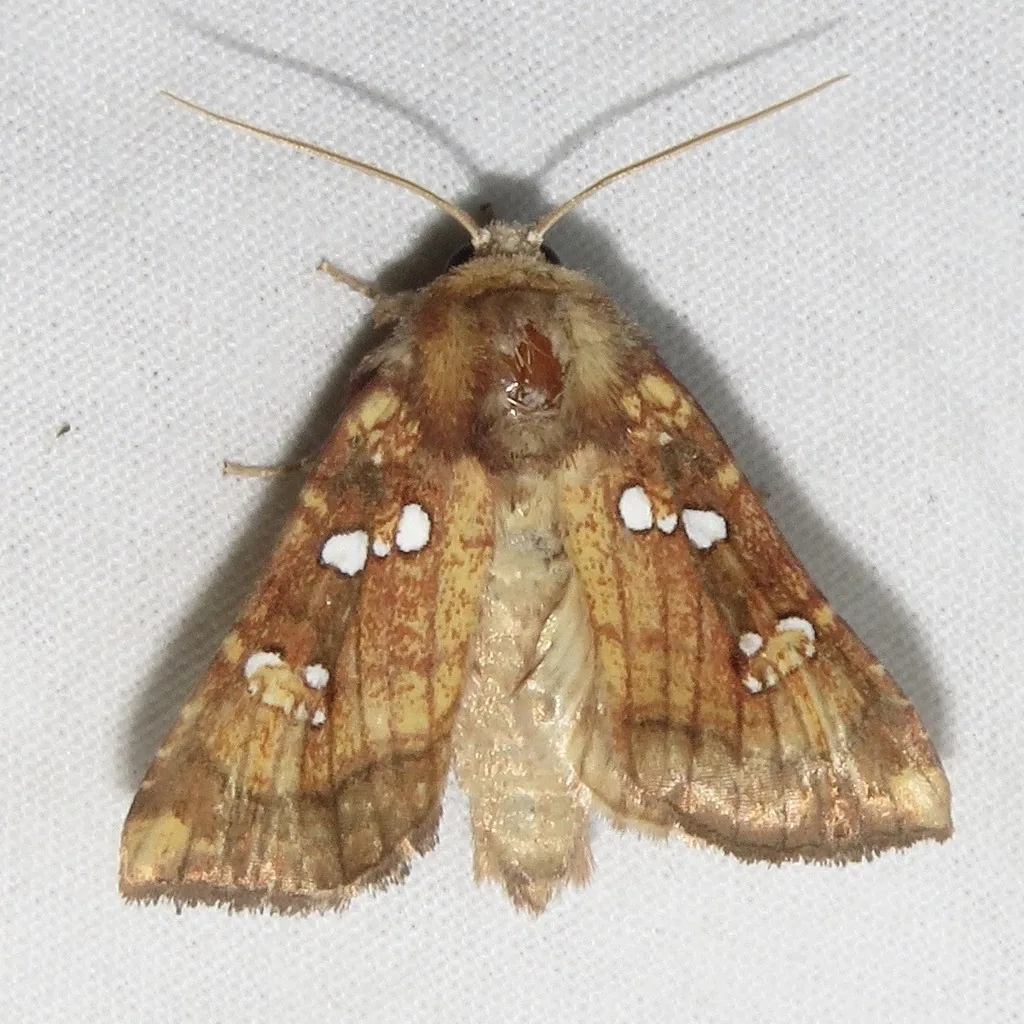
- It is found tunneling inside stems rather than feeding in the open. The adult is a grayish moth, with or without silver spots on the forewings.[1][3][2]
Where it lives
Purdue says it occurs throughout the United States east of the Rocky Mountains. GBIF holds US records since 1990 from 37 states, most from Massachusetts, Wisconsin and Illinois.[2][7][1]
Biology and life cycle
Moths lay eggs from late August until frost on grasses and some broadleaf weeds, and the eggs spend the winter there.[1][2][4]
Iowa State says the eggs hatch very early in spring (Purdue says May) and young larvae bore into grass stems; by mid to late June they outgrow them and move into larger stems nearby, sometimes switching plants more than once.[1][2]
Caterpillars are present from May to August, with one generation a year. Purdue says they pupate in late July, usually just below the soil surface or sometimes inside the stem.[3][2]
Purdue cites an Iowa State degree-day model (base 41 F from January 1): eggs hatch at about 600 degree days, and larvae move from grasses into corn at about 1,400.[2]
Damage and signs
- Infested plants wilt and become discolored, and may die. In corn, Purdue describes ragged rows of holes in the leaves, twisted, stunted plants that produce no ear, and dead centers (dead heart) where larvae burrow upward inside the stem.[3][2][1]
- It is most often found in giant ragweed but also damages tomatoes, corn and other plants; Missouri says its hosts include more than 200 field, vegetable, flower and fruit crops and several weeds.[1][3]
- Field studies add two twists: Bt corn reduced but did not eliminate stalk borer injury, and in a cornfield study stalk borer numbers did not differ between fields with and without a rye cover crop.[5][6]
Health risk
None of these sources reports any harm to people or pets; they treat it only as a plant pest.[1][3][2]
Control
Sanitation
Keep weeds and tall grass controlled and mowed around gardens and flower beds, especially in late summer and fall when moths lay eggs; UMass suggests eliminating grassy weeds in August.[1][4]
Remove and destroy wilted plants, which can be a source of more borers.[1]
Traps and physical control
A plant can sometimes be saved by slicing open the stem and removing the borer by hand.[1]
Pesticides
Garden insecticide sprays and dusts are not effective once the borer is inside the stem; Purdue says there are no rescue treatments at that point.[1][2]
For corn plantings, UMass and Purdue say to scout field edges and former weedy areas soon after corn comes up, and to treat outer rows or infested areas while larvae are small, before they bore into stalks. Follow the label.[4][2]
Common questions
Sources
- Iowa State University Extension and Outreach (Yard and Garden), “Common Stalk Borer (Yard and Garden encyclopedia).” yardandgarden.extension.iastate.edu/encyclopedia/common-stalk-borer (accessed 2026-11-12)
- Purdue University Extension Entomology, “Stalk Borer, Papaipema nebris (field crops IPM).” ag.purdue.edu/department/entm/extension/field-crops-ipm/_docs/stalk-borer_corn.pdf (accessed 2026-11-12)
- University of Missouri Extension, “Caterpillars in Your Yard and Garden (IPM1019), page 42: Stalk borer.” extension.missouri.edu/publications/ipm1019/42 (accessed 2026-11-12)
- UMass Extension Vegetable Program, “Common Stalk Borer (vegetable fact sheet).” ag.umass.edu/vegetable/fact-sheets/stalk-borer-common (accessed 2026-11-12)
- J Econ Entomol 2002, via PubMed, “Effects of transgenic Bt corn on growth and development of the stalk borer Papaipema nebris (Lepidoptera: Noctuidae).” pubmed.ncbi.nlm.nih.gov/12076010/ (accessed 2026-11-12)
- J Econ Entomol 2016, via PubMed, “Increased Risk of Insect Injury to Corn Following Rye Cover Crop.” pubmed.ncbi.nlm.nih.gov/27325884/ (accessed 2026-11-12)
- Global Biodiversity Information Facility (GBIF), “Papaipema nebris: U.S. occurrence records since 1990 by state (GBIF occurrence search).” api.gbif.org/v1/occurrence/search?taxonKey=1778031&country=US&hasGeospatialIssue=false&occurrenceStatus=PRESENT&year=1990%2C2026&facet=stateProvince&facetLimit=400&limit=0 (accessed 2026-11-12)
- iNaturalist, “Papaipema nebris taxon page (order and family).” www.inaturalist.org/taxa/1654142 (accessed 2026-10-06)