On this page
How to identify it
- Larvae are legless, yellow to green, with a brown head and a white stripe down the back. In older larvae the stripe often has pinkish edges. Full-grown larvae are just under 1/2 inch long.[1][2]
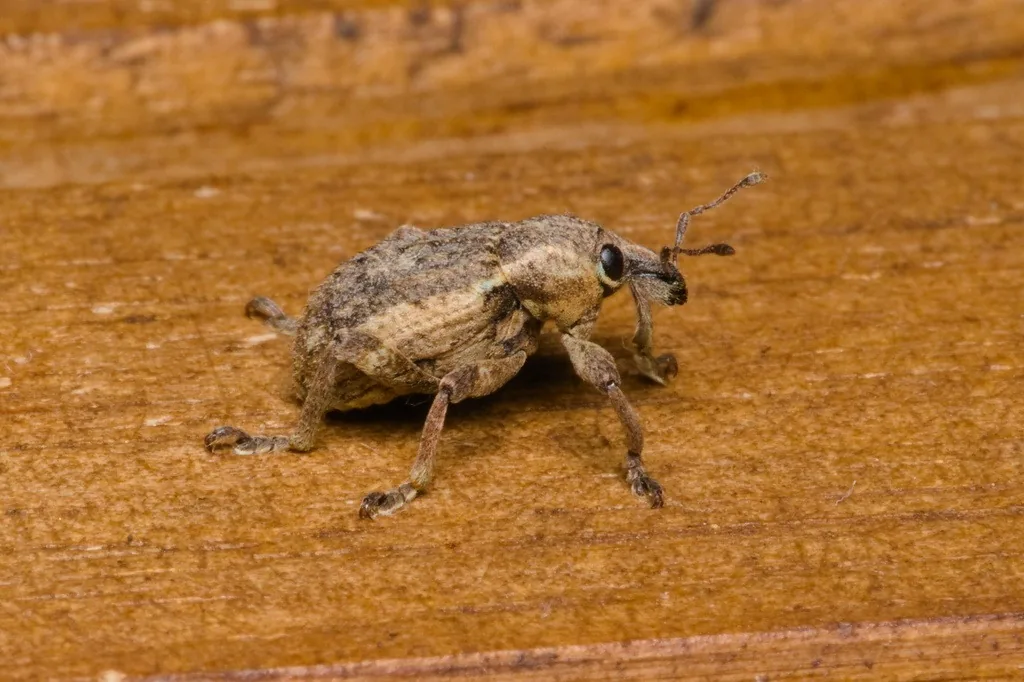
- Adults are brown weevils speckled with lighter and darker scales, with a faint stripe on each wing cover. Kansas State says they resemble alfalfa weevils but are three or more times as large.[1][2]
- Scientific names vary by source: Kansas State files it under Donus zoilus and lists Hypera punctata, Hypera zoilus and Brachypera zoilus as names used in earlier literature, the Crop Protection Network uses Hypera zoilus, and the GBIF Backbone Taxonomy accepts Brachypera zoilus and treats Hypera zoilus as a synonym.[1][2][3][4]
Look-alikes
| Look-alike | How to tell them apart |
|---|---|
| Alfalfa weevil | Alfalfa weevil larvae are also green with a white line down the back, but they have a black head and feed on the upper growing tips. Clover leaf weevil larvae have a brown head, feed on the lower parts of the plant, and are noticeably larger when full grown.[1][2] |
Where it lives
A native of Europe, it has been in the United States for more than 140 years and is now established in most areas of North America where clover and alfalfa are grown.[1][2]
Biology and life cycle
There is one generation a year. Adults lay yellow, oval eggs around their host plants, usually in the fall. Most eggs hatch in fall, though some wait through the winter, and a few adults may survive the winter and lay eggs on mild days.[1][2]
Young larvae feed during mild spells through the winter and become active from late winter into spring, reaching full size between late March and early May.[1][2]
Larvae feed mostly at night or under cloud cover and spend sunny days hiding in leaf litter around the crown.[1][2]
Full-grown larvae pupate in an oval cocoon just under the soil surface or in debris near the base of the plant. The new adults feed for a few days, then stay inactive through most of the summer until fall egg laying.[1][2]
In a Japanese study of the same species (as Hypera punctata), larvae kept feeding and growing through the winter, and last-instar larvae appeared from mid-February on.[5]
Damage and signs
Health risk
It is a pest of alfalfa and clover, and no cited source describes any risk to people or pets.[1][2]
Control
Prevention
Scout by examining the crowns of 20 plants in five different parts of the field, since larvae hide there by day. Check fields right after the first cutting, especially in dry weather.[1][2]
Biological control
Kansas State says a combination of parasitism and disease normally holds it under biological control. The Crop Protection Network says a fungal pathogen that thrives in warm, wet weather typically keeps populations low, so weevils can flourish in cool, dry springs when the fungus does poorly.[1][2]
Pesticides
Kansas State considers chemical control justified only when crowns average five or more healthy larvae and refers growers to its current alfalfa insect management guide. The Crop Protection Network notes that insecticides can control it.[1][2]
Where the sources disagree
Adult size: Kansas State says adults are about 1/4 inch long, while the Crop Protection Network gives 5/8 inch.[1][2]
What keeps it in check: Kansas State credits parasitism and disease together, while the Crop Protection Network singles out a fungal pathogen.[1][2]
Winter: Kansas State says most eggs hatch in fall and the young larvae feed during mild spells through winter, the Crop Protection Network says it overwinters most often as larvae or eggs, and a Japanese study found larvae feeding and growing all winter.[1][2][5]
Scientific name: Kansas State uses Donus zoilus, the Crop Protection Network Hypera zoilus, and the GBIF Backbone Taxonomy Brachypera zoilus.[1][2][3]
Common questions
- How do I tell clover leaf weevil larvae from alfalfa weevil larvae?
- Look at the head and where they feed. Clover leaf weevil larvae have a brown head, feed low on the plant at night and hide at the crown by day; alfalfa weevil larvae have a black head and feed in the growing tips. Full-grown clover leaf weevil larvae are also noticeably larger.[1][2]
- Do I need to spray for clover leaf weevil?
- Rarely. A fungal disease and parasites usually keep it in check. Kansas State sets the threshold at an average of five or more healthy larvae per crown.[1][2]
- Why are clover leaf weevils worse some years?
- The fungus that usually suppresses them thrives in warm, wet weather. In cool, dry springs the fungus develops poorly and the weevils can flourish.[2]
Sources
- Kansas State University Department of Entomology, “Clover Leaf Weevil (Alfalfa Pests).” entomology.k-state.edu/extension/crop-protection/alfalfa/clover-leaf-weevil.html (accessed 2026-11-13)
- Crop Protection Network, “Clover Leaf Weevil in Alfalfa (Alfalfa Pest Management Working Group, 2022).” cropprotectionnetwork.org/encyclopedia/clover-leaf-weevil-in-alfalfa (accessed 2026-11-13)
- Global Biodiversity Information Facility (GBIF), “Brachypera zoilus (J.A.Scopoli, 1763) (GBIF Backbone Taxonomy).” api.gbif.org/v1/species/7553038 (accessed 2026-11-13)
- Global Biodiversity Information Facility (GBIF), “Hypera zoilus (Scopoli, 1763), synonym (GBIF Backbone Taxonomy).” api.gbif.org/v1/species/6097835 (accessed 2026-11-13)
- Cryobiology, 1997 (via PubMed), “Overwintering status and cold hardiness of Hypera punctata (abstract).” pubmed.ncbi.nlm.nih.gov/9367614/ (accessed 2026-11-13)