On this page
How to identify it
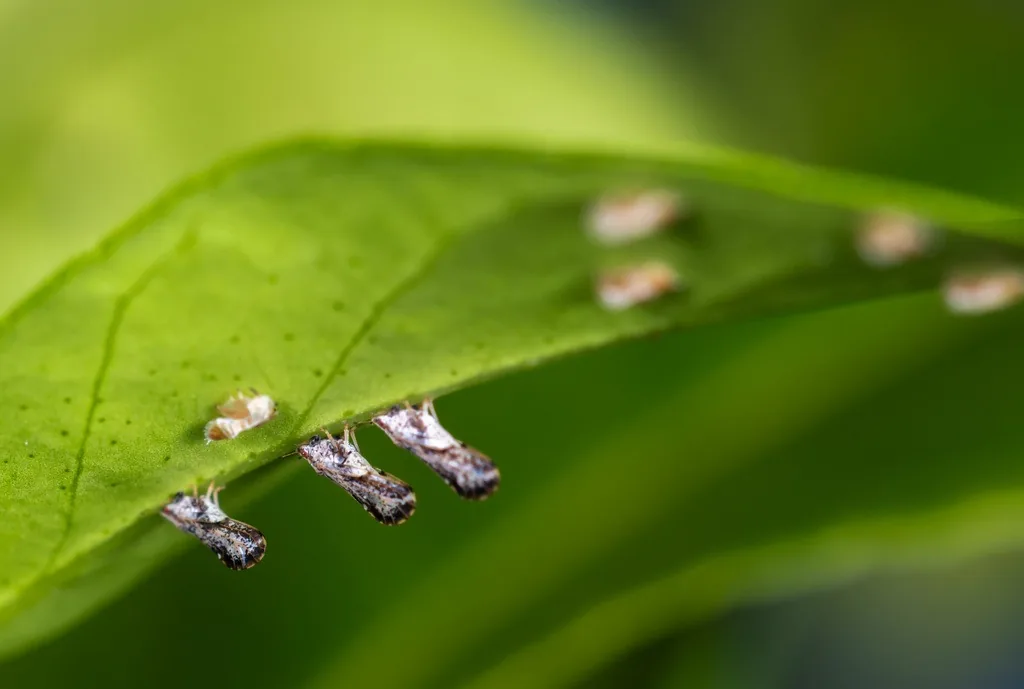
- Adults are mottled brown, aphid- or gnat-sized insects about 1/8 inch long; UC IPM gives 1/8 to 1/6 inch, with red eyes and short antennae. APHIS adds that the last two antenna segments are black and the abdomen can be blue-green, gray-brown or orange-yellow. UF/IFAS gives 3 to 4 mm (about 1/8 inch), a light brown head, and antennae with black tips and two small light brown spots on the middle segments; living adults are coated with a whitish wax that makes them look dusty.[1][2][3]
- Adults feed head down with the body raised at almost 45 degrees, a posture no other citrus pest uses, and they jump or fly when approached.[1][2]
- Eggs are tiny, yellow-orange and almond-shaped, tucked into the folds of new leaves. UF/IFAS says eggs are about 0.3 mm long, pale when laid, then yellow and finally orange before hatching, and stand on end on the plant.[1][2][3]
- Nymphs are flat and yellow to orange, and each makes a curly white wax tube with a bulb at the end, a shape unique to this psyllid. UF/IFAS says nymphs grow from 0.25 mm in the first stage to 1.5 to 1.7 mm in the fifth and last, and move slowly and steadily when disturbed, while adults leap and may fly a short distance.[1][2][3]
Look-alikes
| Look-alike | How to tell them apart |
|---|---|
| Redgum lerp and other eucalyptus psyllids | UC IPM separates Asian citrus psyllid by its brown wing band broken by a clear patch, its tilted feeding posture and its nymphs' wax tubes.[1] |
| Eugenia psyllid | Another garden psyllid; it lacks the Asian citrus psyllid's interrupted wing band and body tilt.[1] |
| Aphids | UF/IFAS says psyllids are most likely to be confused with aphids on tender citrus leaves. Adult psyllids are active jumpers while aphids are sluggish; aphids usually have four- to six-segmented antennae and cornicles on the abdomen, while psyllids usually have 10 antenna segments and no cornicles.[3] |
| African citrus psyllid (Trioza erytreae) | The only other known carrier of citrus greening. UF/IFAS says it has a black head, nearly all-black antennae and a forewing band broadest in the middle; its older nymphs have two dark spots at the base of the abdomen and sit partly enclosed in pits on the leaf.[3] |
Where it lives
It originated in eastern Asia or the Indian subcontinent. In the US it was first found in 1998 in Palm Beach County, Florida, on backyard orange jessamine, and in California in 2008; it has spread through Southern California and been found as far north as the San Francisco Bay Area and near Sacramento. APHIS reports the disease it spreads throughout Georgia, Florida, Mississippi, Puerto Rico and the U.S. Virgin Islands and in parts of Alabama, Arizona, California, Louisiana, South Carolina and Texas. UF/IFAS says it was detected in June 1998 on Florida's east coast from Broward to St. Lucie counties, in dooryard plantings, and had spread to 31 Florida counties by September 2000. It records later first finds in Louisiana in late May 2008, San Diego County, California, on September 2, 2008, and Yuma County, Arizona, on October 27, 2009.[1][2][3]
Biology and life cycle
Females lay eggs in the folds of new citrus leaves, and each can lay several hundred over her life. UF/IFAS says eggs go on the tips of growing shoots, on and between unfurling leaves, and that a female may lay more than 800 eggs in her life.[1][3]
Nymphs feed only on soft new growth and molt four times; adults typically live one to two months. UF/IFAS counts five nymphal stages, says the whole life cycle takes 15 to 47 days depending on the season, and says adults may live for several months.[1][3]
Mature trees flush mostly in spring and fall, but young trees and lemons can flush year round in warm weather, giving psyllids places to breed.[1]
A psyllid picks up the bacterium by feeding on an infected plant and injects it into a healthy one as it feeds. Nymphs can pick it up and spread it as adults only weeks after a tree is infected, long before the tree shows symptoms. UF/IFAS says the psyllid needs an incubation period before it can transmit the bacterium, but then keeps it for life after feeding on a diseased plant for only 15 to 30 minutes, and infected nymphs stay infective as adults.[1][4][3]
There is no winter dormancy, though numbers are low in winter. UF/IFAS reports nine to 10 generations a year, and 16 in field cages; the psyllid is most active when citrus is putting out new growth.[3]
Damage and signs
- Nymphs inject a salivary toxin that twists, curls or kills new shoots and leaves notched leaves; their honeydew grows sooty mold. The psyllid alone damages leaves but doesn't kill trees.[1]
- HLB causes lopsided, blotchy yellowing of leaves, with green on one side of the leaf and yellow on the other. Fruit stays small and partly green, turns lopsided and bitter, and drops early, and trees get twig dieback. UF/IFAS adds green banding along the veins of young leaves, yellow midribs, twig dieback and fruit that is small, hard and poor in juice; a curved central core in sweet orange fruit is, it says, apparently the most reliable sign of greening.[1][2][3]
- APHIS says fruit from infected trees can only be sold for juice, and that the disease has devastated millions of acres of citrus in the US and abroad.[2]
- Hosts include all citrus and close relatives such as calamondin, box orange, Indian curry leaf and orange jessamine. UF/IFAS says hosts are mainly Citrus species, at least two Murraya species and at least three other genera, all in the citrus family (Rutaceae).[1][5][3]
Health risk
It feeds only on plants. APHIS says citrus greening poses no health threat to people or animals, and UC IPM says the fruit is safe to eat.[2][1]
Control
Prevention
Check new leaf flush monthly from spring through fall, walking slowly around each tree and looking for twisted or notched leaves, wax tubes, honeydew and adults.[1]
Buy citrus only from reputable local nurseries; APHIS says to buy only USDA-certified citrus plants. UF/IFAS notes that where greening spread over long distances, it came with infected nursery stock, so only clean, healthy plants should be moved.[1][2][3]
Keep them out
Know the quarantines in your area. Don't move citrus plants, branches, clippings or green waste out of a quarantined area, and don't mail or carry home-grown citrus fruit or plants out of one. In California's quarantine zones fruit may be moved only if it is washed and free of stems and leaves.[2][1]
Biological control
Tiny parasitic wasps such as Tamarixia radiata have been released in California and have reduced psyllid numbers, though not stopped HLB. Control ants on citrus trunks, because ants tend psyllid nymphs for honeydew and fend off their natural enemies. UF/IFAS lists hover flies, lacewings, at least 12 lady beetle species and several parasitic wasps as natural enemies, Tamarixia radiata being the most important; it was introduced intentionally in Florida and accidentally in the Rio Grande Valley of Texas.[1][3]
Pesticides
For home trees with psyllids, UC IPM lists oils and soaps (reapplied every 7 to 14 days), the systemic soil drench imidacloprid (1 to 2 months of nymph control) and foliar sprays; don't apply systemic or broad-spectrum products while trees bloom. APHIS calls intensive chemical control the main tool but costly and increasingly ineffective, and researchers have documented psyllids becoming less susceptible to several insecticides. Follow the label.[1][2][4]
When to call a professional
Report suspected psyllids in new areas or HLB symptoms anywhere: APHIS directs reports to your State Plant Health Director, and in California UC IPM gives the CDFA Exotic Pest Hotline (1-800-491-1899) or the county agricultural commissioner. Infected trees must be destroyed.[2][1]
Citrus greening quarantines
Federal regulated articles for the psyllid and citrus greening include all plants and plant parts, including leaves but not fruit, of citrus, kumquats, trifoliate orange, Murraya (orange jessamine), curry leaf and a list of other citrus relatives.[5]
Texas, for example, quarantines four areas for citrus greening: the Gulf Coast area (Brazoria, Fort Bend, Galveston, Harris and Montgomery counties), the Coastal Bend area (Aransas, Calhoun, Kleberg and Nueces counties), the Valley area (Brooks, Cameron, Hidalgo, Jim Hogg, Kenedy, Starr, Willacy and Zapata counties) and Webb County.[6]
Quarantine maps change as new finds are made, so check the current map with your state department of agriculture or APHIS.[2][6]
Where sources disagree
How fast HLB kills: UC IPM says it can kill a tree in as little as 5 years, while APHIS says most infected trees die within a few years.[1][2]
When symptoms show: UC IPM says it takes one to several years after infection, or 2 or more years in mature trees, and Grafton-Cardwell and colleagues describe a long latent period that lets the pathogen spread widely before it is detected.[1][4]
Feeding angle: UC IPM says adults hold the body at almost 45 degrees; UF/IFAS says almost 30 degrees.[1][3]
Eggs per female: UC IPM says several hundred; UF/IFAS says more than 800.[1][3]
Adult lifespan: UC IPM says typically one to two months; UF/IFAS says adults may live several months.[1][3]
First Florida find: UC IPM and APHIS describe the 1998 find in Palm Beach County on orange jessamine; UF/IFAS describes it as detected along the east coast from Broward to St. Lucie counties.[1][2][3]
Common questions
- How can I tell an Asian citrus psyllid from other bugs on my citrus?
- Look for a tiny mottled brown insect feeding head down with its rear raised at about 45 degrees, and for nymphs making curly white wax tubes on new leaves.[1][2]
- Can citrus greening be cured?
- No. There is no cure, so infected trees are removed and psyllids are controlled to slow the spread.[1][2]
- Is fruit from an infected tree safe to eat?
- Yes. UC IPM says the fruit is safe to eat, and APHIS says the disease poses no health threat to people or animals, though the fruit may be bitter and misshapen.[1][2]
- Can I mail home-grown citrus to family?
- Not out of a quarantined area. APHIS asks people not to mail or transport home-grown citrus fruit or plants out of one.[2]
- Is the Asian citrus psyllid the only insect that spreads citrus greening?
- No, but nearly. UF/IFAS says it and the African citrus psyllid (Trioza erytreae) are the only known carriers of the greening bacterium; six other Diaphorina species reported on citrus don't carry it.[3]
Sources
- University of California Statewide IPM Program, “Asian Citrus Psyllid and Huanglongbing Disease (Pest Notes).” ipm.ucanr.edu/home-and-landscape/asian-citrus-psyllid-and-huanglongbing-disease/ (accessed 2026-11-14)
- USDA Animal and Plant Health Inspection Service (APHIS), “Citrus Greening and Asian Citrus Psyllid.” www.aphis.usda.gov/plant-pests-diseases/citrus-diseases/citrus-greening-and-asian-citrus-psyllid (accessed 2026-11-14)
- University of Florida/IFAS Extension (Featured Creatures), “Asian Citrus Psyllid, Diaphorina citri Kuwayama, EENY-033/IN160.” ask.ifas.ufl.edu/publication/IN160 (accessed 2026-11-14). Its June 2010 quarantine list is dated and not used; current quarantine lines come from APHIS and Texas.
- Annual Review of Entomology, via PubMed, “Biology and management of Asian citrus psyllid, vector of the huanglongbing pathogens (Grafton-Cardwell et al. 2013).” pubmed.ncbi.nlm.nih.gov/23317046/ (accessed 2026-11-14)
- USDA Animal and Plant Health Inspection Service (APHIS), “Asian Citrus Psyllid and Citrus Greening Regulated Articles, 7 C.F.R. 301.76-2(a).” www.aphis.usda.gov/sites/default/files/citrus-greening-asian-citrus-psyllid-regulated-articles.pdf (accessed 2026-11-14)
- Texas Department of Agriculture, “Citrus Greening Quarantine.” texasagriculture.gov/Regulatory-Programs/Plant-Quality/Pest-and-Disease-Alerts/Citrus-Greening (accessed 2026-11-14)
- iNaturalist, “Diaphorina citri taxon page (order and family).” www.inaturalist.org/taxa/199388 (accessed 2026-11-14)