On this page
How to identify it
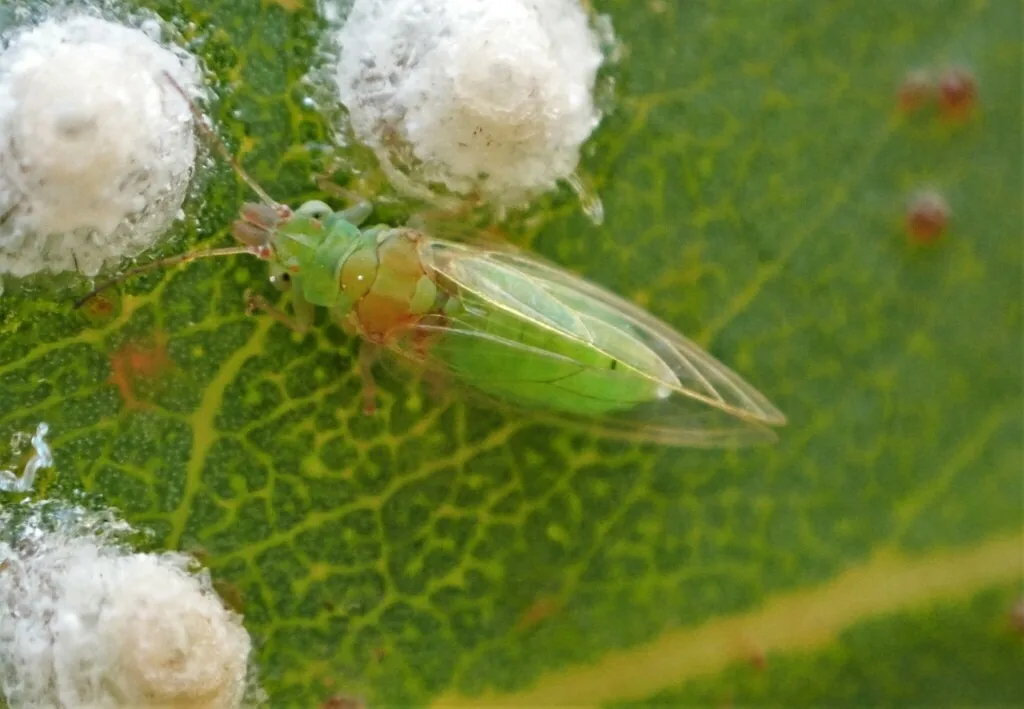
- Nymphs are brownish to yellowish orange and feed under white, hemispherical waxy caps (lerps) 1/25 to 1/6 inch across. The caps turn gray or blackish as they age or get covered with sooty mold.[1]
- A nymph enlarges its lerp as it grows through five instars, and nymphs also leave old lerps to build new, larger ones, so a leaf can carry many empty caps.[1]
- Adults are about 1/6 inch long from head to wing tips, light green to yellow with brownish markings, and sit openly on the leaves. Look for a long forward projection (genal cone) on each side of the head below the eyes; the Asian citrus psyllid has them too. UF/IFAS describes adults as yellow to green, winged and highly mobile.[1][2]
- Eggs are pale orange to yellowish, oblong and less than 1/25 inch long, laid singly or in scattered groups, mostly on young leaves and new shoots.[1]
- UF/IFAS says infestations are most easily recognized by the white lerps, which it describes as conical, and that heavily infested trees are often obviously dripping with honeydew and old lerps; check both old and new leaves.[2]
Look-alikes
| Look-alike | How to tell them apart |
|---|---|
| Armored scales | Lerps on leaves resemble armored scales. A lerp is a waxy cap that a psyllid nymph builds and can leave; lift one and you may find a small, aphidlike nymph underneath or nothing at all.[1] |
| Spottedgum lerp psyllid | Of the psyllids that build lerps on eucalyptus in California, the redgum lerp psyllid makes a roundish cover, while the spottedgum lerp psyllid's cover is feather- or funnel-shaped.[1] |
| Eucalyptus psyllid (Blastopsylla occidentalis) | UF/IFAS says this other Australian eucalyptus psyllid does not make lerps, though its nymphs secrete a waxy substance, and its adults are smaller with much shorter head projections. Look for fuzzy, flocculent secretions on new growth.[2] |
Where it lives
Native to Australia. UC IPM says it was introduced into Los Angeles in 1998, now occurs throughout California, and also occurs in the eastern US and much of the world where its eucalyptus hosts grow. It was reported in Brazil in 2003 and has invaded the Mediterranean, including Italy. GBIF's US records since 1990 come almost entirely from California, with a few from Arizona and Hawaii. UF/IFAS says it was first found in Florida in the spring of 2001, in tourist parks in the Orlando area, probably arriving from California.[1][3][4][5][2]
Biology and life cycle
It infests over two dozen eucalyptus species but prefers river red gum; in California flooded gum and forest red gum are also heavily infested.[1]
Development from egg to adult takes several weeks in warm weather and several months when it is cool, so there are several generations a year. All stages can be found year-round but are less abundant in winter.[1]
Weather matters: in eastern Sicily, numbers rose with air temperature and fell with rain and humidity, and in a Brazilian plantation study egg and nymph density were also lower in rainier months.[6][3]
Tree type matters too. In Brazil, damage was lower on hybrid eucalyptus genotypes than on river red gum, and lower on the upper leaf surface.[3]
Across 19 California populations, about 40% of 380 psyllids carried a secondary bacterial symbiont, ranging from none to 75% by site, and infection rates tracked how heavily the parasitic wasp attacked each population.[7]
UF/IFAS says it is more damaging than other eucalyptus psyllids introduced into North America because it can defoliate trees and has a relatively broad host range among eucalyptus species.[2]
In Australian studies cited by UF/IFAS, which pooled several Glycaspis species, psyllids were most abundant in fall and winter, and urban trees, which were irrigated in the hot season, carried more than similar trees in natural settings.[2]
Damage and signs
- Nymphs do most of the feeding. Heavy infestations make trees drop leaves early, and repeated defoliation weakens trees and leaves them more open to other pests and diseases.[1]
- Adults and nymphs excrete large amounts of honeydew, which drips onto cars, paving and plants below and grows black sooty mold.[1]
- Combined with drought, poor pruning or other stress, psyllid feeding can make susceptible trees decline and die early, sometimes quickly and sometimes over several years.[1]
Health risk
It feeds only on eucalyptus sap; UC IPM describes tree damage and honeydew but no risk to people or pets.[1]
Control
Prevention
Water eucalyptus during long droughts, applying water beneath the outer canopy rather than near the trunk; reducing drought stress can substantially reduce psyllid numbers. Skip nitrogen fertilizer, which pushes the tender new growth psyllids prefer.[1]
When planting, choose eucalyptus species that this psyllid avoids or does not heavily infest; river red gum is its favorite, and Brazilian trials found less damage on hybrid genotypes.[1][3]
Counting lerps does not tell you how many live psyllids there are, because nymphs leave empty caps behind. Look under caps for live nymphs and for parasitized ones before deciding to treat.[1]
Biological control
A tiny parasitic wasp from Australia, Psyllaephagus bliteus, attacks only this psyllid. In California it commonly gives good control on the coast but less in hot inland areas such as the Central Valley. In Italy, where the wasp arrived by accident in 2011, a population model predicted it would cut psyllid density by 64%.[1][4]
Pesticides
Systemic imidacloprid applied to moist soil from late winter to early spring has sometimes worked, but results are variable. UC IPM advises against summer or fall treatment of stressed trees, against treating where the parasitic wasp is active, and to wait until the tree has finished flowering because the insecticide moves into nectar and pollen and is toxic to bees. Follow the label.[1]
Where sources disagree
How well the parasitic wasp works: UC IPM reports good control on the California coast and less inland; an Italian model predicts a 64% cut in psyllid density; but in a Brazilian plantation parasitism was only 2.9%, and those authors do not recommend relying on the wasp there.[1][4][3]
Eastern United States: UC IPM says the psyllid also occurs in the eastern US, but GBIF's US records since 1990 come from California, Arizona and Hawaii only. UF/IFAS, however, reports it established in the Orlando area of Florida since 2001.[1][5][2]
Nymph color and lerp shape: UC IPM describes nymphs as brownish to yellowish orange under a hemispherical lerp, while UF/IFAS describes reddish-bronze nymphs with darker wing pads bearing bright white spots, under conical lerps.[1][2]
Common questions
- What are the white bumps on my eucalyptus leaves?
- Most likely redgum lerp psyllid lerps, waxy caps 1/25 to 1/6 inch across that cover the feeding nymphs. Many may be empty, since nymphs abandon old caps.[1]
- Why is my car sticky under the eucalyptus?
- The psyllids excrete large amounts of sticky honeydew that drips onto whatever is below, and black sooty mold grows on it.[1]
- Should I inject my eucalyptus with insecticide?
- UC IPM prefers a soil or bark application to injecting, since injection wounds the tree, and notes that results with systemic insecticides have been variable. Watering during drought and avoiding nitrogen often help more.[1]
- Is the redgum lerp psyllid in Florida?
- Yes. UF/IFAS says it was first found in Florida in the spring of 2001 in Orlando-area tourist parks, along with the eucalyptus psyllid.[2]
Sources
- University of California Statewide IPM Program, “Pest Notes: Eucalyptus Redgum Lerp Psyllid (Publication 7460).” ipm.ucanr.edu/home-and-landscape/eucalyptus-redgum-lerp-psyllid/ (accessed 2026-11-14)
- University of Florida IFAS Extension (EDIS), “Eucalyptus Psyllid, Blastopsylla occidentalis Taylor and Red Gum Lerp Psyllid, Glycaspis brimblecombei Moore, EENY-306/IN583 (Featured Creatures; S. E. Halbert, R. Gill, J. N. Nisson).” ask.ifas.ufl.edu/publication/IN583 (accessed 2026-11-14)
- PeerJ, via PubMed, “Glycaspis brimblecombei attack patterns on different Eucalyptus genotypes (Tuller et al. 2017).” pubmed.ncbi.nlm.nih.gov/29085744/ (accessed 2026-11-11)
- Journal of Economic Entomology, via PubMed, “Modeling environmental influences in the Psyllaephagus bliteus-Glycaspis brimblecombei parasitoid-host system (Margiotta et al. 2017).” pubmed.ncbi.nlm.nih.gov/28073975/ (accessed 2026-11-11)
- Global Biodiversity Information Facility (GBIF), “Glycaspis brimblecombei: US occurrence records since 1990 by state (GBIF occurrence search API).” api.gbif.org/v1/occurrence/search?taxonKey=2013501&country=US&hasGeospatialIssue=false&occurrenceStatus=PRESENT&year=1990%2C2026&facet=stateProvince&facetLimit=400&limit=0 (accessed 2026-11-11)
- Insects, via PubMed, “Re-visiting the incidence of environmental factors on a pre-imaginal population of the red gum lerp psyllid (Junk et al. 2020).” pubmed.ncbi.nlm.nih.gov/33287178/ (accessed 2026-11-11)
- Applied and Environmental Microbiology, via PubMed, “Frequency of secondary symbiont infection in an invasive psyllid relates to parasitism pressure on a geographic scale in California (Hansen et al. 2007).” pubmed.ncbi.nlm.nih.gov/17933921/ (accessed 2026-11-11)
- iNaturalist, “Glycaspis brimblecombei taxon page (order and family).” www.inaturalist.org/taxa/155373 (accessed 2026-11-11)