On this page
How to identify it
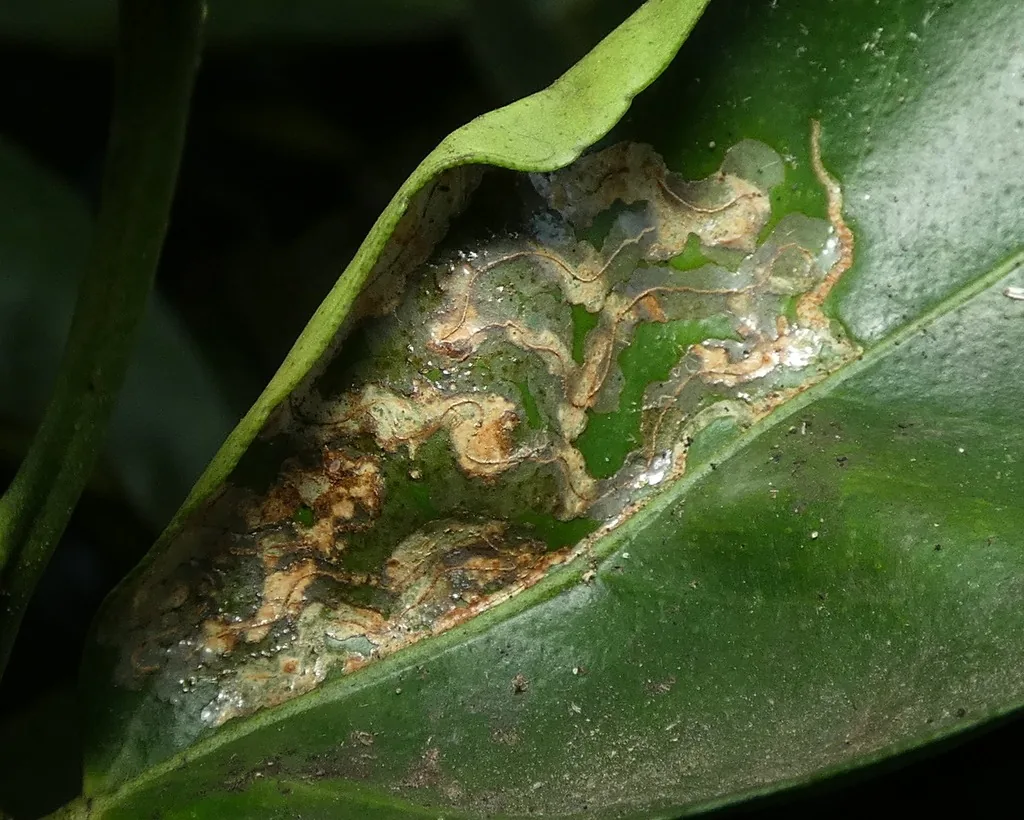
- Larvae make shallow, winding mines just under the leaf surface, with a thin dark line of excrement (frass) running down the middle.[1][4]
- When the larva is ready to pupate it rolls the leaf edge over and pupates inside the curl, leaving a rolled, distorted leaf.[1][4]
- The adult is a tiny, light-colored moth with silvery-and-white forewings marked in brown and white and a black spot at each wing tip. It rests on leaf undersides by day and is rarely seen. UF/IFAS gives a wingspread of 4 mm (about 3/16 inch), but with wings folded at rest the moth looks much smaller, about 2.4 mm (3/32 inch). The hind wings and body are white with long fringe scales, and adults are active by day and in the evening.[1][4][2][3]
- Hosts are citrus (oranges, mandarins, lemons, limes, grapefruit) and close relatives such as kumquat and calamondin. UF/IFAS also lists citrus-family hosts recorded in Asia, such as Murraya paniculata, Poncirus trifoliata and Aegle marmelos, and notes several reported hosts on which larvae cannot complete their life cycle.[1][2][3]
- UF/IFAS describes the larva as up to 3 mm (about 1/8 inch) long and translucent greenish-yellow, inside the mine. Other signs: the leaf skin over a mine looks like a silvery film, and the rolled-over edge of the pupal chamber shows a distinct orange color.[3]
Look-alikes
| Look-alike | How to tell them apart |
|---|---|
| Citrus peelminer | Peelminer larvae leave no frass line in their mines and attack fruit and stems rather than new leaves; their pupae sit in silk cocoons decorated with small whitish balls, usually tucked into bark cracks.[1][4] |
| Other leafminers | Citrus leafminer is the only mining insect that commonly attacks citrus leaves.[1] |
Where it lives
Native to Asia. It was first noted as a pest in Australia in the 1940s and in other major citrus regions in the 1970s, reached Florida in 1993 and northern Mexico in the mid-1990s, and was found in California (Imperial County) in 2000; it now infests most of southern California, the coast north to San Luis Obispo County, and the San Joaquin Valley. GBIF lists about 540 US records since 1990, mostly from California and Florida, with smaller numbers from Texas, Hawaii, Louisiana and a few other states. UF/IFAS says it had been intercepted in the U.S. in 1914 on nursery stock from the Philippines; the 1993 Florida find, in citrus nurseries in Homestead and elsewhere in Miami-Dade, Broward and Collier counties, was the first record for the continental United States and the Western Hemisphere. It spread to all Florida citrus counties, to Alabama, Louisiana and Texas from 1994, and to Hawaii, where it was first detected on Oahu and reached the Big Island by 2002.[1][5][3]
Biology and life cycle
Females lay single eggs on the undersides of tender new leaves, especially along the midvein.[1][2]
Larvae molt four times as they mine. The pupal stage lasts 1 to 3 weeks, and adults live 1 to 2 weeks.[1]
Larvae can survive only in young, shiny flush; leaves that have hardened off are not attacked unless numbers are extremely high.[1]
It does best between 70 and 85°F with relative humidity above 60%. In California, summer heat inland seems to hold it down, while in cooler coastal areas numbers can stay high from summer through fall.[1]
UC's grower guide says it is generally active from midsummer through fall and early winter.[4]
UF/IFAS says adults emerge about dawn and are active in the morning, with more activity at dusk or night; females lay eggs in the evening and at night. Adults live only a few days, and in Florida a new generation is produced about every three weeks.[3]
UF/IFAS says there is usually one mine per leaf, but heavy infestations can have two or three, and up to nine have been found on large leaves in Florida. Females lay on leaves less than 1.27 cm (1/2 inch) long.[3]
Damage and signs
- Mined leaves curl and look distorted. Very young trees, which flush more and have little mature foliage, may grow more slowly.[1][2]
- Trees older than about 4 years tolerate the damage with little or no effect on growth or fruit yield.[1][4][2]
- In mature orange and mandarin orchards near Valencia, Spain, studied from 1996 to 1999, the leafminer damaged new leaves from July to November, yet trees sprayed against it did not differ from unsprayed trees in flowering, fruit number or fruit size; the authors concluded it usually does not affect yield of mature trees there.[6]
- Young trees are a different story: in a 3-year UC Riverside trial on newly planted mandarins, programs combining a systemic soil treatment with repeated foliar sprays gave 1.2 to 2.5 times the yield of untreated trees in later years, though each treatment held larvae down for only 2 to 3 weeks.[7]
- In Florida, leafminer mines give citrus bacterial canker a way into leaves; UC notes the disease is not found in California. In Brazilian trials, the adult moths themselves proved poor carriers of the canker bacterium.[4][8]
Health risk
It mines citrus leaves only; none of the sources describes any risk to people or pets.[1][2]
Control
Prevention
Prune live branches no more than once a year so flushes of new growth stay short and uniform.[1][4]
Don't apply nitrogen fertilizer when leafminer numbers are high, usually summer and fall, since it pushes out new leaves for them to attack.[1][2]
Leave mined leaves on the tree; their undamaged parts still make food.[1][2]
Traps and physical control
Remove water sprouts and the suckers that grow from below the graft union; they keep producing new leaves that draw egg-laying moths.[1][4]
Pheromone traps catch male moths and show when they are flying, but they don't catch enough to control the pest. UF/IFAS says the sex pheromone was developed in Japan in 1985 and recommends the traps for timing.[1][3]
Biological control
Tiny nonstinging parasitic wasps such as Cirrospilus and Pnigalio lay eggs in the mines and kill the larvae. Native species find citrus on their own, so there is no need to buy and release them; avoid broad-spectrum sprays that kill them.[1]
UF/IFAS says natural enemies already present in Florida have caused up to 90% mortality of larvae and pupae. The introduced parasitoid Ageniaspis citricola, established through most of Florida, accounts for up to 30% of that, mostly later in the year, and UF/IFAS calls biological control and oil applications suitable ways to reduce numbers in Florida.[3]
Pesticides
Mature trees rarely if ever need treatment. For very young or high-value trees, UC IPM names azadirachtin or spinosad on new flush, repeated every 7 to 14 days, or one imidacloprid soil application a year timed to new flush and kept away from the month before and during bloom to protect bees. Clemson notes that horticultural oil does not control leafminers. Follow the label.[1][2]
Where sources disagree
How soon eggs hatch: about 1 week after laying (UC pest note) or about 4 to 5 days (UC grower guide and Clemson). UF/IFAS gives a wider range: hatching within 2 to 10 days.[1][4][2][3]
Moth size: under 1/4 inch long (UC pest note), under 1/8 inch (Clemson), or about 2 mm long with a wingspan of about 4 mm (UC grower guide). UF/IFAS gives a 4 mm wingspread and about 2.4 mm at rest.[1][2][4][3]
Timing: the UC pest note gives 2 to 3 weeks of larval feeding and 3 to 7 weeks for the whole life cycle; the UC grower guide gives 1 to 3 weeks and 2 to 7 weeks. UF/IFAS gives 5 to 20 days for larvae, 6 to 22 days for pupae and about 13 to 52 days in total.[1][4][3]
Oil: Clemson says horticultural oil will not control leafminers, while the UC grower guide says oil has deterred egg-laying in nurseries, used carefully to avoid plant injury. UF/IFAS lists oil applications, with biological control, as suitable in Florida.[2][4][3]
Mature trees: the UC pest note says trees more than 4 years old tolerate the damage with negligible effect on growth and yield, while UF/IFAS says heavy infestations may affect production on mature trees, though this has been shown only on limes.[1][3]
Common questions
- Why are the new leaves on my citrus curled with squiggly lines in them?
- Those are citrus leafminer mines: winding tunnels with a thin dark line down the middle, made by larvae feeding inside young leaves.[1][4]
- Will citrus leafminer kill my tree?
- Unlikely. Trees older than about 4 years tolerate it, and even heavily infested young trees rarely die.[1][2]
- Should I prune off curled leaves?
- No. The undamaged parts of those leaves keep feeding the tree.[1][2]
- Do natural enemies keep citrus leafminer down in Florida?
- They help a great deal. UF/IFAS says natural enemies already present in Florida have caused up to 90% mortality of larvae and pupae, with the introduced wasp Ageniaspis citricola responsible for up to 30% of it.[3]
Sources
- University of California Statewide IPM Program, “Pest Notes: Citrus Leafminer (Publication 74137).” ipm.ucanr.edu/PMG/PESTNOTES/pn74137.html (accessed 2026-11-14)
- Clemson Cooperative Extension Home & Garden Information Center, “Citrus Insects & Related Pests (HGIC 2221).” hgic.clemson.edu/factsheet/citrus-insects-related-pests/ (accessed 2026-11-14)
- University of Florida IFAS Extension (EDIS), “Citrus Leafminer, Phyllocnistis citrella Stainton, EENY038/IN165 (Featured Creatures).” ask.ifas.ufl.edu/publication/IN165 (accessed 2026-11-14)
- University of California Statewide IPM Program, “Citrus Leafminer (Citrus Pest Management Guidelines).” ipm.ucanr.edu/agriculture/citrus/citrus-leafminer/ (accessed 2026-11-14)
- Global Biodiversity Information Facility (GBIF), “Phyllocnistis citrella: US occurrence records since 1990 by state (GBIF occurrence search API).” api.gbif.org/v1/occurrence/search?taxonKey=1749580&country=US&hasGeospatialIssue=false&occurrenceStatus=PRESENT&year=1990%2C2026&facet=stateProvince&facetLimit=400&limit=0 (accessed 2026-11-11)
- Journal of Economic Entomology, via PubMed, “Impact of Phyllocnistis citrella on leaf area development and yield of mature citrus trees in the Mediterranean area (Garcia-Mari et al. 2002).” pubmed.ncbi.nlm.nih.gov/12403423/ (accessed 2026-11-11)
- Journal of Economic Entomology, via PubMed, “Impact of insecticide treatments for Phyllocnistis citrella on growth and yield of young mandarins (Grafton-Cardwell & Daugherty 2021).” pubmed.ncbi.nlm.nih.gov/33860300/ (accessed 2026-11-11)
- Plant Disease, via PubMed, “Adult citrus leafminers (Phyllocnistis citrella) are not efficient vectors for Xanthomonas axonopodis pv. citri (Belasque et al. 2005).” pubmed.ncbi.nlm.nih.gov/30795383/ (accessed 2026-11-11)
- iNaturalist, “Phyllocnistis citrella taxon page (order and family).” www.inaturalist.org/taxa/257156 (accessed 2026-11-11)