On this page
How to identify it
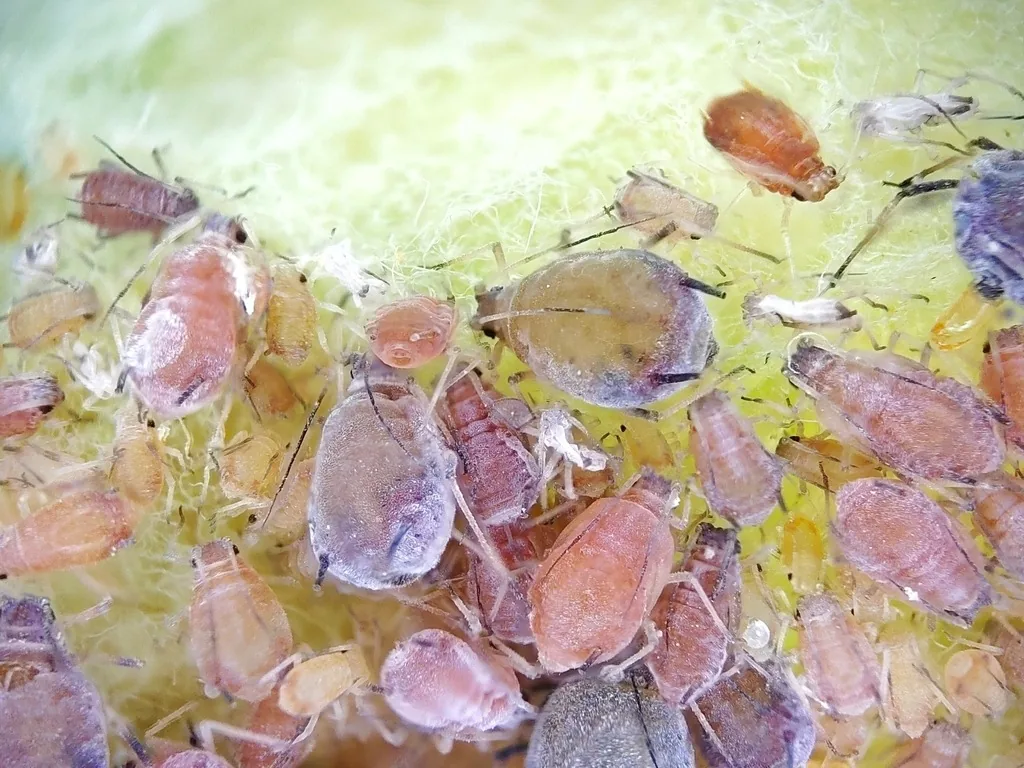
- Newly hatched nymphs are dark green and turn purple as they grow. Wingless adults on apple are purplish to rosy with a waxy, powdery coating, about 3/32 inch (2.5 mm) long.[1][3][2]
- Tightly curled leaves, often bright crimson, are the telltale sign.[1]
- Winged adults that fly to and from apple in spring and fall are brownish green with a black head and thorax.[2]
- The overwintering eggs are glossy black and elongate; Kentucky gives their length as 1/2 mm and NC State as about 0.4 mm.[1][2]
Look-alikes
| Look-alike | How to tell them apart |
|---|---|
| Other apple aphids | Green apple and apple-grain aphids also feed on apples, but Kentucky says they don't curl leaves and gives them a much higher action threshold.[1] |
Where it lives
It was introduced to North America from Europe in the late 1800s (NC State). Kentucky and NC State Extension cover it in eastern orchards and UC IPM in California apples; NC State says it may also feed on pear.[2][1][3]
Biology and life cycle
It overwinters as eggs on twigs, fruit spurs, bud axils and bark crevices. Kentucky says the eggs hatch shortly after silver tip; NC State says around bud break. All the hatchlings are females (stem mothers) that give birth to live young without mating.[1][2][3]
After several generations on apple, winged forms fly to plantain, mostly narrow-leaved (buckhorn or English) plantain; NC State says the move is usually done by late June. Kentucky also lists dock, and UC IPM lists the broadleaf plantains Plantago major and P. rugelii.[1][2][3]
In fall, winged females fly back to apple and give birth to egg-laying females. Males follow and mate with them, and the females lay the overwintering eggs.[2][1]
Damage and signs
- Even low numbers can stunt and deform fruit, leaving it small, hard and knotty, and honeydew grows sooty mold.[1][2]
- Cortland, Ida Red and Golden Delicious are especially susceptible.[1]
- Numbers vary a lot from year to year, and UC IPM says it isn't a pest every year. NC State says the worst injury usually follows cool springs, when the aphids build up faster than their natural enemies.[3][2]
Health risk
It feeds on apple trees, and no cited source describes any risk to people or pets.[1][2][3]
Control
Prevention
Check early. Kentucky says to check at the pink stage, because once leaves curl tightly, spray coverage and control get much harder. UC IPM says to look for eggs on fruit spurs with a hand lens during the dormant season.[1][3]
Thresholds differ: Kentucky suggests treating when 5% of leaf terminals have rosy apple aphid colonies, while NC State uses more than 10% of interior shoot terminals.[1][2]
Sanitation
UC IPM suggests keeping plantain out of the orchard ground cover, since it's the summer host; it often becomes a problem where the cover is mowed rather than cultivated.[3]
Biological control
Sources differ on how much predators help. Kentucky says they often control it, so open curled leaves to see whether aphids or predators remain before deciding. NC State and UC IPM say natural enemies alone usually aren't enough or act after fruit size is already reduced, and a West Virginia USDA study found that predators, mainly the lady beetle Harmonia axyridis, killed most stem mothers before bloom but not reliably enough to prevent damage.[1][2][3][4]
Predators include lady beetles, green and brown lacewings, syrphid fly larvae and soldier beetles. UC IPM warns that in-season sprays, even soap, can kill these natural enemies and let the aphids build up.[3][2]
Pesticides
Kentucky says a delayed dormant oil spray between green tip and half-inch green kills newly hatched aphids; NC State says control is best from tight cluster to pink. Kentucky also lists insecticidal soap or summer horticultural oil, which give no residual control, so coverage must be thorough, and warns that oil can injure trees in heat above 100°F with high humidity and may not mix with sulfur products.[1][2]
Common questions
- Why are my apple leaves curled and red?
- Rosy apple aphids feeding inside curled leaves are a common cause.[1]
- Should I spray right away?
- Open curled leaves first. Kentucky says predators may already be controlling the aphids, but NC State says natural enemies alone are usually not enough, so compare what you find with a threshold.[1][2]
Sources
- University of Kentucky Entomology (ENTFACT), “Rosy Apple Aphid (ENTFACT-211).” entomology.mgcafe.uky.edu/ef211 (accessed 2026-11-13)
- NC State Extension, “Rosy Apple Aphid.” content.ces.ncsu.edu/rosy-apple-aphid (accessed 2026-11-13)
- UC Statewide IPM Program (UC IPM), “Rosy Apple Aphid (Apple Pest Management Guidelines).” ipm.ucanr.edu/agriculture/apple/rosy-apple-aphid/ (accessed 2026-11-13)
- Environmental Entomology (via PubMed), “Conservation biological control of rosy apple aphid, Dysaphis plantaginea (Passerini), in eastern North America. Brown & Mathews 2007 (USDA ARS) (abstract).” pubmed.ncbi.nlm.nih.gov/18284737/ (accessed 2026-11-13)
- Global Biodiversity Information Facility (GBIF), “Dysaphis plantaginea (Passerini, 1860) (GBIF Backbone Taxonomy).” api.gbif.org/v1/species/2075245 (accessed 2026-11-13)