On this page
How to identify it
- Small white silken molting mats on the undersides of skeletonized leaves are the easiest sign.[1][2]
- Young caterpillars mine inside the leaf, making splotchy areas that can be mistaken for a leaf disease; older ones feed on the leaf underside.[1][2]
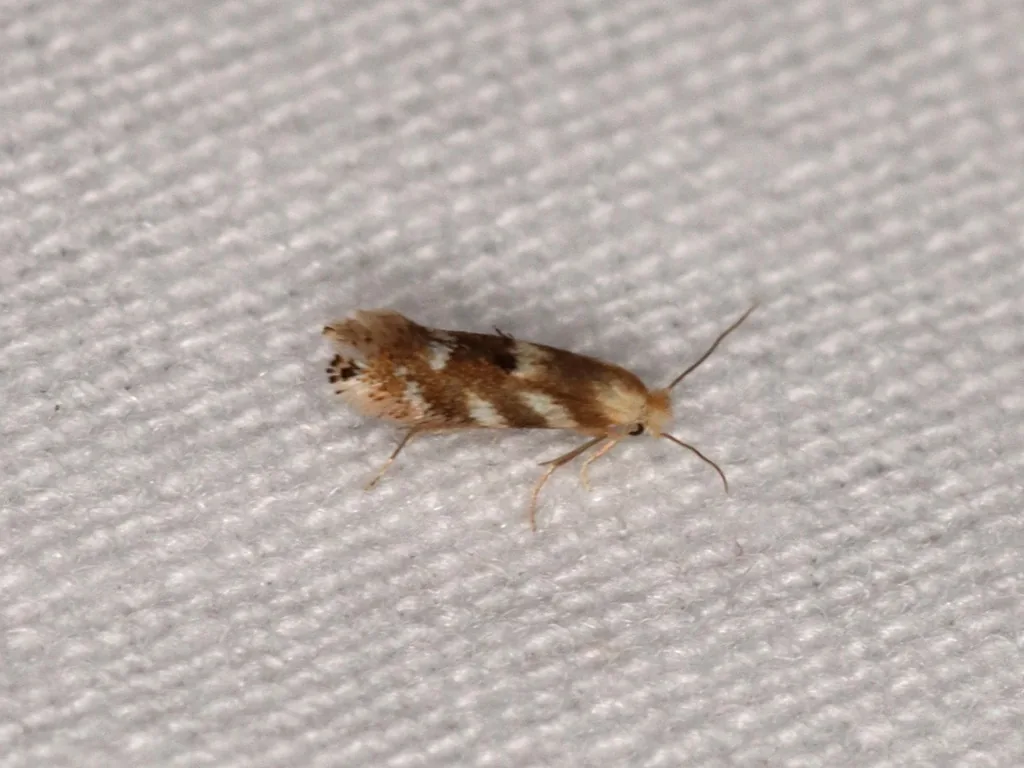
- The adult is a tiny moth; Natural Resources Canada shows a pinned adult with a wingspan of 7 mm.[2]
Look-alikes
| Look-alike | How to tell them apart |
|---|---|
| Birch leafminer | A sawfly that also mines birch leaves.[1] |
| Japanese beetle and other causes of leaf drop | Drought, other insects and fungal diseases also cause birch leaf drop, so find the cause before acting.[1] |
Where it lives
Native to North America with a transcontinental distribution. Natural Resources Canada lists gray, white and yellow birch as its main hosts.[1][2]
Biology and life cycle
There is one generation a year. Larvae are active in midsummer, and pupae spend the winter in silk cocoons attached to fallen leaves and other debris under the tree.[1][2]
Caterpillars molt twice on their silk mats, then drop to the ground to spin cocoons.[1][2]
In Canada, outbreaks come about every 9 to 10 years. Over 3 to 5 years the population grows fast and spreads across large areas, then drops back to normal levels a few years later. Eight separate outbreaks have been reported in eastern Canada since the end of the 19th century.[2]
Penn State says the pupae tolerate fall and winter weather well, and warm, wet conditions favor hatching.[1]
Damage and signs
- Heavy infestations skeletonize leaves completely; they turn brown in late August and early September and drop early.[1][2]
- Penn State calls it most likely a minor pest that can usually be ignored, though its feeding has caused significant defoliation in some areas. Leaves drop after the caterpillars have finished feeding and pupated.[1]
Health risk
Neither cited source describes any risk to people or pets; the caterpillars feed on birch leaves.[1][2]
Control
Sanitation
On valuable landscape birches, clear away fallen leaves and debris under the tree in late fall or early spring to remove the overwintering pupae. Penn State says to remove and destroy the litter; Natural Resources Canada suggests collecting and burning it.[1][2]
Common questions
- Why are my birch leaves brown and see-through in August?
- Often the birch skeletonizer; look for tiny white silk pads under the leaves.[1][2]
- Do I need to spray?
- Usually not; it is a minor pest, and leaf-litter cleanup reduces next year's numbers.[1][2]
- Will it kill my birch?
- Neither source reports it killing trees. Penn State calls it a minor pest, and notes that drought, other insects and fungal diseases also cause birch leaf drop, so confirm the cause before acting.[1][2]
Sources
- Penn State Extension, “The Birch Skeletonizer, Bucculatrix canadensisella Chambers (updated May 13, 2026).” extension.psu.edu/the-birch-skeletonizer-bucculatrix-canadensisella-chambers/ (accessed 2026-11-13)
- Natural Resources Canada, Canadian Forest Service, “Birch skeletonizer (Trees, insects and diseases of Canada's forests).” tidcf.nrcan.gc.ca/en/insects/factsheet/8184 (accessed 2026-11-13)
- Global Biodiversity Information Facility (GBIF), “Bucculatrix canadensisella Chambers, 1875 (GBIF Backbone Taxonomy).” api.gbif.org/v1/species/10014166 (accessed 2026-11-13)