On this page
How to identify it
- Adults are tiny mottled moths with a wingspan of about 1/3 inch (the Forest Service says 8 to 9 mm); UC IPM says hairlike fringes line the rear edges of the wings.[1][2][3]
- Mature larvae are about 1/4 inch (6 mm) long and pale yellow, green or olive, with rows of pale spots.[1][2][3]
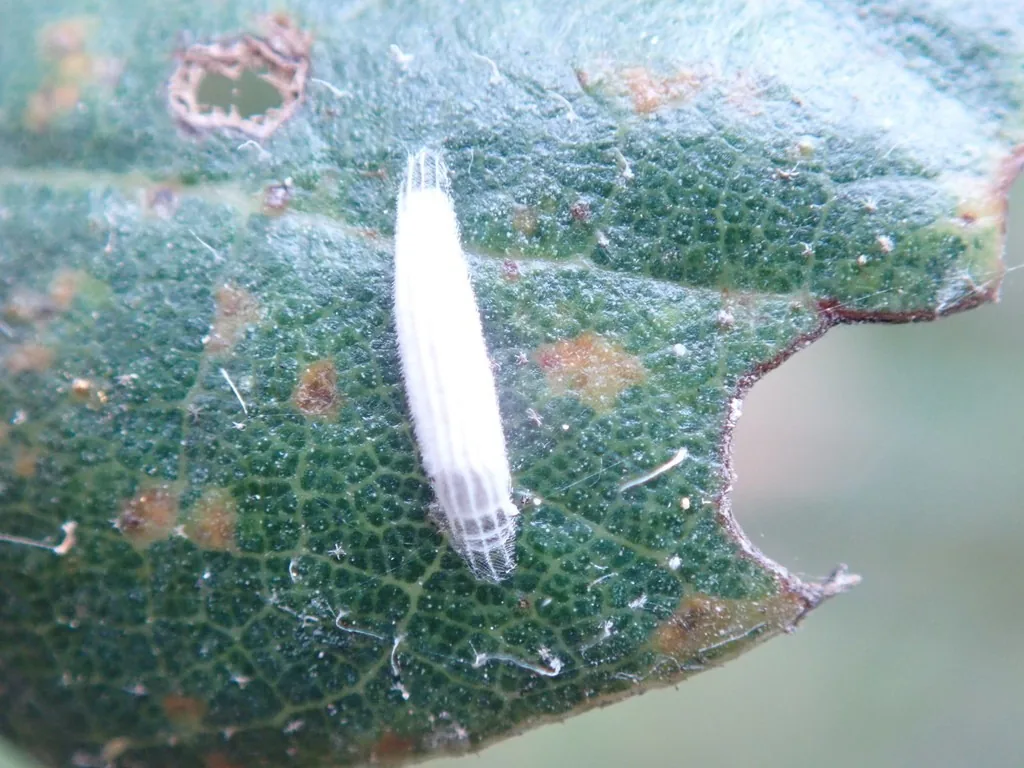
- Mature larvae spin oblong, cigar-shaped white cocoons with distinct lengthwise ribs on leaves, twigs, bark and objects below; young larvae make small, flat, round white cocoons on the leaf underside.[1][2][3]
Where it lives
In California it's reported on California black, coast live, interior live and valley oaks; the Forest Service says it occurs throughout the state and probably on other oaks too. The PNW Insect Management Handbook also covers it as a landscape oak pest.[2][3][1]
Biology and life cycle
Young larvae make narrow linear mines inside leaves; after their first molt they feed on the leaf underside, leaving only the upper surface and veins.[1][2][3]
It overwinters in its cocoon; see where the sources disagree on the stage.[1][2][3]
Moths appear in spring and lay eggs on oak leaves, and a summer generation follows, for two generations a year.[1][2][3]
Damage and signs
Health risk
It feeds on oak leaves. The PNW handbook, UC IPM and the USDA Forest Service describe leaf damage only and don't mention any risk to people or pets.[1][2][3]
Control
Prevention
Cocoons are easily carried from place to place on infested plant material.[1]
Sanitation
Rake up fallen leaves to remove cocoons, and destroy them by deep composting.[1]
Biological control
Natural enemies help keep it and many other oak insects in check; the PNW handbook and UC IPM both advise against broad-spectrum insecticides that kill them.[1][2]
UC IPM says control generally isn't needed to protect oak health. If damage is intolerable, it suggests Bacillus thuringiensis (Bt) sprayed thoroughly onto leaf undersides, timed for when the round cocoons of the first-stage larvae appear, and hiring a professional applicator for large oaks.[2]
Where the sources disagree
Overwintering: UC IPM says it overwinters as a prepupa or pupa in the elongate cocoon, and the Forest Service says as pupae. The PNW handbook says it appears to overwinter in its cocoon and that immature larvae make flat, white, round hibernating cocoons.[2][3][1]
Severity: UC IPM says even extensive mining appears not to threaten healthy oaks. The Forest Service guide calls it one of the more common oak insects and says it may cause serious leaf damage over large areas in some years.[2][3]
Adult color: the PNW handbook and the Forest Service describe the moth as mottled white, brown and black; UC IPM says mottled brown, tan and silvery to whitish.[1][3][2]
Names: UC IPM and the Forest Service place it in the family Lyonetiidae, while GBIF lists Bucculatricidae. The PNW handbook's heading gives the name oak skeletonizer to a different species, Bucculatrix ainsliella, and calls B. albertiella the oak-ribbed skeletonizer.[2][3][4][1]
Common questions
- What are the tiny ribbed white cocoons on my oak leaves?
- Likely oak ribbed casemaker (oak skeletonizer) cocoons, which are oblong and white with lengthwise ribs; small round white ones are made by younger larvae.[1][2]
- Why are my oak leaves turning see-through?
- Older larvae eat the leaf undersides, leaving only the upper surface and veins, which turn brown and translucent.[1][2][3]
Sources
- Pacific Northwest Pest Management Handbooks (OSU, WSU, University of Idaho), “Oak (Quercus): Oak skeletonizer (Insect Management Handbook).” pnwhandbooks.org/insect/hort/landscape/hosts-pests-landscape-plants/oak-quercus-oak-skeletonizer (accessed 2026-11-13)
- University of California Statewide IPM Program, “Oak Ribbed Casemaker (Home and Landscape).” ipm.ucanr.edu/home-and-landscape/oak-ribbed-casemaker/ (accessed 2026-11-13)
- USDA Forest Service, Pacific Southwest Research Station, “A Field Guide to Insects and Diseases of California Oaks (Gen. Tech. Rep. PSW-GTR-197; T. J. Swiecki and E. A. Bernhardt, 2006).” www.fs.usda.gov/psw/publications/documents/psw_gtr197/psw_gtr197.pdf (accessed 2026-11-13)
- Global Biodiversity Information Facility (GBIF), “Bucculatrix albertiella Busck, 1909 (GBIF Backbone Taxonomy).” api.gbif.org/v1/species/1751476 (accessed 2026-11-13)
- iNaturalist, “Bucculatrix albertiella taxon page (order and family).” www.inaturalist.org/taxa/469759 (accessed 2026-10-06)