The short answer
- Look at the face. Only chipmunks have stripes on the sides of the face: the eastern chipmunk has two tan and two brown stripes on each side. Golden-mantled ground squirrels have no stripes on the head, and the thirteen-lined ground squirrel's head stripes run along the top of the head while its cheeks are plain yellow or tan.[1][2][18][19][8]
- Look at the stripes on the body. A chipmunk's back stripes are solid and end at the reddish rump. A thirteen-lined ground squirrel has 13 stripes from head to rump, and its pale stripes break into rows of spots. California ground squirrels have no stripes at all: their fur is mottled brown with white and gray flecks.[1][2][4][8][14][15]
- Watch it run. ICWDM says a startled chipmunk carries its tail upright, while a ground squirrel carries its tail horizontally along the ground.[2][8][9]
Animals on this page
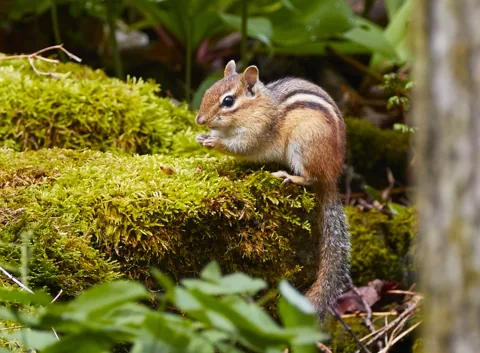 Eastern chipmunk
Tamias striatus
The eastern chipmunk is a small, striped ground squirrel that lives in woodland edges and around homes. Most problems are a nuisance, but many chipmunks burrowing near a house can undermine patios, stairs, retaining walls and foundations.
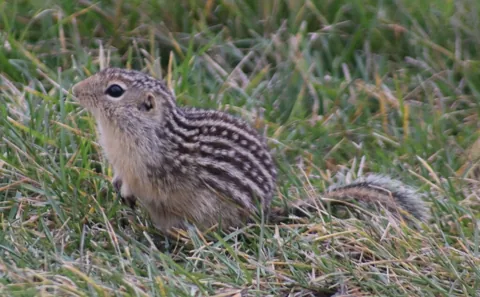 Thirteen-lined Ground Squirrel
Ictidomys tridecemlineatus (formerly Spermophilus tridecemlineatus)
The thirteen-lined ground squirrel is a small, striped ground squirrel of the Midwest and Great Plains that favors short-mown grass. It digs up newly planted seeds and raids vegetable gardens, but it also eats many crop-damaging insects.
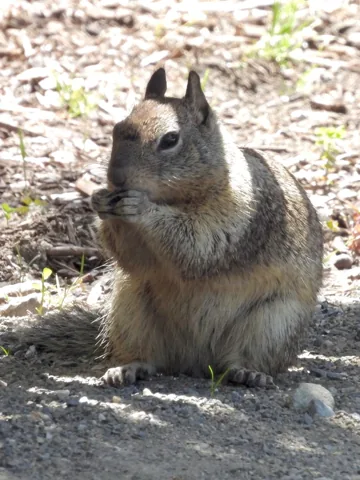 Ground Squirrels
Otospermophilus beecheyi and O. douglasii (California ground squirrel)
Ground squirrels are burrowing rodents that forage above ground near their tunnels. The California ground squirrel is the most common species around homes and gardens in the West, where its digging and feeding can do considerable damage. Los Angeles County's agricultural commissioner calls it the ground squirrel most likely to be met there; it is also known as the Beechey ground squirrel.
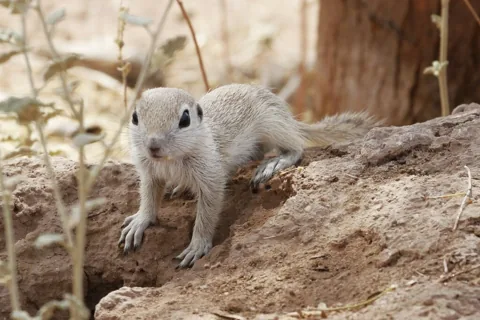 Round-tailed Ground Squirrel
Xerospermophilus tereticaudus (formerly Spermophilus tereticaudus)
The round-tailed ground squirrel is a small, social ground squirrel of the low desert that lives in colonies and digs burrows in flat, open, sandy ground, including desert yards. It can churn up gravel and plantings, and like other wild rodents in the Southwest it can carry fleas.
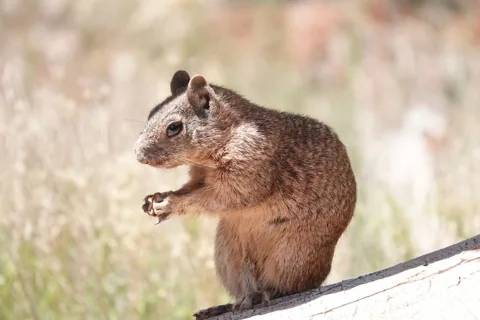 Rock Squirrel
Otospermophilus variegatus (formerly Spermophilus variegatus)
The rock squirrel is a large, heavy-bodied ground squirrel of the Southwest that digs open burrows around homes, gardens and orchards. It eats seeds, fruit and garden plants, its burrows can damage landscapes and structures, and, like other wild rodents in the West, it can carry fleas that spread plague.
No photo yet
Ground squirrel flea
Oropsylla montana
This is the flea behind the handful of plague cases the western United States records each year. It lives in the nests of ground squirrels, west of the Rockies, and it only bothers people when squirrels are abundant or dying. Researchers call it a moderately effective vector, which is the useful part: a bite is unlikely to transmit anything, but a burrow full of dead squirrels and hungry fleas is a situation worth backing away from.
Side by side
Which ground squirrel you are comparing depends on where you live. The eastern chipmunk covers most of the eastern US except the southeastern coast and Florida; the thirteen-lined ground squirrel is mainly a Midwest grassland species; the golden-mantled ground squirrel lives in western parks such as Yellowstone and Bryce Canyon, where Yellowstone finds it at all elevations; and the California ground squirrel ranges from northwestern Baja California through California, western Nevada and western Oregon into south central Washington.[2][8][13][19][16][15]
- Size: the eastern chipmunk's body is 5 to 6 inches long and it weighs about 3 ounces, with a 3 to 4 inch tail. Missouri Department of Conservation gives a total length of 8 to 12 inches and a weight of 2 to 5 ounces; NC Wildlife gives 8 to 10 inches including the tail. The least chipmunk of the West is smaller still, under 7 to 9 inches including the tail.[1][2][4][6][18]
- Size of the striped ground squirrels: ICWDM puts the thirteen-lined ground squirrel at about 10 inches including a 3-inch tail and about 8 ounces. Illinois Extension says it averages 11 inches with a 5-inch tail, and Minnesota DNR gives about 11 inches with a 4-inch tail and 5 to 9 ounces. Golden-mantled ground squirrels are 9 to 12 inches long, and Yellowstone gives 7.4 to 11 ounces.[8][12][13][16][19]
- Size of the California ground squirrel: 14 to 20 inches including the tail and 21 to 30 ounces, many times heavier than a chipmunk.[15][1]
- Weight changes with the season. Wildlife Illinois says thirteen-lined ground squirrels weigh 8 to 9 ounces in fall, much larger than a chipmunk, but only 4 to 5 ounces when they come out of hibernation in spring, which is close to a chipmunk's 2 to 5 ounces. Size alone is a weak clue in spring.[14][4][7]
- Face: chipmunks have conspicuous stripes on the cheeks. Rocky Mountain National Park says only the chipmunk has stripes on its face, and the least chipmunk has two stripes that mask its face. Bryce Canyon separates the Uinta chipmunk from the golden-mantled ground squirrel by the stripes around the chipmunk's eyes. On the thirteen-lined ground squirrel, light and dark stripes run along the top of the head and end between the eyes, and the cheeks are yellow or tan.[4][7][18][17][8]
- Back stripes: the eastern chipmunk has five dark stripes from shoulders to rump with buff or tan bands between them, ending at the reddish rump. The thirteen-lined ground squirrel's stripes run from head to rump, and Minnesota DNR counts seven dark stripes separated by six lighter ones, with yellowish squares or dots in them. The golden-mantled ground squirrel has two white side stripes bordered by black, and Yellowstone notes those stripes do not reach the sides of the head.[4][1][2][8][13][16][19]
- Fur without stripes: the California ground squirrel is mottled brown with white and gray markings on the back, has a white ring around each eye, erect ears and a tail that is somewhat bushy but less so than a tree squirrel's.[15]
- Tail: a chipmunk's tail is furred but not bushy, somewhat flattened and shorter than the body. When startled, ground squirrels hold the tail level along the ground as they run to the nearest burrow; chipmunks carry it upright.[4][7][1][2][9]
- Cheek pouches: both have them, so a full mouth doesn't tell you which you have. Chipmunks carry food and dug soil in furred cheek pouches, and Wildlife Illinois says all ground squirrels have internal cheek pouches; Yellowstone notes the golden-mantled ground squirrel uses them for food too.[1][5][7][14][19]
- Burrow openings: a chipmunk burrow entrance is about 2 inches across with no obvious mound of dirt, because the chipmunk carries the soil away in its cheek pouches. Thirteen-lined ground squirrel openings are also about 2 inches across, often hidden in vegetation and rarely with soil scattered in front, so the holes alone can look alike. California ground squirrel burrows are about 4 inches across, in colonies, and UC IPM mentions burrows and mounds that make lawns hard to mow.[1][3][9][15]
- Where you find them: eastern chipmunks favor woodland edges over deep forest and live around wood piles, ground cover and foundations, and they climb trees in fall to gather nuts, fruits and seeds. Thirteen-lined ground squirrels prefer grass that is cut low: lawns, golf courses, parks, athletic fields and cemeteries. Golden-mantled ground squirrels use rocky areas, meadow edges and forest openings.[4][1][3][9][10][14][19]
- Daily habits: thirteen-lined ground squirrels come above ground when the sun is high and the temperature is above 80 degrees F, go back down long before sundown, and rarely come out on damp or overcast days.[9]
- Winter: thirteen-lined ground squirrels begin hibernating in September or early October and come out between late March and early May in the north; Wildlife Illinois says they have been known to hibernate 250 days. Golden-mantled ground squirrels are true hibernators. Sources describe chipmunks differently: Penn State says they don't enter true hibernation and rely on food cached in the burrow, Rocky Mountain National Park says least chipmunks are in torpor and wake now and then to eat stored food, ICWDM says most eastern chipmunks emerge from torpor by early March, and Missouri Extension simply says they hibernate in winter.[9][14][16][19][1][18][3][5]
- Food: chipmunks mostly eat nuts, seeds and berries such as hickory nuts, acorns, beechnuts and walnuts, plus corn and wheat. Thirteen-lined ground squirrels eat grasshoppers and beetle and moth larvae, along with grasses, weeds and seeds. California ground squirrels are mainly plant eaters whose diet changes with the season.[4][9][12][15]
- Damage: in large numbers chipmunks can burrow under patios, stairs, retaining walls and foundations. Thirteen-lined ground squirrels burrow and feed in golf courses, parks, lawns, athletic fields, earthen dikes and cemeteries. California ground squirrels damage grains and nut and fruit trees, gnaw sprinkler heads, irrigation boxes and lines, and their burrows are a hazard to machinery.[1][10][15]
How to confirm which one it is
Get a side view of the head. A photo that shows the cheek is the most useful one: stripes through or around the eye mean chipmunk; a plain cheek with stripes only along the top of the head or none at all means ground squirrel.[18][17][8][19]
- Startle it and watch the tail. Tail straight up on the run fits a chipmunk; tail held flat and level fits a ground squirrel.[2][9]
- Check whether the pale stripes are broken into spots. Spots in rows along the back point to the thirteen-lined ground squirrel; Minnesota DNR calls them yellowish squares or dots.[8][13][14]
- Measure the burrow opening. About 2 inches fits a chipmunk or a thirteen-lined ground squirrel; about 4 inches, in a cluster of holes, fits the California ground squirrel.[1][9][15]
- Notice where it lives. A striped rodent at the edge of woods, under a deck or in a wood pile is more likely a chipmunk; one in short, open grass on a sunny day is more likely a thirteen-lined ground squirrel.[4][1][9]
Why it matters
Fences and screens differ. Penn State uses quarter-inch hardware cloth over bulbs and seeds and to close gaps chipmunks could enter. For thirteen-lined ground squirrels around gardens, Illinois Extension and Wildlife Illinois use hardware cloth 18 inches high and 6 inches into the ground.[1][12][7]
- Legal status differs by species and state. Penn State says chipmunks are not protected by federal law but are protected by the Pennsylvania Game Commission. Minnesota DNR says thirteen-liners are unprotected there. California classifies ground squirrels as nongame mammals that an owner or tenant can control when they injure crops or property, while some tree squirrels are game animals that need a permit. Check your state wildlife agency before trapping.[1][13][15]
- In California, UC IPM warns that some small protected ground squirrels and other endangered animals share the California ground squirrel's range, so it asks for proper identification before any control.[15]
- Disease risk is not the same everywhere. CDC says plague occurs naturally in parts of the western United States and cycles among wild rodents and their fleas, mainly in semi-arid upland forests and grasslands. People usually get it from the bite of an infected rodent flea or by handling an infected animal.[20][21]
If it's chipmunks
Move bird feeders 15 to 30 feet from buildings so spilled seed doesn't feed chipmunks next to the house.[1]
- Don't plant ground cover, shrubs and trees in an unbroken line from woods to the foundation, and keep wood piles and debris away from the house, where they also hide burrows.[1]
- Cover bulbs and seeds with quarter-inch hardware cloth and bury the cloth under soil. Seal openings into buildings with caulk or quarter-inch hardware cloth.[1]
- Taste repellents with Bitrex, thiram or ammonium soaps of higher fatty acids are labeled against squirrels for bulbs, seeds and ornamental foliage, not food crops, and need repeat applications.[1]
- Live traps or rat snap traps work if placed where chipmunks travel or feed; wire the doors open at first so they get used to the bait, and check traps daily.[5]
- For burrows under a patio or foundation, the step-by-step chipmunk guide covers exclusion and trapping in more detail.[1][3]
If it's ground squirrels
Thirteen-lined ground squirrels: put hardware cloth around garden beds 18 inches above ground and 6 inches below. Illinois Extension says rat-sized snap traps work when set near the hole and covered with a box to protect other wildlife, and live traps can be baited with seed.[12][7]
- Illinois Extension notes no repellents are registered for thirteen-lined ground squirrels in Illinois. ICWDM lists taste repellents with capsaicin, Bitrex or ammonium soaps of fatty acids for bulbs, seeds and foliage, says they usually don't stop all damage, and tells you to check state pesticide rules first.[12][11]
- Keep feeders out of reach: ICWDM advises modifying bird feeders so rodents can't get to them.[11]
- California ground squirrels: UC IPM's Pest Note covers trapping, burrow fumigation and treated-grain baits. Before using any pesticide, read the label for restrictions tied to endangered species in your area.[15]
- In plague areas, CDC advises clearing brush, rock piles, junk and cluttered firewood, removing pet and wild animal food, and rodent-proofing buildings. Use a repellent with DEET on skin and permethrin on clothing if you could be exposed to fleas outdoors.[22]
- CDC says sudden illness or death among wild rodents such as squirrels could indicate plague activity. Wear gloves if you must handle an animal that could be infected, and contact your local health department with questions about disposing of dead animals.[20][22]
Pets and plague
The Merck Veterinary Manual says plague bacteria are maintained between rodents, including chipmunks, squirrels and prairie dogs, and their fleas, and that when rodents die off their fleas look for other hosts, including cats, dogs and humans.[23]
- Merck says cats most often get the bubonic form, with high fever, lethargy, loss of appetite and swollen lymph nodes, and that dogs are less likely than cats to get sick.[23]
Common questions
- Is a chipmunk a ground squirrel?
- Yes. Missouri Department of Conservation calls the eastern chipmunk a small, ground-dwelling squirrel, and Wildlife Illinois calls it the state's smallest ground squirrel. In everyday use, ground squirrel means the larger relatives such as the thirteen-lined, golden-mantled and California ground squirrels.[4][7][14]
- What is the striped squirrel with spots in my lawn?
- Most likely a thirteen-lined ground squirrel. Its light stripes break into rows of spots, it prefers short grass such as lawns and golf courses, and it runs with its tail held flat.[8][9][13]
- The animal has stripes on its sides but not its face. Is it a chipmunk?
- Probably not. That pattern fits the golden-mantled ground squirrel of the West, which Yellowstone and Rocky Mountain National Park say is often mistaken for a chipmunk but is larger and has no stripes on its head.[19][18][16]
- Can I tell them apart by the burrow?
- Only sometimes. Chipmunk and thirteen-lined ground squirrel holes are both about 2 inches across with little or no dirt around them. A 4-inch hole in a colony of burrows fits the California ground squirrel.[1][9][15]
- Do chipmunks or ground squirrels carry plague?
- CDC says plague cycles among wild rodents and their fleas in parts of the western United States, and that sudden deaths among squirrels could indicate plague activity. The Merck Veterinary Manual lists chipmunks as well as squirrels among the rodents involved. In the West, keep away from burrows and dead rodents and protect yourself from fleas.[20][21][22][23]
Photo credits
- Eastern chipmunk: David Bird, public domain (CC0), via iNaturalist
- Thirteen-lined Ground Squirrel: (c) Sean Frey, some rights reserved (CC BY) — via iNaturalist, CC BY 4.0
- Ground Squirrels: (c) Rudyard, some rights reserved (CC BY) — via iNaturalist, CC BY 4.0
- Round-tailed Ground Squirrel: (c) Xochitl Zambrano, some rights reserved (CC BY) — via iNaturalist, CC BY 4.0
- Rock Squirrel: (c) Jacob Saucier, some rights reserved (CC BY) — via iNaturalist, CC BY 4.0
Sources
- Penn State Extension, “Chipmunks.” extension.psu.edu/chipmunks (accessed 2026-11-14)
- Internet Center for Wildlife Damage Management, “Chipmunks.” icwdm.org/species/rodents/chipmunks/ (accessed 2026-11-14)
- Internet Center for Wildlife Damage Management, “Chipmunk Biology.” icwdm.org/species/rodents/chipmunks/chipmunk-biology/ (accessed 2026-11-14)
- Missouri Department of Conservation, “Eastern Chipmunk (Field Guide).” mdc.mo.gov/discover-nature/field-guide/eastern-chipmunk (accessed 2026-11-14)
- University of Missouri Extension, “Controlling Chipmunk Damage (G9527).” extension.missouri.edu/media/wysiwyg/Extensiondata/Pub/pdf/agguides/wildlife/g09527.pdf (accessed 2026-11-14)
- North Carolina Wildlife Resources Commission, “Eastern Chipmunk.” www.ncwildlife.gov/species/eastern-chipmunk (accessed 2026-11-14)
- Wildlife Illinois (University of Illinois Extension), “Chipmunk.” wildlifeillinois.org/identify-wildlife/chipmunk/ (accessed 2026-11-14)
- Internet Center for Wildlife Damage Management, “Thirteen-lined Ground Squirrels.” icwdm.org/species/rodents/thirteen-lined-ground-squirrels/ (accessed 2026-11-14)
- Internet Center for Wildlife Damage Management, “Thirteen-lined Ground Squirrel Biology.” icwdm.org/species/rodents/thirteen-lined-ground-squirrels/thirteen-lined-ground-squirrel-biology/ (accessed 2026-11-14)
- Internet Center for Wildlife Damage Management, “Thirteen-lined Ground Squirrel Damage Identification.” icwdm.org/species/rodents/thirteen-lined-ground-squirrels/thirteen-lined-ground-squirrel-damage-identification/ (accessed 2026-11-14)
- Internet Center for Wildlife Damage Management, “Thirteen-lined Ground Squirrel Prevention and Control Methods.” icwdm.org/species/rodents/thirteen-lined-ground-squirrels/thirteen-lined-ground-squirrel-prevention-and-control-methods/ (accessed 2026-11-14)
- University of Illinois Extension, “Managing thirteen-lined ground squirrel.” extension.illinois.edu/blogs/good-growing/2022-10-14-managing-thirteen-lined-ground-squirrel (accessed 2026-11-14)
- Minnesota Department of Natural Resources, “Thirteen-lined ground squirrel.” www.dnr.state.mn.us/mammals/thirteenlinedgroundsquirrel.html (accessed 2026-11-14)
- Wildlife Illinois (University of Illinois Extension), “Ground Squirrels.” wildlifeillinois.org/identify-wildlife/ground-squirrels/ (accessed 2026-11-14)
- University of California Statewide IPM Program, “Pest Notes: Ground Squirrel.” ipm.ucanr.edu/legacy_assets/PDF/PESTNOTES/pngroundsquirrel.pdf (accessed 2026-11-14)
- National Park Service, Bryce Canyon National Park, “Golden-mantled Ground Squirrel.” www.nps.gov/brca/learn/nature/groundsquirrel.htm (accessed 2026-11-14)
- National Park Service, Bryce Canyon National Park, “Uintah Chipmunk.” www.nps.gov/brca/learn/nature/uchipmunk.htm (accessed 2026-11-14)
- National Park Service, Rocky Mountain National Park, “Squirrels and Chipmunks.” www.nps.gov/romo/learn/nature/squirrel_chipmunk.htm (accessed 2026-11-14)
- National Park Service, Yellowstone National Park, “Golden-mantled Ground Squirrel.” www.nps.gov/yell/learn/nature/golden-mantled-ground-squirrel.htm (accessed 2026-11-14)
- Centers for Disease Control and Prevention, “About Plague.” www.cdc.gov/plague/about/index.html (accessed 2026-11-14)
- Centers for Disease Control and Prevention, “How Plague Spreads.” www.cdc.gov/plague/causes/index.html (accessed 2026-11-14)
- Centers for Disease Control and Prevention, “Preventing Plague.” www.cdc.gov/plague/prevention/index.html (accessed 2026-11-14)
- Merck Veterinary Manual, “Plague in Animals.” www.merckvetmanual.com/generalized-conditions/plague/plague-in-animals (accessed 2026-11-14)