The short answer
- Time of the noise: rats are mostly active at night, and roof rats are often first noticed as scurrying in the attic when the house is quiet. Gray, fox and red squirrels are active by day, mostly early morning and late afternoon. The exception is the flying squirrel, which is nocturnal and the most common squirrel in attics in Virginia.[5][2][7][11][8][14]
- Droppings: rat droppings are dark, about ½ to ¾ inch long, pointed on the roof rat and blunt on the larger Norway rat. Flying squirrels leave urine and feces that stain, often below the vent they use.[6][7][1][9]
- Entry hole: rats can squeeze under a door through a 1/2-inch gap. Squirrels use bigger, chewed holes: about baseball size for gray and fox squirrels, golf-ball size for red squirrels and quarter size for flying squirrels.[5][9]
- Squirrels are wildlife under state law, so check your state wildlife agency's rules before trapping, and never seal a hole while young are inside. Rats are controlled by sealing every gap and trapping inside.[15][16][10][19]
Animals on this page
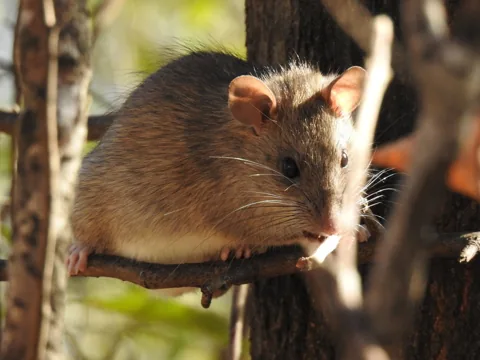 Roof Rat
Rattus rattus
The roof rat, also called the black or ship rat, is a sleek, agile climber that nests above ground in trees, ivy, attics and wall voids.
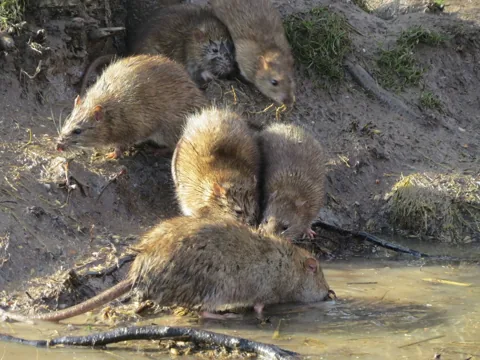 Norway Rat
Rattus norvegicus
The Norway rat, also called the brown or sewer rat, is a large, burrowing rat found throughout the contiguous United States wherever people live.
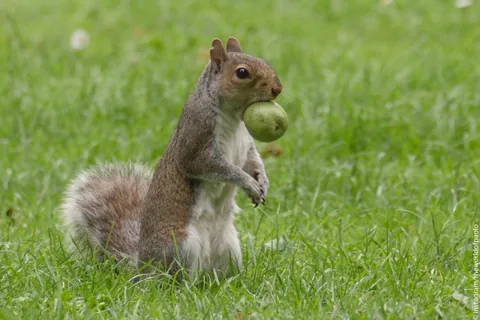 Tree squirrels (eastern gray and fox squirrels)
Sciurus species (shown: eastern gray squirrel, S. carolinensis)
Tree squirrels such as the eastern gray squirrel and fox squirrel are bushy-tailed, daytime rodents. Around homes they raid fruit, nuts and bird feeders, dig up lawns and gardens, and chew their way into attics.
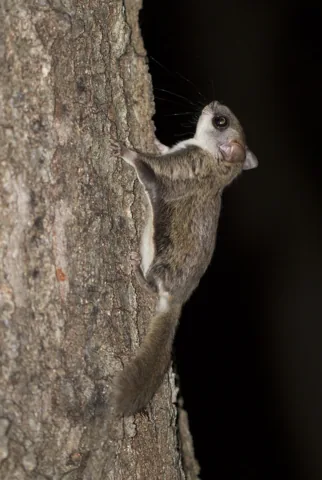 Southern flying squirrel
Glaucomys volans
The southern flying squirrel is a small, night-active squirrel that glides between trees on folds of skin. Most complaints come from homeowners with flying squirrels living in the house, where they get in through small holes around dormers, ridge vents, eaves and attic vents.
Side by side
The rats you hear in attics are usually roof rats, which prefer to nest off the ground in attics, wall voids, false ceilings and cabinets. Norway rats usually nest in burrows at or below ground, and when both live in one building, Norway rats tend to be in the basement and ground floors and roof rats on the upper floors.[5][1][3][7]
- Rat size: roof rats are sleek, with a body of 6 to 8 inches and a tail longer than the head and body. UC IPM gives roof rats 5 to 10 ounces and the heavier Norway rat 7 to 18 ounces, with a blunt muzzle and a shorter tail.[1][5][6]
- Squirrel size: Penn State gives the eastern gray squirrel 16 to 24 inches and 15 to 24 ounces with a bushy tail. Flying squirrels are much smaller, between 8 and 10 inches and 1.3 and 4 ounces, with soft gray-brown fur, large dark eyes, a flat tail and loose folds of skin between the legs for gliding.[12][13][11]
- Time of activity, rats: UC IPM says rats are mostly active at night, and ICWDM says Norway rats become active around dusk. Arizona extension says roof rats are nocturnal and start to roam at twilight. Rats seen in daytime can mean a large population.[5][3][7][4]
- Time of activity, squirrels: ICWDM and UC IPM say tree squirrels are active by day, most active in early morning and late afternoon, and don't hibernate. Flying squirrels are active at night, which Connecticut DEEP says is why they are seldom seen.[8][11][13][12]
- Sounds: rats make gnawing, climbing in walls, clawing, squeaks and fighting noises, and NC State describes periodic scratching and rustling from movement, feeding and nesting. ICWDM notes noisy mating chases among squirrels in breeding season, and Virginia's wildlife agency suggests a radio playing talk or loud music in the attic may encourage squirrels to leave.[4][6][8][14]
- Droppings, rats: NC State says rat droppings are roughly ½ to ¾ of an inch long, cylindrical and dark when fresh, and that rats produce between 30 and 50 droppings a day. Arizona extension gives roof rat droppings as black, banana-shaped and pointed, ¼ to ½ inch long, and Norway rat droppings as blunt-ended and ¾ to 1 inch; ICWDM gives roof rat droppings as about 1/2 inch with pointed ends.[6][7][1]
- Droppings can mislead. Arizona extension says identifying rat species from droppings alone is not reliable, and ICWDM says roof rats living overhead may leave little sign on the floor. Arizona suggests looking for smudge marks left by oil and dirt from their fur as well.[7][2]
- Droppings, squirrels: ICWDM says flying squirrel feces mixed with urine can cause stains, and shows urine and feces below an attic vent where flying squirrels were leaving the home.[9]
- Entry holes and gnawing, rats: UC IPM says rats, especially young ones, can squeeze beneath a door with only a 1/2-inch gap and will gnaw a wooden door to enlarge it. NC State says they chew wood, plastic, wires, insulation and even some metal.[5][6]
- Entry holes and gnawing, squirrels: ICWDM says fox and gray squirrels use holes the size of a baseball, red squirrels a golf ball and flying squirrels a quarter. Penn State says squirrels chew siding and under the eaves to make openings, and Connecticut DEEP says flying squirrels get in through small holes around dormers, ridge vents, eaves and attic vents.[9][12][13][11]
- Nests: ICWDM says roof rats in a residence may tear up insulation for nesting, and NC State shows a rat nest in an open attic. Squirrels build leaf nests of sticks and dry leaves, and ICWDM shows a pile of leafy debris as a gray squirrel nest in a building soffit.[2][6][8][12]
- Wiring: both chew wires. UC IPM says roof rats in an attic may cause electrical sparks and fires from gnawing and nest building, and ICWDM says squirrels chew electrical lines, leading to fires, and given enough time can weaken rafters.[5][6][9]
Season: when each moves in and has young
Squirrels: fox and gray squirrels breed in mid-December or early January, and some breed again in June. ICWDM says young may be present from February through August.[12][8][10]
- Flying squirrels: Connecticut DEEP says mating occurs in late winter with a second breeding period in summer.[13]
- Rats: ICWDM says roof rat breeding usually peaks in spring and fall and may run nearly year-round in warm regions. Arizona extension says roof rats there are far more active in the cooler months, November through May.[1][7]
How to confirm which one you have
Listen at different hours. Daytime scurrying points to gray, fox or red squirrels. Noise after dark points to rats or flying squirrels.[11][8][5][2]
- Look in the attic with a flashlight. Arizona extension suggests looking for droppings, and for roof rats, smudge marks up high where they travel. ICWDM recommends a nighttime search with a powerful flashlight to spot rats and their travel routes.[7][2]
- Walk around the outside of the house. A chewed hole the size of a baseball or golf ball under the eaves or in siding points to squirrels; a quarter-size hole near a vent can be flying squirrels; small gaps around pipes and doors fit rats.[9][12][5]
- Watch the entry at dusk. Roof rats are often seen at night running along utility lines and fence tops, and Arizona extension says people mostly see them at twilight.[5][7]
- Don't handle droppings with bare hands or sweep them up to look closely; see the cleanup steps below.[18]
Why the difference matters
Squirrels are regulated wildlife. In New York, DEC lists rats (except the Allegheny woodrat), red squirrels and flying squirrels as animals a landowner may take when they are a nuisance, but a DEC permit is needed to take a gray, black or fox squirrel that is only a nuisance rather than damaging property. New York also bars moving a trapped animal off your property.[15]
- Pennsylvania's Game Commission says landowners should contact the region office before trapping nuisance wildlife, live wildlife may not be kept, sold or given away, and any wildlife killed must be reported.[16]
- Virginia says no kill permit is needed from the state when landowners kill squirrels for their own use during the closed season, but sends you to the local Commonwealth's Attorney for legal removal methods and notes local ordinances are usually stricter. Missouri's Department of Conservation does not recommend relocating trapped animals.[14][17]
- Young squirrels change the timing. ICWDM says to avoid abandoning young, which may be present from February through August, and the Pennsylvania Game Commission advises letting young leave a maternity den, a good bet being to wait until fall, before excluding.[10][16]
- The holes are different sizes. Rats get through gaps squirrels can't, so sealing for rats means closing every small opening, not just the one chewed hole.[5][19][9]
What to do for each
Squirrels: confirm no young are inside, then let the squirrels out with a one-way door or an 18-inch section of 4-inch plastic pipe over the hole, pointing down at a 45° angle. Secure vents and chimneys first. ICWDM suggests a spring-loaded one-way door with a large apron, at least 1-foot square, around the hole to reduce chew-ins.[10][12]
- Squirrels: don't lock one inside. Penn State suggests placing traps inside as a precaution after closing openings, and Connecticut DEEP warns that adults may cause severe damage chewing back in to reach young, and suggests heavy, half-inch wire mesh if chewing persists. Virginia suggests plugging the hole with wire mesh or metal sheeting once they're out.[12][13][14]
- Rats: seal every gap. CDC says to fill small holes with steel wool held in with caulk or spray foam, and to use lath screen, metal, cement, hardware cloth or metal sheeting for larger holes, including around pipes and utility lines.[19][5]
- Rats: trap inside. In an attic, set traps along the routes and near droppings and gnawing, and see our snap trap guide for placement.[5][6]
- Both: trim back tree limbs and vines that reach the roof. Roof rats travel utility lines and fence tops, and Connecticut DEEP says pruning overhanging limbs may discourage squirrels.[5][13][10]
Health and cleanup
CDC says diseases are mainly spread to people from rodents when they breathe in contaminated air, so don't vacuum or sweep rodent urine, droppings or nesting material. Follow CDC's wet-cleaning steps instead.[18]
- CDC says rare cases of epidemic typhus (sylvatic typhus) in the United States happen when people are exposed to flying squirrels and their nests, and advises avoiding contact with flying squirrels and their nests. Tell your healthcare provider about any contact if you get sick.[20]
- CDC notes fleas are common on rodents and suggests an EPA-registered repellent on clothing, shoes and hands while picking up dead rodents and cleaning nesting material.[18]
Common questions
- Is it rats or squirrels if I only hear it at night?
- Most likely rats or flying squirrels. Gray, fox and red squirrels are active by day; flying squirrels and rats are active at night. Check the size of the entry hole and the droppings to separate them.[5][8][11][9]
- Can I tell rat droppings from squirrel droppings?
- Rat droppings are dark and about ½ to ¾ inch long, pointed on roof rats and blunt on Norway rats. Our sources don't give a size for squirrel droppings, but ICWDM notes flying squirrel urine and feces stain surfaces near where they exit.[6][7][9]
- Can I just trap and release a squirrel somewhere else?
- Often not. New York bars moving a trapped animal off your property, Missouri doesn't recommend relocation, and Pennsylvania wants you to contact the Game Commission region office before trapping. Check your state wildlife agency.[15][17][16]
- Will a one-way door work for rats?
- The sources here describe one-way doors for squirrels. For rats, they recommend sealing every gap with metal and steel wool and trapping inside.[10][19][5]
Photo credits
- Roof Rat: (c) Laura Mae, some rights reserved (CC BY) — via iNaturalist, CC BY 4.0
- Norway Rat: petehawkins, public domain (CC0), via iNaturalist
- Tree squirrels (eastern gray and fox squirrels): (c) Paolo Zucca, some rights reserved (CC BY) — via iNaturalist, CC BY 4.0
- Southern flying squirrel: (c) Kristof & Yulia, some rights reserved (CC BY) — via iNaturalist, CC BY 4.0
Sources
- Internet Center for Wildlife Damage Management (ICWDM), “Roof Rat Biology.” icwdm.org/species/rodents/roof-rats/roof-rat-biology/ (accessed 2026-11-14)
- Internet Center for Wildlife Damage Management (ICWDM), “Roof Rat Damage Identification.” icwdm.org/species/rodents/roof-rats/roof-rat-damage-identification/ (accessed 2026-11-14)
- Internet Center for Wildlife Damage Management (ICWDM), “Norway Rat Biology.” icwdm.org/species/rodents/norway-rats/norway-rat-biology/ (accessed 2026-11-14)
- Internet Center for Wildlife Damage Management (ICWDM), “Norway Rat Damage Identification.” icwdm.org/species/rodents/norway-rats/norway-rat-damage-identification/ (accessed 2026-11-14)
- University of California Statewide IPM Program, “Pest Notes: Rats.” ipm.ucanr.edu/home-and-landscape/rats/ (accessed 2026-11-14)
- NC State Extension, “Surveillance and Management of Common Structure-Invading Rats.” content.ces.ncsu.edu/surveillance-and-management-of-common-structure-invading-rats (accessed 2026-11-14)
- University of Arizona Cooperative Extension, “AZ1775: Roof Rats: Identification, Ecology, and Signs.” extension.arizona.edu/sites/extension.arizona.edu/files/pubs/az1775-2018.pdf (accessed 2026-11-14)
- Internet Center for Wildlife Damage Management (ICWDM), “Tree Squirrel Biology.” icwdm.org/species/rodents/tree-squirrels/tree-squirrel-biology/ (accessed 2026-11-14)
- Internet Center for Wildlife Damage Management (ICWDM), “Tree Squirrel Damage Identification.” icwdm.org/species/rodents/tree-squirrels/tree-squirrel-damage-identification/ (accessed 2026-11-14)
- Internet Center for Wildlife Damage Management (ICWDM), “Tree Squirrel Damage Prevention and Control Methods.” icwdm.org/species/rodents/tree-squirrels/tree-squirrel-damage-prevention-and-control-methods/ (accessed 2026-11-14)
- University of California Statewide IPM Program, “Pest Notes: Tree Squirrels.” ipm.ucanr.edu/home-and-landscape/tree-squirrels/ (accessed 2026-11-14)
- Penn State Extension, “Tree Squirrels.” extension.psu.edu/tree-squirrels (accessed 2026-11-14)
- Connecticut Department of Energy and Environmental Protection, Wildlife Division, “Flying Squirrels (Wildlife in Connecticut Informational Series).” portal.ct.gov/-/media/deep/wildlife/pdf_files/outreach/fact_sheets/flysqrlpdf.pdf (accessed 2026-11-14)
- Virginia Department of Wildlife Resources, “Problems with Squirrels.” dwr.virginia.gov/wildlife/nuisance/squirrels/ (accessed 2026-11-14)
- New York State Department of Environmental Conservation, “Remove or Take Nuisance Animals Legally.” dec.ny.gov/nature/animals-fish-plants/nuisance-wildlife-species/remove-take-legally (accessed 2026-11-14)
- Pennsylvania Game Commission, “Nuisance Wildlife.” www.pgc.pa.gov/Wildlife/Pages/NuisanceWildlife.aspx (accessed 2026-11-14)
- Missouri Department of Conservation, “Wildlife Control Guidelines.” mdc.mo.gov/wildlife/nuisance-problem-species/wildlife-control-guidelines (accessed 2026-11-14)
- U.S. Centers for Disease Control and Prevention, “How to Clean Up After Rodents.” www.cdc.gov/healthy-pets/rodent-control/clean-up.html (accessed 2026-11-14)
- U.S. Centers for Disease Control and Prevention, “How to Seal Up to Prevent Rodents.” www.cdc.gov/healthy-pets/rodent-control/seal-up.html (accessed 2026-11-14)
- U.S. Centers for Disease Control and Prevention, “About Epidemic Typhus.” www.cdc.gov/typhus/about/epidemic.html (accessed 2026-11-14)