The short answer
- Belly and tail edge: on an eastern gray squirrel the belly and the fringe of the tail are white. On a fox squirrel they are reddish yellow to orange.[5][10][13][16][14]
- Size: the fox squirrel is the bigger, heavier animal. Missouri's wildlife agency gives up to 29 inches nose to tail for the fox squirrel and up to 21 inches for the gray.[5][1][15][9]
- Back color alone can fool you: gray squirrels can be reddish, black or white, and fox squirrels come in many color forms, including black ones with white noses and ear tips.[1][5][15][16]
- Damage and attic signs are the same for both: chewed baseball-size holes, nests of leaves and insulation, digging in lawns and gardens, and noise in daylight rather than at night.[3][10][8][2]
Squirrels on this page
 Tree squirrels (eastern gray and fox squirrels)
Sciurus species (shown: eastern gray squirrel, S. carolinensis)
Tree squirrels such as the eastern gray squirrel and fox squirrel are bushy-tailed, daytime rodents. Around homes they raid fruit, nuts and bird feeders, dig up lawns and gardens, and chew their way into attics.
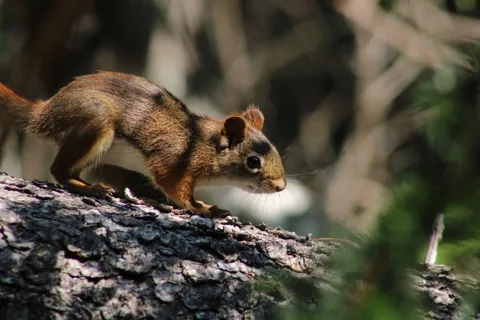 American red squirrel (pine squirrel)
Tamiasciurus hudsonicus
The American red squirrel is a small, rusty-red tree squirrel of conifer and mixed forests across the North and in the mountains. It is noisy and territorial, and it can move into attics and other parts of buildings, sometimes filling them with stored pine cones.
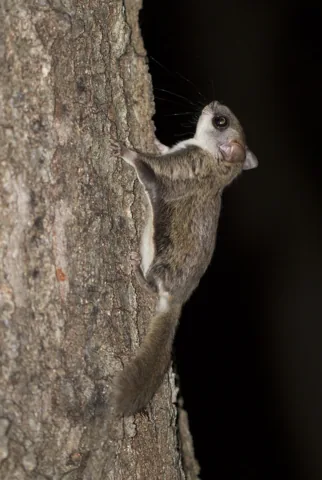 Southern flying squirrel
Glaucomys volans
The southern flying squirrel is a small, night-active squirrel that glides between trees on folds of skin. Most complaints come from homeowners with flying squirrels living in the house, where they get in through small holes around dormers, ridge vents, eaves and attic vents.
Side by side
Both are tree squirrels in the genus Sciurus: the eastern gray squirrel is Sciurus carolinensis and the eastern fox squirrel is Sciurus niger. Wildlife agencies tell them apart mainly by the color of the belly and tail fringe and by size.[5][7][1]
- Length of a fox squirrel: ICWDM gives 18 to 27 inches from nose to tail tip, Missouri Department of Conservation 19 to 29 inches, Indiana DNR 17 to 28 inches, and Wildlife Illinois 19½ to 22 inches.[1][5][16][9]
- Length of a gray squirrel: ICWDM gives 16 to 20 inches, Missouri Department of Conservation 14 to 21 inches, Penn State 16 to 24 inches, and Wildlife Illinois 17¼ to 18¼ inches.[1][5][7][9]
- Weight: fox squirrels weigh 1¾ to 2¼ pounds by ICWDM's figures, 1.9 to 2.2 pounds per Penn State and 1 to 3 pounds per Missouri. Gray squirrels weigh 1¼ to 1¾ pounds per ICWDM, 15 to 24 ounces per Penn State and ¾ to 1½ pounds per Missouri. North Carolina's wildlife agency calls the fox squirrel nearly twice the size of the gray.[1][7][5][15]
- Belly: white on the gray squirrel, according to Missouri, Penn State and Connecticut DEEP. The fox squirrel's belly is reddish yellow (Missouri), orange (Texas Parks and Wildlife), orange-brown (Indiana DNR) or red-orange (Texas A&M AgriLife); Penn State describes it as tan.[5][7][10][13][16][14]
- Tail: the gray squirrel's tail has a white fringe. The fox squirrel's tail fringe is reddish yellow, and Texas sources describe the tail as cinnamon or cinnamon mixed with black.[5][13][14]
- Back: gray squirrels are usually silver-gray on the back and sides. Fox squirrels are usually a grizzled mix of reddish yellow, brown, black and gray, which Missouri sums up as gray for one and reddish yellow for the other.[5][10][16][13][1]
- Build: Missouri describes the gray squirrel as slender and the fox squirrel as heavy-bodied. Penn State says the fox squirrel is larger but has the same body shape.[5][7]
- Habitat: in Missouri, gray squirrels are more common in bottomland forest with a bushy understory and fox squirrels on higher ridges, farm woodlots and timbered fence rows. ICWDM says Midwest fox squirrels favor farm woodlots while grays use larger forest blocks, and in the Southeast fox squirrels are tied to mature pine forests.[5][2][15]
- Open country: fox squirrels do well in open, park-like woods. Texas Parks and Wildlife says they are most numerous in open upland forest, and Indiana DNR says that before settlement they lived only in savanna along the prairie edge in the northwest of the state, then spread as timber was cut and land farmed.[13][16][14]
- Towns: both live in cities and suburbs. Gray squirrels are often found in great numbers in parks, and Penn State says urban backyards have become prime gray squirrel habitat. In California, introduced eastern fox squirrels are well established in most major cities.[2][7][10][8][5]
- Range: fox squirrels occur in much of the eastern and central U.S. and in several western places where they were introduced. Eastern gray squirrels share much of that range but are absent from many western parts of the fox squirrel's range.[1][8]
- Time on the ground: UC IPM says the fox squirrel spends considerable time foraging on the ground, and Indiana DNR says it spends more time on the ground than other tree squirrels.[8][16]
- Breeding: both breed in mid-December or early January, and some breed again in early summer. Missouri says fox squirrels begin breeding 10 days to 2 weeks earlier than grays.[2][5][7]
Black, white and odd-colored squirrels
Coat color varies so much in both species that the back alone is not a reliable guide. Look at the belly and the edge of the tail instead.[1][5][7]
- Gray squirrels: black individuals are common in northern parts of the range and can turn up in the same litter as gray ones. Some grays have a reddish cast, and local populations of white gray squirrels exist in places such as western North Carolina and upstate New York.[1][5][9]
- White gray squirrels are not albinos: ICWDM notes they still have gray on the back of the head, neck or shoulders. True albinos also occur occasionally.[1][5]
- Fox squirrels: ICWDM counts at least 12 or 13 color varieties. In North Carolina's Sandhills and Coastal Plain they are grayish with black on the head and feet and white on the nose, paws and ear tips; some are nearly all black.[1][15]
- Indiana DNR notes black fox squirrels with white undersides, and fox squirrels with white ears and nose or a white tail.[16]
Attic, yard and garden damage
The two species eat the same foods and cause the same kinds of damage, so for a homeowner the plan is largely the same. Which one you see more often depends on where you live: Penn State says gray and flying squirrels are usually the culprits in Pennsylvania, where fox squirrels are rare, while UC IPM calls the introduced eastern fox squirrel by far the most serious tree squirrel pest of homes and gardens in California.[7][8]
- Attics and buildings: they get in through gaps, broken vent screens and eaves. ICWDM says fox and gray squirrels use holes about the size of a baseball, and Missouri notes chewing on decks, siding, fencing and wiring.[3][6][8][10]
- Signs indoors: Connecticut DEEP says gnawing, scratching and pattering in early morning or daylight usually signals squirrels, and balls of torn insulation, cardboard, leaves and twigs may mark a nest.[10]
- Lawns and beds: both bury nuts one at a time around their range, and digging to bury or recover them tears up lawns, mostly in fall. They also dig up and eat flower bulbs and newly planted seeds.[2][8][3][6]
- Vegetables and fruit: Missouri lists sweet corn and tomatoes; UC IPM adds strawberries, nuts such as almonds and walnuts, and tree fruits including oranges, avocados, apples and apricots.[6][8]
- Trees: both chew bark, and UC IPM says squirrels strip bark to feed on the inner layer. ICWDM notes fox squirrels damaging loblolly and other pines in the Southeast.[3][8][2]
- Bird feeders and houses: squirrels take food meant for birds and sometimes enlarge bird house openings to eat nestlings.[3][18]
How to confirm which one you have
Both are active in daylight, most of all in early morning and late afternoon, so you can usually get a look at the animal itself.[8][13][14]
- Check the underside: the belly and the fringe along the tail edges are white on a gray squirrel and orange to reddish yellow on a fox squirrel.[5][10][13][16]
- Judge size against the other squirrels in your yard if both occur there; the fox squirrel is noticeably bigger and heavier.[5][15][1]
- Time of day: Indiana DNR says fox squirrels are typically more active in late morning and midday than gray squirrels. Texas sources say fox squirrels are usually active early in the morning and late in the afternoon, so treat timing as a weak clue.[16][13][14]
- Rule out the smaller attic squirrels: night-time noise points to flying squirrels, which are the only squirrels active at night, and a hole the size of a golf ball or a quarter points to red or flying squirrels rather than either big tree squirrel.[2][3][12]
Other attic squirrels: red and flying squirrels
Two smaller tree squirrels also move into houses. They are easy to tell from fox and gray squirrels by size alone.[7][1]
- Red squirrel: red-brown above and white below, often with a black side stripe and small ear tufts in winter. Penn State gives 9 to 13 inches and 4 to 8 ounces; Connecticut DEEP gives 11 to 14 inches and about 7 ounces. Red squirrels store food in one place, and ICWDM says trash-bag-sized piles of pine cones in attics or gutters are not unusual.[7][11][2][9]
- Flying squirrels: small, with large dark eyes and a gliding fold of skin, and active only at night. Virginia's wildlife agency says they are the most common squirrels in attics there.[12][18][2]
- Legal difference: in New York, red and flying squirrels may be taken when they are a nuisance, but a DEC permit is needed for gray, black and fox squirrels that are only a nuisance.[19]
Why the species matters
Exclusion works the same way for both, but the law may not treat them the same. ICWDM says fox and gray squirrels are classified as game animals in most states, so trapping permits may be required; rules vary, so check with your state wildlife agency before trapping or killing either one.[4][1]
- California: tree squirrels are game mammals, but UC IPM says eastern fox squirrels injuring crops or other property may be controlled by the owner or tenant without a permit. Gray squirrels need a California Department of Fish and Wildlife permit.[8]
- Missouri: both are game mammals, but the Missouri Department of Conservation says damage-causing squirrels may be shot or trapped out of season without a permit, under the rules in its Wildlife Code.[6]
- New York: DEC requires a permit to take a gray, black or fox squirrel that is only a nuisance.[19]
- Moving squirrels: Missouri does not recommend relocating trapped animals, because it can spread disease and a strange squirrel dropped into an established group can upset its social order.[17]
What to do for either squirrel
The same steps work on both species. For the full attic plan, including one-way doors, birthing seasons and state trapping rules, see our guide to squirrels in the attic.[4][6][10]
- Cut off roof access: trim trees next to the house so squirrels cannot jump onto the roof, and trim shrubs and vines.[6][10]
- Collar isolated trees and poles: Missouri suggests a two-foot-wide band of smooth metal 6 feet above the ground, attached with wire and springs so the tree can grow.[6]
- Seal entry holes only when no squirrels are inside. Connecticut DEEP warns that adults can do severe damage chewing back in to reach their young.[10][4]
- Use one-way doors on a sound structure: ICWDM says they work best when the rest of the house is sealed, and that fox and gray squirrels are harder to exclude than flying and red squirrels because of their stronger jaws.[4]
- Feeders: Virginia's wildlife agency suggests hanging feeders on a wire between two trees with rotating tubes on the wire, or using safflower seed, which squirrels tend to avoid.[18]
Health
CDC says people can catch tularemia through contact with infected animals, especially rodents, rabbits and hares, and advises gloves when handling rodents.[20][21]
- Rabies: the Wisconsin Department of Health Services says small rodents, squirrels included, are rarely found infected with rabies and have not been known to pass it to people. After a bite, talk to your state or local health department.[22]
Common questions
- Are fox squirrels and gray squirrels the same species?
- No. The eastern gray squirrel is Sciurus carolinensis and the eastern fox squirrel is Sciurus niger, two species in the same genus.[5][7]
- Which is bigger, a fox squirrel or a gray squirrel?
- The fox squirrel. ICWDM gives 18 to 27 inches and 1¾ to 2¼ pounds for fox squirrels against 16 to 20 inches and 1¼ to 1¾ pounds for eastern gray squirrels.[1]
- Is a black squirrel a fox squirrel or a gray squirrel?
- Either. Black gray squirrels are common in the north and can share a litter with gray ones; fox squirrels are occasionally all black too. Indiana DNR describes black fox squirrels with white undersides.[1][5][16]
- Do fox squirrels do more damage than gray squirrels?
- Their damage is the same kind. Which one causes more problems depends on the region: UC IPM names the fox squirrel the worst tree squirrel pest in California, while Penn State says gray and flying squirrels are usually the culprits in Pennsylvania.[8][7][3]
- Can I trap a fox or gray squirrel in my attic?
- Possibly, but both are game animals in most states, so a permit may be needed. Rules differ by state; check with your state wildlife agency first.[4][1][6][19]
Photo credits
- Tree squirrels (eastern gray and fox squirrels): (c) Paolo Zucca, some rights reserved (CC BY) — via iNaturalist, CC BY 4.0
- American red squirrel (pine squirrel): (c) oksanaetal, some rights reserved (CC BY) — via iNaturalist, CC BY 4.0
- Southern flying squirrel: (c) Kristof & Yulia, some rights reserved (CC BY) — via iNaturalist, CC BY 4.0
Sources
- Internet Center for Wildlife Damage Management, “Tree Squirrels.” icwdm.org/species/rodents/tree-squirrels/ (accessed 2026-11-14)
- Internet Center for Wildlife Damage Management, “Tree Squirrel Biology.” icwdm.org/species/rodents/tree-squirrels/tree-squirrel-biology/ (accessed 2026-11-14)
- Internet Center for Wildlife Damage Management, “Tree Squirrel Damage Identification.” icwdm.org/species/rodents/tree-squirrels/tree-squirrel-damage-identification/ (accessed 2026-11-14)
- Internet Center for Wildlife Damage Management, “Tree Squirrel Damage Prevention and Control Methods.” icwdm.org/species/rodents/tree-squirrels/tree-squirrel-damage-prevention-and-control-methods/ (accessed 2026-11-14)
- Missouri Department of Conservation, “Eastern Gray Squirrel and Eastern Fox Squirrel.” mdc.mo.gov/discover-nature/field-guide/eastern-gray-squirrel-eastern-fox-squirrel (accessed 2026-11-14)
- Missouri Department of Conservation, “Squirrel Control.” mdc.mo.gov/wildlife/nuisance-problem-species/squirrel-control (accessed 2026-11-14)
- Penn State Extension, “Tree Squirrels.” extension.psu.edu/tree-squirrels (accessed 2026-11-14)
- University of California Statewide IPM Program, “Pest Notes: Tree Squirrels.” ipm.ucanr.edu/home-and-landscape/tree-squirrels/ (accessed 2026-11-14)
- Wildlife Illinois (University of Illinois Extension), “Tree Squirrels.” wildlifeillinois.org/identify-wildlife/tree-squirrels/ (accessed 2026-11-14)
- Connecticut Department of Energy and Environmental Protection, “Gray Squirrel.” portal.ct.gov/deep/wildlife/fact-sheets/gray-squirrel (accessed 2026-11-14)
- Connecticut Department of Energy and Environmental Protection, “Red Squirrel.” portal.ct.gov/DEEP/Wildlife/Fact-Sheets/Red-Squirrel (accessed 2026-11-14)
- Connecticut Department of Environmental Protection, Wildlife Division, “Southern Flying Squirrel (fact sheet).” portal.ct.gov/-/media/deep/wildlife/pdf_files/outreach/fact_sheets/flysqrlpdf.pdf (accessed 2026-11-14)
- Texas Parks and Wildlife Department, “Eastern Fox Squirrel (Sciurus niger).” tpwd.texas.gov/huntwild/wild/species/easternfoxsquirrel/ (accessed 2026-11-14)
- Texas A&M AgriLife Extension, “Eastern Fox Squirrel (Sciurus niger): Ecology and Management (RWFM-PU-426).” cdn-de.agrilife.org/extension/departments/agec/agec-pu-426/publications/files/eastern-fox-squirrel-ecology-and-management.pdf (accessed 2026-11-14)
- North Carolina Wildlife Resources Commission, “Fox Squirrel (North Carolina Wildlife Profiles).” www.ncwildlife.gov/media/2250/download?attachment= (accessed 2026-11-14)
- Indiana Department of Natural Resources, “Fox Squirrel.” www.in.gov/dnr/fish-and-wildlife/wildlife-resources/animals/fox-squirrel (accessed 2026-11-14)
- Missouri Department of Conservation, “Wildlife Control Guidelines.” mdc.mo.gov/wildlife/nuisance-problem-species/wildlife-control-guidelines (accessed 2026-11-14)
- Virginia Department of Wildlife Resources, “Problems with Squirrels.” dwr.virginia.gov/wildlife/nuisance/squirrels/ (accessed 2026-11-14)
- New York State Department of Environmental Conservation, “Remove or "Take" Nuisance Animals Legally.” dec.ny.gov/nature/animals-fish-plants/nuisance-wildlife-species/remove-take-legally (accessed 2026-11-14)
- Centers for Disease Control and Prevention, “About Tularemia.” www.cdc.gov/tularemia/about/index.html (accessed 2026-11-14)
- Centers for Disease Control and Prevention, “Preventing Tularemia.” www.cdc.gov/tularemia/prevention/index.html (accessed 2026-11-14)
- Wisconsin Department of Health Services, “Rabies: Small Rodents.” www.dhs.wisconsin.gov/communicable/Rabies/RabiesAlgorithm/SmallRodentsAll.htm (accessed 2026-11-14)