The short answer
- Mostly at night, when the house is quiet: mice or rats. UC IPM says both are most active at night, and ICWDM says sounds in the attic are often the first sign of roof rats, heard scurrying once everyone is asleep.[2][1][21]
- During the day: tree squirrels or birds. UC IPM says tree squirrels are active in daylight, and Nebraska Extension says pigeons, house sparrows and starlings are too, with noise among their telltale signs. Night noise with squirrel-sized movement can be flying squirrels, the only squirrels active at night (Penn State).[3][14][6]
- Around dusk and dawn, sometimes with squeaking: bats. ICWDM says bats get noisy before they leave the roost at dusk and when they return at dawn, and on hot days in attics.[24][4]
- First steps: don't seal the hole yet, because you could trap animals or their young inside. Note the time of the noise, check for droppings and fresh gnawing, and if a bat has been in a living space, call your health department.[6][4][15][18]
Profiles on this site
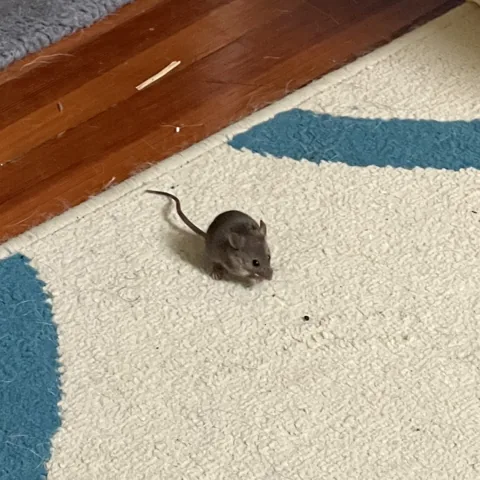 House Mouse
Mus musculus
The house mouse is a small, adaptable rodent that lives close to people in homes, schools and food businesses, eating and contaminating food, gnawing wiring and carrying disease.
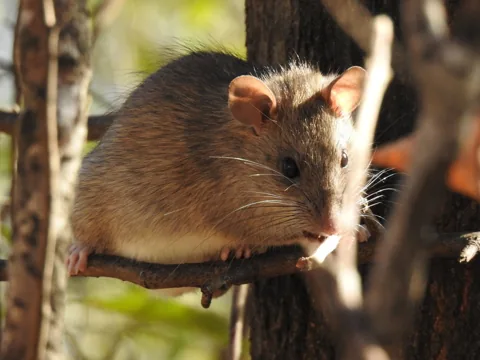 Roof Rat
Rattus rattus
The roof rat, also called the black or ship rat, is a sleek, agile climber that nests above ground in trees, ivy, attics and wall voids.
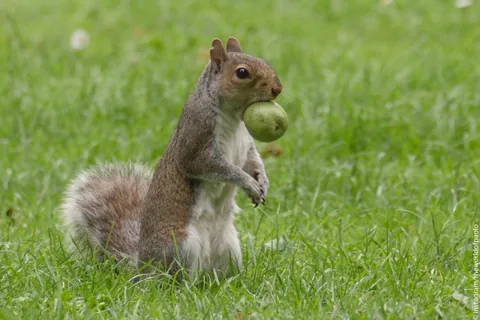 Tree squirrels (eastern gray and fox squirrels)
Sciurus species (shown: eastern gray squirrel, S. carolinensis)
Tree squirrels such as the eastern gray squirrel and fox squirrel are bushy-tailed, daytime rodents. Around homes they raid fruit, nuts and bird feeders, dig up lawns and gardens, and chew their way into attics.
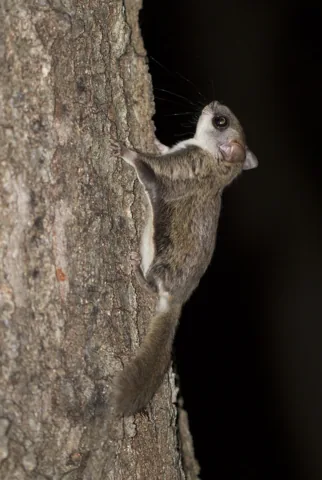 Southern flying squirrel
Glaucomys volans
The southern flying squirrel is a small, night-active squirrel that glides between trees on folds of skin. Most complaints come from homeowners with flying squirrels living in the house, where they get in through small holes around dormers, ridge vents, eaves and attic vents.
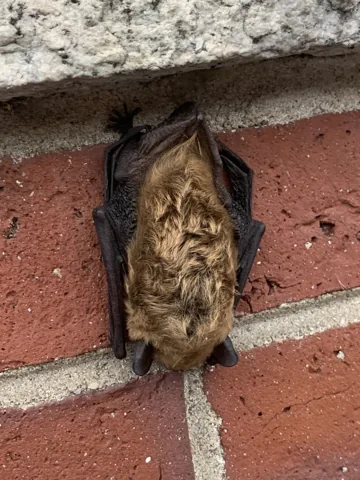 Bats (big brown bat and little brown bat)
Eptesicus fuscus and Myotis lucifugus (shown: big brown bat)
Bats are flying, insect-eating mammals that sometimes roost in attics, walls and other parts of buildings. They are valuable insect eaters, but colonies leave droppings, urine stains and odor.
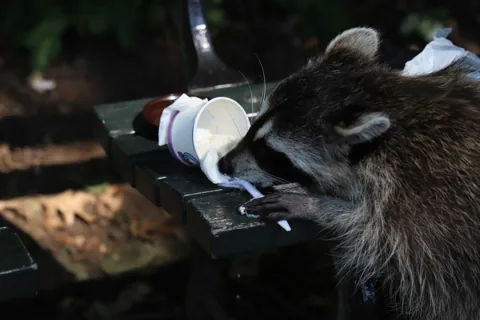 Raccoon
Procyon lotor
Raccoons are masked, ring-tailed mammals that adapt very well to towns and suburbs. They raid garbage and gardens, den in attics, chimneys and under decks, and can carry rabies and raccoon roundworm.
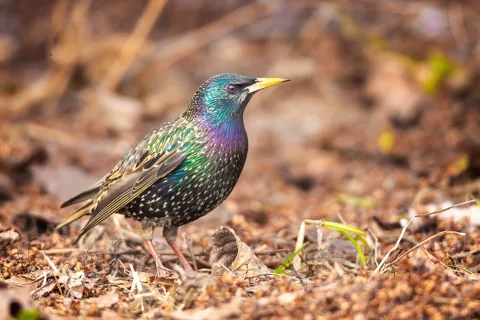 European starling
Sturnus vulgaris
The European starling is a stocky, short-tailed, non-native bird that now lives across most of North America. Pairs nest in building cavities and vents in spring, and fall and winter flocks of thousands foul roost sites with noise and droppings. The Missouri Department of Conservation lists it as invasive.
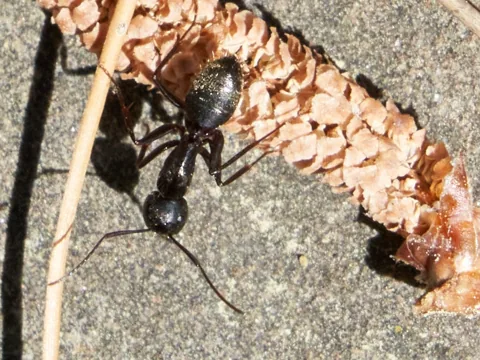 Carpenter Ants
Camponotus species
Carpenter ants don't eat wood the way termites do; they excavate it to nest, usually starting where wood is damp or decayed, and indoor nests are often satellites of a parent colony outdoors. Minnesota and Clemson extension both stress that they don't eat wood; they tunnel into it to make a nest.
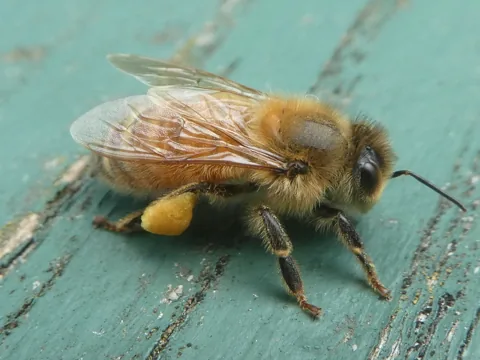 Western Honey Bee
Apis mellifera
Honey bees are important pollinators, but a colony that moves into a wall void or attic can become a stinging hazard. A swarm is temporary and usually best left alone, while an established colony in a building should be removed along with its comb.
What the noise could be, by time and sound
Timing narrows the list fast, because each culprit keeps its own hours. The descriptions below are what extension services and wildlife agencies report; our rats vs squirrels and bats vs birds pages go deeper on those two pairs.[1][3][24][14]
- Mice: UC IPM says house mice are most active at night but may be seen in daylight when food is around. They squeeze through very small gaps; UC IPM gives openings as small as 1/4 inch.[2]
- Rats: UC IPM says rats are mostly active at night. ICWDM lists gnawing, climbing in walls, clawing, various squeaks and fighting noises as common where rats live, loudest at the times they are most active. Roof rats favor attics and upper walls, and ICWDM says attic sounds are often the first sign of them.[1][22][21]
- Tree squirrels such as gray and fox squirrels: active in daylight (UC IPM). ICWDM and Penn State describe noisy mating chases in the breeding season, which for gray squirrels falls in mid-December or early January and again in June.[3][23][6]
- Flying squirrels: Penn State says they are the only squirrels active at night and, being small, are prone to nesting in attics. Connecticut DEEP says their nocturnal habits mean they are seldom seen, and that they get in through small holes around dormers, ridge vents, eaves and attic vents.[6][8][23]
- Bats: ICWDM describes sounds from vocalizing, grooming, scratching, crawling or climbing in attics, under eaves, behind walls and between floors, loudest before dusk emergence and at the dawn return. UC IPM notes that colonies often go unnoticed for years until odor, noise or droppings build up.[24][4]
- Birds in vents and eaves: Illinois Extension says starlings nest in natural cavities but also use open spaces in buildings, where nests can block airflow. Nebraska Extension says pest birds are active in daylight and lists nests, noise and white dropping stains as the giveaways.[13][14]
- Raccoons: Missouri Department of Conservation says raccoons are most active at night. UC IPM says females looking for a nest site may rip off shingles, fascia boards or rooftop ventilators to reach an attic. In chimneys, ICWDM says noise from the fireplace is a classic sign of young raccoons, with weeks of scratching, rustling and chirring until the mother moves them.[9][5][25]
- Carpenter ants: Penn State says a satellite colony in a wall or ceiling can sometimes be found by listening for a rustling sound with a stethoscope or an upturned water glass. Nebraska Extension describes it as a noise like crinkling cellophane as the ants chew wood, and says they are most active after dusk and before dawn.[7][10]
- Honey bees, and sometimes yellowjackets: University of Kentucky says scout bees often pick wall voids for a colony and that tapping the wall with a hammer may bring an answering buzz. University of Minnesota says yellowjackets also nest in wall voids and attics, where they are harder to control.[11][12]
Is the noise a sign of more?
Often, yes. ICWDM says rats are normally nocturnal and wary, so far more are usually present than are seen, and that rats seen in daylight, or three or more seen at night, point to a large population.[22]
With bats, birds, squirrels and raccoons, noise in spring and summer may mean young. UC IPM says female bats gather in spring to give birth and rear young, which can fly within a month or two. ICWDM says tree squirrels average about 3 young per litter, and that raccoon young in chimneys keep up their noises for several weeks.[4][23][25]
How to confirm what it is
Sound alone rarely settles it. Pair the timing with physical signs: ICWDM and UC IPM both treat droppings, gnawing and tracks as the evidence that shows which animal is there and where it travels.[26][2][1]
- Look for droppings, gnaw marks and tracks near where you hear it. UC IPM says these reveal mouse and rat activity and mark the best places for traps; our mouse droppings page shows how to read them.[2][1]
- Lay a flour patch: ICWDM says flour rolled smooth and left overnight in a suspected pathway will show whether rodents are moving through.[26]
- Find the way in. Connecticut DEEP lists small holes around dormers, ridge vents, eaves and attic vents for flying squirrels; UC IPM lists vents, fascia boards and rooftop ventilators for raccoons; CDC says to check inside and out for large and small gaps.[8][5][16]
- Watch at dusk. UC IPM says to watch the building as bats start to emerge at dusk to see where they exit, and New Jersey's bat guidelines call for an emergence watch before an exit is sealed.[4][15]
- For insects, listen closely. Penn State and Nebraska Extension describe using a stethoscope to pick up carpenter ants in a wall; Kentucky describes tapping the wall and listening for bees to buzz back.[7][10][11]
Safety first
Most of the risk comes from what you do next, not from the noise itself. The two common mistakes are sealing animals in and stirring up rodent droppings.[6][4][17]
- Don't seal the opening while animals are inside. Penn State says to close attic openings but make sure squirrels are not locked in. UC IPM says shutting out bat parents starves the young and brings odor and flies, and New Jersey's bat guidelines warn of odor from young bats that die in the roost. ICWDM notes similar odor problems when any animal dies where you can't reach it.[6][4][15][24]
- With stinging insects, wait too. University of Minnesota says not to seal a yellowjacket nest opening until all the yellowjackets are dead, since they can move into the house instead.[12]
- Rodent droppings and nests: CDC says to wear rubber or plastic gloves and not to sweep or vacuum urine, droppings or nest material. CDC and Washington State Department of Health say hantavirus spreads from rodent urine, droppings and saliva, and that people can breathe in contaminated dust after disturbing droppings or nests; the deer mouse carries the most common strain in the US.[17][19][20]
- Bats: CDC says to avoid touching bats, that bat bites can be tiny enough to miss, and that any contact with a bat should be reported to the health department, which can arrange rabies testing. Our I found a bat in my house page walks through that.[18]
- Wiring: UC IPM says rats and house mice gnaw electrical wires, and its house mouse note says many fires of unknown origin are believed to be caused by rodents gnawing on wires.[1][2]
What to do next
Once you know the culprit, follow the matching guide below rather than one general plan. UC IPM says sound devices, including ultrasonic ones, do little against rats, mice or bats, so skip them.[1][2][4]
- Mice or rats: trap, then seal. CDC says to seal gaps and holes inside and out; UC IPM suggests wire screen or coarse steel wool that mice cannot chew through. See our mouse droppings page and rats vs squirrels guide.[16][2]
- Squirrels: Penn State describes a one-way door or a downward-angled pipe over the entry so squirrels can leave but not return, then sealing with heavy wire mesh. Our squirrels in the attic guide covers baby season.[6]
- Bats: exclusion after the young can fly. New Jersey allows bat exclusions only from April 1 to April 30 and August 1 to October 15 and bans them May 1 to July 31; UC IPM says flightless young may be present usually May through September in California. Check your own state's rules.[15][4]
- Raccoons in a chimney or attic: ICWDM recommends a securely fastened chimney cap, and UC IPM says to be sure no animals are inside before covering the opening. Our raccoons in the attic guide has the rest.[25][5]
- Bees or carpenter ants: see our bees in walls guide (Kentucky says comb left in a wall can melt and leak honey through the wall) and carpenter ants vs carpenter bees.[11][7]
When to call a pro
UC IPM's house mouse advice centers on trapping and sealing gaps. Larger animals, bats, nursing young and stinging insects are where the sources below point to professional help.[2][5][18][12]
- Raccoons: UC IPM advises most homeowners to hire a professional wildlife control operator, who can tell whether a trapped female is nursing young, and says hiring professionals is often the only effective way to remove raccoons nesting in a chimney.[5]
- Bats in living space or a colony to exclude: CDC says to call animal control or the health department for a bat in the home; New Jersey says native nongame wildlife is protected there, and that excluding females in the nursery season can be an illegal take.[18][15]
- Stinging insects in a wall: University of Minnesota says not to manage a nest yourself if you are allergic to stings, and that nests inside walls are harder to control. Kentucky says removing a colony from a wall void may not be practical.[12][11]
- Wildlife laws vary: UC IPM says that in California, live-trapped wildlife cannot be released elsewhere without a permit from the state Department of Fish and Wildlife. Ask your state wildlife agency before trapping and moving any animal.[2][5]
Common questions
- Why do I only hear it at night?
- Mice, rats, flying squirrels and raccoons are all mostly active at night, according to UC IPM, Penn State and Missouri Department of Conservation. ICWDM notes roof rats are often heard once the house goes quiet.[2][1][6][9][21]
- Can a squirrel be in my walls in the daytime?
- Yes. UC IPM says tree squirrels are active in daylight, and Penn State says flying squirrels are the only night-active squirrels, so daytime scratching in an attic or upper wall often points to them.[3][6]
- Will an ultrasonic plug-in drive them out?
- Unlikely. UC IPM says rats get used to repeated sounds, finds little evidence that sound devices drive out mice or rats, and says every ultrasonic device tested against bats has failed.[1][2][4]
- Could it be bugs, not an animal?
- Sometimes. Penn State and Nebraska Extension describe carpenter ants making a rustling or crinkling noise inside walls, and Kentucky describes honey bees buzzing back when you tap the wall.[7][10][11]
Photo credits
- House Mouse: (c) Carrie Seltzer, some rights reserved (CC BY) — via iNaturalist, CC BY 4.0
- Roof Rat: (c) Laura Mae, some rights reserved (CC BY) — via iNaturalist, CC BY 4.0
- Tree squirrels (eastern gray and fox squirrels): (c) Paolo Zucca, some rights reserved (CC BY) — via iNaturalist, CC BY 4.0
- Southern flying squirrel: (c) Kristof & Yulia, some rights reserved (CC BY) — via iNaturalist, CC BY 4.0
- Bats (big brown bat and little brown bat): (c) Thomas Irvine, some rights reserved (CC BY) — via iNaturalist, CC BY 4.0
- Raccoon: (c) Steven Bodzin, some rights reserved (CC BY) — via iNaturalist, CC BY 4.0
- European starling: (c) egorbirder, some rights reserved (CC BY) — via iNaturalist, CC BY 4.0
- Carpenter Ants: (c) Linda Watson, some rights reserved (CC BY) — via iNaturalist, CC BY 4.0
- Western Honey Bee: (c) Doug Miller, some rights reserved (CC BY) — via iNaturalist, CC BY 4.0
Sources
- University of California Statewide IPM Program, “Rats (Pest Notes).” ipm.ucanr.edu/home-and-landscape/rats/ (accessed 2026-11-14)
- University of California Statewide IPM Program, “House Mouse (Pest Notes).” ipm.ucanr.edu/home-and-landscape/house-mouse/ (accessed 2026-11-14)
- University of California Statewide IPM Program, “Tree Squirrels (Pest Notes).” ipm.ucanr.edu/home-and-landscape/tree-squirrels/ (accessed 2026-11-14)
- University of California Statewide IPM Program, “Bats (Pest Notes).” ipm.ucanr.edu/home-and-landscape/bats/ (accessed 2026-11-14)
- University of California Statewide IPM Program, “Raccoons (Pest Notes).” ipm.ucanr.edu/home-and-landscape/raccoons/ (accessed 2026-11-14)
- Penn State Extension, “Tree Squirrels.” extension.psu.edu/tree-squirrels (accessed 2026-11-14)
- Penn State Extension, “Carpenter Ants.” extension.psu.edu/carpenter-ants (accessed 2026-11-14)
- Connecticut Department of Energy and Environmental Protection, Wildlife Division, “Flying Squirrels (Wildlife in Connecticut fact sheet).” portal.ct.gov/-/media/deep/wildlife/pdf_files/outreach/fact_sheets/flysqrlpdf.pdf (accessed 2026-11-14)
- Missouri Department of Conservation, “Raccoon (Field Guide).” mdc.mo.gov/discover-nature/field-guide/raccoon (accessed 2026-11-14)
- University of Nebraska-Lincoln Extension, “EC1570: Identification of Structure-Invading Ants in Nebraska (rev. 2023).” extensionpubs.unl.edu/publication/421/pdf/view (accessed 2026-11-14)
- University of Kentucky Entomology, “ENTFACT-606: Controlling Nuisance Honey Bees.” entomology.mgcafe.uky.edu/ef606 (accessed 2026-11-14)
- University of Minnesota Extension, “Wasps and bees.” extension.umn.edu/insects-infest-homes/wasps-and-bees (accessed 2026-11-14)
- University of Illinois Extension, “European Starlings.” extension.illinois.edu/invasives/european-starlings (accessed 2026-11-14)
- University of Nebraska-Lincoln Extension, “G2024: Urban Pest Birds: Controlling Damage.” extensionpubs.unl.edu/publication/g2024/html/view (accessed 2026-11-14)
- New Jersey Division of Fish and Wildlife, Endangered and Nongame Species Program, “Nuisance Wildlife Control Guidelines for Bats.” nj.gov/dep/fgw/ensp/pdf/bat_control.pdf (accessed 2026-11-14)
- Centers for Disease Control and Prevention, “How to Seal Up to Prevent Rodents.” www.cdc.gov/healthy-pets/rodent-control/seal-up.html (accessed 2026-11-14)
- Centers for Disease Control and Prevention, “How to Clean Up After Rodents.” www.cdc.gov/healthy-pets/rodent-control/clean-up.html (accessed 2026-11-14)
- Centers for Disease Control and Prevention, “Preventing Rabies from Bats.” www.cdc.gov/rabies/exposure/animals/bats.html (accessed 2026-11-14)
- Centers for Disease Control and Prevention, “About Hantavirus.” www.cdc.gov/hantavirus/about/index.html (accessed 2026-11-14)
- Washington State Department of Health, “Hantavirus.” doh.wa.gov/you-and-your-family/illness-and-disease-z/hantavirus (accessed 2026-11-14)
- Internet Center for Wildlife Damage Management, “Roof Rat Damage Identification.” icwdm.org/species/rodents/roof-rats/roof-rat-damage-identification/ (accessed 2026-11-14)
- Internet Center for Wildlife Damage Management, “Norway Rat Damage Identification.” icwdm.org/species/rodents/norway-rats/norway-rat-damage-identification/ (accessed 2026-11-14)
- Internet Center for Wildlife Damage Management, “Tree Squirrel Biology.” icwdm.org/species/rodents/tree-squirrels/tree-squirrel-biology/ (accessed 2026-11-14)
- Internet Center for Wildlife Damage Management, “Bat Damage Identification.” icwdm.org/species/other-mammals/bats/bat-damage-identification/ (accessed 2026-11-14)
- Internet Center for Wildlife Damage Management, “Raccoon Damage Prevention and Control Methods.” icwdm.org/species/carnivores/raccoons/raccoon-damage-prevention-and-control-methods/ (accessed 2026-11-14)
- Internet Center for Wildlife Damage Management, “House Mice: Identification and Damage Signs.” icwdm.org/species/rodents/house-mice/ (accessed 2026-11-14)