On this page
How to identify it
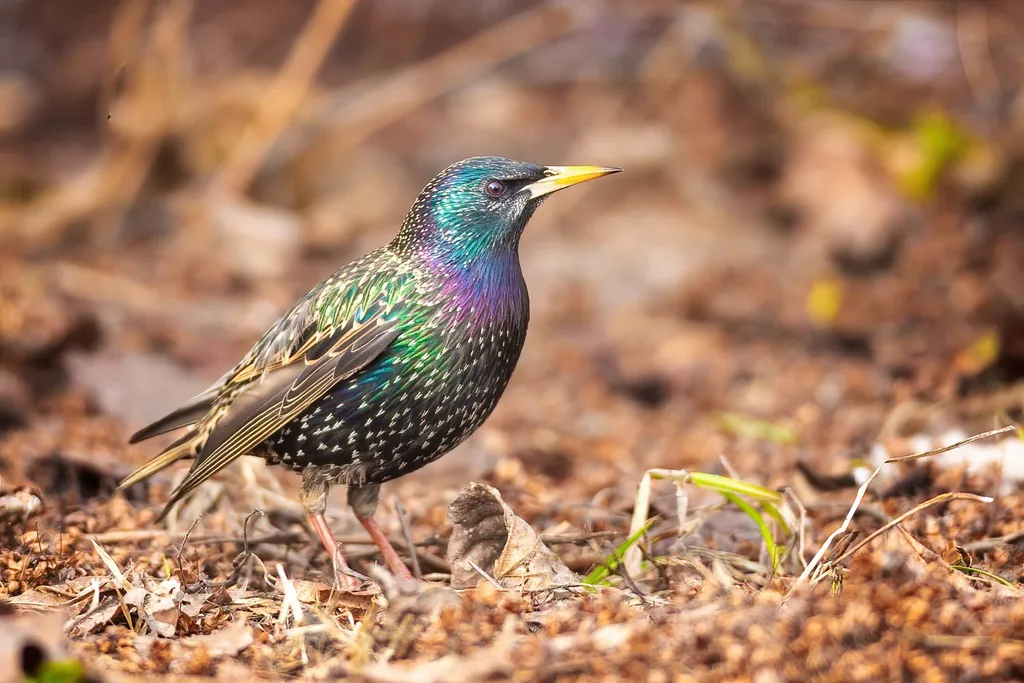
- A robin-sized, short-tailed bird about 8 inches long and about 3 ounces, with a long, slender, pointed bill. Missouri's field guide gives 8 1/2 inches from bill tip to tail tip.[3][2][4]
- Looks black from a distance; up close, summer plumage is glossy purplish-green and winter plumage is brownish with white spots.[2][3]
- The bill turns light brownish yellow in the breeding season, and both sexes have pinkish-red legs.[3]
- A varied song that often mimics other birds, and fall flocks that swirl together in coordinated murmurations.[3][2]
- A fan-shaped spray of droppings on the wall below a cavity can mark an active starling nest.[3]
Look-alikes
| Look-alike | How to tell them apart |
|---|---|
| Common grackle, blackbirds and brown-headed cowbird | These native black birds look similar, but the starling has a short tail and long, slender bill; native species are protected, so confirm the identification before any control.[2][3][1] |
| Pigeon | Pigeons are much larger, about 12 inches long, and nest on sheltered ledges; starlings are about 8 inches and nest inside cavities.[3] |
Where it lives
Released in New York City around 1890, starlings spread across nearly all of the United States and Canada and now number over 200 million in North America.[2][1]
Biology and life cycle
From April to August, pairs fill a cavity with a messy mass of plant stems around a neater cup of grass and feathers, usually raising two broods a year.[1][3]
Females lay about four to six eggs per clutch. The Missouri Department of Conservation gives 3 to 6 eggs, about 12 days of incubation, fledging at 21 to 23 days, and one or two broods a year.[3][4]
They prefer tree cavities but readily nest in nooks of houses, barns, office buildings and traffic lights, and take over bluebird and purple martin boxes. Missouri adds crannies in signs and woodpecker holes, and says starlings displace or evict bluebirds, wood ducks, sapsuckers, flycatchers and purple martins.[1][2][4]
They eat insects, especially during nesting, plus seeds, grain, fruit and berries, livestock feed and bird-feeder seed.[1][3][2]
After nesting they form flocks that can reach tens of thousands, returning to the same winter roosts in buildings and dense trees year after year.[1][2]
Damage and signs
- Nests in vents and wall cavities can block airflow, and the bulky nest material is highly flammable.[2][1]
- Winter roosts leave heavy droppings that corrode structures and foul sidewalks, cars and buildings, along with loud early-morning and evening chatter.[1][2][3]
- Flocks eat and contaminate livestock feed and damage fruit and grain crops.[2][1]
- Starlings compete with native cavity nesters and often destroy bluebird nests, occasionally killing the adults. Missouri's conservation department calls this competition a conservation concern for native cavity nesters.[3][1][4]
Health risk
NIOSH lists blackbirds, including starlings and grackles, among the birds typically linked to histoplasmosis outbreaks; the fungus grows especially well in soil or material with large amounts of bird droppings, and CDC says most outbreaks followed disturbance of contaminated soil or droppings. A 2021 review of several hundred studies found the strongest evidence that starlings carry and spread E. coli and Campylobacter bacteria, mainly around dairies and livestock feedlots; a Kansas feedlot study found Salmonella in only three starling samples.[9][10][11][12]
Control
Prevention
Use bluebird boxes with an entrance hole exactly 1-1/2 inches across, which keeps starlings out.[1][2]
Thinning dense windbreaks or tree stands by about one-third can break up large starling roosts.[1][2]
Keep them out
Screen bathroom and exhaust vents with 1/2-inch mesh, taking care with dryer vents where lint can build up, and cap chimneys with stainless steel screens.[3]
Box out spaces under dormers, eaves and porches and cover rafters with hardware cloth or netting so birds can't nest or roost there.[3][1][2]
Sanitation
Clean up spilled grain and seed, use covered trash containers, and don't feed birds on your property.[1][3]
Traps and physical control
Pull nests and eggs from building cavities and nest boxes every couple of weeks through the nesting season, since starlings rebuild quickly.[1][3]
Decoy traps can catch large numbers of starlings; prebait the area and check traps daily so native birds can be released unharmed.[1][3]
When to call a professional
The avicide sold for starling control and the 4-aminopyridine frightening bait are restricted to certified pesticide applicators.[3]
Scare devices: short-lived help
Noise makers, air cannons, balloons and effigies usually work only briefly because starlings get used to them; vary type, timing and placement.[1][2][3]
Ultrasonic devices have no reliable evidence of working against birds.[3]
Legal status
The federal Migratory Bird Treaty Act applies only to native migratory birds. The U.S. Fish and Wildlife Service says the starling family is not covered by the treaties the law carries out, so the European starling is not protected by it.[5][7][6]
The Service also says states and communities may protect non-native birds at their discretion, so check state and local rules before trapping or shooting. California, for example, lets starlings be taken at any time of year and in any number.[6][8][3]
Health evidence: what is and isn't shown
Researchers reviewing the literature say many pathogens have been reported in starlings, but the strongest evidence is for E. coli and Campylobacter around intensive livestock operations; at one Kansas feedlot, starlings were not a significant source of Salmonella or E. coli O157.[11][12]
Histoplasma grows especially well where bird droppings pile up, and outbreaks have mostly followed disturbance of contaminated soil or droppings, so take care when cleaning old roost sites; the droppings cleanup guide covers protection.[9][10]
Common questions
- How do I get starlings out of my dryer or bathroom vent?
- Remove the nest material, then cover the vent opening with a mesh guard; check dryer vents often because lint can collect and catch fire.[3][1]
- Is it legal to remove a starling nest?
- Federally, yes: USFWS says the European starling is not protected by the Migratory Bird Treaty Act, which protects native migratory birds, their nests and their eggs. Make sure the nest isn't a native bird's, and check state and local rules.[7][5][6]
- Why do thousands of starlings roost in the same trees every winter?
- Winter flocks pick warm, sheltered roosts in dense trees and buildings and often return to the same spot in later years.[1]
Sources
- Iowa State University Extension and Outreach, Natural Resource Stewardship, “Nuisance Birds: Damage Management (last reviewed July 1, 2019).” naturalresources.extension.iastate.edu/encyclopedia/nuisance-birds-damage-management (accessed 2026-11-11)
- University of Illinois Extension, “European Starlings (Invasive Species).” extension.illinois.edu/invasives/european-starlings (accessed 2026-11-11)
- University of Nebraska-Lincoln Extension, “G2024: Urban Pest Birds: Controlling Damage.” extensionpubs.unl.edu/publication/g2024/html/view (accessed 2026-11-11)
- Missouri Department of Conservation, “European Starling (Field Guide).” mdc.mo.gov/discover-nature/field-guide/european-starling (accessed 2026-11-11)
- U.S. Fish and Wildlife Service, “Migratory Bird Treaty Act of 1918.” www.fws.gov/law/migratory-bird-treaty-act-1918 (accessed 2026-11-11)
- U.S. Fish and Wildlife Service, “Service Publishes Final List of Non-Native Bird Species (March 15, 2005).” www.fws.gov/story/2005-03/service-publishes-final-list-non-native-bird-species (accessed 2026-11-11)
- U.S. Fish and Wildlife Service, “List of Bird Species To Which the Migratory Bird Treaty Act Does Not Apply (85 FR, April 16, 2020; FR Doc. 2020-06782).” www.fws.gov/sites/default/files/federal_register_document/2020-06782.pdf (accessed 2026-11-11)
- California Department of Fish and Wildlife / California Fish and Game Commission, “2026-2027 Mammal Hunting and Trapping Regulations (incl. Cal. Code Regs. tit. 14, s. 472).” nrm.dfg.ca.gov/FileHandler.ashx?DocumentID=202568&inline (accessed 2026-11-13)
- National Institute for Occupational Safety and Health (CDC), “Histoplasma in the Environment: An Overview.” www.cdc.gov/niosh/histoplasmosis/about/environment.html (accessed 2026-11-11)
- Centers for Disease Control and Prevention, “How People Get Histoplasmosis.” www.cdc.gov/histoplasmosis/causes/index.html (accessed 2026-11-11)
- Animals (Basel), via PubMed, “Cabe (2021), European starlings (Sturnus vulgaris) as vectors and reservoirs of pathogens affecting humans and domestic livestock.” pubmed.ncbi.nlm.nih.gov/33578636/ (accessed 2026-11-11)
- Avian Diseases, via PubMed, “Gaukler et al. (2009), Escherichia coli, Salmonella, and Mycobacterium avium subsp. paratuberculosis in wild European starlings at a Kansas cattle feedlot.” pubmed.ncbi.nlm.nih.gov/20095155/ (accessed 2026-11-11)
- iNaturalist, “Sturnus vulgaris taxon page (order and family).” www.inaturalist.org/taxa/14850 (accessed 2026-11-11)