On this page
How to identify it
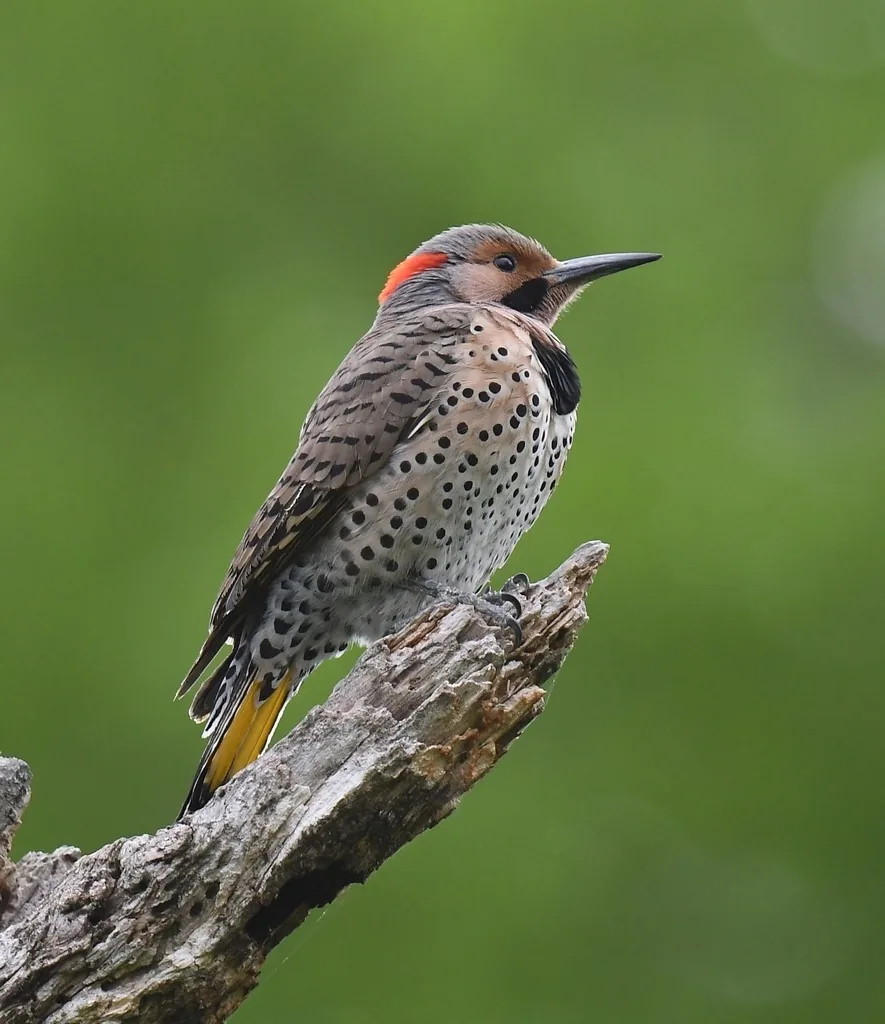
- Usually 7 to 15 inches long, with a stout, sharply pointed bill and stiff tail feathers used as a prop on tree trunks and walls.[2][1]
- Two toes point forward and two backward on each foot, letting the bird cling to vertical wood.[2][1]
- Most males show a pattern of black, white and red; females look similar but usually lack the red.[2][1]
- Rhythmic drumming on hollow branches, gutters, chimney caps or vents is often heard before the bird is seen.[2][1]
Look-alikes
Where it lives
Woodpeckers live throughout the United States; different species cause damage in different regions, and downy woodpeckers and northern flickers are common in suburbs and city parks.[2][4]
Biology and life cycle
Species most often involved with damage to homes include the downy, hairy, red-bellied, red-headed, acorn and pileated woodpeckers and the northern flicker.[2]
They breed in spring, laying 2 to 6 eggs in a cavity in a tree or structure, and both parents feed the young.[4]
Downy and hairy woodpeckers dig new cavities each year, while northern flickers often return to the same one.[4]
Most species feed on wood-boring insects, ants, berries, fruit and nuts; flickers often pick ants off the ground.[4]
Drumming advertises territory and attracts mates, and both males and females do it.[2][1]
Damage and signs
- Damage to buildings peaks from February through June during breeding season, with another round in fall.[3]
- A line of small holes in a row usually means a woodpecker was hunting insects; larger holes may be a nest cavity in the wall.[1]
- Cedar and redwood siding are favorites, especially channeled plywood with gaps where insects hide.[1][3]
- Houses stained in earth tones are more likely to be pecked than painted ones.[1][5]
- Acorn woodpeckers in the West drill rows of holes to store acorns and wedge them under roof shakes.[1][3]
- Vacation homes and barns can be badly damaged because pecking goes unnoticed for long periods.[3]
Health risk
ICWDM says woodpeckers aren't known to be a significant disease risk for people or domestic animals. The problems it and UC IPM describe are property damage and noise.[3][1]
Control
Prevention
Keep siding, trim and decking in good repair, and check cedar or log homes for insect infestation.[1]
When residing near woods, choose clapboard or synthetic siding over grooved plywood or board-and-batten, and paint rather than stain.[5]
Keep them out
Hang lightweight 3/4-inch bird netting from the eaves down the siding, kept at least 3 inches from the wall and pulled taut so birds can't get behind or tangled.[1][5]
Cover pecked spots with sheet metal or 1/4-inch hardware cloth, painted to match, as soon as damage starts.[1][5]
If a woodpecker is drumming on a chimney or metal vent, wrapping it with hardware cloth may help.[1]
Traps and physical control
Fill holes with wood plugs or putty quickly, since existing holes can encourage more pecking.[1][5]
Moving, reflective deterrents such as Mylar tape strips, pie pans and pinwheels hung near damage have had some success when used early.[1][5]
When to call a professional
For large or two-story netting jobs, a bird control or pest control professional can help with installation.[1]
What usually doesn't work
Plastic hawks, owls, snakes and cat silhouettes are generally ineffective.[1][5]
Ultrasonic devices are rarely effective as advertised, and many taste or odor repellents have shown little or no success.[5][1]
Suet feeders and nest boxes don't consistently reduce damage and may draw more woodpeckers.[1]
Sticky gels may help but can stain surfaces and trap or harm small birds.[1][5]
Legal status
The Migratory Bird Treaty Act bars taking protected birds, including killing or capturing them, without prior authorization from the U.S. Fish and Wildlife Service. Its 2023 protected-species list includes 26 members of the woodpecker family, among them the downy, hairy, red-bellied, red-headed, acorn and pileated woodpeckers, the northern flicker and the sapsuckers.[6][7]
You don't need a federal permit to scare or harass birds, except eagles and federally listed threatened or endangered species. UC IPM says methods that don't harm the bird or its active nest, such as netting and scare devices, are allowed.[8][1][2]
Killing a woodpecker requires a federal depredation permit. Applicants must document nonlethal attempts first and keep them up, include a USDA Wildlife Services review form, and file an annual report; permits last a year. UC IPM says the permit must specify trapping or shooting, and ICWDM says sound justification is needed.[8][1][2]
Some species get extra protection. The red-cockaded woodpecker, which nests only in cavities it digs in living pines in the Southeast, has become endangered as mature pines were lost, and in California the Gila woodpecker and gilded flicker are state-listed endangered and can't be harassed at all. UC IPM says exclusion is allowed if it's installed before those birds are in the area.[9][2][1]
Common questions
- Why is a woodpecker drumming on my metal gutter?
- It's claiming territory or signaling a mate. Woodpeckers pick surfaces that resonate loudly, such as gutters, downspouts, chimney caps and vents.[1][2]
- Does woodpecker damage mean I have bugs in my siding?
- Sometimes. Rows of small holes suggest the bird is after insects, but woodpeckers also peck sound wood, so inspect before treating.[1][5]
- Can I get rid of a woodpecker myself?
- You can block and scare it. Netting is the most effective option and no permit is needed for scaring, but killing or harming a woodpecker requires a federal depredation permit.[1][2][8]
Sources
- University of California Statewide IPM Program, “Woodpeckers (Pest Notes, Home and Landscape).” ipm.ucanr.edu/home-and-landscape/woodpeckers/ (accessed 2026-11-13)
- Internet Center for Wildlife Damage Management, “Woodpeckers: Identification.” icwdm.org/species/birds/woodpeckers/ (accessed 2026-11-13). Run by university wildlife damage specialists (maintained at the University of Wisconsin-Stevens Point); species modules are based on Prevention and Control of Wildlife Damage (University of Nebraska Cooperative Extension, 1994).
- Internet Center for Wildlife Damage Management, “Woodpecker Damage Identification.” icwdm.org/species/birds/woodpeckers/woodpecker-damage-identification/ (accessed 2026-11-13). Run by university wildlife damage specialists (maintained at the University of Wisconsin-Stevens Point); species modules are based on Prevention and Control of Wildlife Damage (University of Nebraska Cooperative Extension, 1994).
- Internet Center for Wildlife Damage Management, “Woodpecker Biology.” icwdm.org/species/birds/woodpeckers/woodpecker-biology/ (accessed 2026-11-13). Run by university wildlife damage specialists (maintained at the University of Wisconsin-Stevens Point); species modules are based on Prevention and Control of Wildlife Damage (University of Nebraska Cooperative Extension, 1994).
- Internet Center for Wildlife Damage Management, “Woodpecker Damage Prevention and Control Methods.” icwdm.org/species/birds/woodpeckers/woodpecker-damage-prevention-and-control-methods/ (accessed 2026-11-13). Run by university wildlife damage specialists (maintained at the University of Wisconsin-Stevens Point); species modules are based on Prevention and Control of Wildlife Damage (University of Nebraska Cooperative Extension, 1994).
- U.S. Fish and Wildlife Service, “Migratory Bird Treaty Act of 1918.” www.fws.gov/law/migratory-bird-treaty-act-1918 (accessed 2026-11-13)
- U.S. Fish and Wildlife Service, “Migratory Bird Treaty Act protected species list (10.13 list, 2023), Excel.” www.fws.gov/sites/default/files/documents/CFR50-Part10.13-2023.xlsx (accessed 2026-11-13)
- U.S. Fish and Wildlife Service, “3-200-13: Migratory Bird Depredation permit.” www.fws.gov/service/3-200-13-migratory-bird-depredation (accessed 2026-11-13)
- U.S. Fish and Wildlife Service, “Red-cockaded woodpecker (Dryobates borealis).” www.fws.gov/species/red-cockaded-woodpecker-dryobates-borealis (accessed 2026-11-13)
- Global Biodiversity Information Facility (GBIF), “Picidae (GBIF Backbone Taxonomy).” api.gbif.org/v1/species/9333 (accessed 2026-11-13)
- Global Biodiversity Information Facility (GBIF), “Colaptes auratus (Linnaeus, 1758) (GBIF Backbone Taxonomy).” api.gbif.org/v1/species/2478259 (accessed 2026-11-13)
- iNaturalist, “Colaptes auratus taxon page (order and family).” www.inaturalist.org/taxa/18236 (accessed 2026-10-06)