On this page
How to identify it
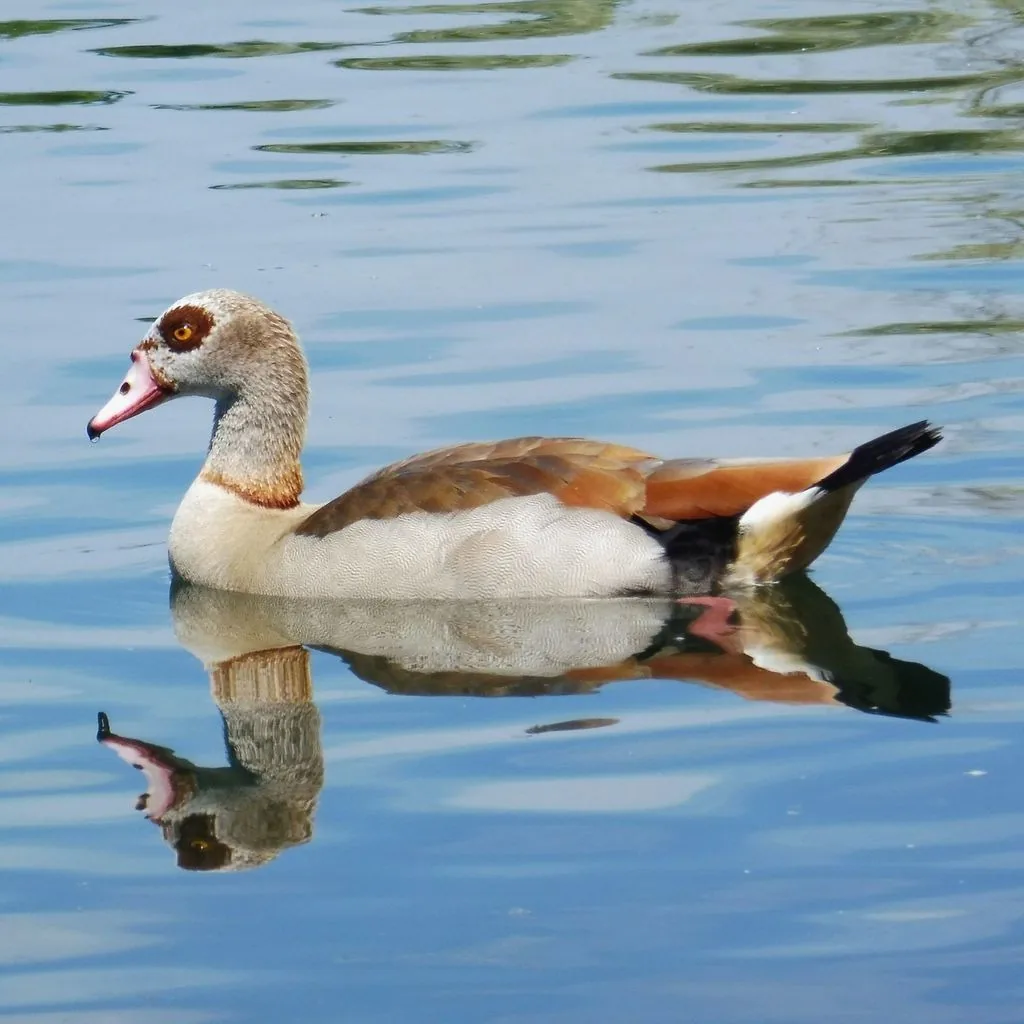
- A pale foxy-brown goose with long pink legs and a pinkish bill. UF/IFAS Extension describes the legs and bill as dark pink, with a black tip on the bill.[1][2]
- Dark reddish-brown patches of variable size surround the eyes, and another dark patch sits on the lower breast. UF/IFAS Extension adds dark chestnut back feathers, a light beige chest, a whitish-beige head and an orange collar around the neck; juveniles lack the eye patch.[1][2]
- In flight the wings look broad, with a large white area across the inner wing. UF/IFAS Extension describes the flight feathers as dark chestnut to iridescent green around the large white patch.[1][2]
- Adults stand about 63 to 73 cm (about 25 to 29 inches) tall and weigh 1.5 to 2.3 kg.[1]
- The call is a loud, braying honk.[1]
- It is the only living member of its genus and is placed in the shelduck subfamily (Tadorninae) of the duck family, not with the true geese.[1]
Look-alikes
| Look-alike | How to tell them apart |
|---|---|
| Canada goose | A Canada goose is black and tan with a large white patch on the cheek and grows much bigger, up to 24 pounds; the Egyptian goose is pale brown with dark patches around the eyes and a pink bill.[3][1] |
| Muscovy duck | Muscovy ducks have fleshy red, warty caruncles on the face, often reduced or absent in females, and may be solid white, solid black or mottled. Egyptian geese have no facial bumps; look for the dark chestnut eye patch and the pink, black-tipped bill.[4][2] |
Where it lives
Native to Africa. The first documented Florida sightings came from Martin County on the southeast coast in 1993-94, and Arkansas birds trace to captive waterfowl, including a drive-through safari park that had geese from the early 1980s. The Fish and Wildlife Service treats only the Florida, Texas, California and Arkansas populations as established and rates the climate match as highest in the southern U.S. and California. GBIF's public U.S. records since 1990 (about 180,000) are wider: they place the bird in 7 states on the map, mostly Florida, California and Texas, with smaller numbers from North Carolina, Arkansas, Arizona and New Mexico.[1][5]
Biology and life cycle
They spend most of their time on rivers, lakes, ponds and wetlands but often walk away from the water to graze in pastures, fields and lawns.[1]
The diet is mostly plants: young grass, grain and leaves, with some insects, worms and frogs. A four-year study of 100 geese in Germany found mainly corn, grasses and grains, plus mussel fragments and worms. UF/IFAS Extension in Sumter County lists the main foods as seeds, grass and algae, with occasional insects, frogs and worms.[1][6][2]
Pairs are monogamous and nest in dense vegetation, in holes or on the ground; they also take over old nests of larger birds in trees or on high ledges. UF/IFAS Extension says nests are usually on the ground but can also be on top of trees and buildings.[1][2]
A clutch holds 5 to 12 eggs, incubated for 28 to 30 days by both parents, and the young fledge in about 70 days. The female lays one egg a day before incubation begins.[1][2]
Males turn loud and aggressive during courtship, with noisy displays and unusually loud honking. In courtship a pair faces each other, spreads its wings and arches the neck and head upward.[1][2]
UF/IFAS Extension cites a study finding that the geese prefer open areas to woodland, likely because they graze on grass and low vegetation, and notes that elsewhere in the world some travel 40 to 500 miles to a new home.[2]
Damage and signs
- In the U.S. they live mostly in towns and suburbs; an Arkansas habitat study found the share of urban land cover was the strongest predictor of where they settle.[1][7]
- Large groups can damage habitat by grazing and trampling, and their droppings can over-fertilize still ponds. UF/IFAS Extension says they have caused significant damage in suburban areas such as parks, where feeding damage and droppings can be a major problem; a single goose left a tremendous amount of droppings around one commercial building.[1][2]
- They are dominant and aggressive toward other birds, with what researchers describe as extremely fierce territorial behavior during pair formation and nesting. Intruders near a nest are met with honking, hissing and sometimes chasing.[1][2]
- In Europe they keep coots and other waterbirds from setting up territories and take over nest sites, nest boxes and platforms used by other species.[1]
Health risk
Egyptian geese can carry avian influenza viruses: H5N2 was isolated from a wild Egyptian goose in South Africa in 2004 and H1N8 from another wild bird, and a 2024 study found Arkansas areas well suited to the geese also hold three to five times the state's average density of chicken houses. Evidence on human pathogens in their droppings is limited: a German study found no Salmonella in 138 samples from parks and swimming pools, though droppings spiked with Salmonella in the lab stayed infectious for up to six hours in chlorinated pool water, and the authors call for larger studies.[1][7][8]
Control
Traps and physical control
Florida property owners may take nuisance wildlife causing damage with live traps or snares or, where allowed, firearms during daylight. Every trap must be checked at least once every 24 hours.[9]
Live-captured nuisance animals must be released legally or humanely euthanized within 24 hours, and only native species may be released, so a captured Egyptian goose cannot be let go.[9]
When to call a professional
Owners may authorize another person, such as a wildlife trapper, to remove nuisance animals; the FWC does not license trappers but lets them advertise on its website.[9]
Legal status
The U.S. Fish and Wildlife Service lists the Egyptian goose among nonnative birds that the Migratory Bird Treaty Act does not protect.[10]
Florida's nuisance wildlife rules still apply: any non-target animal must be released at the capture site immediately, and wildlife can't be released on any land without the landowner's written permission.[9]
Firing a gun may be banned in some cities and residential areas, so check with local law enforcement first.[9]
Florida allows nonnative wildlife to be transported only for euthanasia, never to be relocated.[9]
Where the sources disagree
Clutch size: the Fish and Wildlife Service gives 5 to 12 eggs; UF/IFAS Extension in Sumter County gives 5 to 11.[1][2]
Size next to a Muscovy duck: UF/IFAS Extension in Sumter County says Egyptian geese reach almost 29 inches tall and about 5 pounds and are larger than a Muscovy duck, but UF's Muscovy duck fact sheet gives male Muscovies at about 10 to 15 pounds, and the Fish and Wildlife Service weighs Egyptian geese at 1.5 to 2.3 kg.[2][4][1]
Common questions
- Are Egyptian geese protected like Canada geese?
- Not federally. The Fish and Wildlife Service lists them as nonnative birds outside the Migratory Bird Treaty Act, but Florida's nuisance wildlife rules and local firearm limits still apply.[10][9]
- Why are Egyptian geese so aggressive?
- Males become loud and aggressive during courtship, and pairs defend nest sites fiercely, driving off other waterbirds and taking over their nests. UF/IFAS Extension notes that intruders near a nest are met with honking, hissing and even chasing.[1][2]
- Can I trap Egyptian geese and release them at a lake?
- Not in Florida. Only native species may be released; nonnative wildlife may be transported only for euthanasia.[9]
Sources
- U.S. Fish and Wildlife Service, “Egyptian Goose (Alopochen aegyptiaca) Ecological Risk Screening Summary (December 2016; web version April 2, 2018).” www.fws.gov/sites/default/files/documents/Ecological-Risk-Screening-Summary-Egyptian-Goose.pdf (accessed 2026-11-14)
- UF/IFAS Extension Sumter County, “Wildlife & Invasive Species Education (WISE) Species Profile: The Egyptian Goose (Jim E. Davis, updated March 25, 2024).” blogs.ifas.ufl.edu/sumterco/2022/12/28/wildlife-invasive-species-education-wise-species-profile-the-egyptian-goose/ (accessed 2026-11-14). Used for identification, behavior, diet and damage; its line on droppings spreading disease is not used.
- Internet Center for Wildlife Damage Management, “Canada Geese: Identification.” icwdm.org/species/birds/canada-geese/ (accessed 2026-11-14). Run by university wildlife damage specialists (maintained at the University of Wisconsin-Stevens Point); species modules are based on Prevention and Control of Wildlife Damage (University of Nebraska Cooperative Extension, 1994).
- University of Florida IFAS Extension (EDIS), “Florida's Introduced Birds: Muscovy Duck (Cairina moschata), WEC 254.” journals.flvc.org/edis/article/download/117879/115886 (accessed 2026-11-14). First published March 2009; archival EDIS copy on journals.flvc.org (the current ask.ifas.ufl.edu/publication/UW299 page returns 410). Used for Muscovy identification only.
- Global Biodiversity Information Facility (GBIF), “Alopochen aegyptiaca: occurrence records in the U.S., 1990-2026 (GBIF occurrence search).” api.gbif.org/v1/occurrence/search?taxonKey=2498252&country=US&hasGeospatialIssue=false&occurrenceStatus=PRESENT&year=1990%2C2026&facet=stateProvince&facetLimit=400&limit=0 (accessed 2026-11-14). State counts are records reported (iNaturalist research-grade, museum specimens, surveys), not abundance.
- International Journal for Parasitology: Parasites and Wildlife, via PubMed, “Multi-year dietary and parasitological investigations of invasive Egyptian geese (Alopochen aegyptiaca) in central Germany (Schantz et al. 2026).” pubmed.ncbi.nlm.nih.gov/42774751/ (accessed 2026-11-14). Cited from the PubMed abstract.
- Ecology and Evolution, via PubMed, “Risk of invasive waterfowl interaction with poultry production: understanding potential for avian pathogen transmission via species distribution models (Jackson et al. 2024).” pubmed.ncbi.nlm.nih.gov/39026949/ (accessed 2026-11-14). Cited from the PubMed abstract.
- Animals (Basel), via PubMed, “Role of free-ranging synanthropic Egyptian geese (Alopochen aegyptiaca) as natural host reservoirs for Salmonella spp. in Germany (Fischer et al. 2023).” pubmed.ncbi.nlm.nih.gov/37958158/ (accessed 2026-11-14). Cited from the PubMed abstract.
- Florida Fish and Wildlife Conservation Commission, “FAQs: Nuisance Wildlife.” myfwc.com/conservation/you-conserve/wildlife/faqs/ (accessed 2026-11-14)
- U.S. Fish and Wildlife Service, “Final List of Bird Species to Which the Migratory Bird Treaty Act Does Not Apply (notice of availability, April 16, 2020; FWS-hosted copy).” www.fws.gov/sites/default/files/federal_register_document/2020-06782.pdf (accessed 2026-11-14)
- iNaturalist, “Alopochen aegyptiaca taxon page (order and family).” www.inaturalist.org/taxa/72486 (accessed 2026-11-14)