On this page
How to identify it
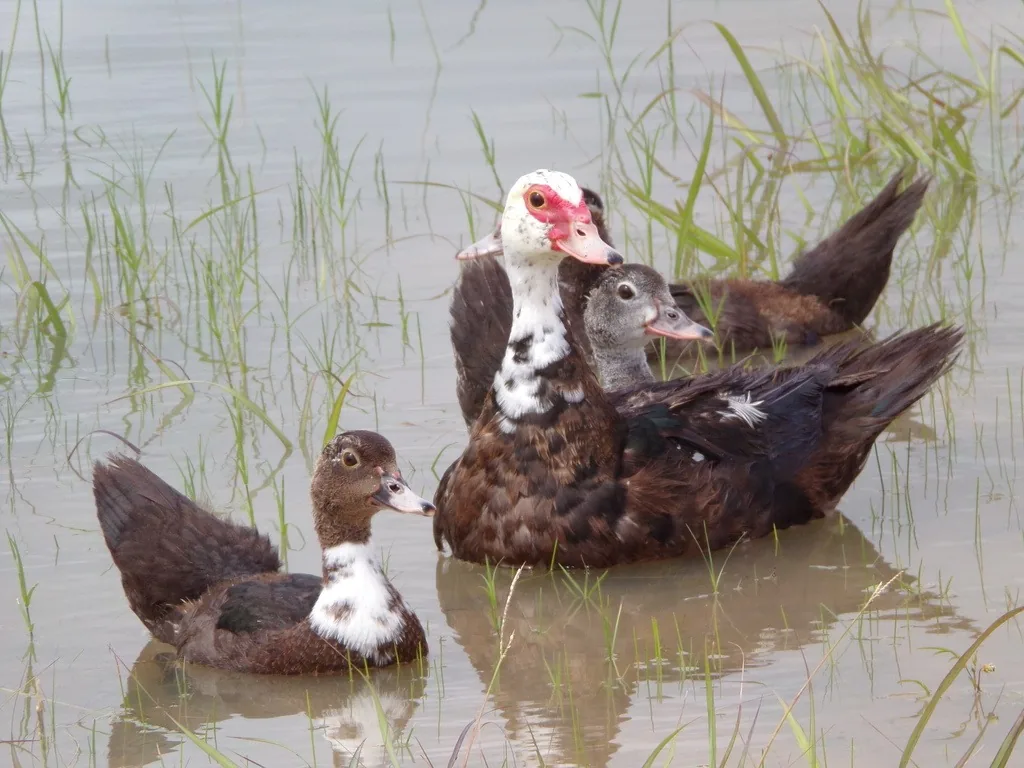
- Males have fleshy red caruncles, or warty bumps, on the face over the eyes and at the base of the bill; females have smaller caruncles or none.[2]
- Their plumage is brownish-black with an iridescent green and purple sheen and white wing patches.[1]
- They are big ducks, averaging about 9 pounds with a wingspan of 54 to 61 inches; males are generally larger than females.[1]
Look-alikes
Where it lives
Native to Mexico, Central and South America and parts of Texas. In Florida, feral populations occur all over the state, the largest around Jacksonville, Miami, Fort Lauderdale, West Palm Beach, Fort Myers, Tampa and Orlando.[1][2]
Biology and life cycle
They eat roots, stems, leaves and seeds of water and land plants, plus small fish, reptiles, crustaceans, insects and human handouts.[1][2]
Muscovies do not migrate and are active during the day. Dominant males hold territories and mate with the females nesting there.[1]
They breed prolifically, so a local flock can grow dramatically in a short time.[2]
Damage and signs
- Growing flocks leave messy sidewalks and driveways.[1]
- They can cause excessive nutrient loading in small ponds.[1]
- Residents complain about their droppings, property damage and aggressive behavior.[2]
- Feral Muscovies compete with native waterfowl, can spread disease to them and may interbreed with native ducks.[1][2]
Health risk
FWC warns that Muscovies can transmit disease to native waterfowl, especially in overcrowded flocks; the sources describe no specific health risk to people.[1][2]
Control
Prevention
Never feed Muscovy ducks, either by hand or by leaving feed where they can reach it. Feeding leads to overcrowding, mess and the potential to spread disease.[2]
Traps and physical control
Make your yard unwelcome by spraying the ducks with a garden hose or letting a dog chase them off without catching them.[2]
Ducks used to handouts can often be caught with a net, or in welded-wire funnel traps baited with corn; check traps at least once every 24 hours.[1]
The federal control order also lets landowners destroy Muscovy nests and eggs at any time when found.[5]
When to call a professional
In Florida the FWC does not remove nuisance Muscovies; landowners can act under the federal control order or hire a licensed nuisance wildlife trapper.[1][3]
The federal control order
Muscovy ducks are covered by the Migratory Bird Treaty Act, but a U.S. Fish and Wildlife Service control order lets people remove them without a federal permit in most of the country.[1][5]
Under the federal control order, landowners, wildlife agencies and their tenants, employees or agents may remove or destroy Muscovies and their nests or eggs at any time when found.[5]
The order covers the contiguous United States except Hidalgo, Starr and Zapata Counties in Texas. It does not cover Alaska, Hawaii or U.S. territories.[5]
Removed ducks may not be released elsewhere, kept, eaten or sold. They must be buried, incinerated, or donated to a public museum or institution for science or education.[5]
Florida's wildlife agency says anyone shooting Muscovies must use nontoxic shot or bullets.[2]
State and local rules still apply, so what is allowed varies. North Carolina requires no state permit, while Florida's wildlife agency says to check firearm ordinances with the local sheriff's office or police department before shooting.[5][2]
Florida rules
Florida considers Muscovies a nonnative species. No permit is needed to possess them, but state law and federal rules forbid releasing them.[1][2]
No permit is needed to remove them with humane live capture such as nets or cage traps. Traps must be checked every 24 hours, and other animals caught must be released on site.[1][2]
Muscovies may be shot on private property in daylight with landowner permission, using nontoxic shot or bullets; check local firearm ordinances first.[1][2]
Captured birds must be humanely euthanized or donated to a scientific or educational institution that keeps them from escaping, and euthanized birds must be buried or incinerated.[2][1]
Common questions
- Can I get rid of Muscovy ducks on my property without a permit?
- In most of the lower 48 states, yes: the federal control order lets landowners remove Muscovies, nests and eggs without a federal permit. State and local rules still apply.[5][3]
- Can I catch Muscovy ducks and take them to a park or lake?
- No. Releasing captured Muscovies anywhere else is illegal under federal rules and Florida law, because they spread disease, interbreed with native ducks and multiply quickly.[5][1][2]
- Why are the Muscovy ducks in my neighborhood so aggressive?
- FWC lists aggressive behavior among common complaints about Muscovies and advises never feeding them, since feeding leads to overcrowding; haze them off your property with a water hose or a dog that chases but does not catch them.[2]
Sources
- Florida Fish and Wildlife Conservation Commission, “Muscovy Ducks (Cairina moschata) species profile.” myfwc.com/wildlifehabitats/profiles/birds/waterfowl/muscovy-ducks/ (accessed 2026-11-12)
- Florida Fish and Wildlife Conservation Commission, “Nonnative Species: Muscovy Ducks (flyer).” myfwc.com/media/arzj5c2y/muscovy-duck.pdf (accessed 2026-11-13). Cites the control order under its former number, 50 CFR 21.54.
- Florida Fish and Wildlife Conservation Commission, “FAQs: Nuisance Wildlife.” myfwc.com/conservation/you-conserve/wildlife/faqs-nuisance-wildlife/ (accessed 2026-11-12)
- iNaturalist, “Cairina moschata taxon page (order and family).” www.inaturalist.org/taxa/7120 (accessed 2026-10-06)
- North Carolina Wildlife Resources Commission, “Muscovy Ducks.” ncwildlife.gov/media/2296/download (accessed 2026-11-13). Guidance for wildlife control agents on depredation order 50 CFR 21.54.