On this page
How to identify it
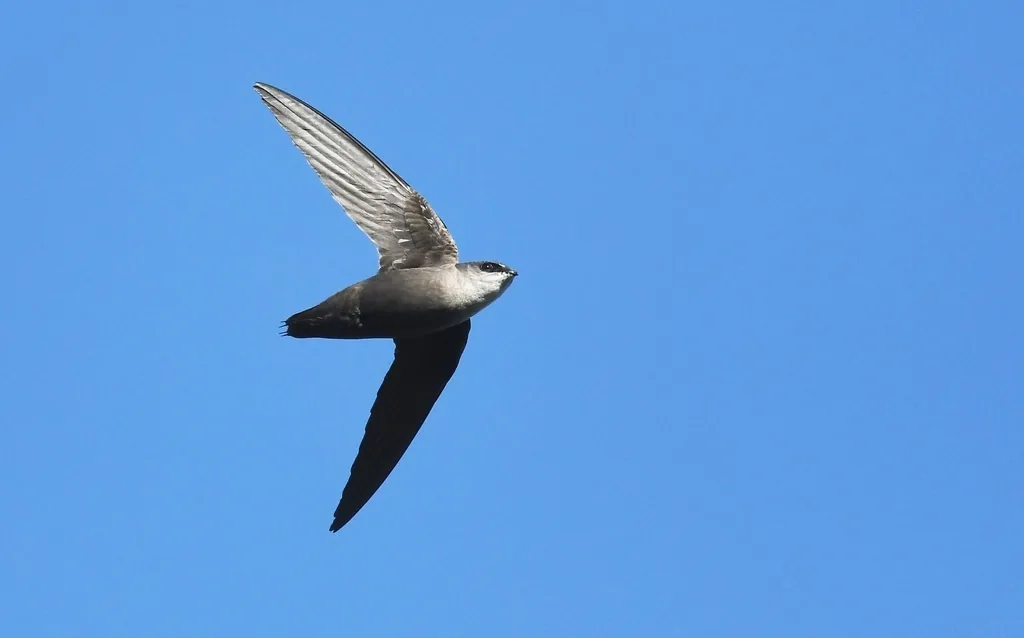
- A small brown bird, about 5 1/4 inches long, with a whitish throat and upper breast and a short, square-tipped tail.[1]
- In flight it looks like a flying cigar with long, narrow, curved wings that flap quickly, stiffly and shallowly; in the breeding season pairs often glide with wings raised in a V.[1]
- It cannot perch upright on branches; it clings only to vertical surfaces inside chimneys, hollow trees and similar dark spaces.[1][2]
- Its call is a rapid series of loud chips or ticking sounds, and nestlings make a loud chirping inside the chimney.[1][2]
Look-alikes
| Look-alike | How to tell them apart |
|---|---|
| Swallows, including cliff swallows | In swallows the bend of the wing is farther out from the body, giving a triangular wing and graceful, fluid wingbeats; swift wings together form a crescent and beat shallowly and stiffly.[1] |
Where it lives
Chimney swifts spend the summer across eastern North America and migrate to South America for the winter, leaving Missouri in October. GBIF holds about 3.6 million US records since 1990 from 39 states, counting the District of Columbia, most from Pennsylvania, Texas and Ohio.[1][7]
Biology and life cycle
They originally nested in hollow trees, especially large hollow sycamores, and on cliff faces; as old forests were cut and chimneys spread, most came to rely on chimneys, old barns, silos and similar structures.[1][2]
The nest is a small cup of twigs glued together and to the chimney wall with saliva.[1]
Only one pair nests in a chimney, though the nestlings' loud chirping makes it sound like more.[1]
Swifts arrive in Missouri in April. Females lay 3 to 5 eggs; incubation lasts about 15 to 20 days, and the young fledge 15 to 20 days after hatching.[1]
In fall evenings, hundreds of migrating swifts may circle a large chimney for an hour before dropping in to roost for the night. In a Nova Scotia study, 76 percent of swifts used more than one of the ten roosts in a local network during the breeding season.[1][6]
They catch flying insects on the wing, including mosquitoes and other biting flies, termites, beetles, true bugs, mayflies and caddisflies.[1]
In New Brunswick and Nova Scotia, swifts chose cooler chimneys for nesting; occupancy fell as maximum and average chimney temperatures rose, and chimney material made no difference.[5]
Damage and signs
Health risk
North Carolina's wildlife agency lists no safety concerns from chimney swifts, but recommends gloves when handling any animal.[2]
Control
Prevention
Wait it out: once the young are calling, they will fledge within a few weeks and the noise will stop.[2]
Keep them out
After the swifts have left for the season, cap the top of the chimney to keep birds out in the future.[2]
Never cap a chimney with an active nest, because shutting out the adults will cause the young to die.[2]
Sanitation
Have the chimney cleaned each year for safety, but not while swifts are nesting, from May through August.[1]
When to call a professional
North Carolina's wildlife agency says removing swifts always requires a federal permit, obtained with help from USDA Wildlife Services through the U.S. Fish and Wildlife Service, plus a state depredation permit.[2]
Legal status
The chimney swift is on the federal list of migratory birds protected by the Migratory Bird Treaty Act.[9][3][2]
The Act prohibits taking (including killing, capturing, selling, trading and transporting) protected migratory birds without prior authorization from the U.S. Fish and Wildlife Service, and the Service says that protection covers their nests and eggs too.[3][10]
Swifts can't be relocated, and active nests with eggs or nestlings can't be removed, without a federal permit.[2][10]
If a young swift falls into the fireplace
Young swifts can climb and preen before their feathers grow in, so leave a fallen nestling alone for 24 hours before calling a licensed wildlife rehabilitator.[2]
Licensed rehabilitators can take sick or injured swifts.[2]
Why swift numbers are falling
Swifts were abundant when most buildings had stone, brick or tile-lined chimneys. The Missouri Department of Conservation says numbers have declined steeply since the 1960s as chimneys are capped or lined with metal that swifts can't cling to, and some people build swift towers to help.[1]
A 48-year record of swift droppings from an Ontario chimney, 1944 to 1992, showed a steep rise in DDT that coincided with fewer beetle remains and more true bug remains, and its authors argue the change in prey had nutritional consequences for swifts and other aerial insectivores.[4]
Where sources disagree
Is the decline about chimneys? The Missouri Department of Conservation blames capped and metal-lined chimneys. A 2019 study of nesting chimneys notes that data from Ontario did not support a shortage of chimneys as the limiting factor and points to chimney quality, such as temperature, instead; a 2012 study points to pesticide-driven changes in the insects swifts eat.[1][5][4]
Do you always need a permit? North Carolina's wildlife agency says a federal permit is always required to remove chimney swifts. A federal rule lets people promptly remove migratory birds, nests, eggs and nestlings from inside homes and businesses where they disrupt normal use, but the Fish and Wildlife Service's summary of that rule doesn't mention chimneys, and state laws can add their own protections.[2][11][10]
Common questions
- Can I get the birds out of my chimney now?
- Not if they are nesting. Chimney swifts are federally protected, and active nests with eggs or nestlings can't be removed without a federal permit, so wait until the young fledge and the birds leave.[2][9]
- When can I cap my chimney?
- Outside the nesting season, after the swifts have left. In Missouri they leave for South America in October.[2][1]
- What is the chattering noise in my chimney?
- If you hear loud, chirping calls in summer, it's likely chimney swift nestlings, which become noisy at about two weeks old.[2][1]
- Are chimney swifts declining?
- Yes. Missouri reports a steep decline since the 1960s; researchers have pointed to lost or unsuitable chimneys and to pesticide-driven changes in their insect prey.[1][5][4]
Sources
- Missouri Department of Conservation, “Chimney Swift (Field Guide).” mdc.mo.gov/discover-nature/field-guide/chimney-swift (accessed 2026-11-11)
- North Carolina Wildlife Resources Commission, “Chimney Swifts (wildlife damage control guidance).” ncwildlife.gov/media/2294/download (accessed 2026-11-11)
- U.S. Fish and Wildlife Service, “Migratory Bird Treaty Act of 1918.” www.fws.gov/law/migratory-bird-treaty-act-1918 (accessed 2026-11-13)
- Proceedings of the Royal Society B, via PubMed, “Historical pesticide applications coincided with an altered diet of aerially foraging insectivorous chimney swifts (Nocera et al. 2012).” pubmed.ncbi.nlm.nih.gov/22513860/ (accessed 2026-11-11). Cited from the PubMed abstract.
- Journal of Thermal Biology, via PubMed, “Ambient temperature preferences of chimney swifts (Chaetura pelagica) for nest site selection (2019).” pubmed.ncbi.nlm.nih.gov/30784493/ (accessed 2026-11-11). Cited from the PubMed abstract.
- Ecology and Evolution, via PubMed, “Roost sites of chimney swift (Chaetura pelagica) form large-scale spatial networks (2021).” pubmed.ncbi.nlm.nih.gov/33976777/ (accessed 2026-11-11). Cited from the PubMed abstract.
- Global Biodiversity Information Facility (GBIF), “Chaetura pelagica: US occurrence records since 1990 by state (GBIF occurrence search API).” api.gbif.org/v1/occurrence/search?taxonKey=4409023&country=US&hasGeospatialIssue=false&occurrenceStatus=PRESENT&year=1990%2C2026&facet=stateProvince&facetLimit=400&limit=0 (accessed 2026-11-11). State counts are records reported (iNaturalist research-grade, museum specimens, surveys), not abundance.
- iNaturalist, “Chaetura pelagica taxon page (order and family).” www.inaturalist.org/taxa/6571 (accessed 2026-11-11)
- U.S. Fish and Wildlife Service, “List of Birds Protected by the Migratory Bird Treaty Act, 50 CFR 10.13 (2023 update, spreadsheet).” www.fws.gov/sites/default/files/documents/CFR50-Part10.13-2023.xlsx (accessed 2026-11-13). Linked from https://www.fws.gov/media/list-birds-protected-migratory-bird-treaty-act-2023
- U.S. Fish and Wildlife Service, “Migratory Bird Program Memorandum 2: Authorizations to take migratory bird nests and contents (Jan. 2025).” www.fws.gov/sites/default/files/documents/2025-01/mbpm-2-nest-memorandum-2025.pdf (accessed 2026-11-13)