On this page
How to identify it
- A medium-sized parrot, about 11 to 13 inches from head to the tip of its long, tapered tail, weighing 3 to 4 ounces. UF/IFAS gives a wingspan of 20 inches (53 cm) and a weight of 3 to 4 ounces.[2][1][3]
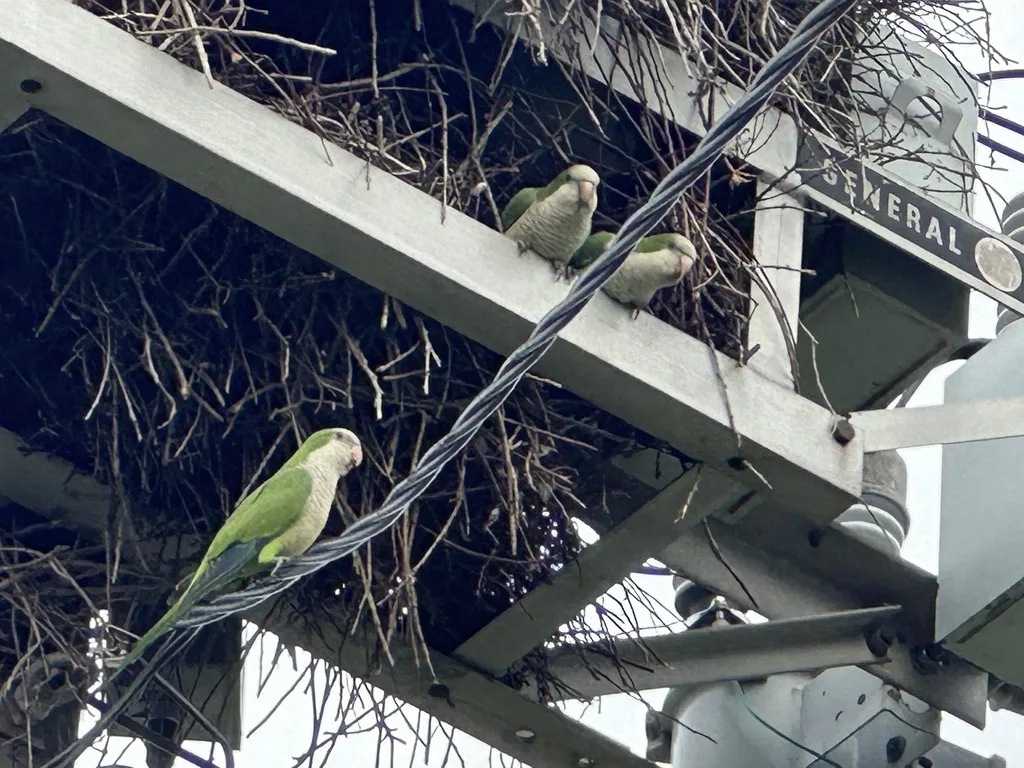
- Mostly green, with a gray face, throat and breast; the gray breast feathers have pale edges that give a scalloped look.[2][4]
- The bill is pale pinkish, and blue flight feathers show on the wings in flight. UF/IFAS adds that the thick bill is yellow-brown, the flight feathers are blue to bluish-black, the sexes look alike all year, and juveniles may be brighter green.[2][4][3]
- The gray head and breast set it apart from other parrots living wild in North America.[1]
- Flocks are loud, and their raucous contact calls can be very annoying to neighbors of a colony.[1][4]
Look-alikes
| Look-alike | How to tell them apart |
|---|---|
| Other feral parrots and parakeets | Other escaped parrots lack the monk parakeet's gray face and breast, and none build bulky stick nests.[1][2] |
| White-winged and yellow-chevroned parakeets | Two introduced Florida parakeets that look very similar but are slightly smaller, with green faces and chests and an obvious yellow band on the wings, UF/IFAS says.[3] |
| Nanday conure (black-hooded parakeet) | Another introduced Florida parrot of similar build, but with a distinctly black head, according to UF/IFAS.[3] |
| Budgerigar | UF/IFAS says budgies lack the monk parakeet's gray face and chest and are only half its size.[3] |
Where it lives
Native to lowland South America. Established U.S. populations live in New York, Connecticut, Illinois, Texas, Louisiana and Florida, with Florida's largest around Miami, West Palm Beach and Tampa. UF/IFAS says populations have been documented in at least 14 states but often disappear as fast as they arrive; the greatest concentrations are in peninsular Florida and southeastern Texas, with persistent populations in New York City, Chicago and Connecticut. The species was first documented nesting in Florida in 1969.[1][2][3]
Biology and life cycle
They live in social flocks and build bulky nests of sticks and twigs, adding to and maintaining them all year.[2][1]
Nests are communal: each pair has its own apartment of at least two chambers, built onto the main structure as the colony grows.[2][1]
Pairs are monogamous and raise one clutch of 4 to 8 eggs a year.[1]
They eat fruit, seeds, buds, flowers and insects, and readily visit backyard feeders for sunflower seeds. UF/IFAS adds grass seeds, acorns, pine nuts, palm fruits and dandelions, and says flocks sometimes forage while sentinels watch for predators from high perches.[1][2][3]
Monk parakeets don't shy away from people and are found in towns, suburbs, farms and orchards.[2][4]
In the 1960s monk parakeets became very popular pets, and U.S. imports rose to more than 16,000 birds a year by the end of the decade, UF/IFAS says; wild birds reported since then probably escaped from damaged shipping crates, owners or zoos, or were released.[3]
UF/IFAS calls it the only parrot that builds nests of sticks instead of using cavities. In Florida it nests in tall melaleuca or palm trees, or more often on radio towers, light poles and electric utility structures, using whatever material is nearby, often landscape plants such as bougainvillea.[3]
Damage and signs
- The main U.S. conflict is with electric utilities. In one south Florida study, 60 percent of nests were on energized utility equipment.[1]
- Nesting material can complete a circuit between energized parts or to a grounded part, causing power outages and fires that damage transformers. UF/IFAS says large nests cause short circuits mainly when they get wet, and that removing them from utility structures can be difficult and dangerous.[1][3]
- Monk parakeets and other birds damage tropical fruit crops such as longans and mangos, and they may also feed on citrus, corn and sorghum. In South America, UF/IFAS says, monk parakeets destroyed up to 45% of some crops in the mid-1970s; impacts that severe have not been seen in Florida, though research suggests they may significantly damage some specialty tropical fruits.[1][2][3]
- Their raucous contact calls can be very annoying to people living near a colony.[1]
- Their effect on native wildlife is likely minimal, UF/IFAS says, since they nest mostly on man-made structures and get much of their food from bird feeders.[3]
Health risk
The main safety concern is nests on energized utility equipment, which can short circuit and start fires.[1]
Control
Prevention
UF/IFAS suggests limiting food: taking down bird feeders and removing fruit-producing ornamentals, especially invasive Brazilian pepper, can make a yard less attractive and keeps the birds from spreading those seeds. It also urges pet owners never to release birds outdoors.[3]
Keep them out
Hard plastic anti-perching cones can be somewhat effective on transmission towers, but there is no practical way to exclude them from distribution poles or substations.[1]
Traps and physical control
Nest removal gives only short-term relief, because the birds tend to rebuild immediately.[1]
Red laser light made monk parakeets leave a nest colony in tests, but the effect didn't last.[1]
Pesticides
No toxicants are registered for monk parakeets. The contraceptive diazacon cut eggs and chicks by 68 percent in trials but remains experimental and unregistered with the EPA.[1]
When to call a professional
Where removal is legal, trapping at the nest with a long-handled net works best after dark, when birds are less likely to scatter.[1]
Legal status
Monk parakeets are non-native and not protected by the federal Migratory Bird Treaty Act.[1]
The U.S. Fish and Wildlife Service's list of birds outside the Act includes the parrot family, Psittacidae.[5]
State rules vary considerably, from no regulation at all to complete protection, so check with your state wildlife agency before taking any action.[1]
In Florida they are regulated as Class III wildlife: a permit is needed to keep them for exhibition or sale, but not as personal pets.[2]
Why shooting is rarely an option
Most U.S. monk parakeets nest, feed and fly in populated areas, which severely limits the use of firearms.[1]
Common questions
- Are monk parakeets protected?
- Not federally, since the Migratory Bird Treaty Act doesn't cover them, but state protection ranges from none to complete.[1][5]
- Why do monk parakeets build nests on power poles?
- They build big stick nests on human structures, and utility equipment is a favorite; in one Florida study most nests were on energized equipment.[4][1]
- Will knocking down the nest make them leave?
- Usually not for long. Monk parakeets tend to rebuild right away, so nest removal gives only short-term relief.[1]
Sources
- USDA APHIS Wildlife Services, “Monk Parakeets, Wildlife Damage Management Technical Series (M. L. Avery and J. R. Lindsay, November 2016).” www.aphis.usda.gov/sites/default/files/Monk-Parakeet.pdf (accessed 2026-11-12)
- Florida Fish and Wildlife Conservation Commission, “Monk Parakeet (Myiopsitta monachus) species profile.” myfwc.com/wildlifehabitats/profiles/birds/monk-parakeet/ (accessed 2026-11-12)
- University of Florida IFAS Extension (EDIS), “Florida's Introduced Birds: Monk Parakeet (Myiopsitta monachus), WEC257/UW302 (S. A. Johnson and S. Logue, June 2009).” journals.flvc.org/edis/article/view/117964 (accessed 2026-11-14). Archived EDIS fact sheet; the Ask IFAS page (ask.ifas.ufl.edu/publication/UW302) returns 410, so the journals.flvc.org EDIS copy was read.
- Cornell Lab of Ornithology, All About Birds, “Monk Parakeet Identification.” www.allaboutbirds.org/guide/Monk_Parakeet/id (accessed 2026-11-12)
- U.S. Fish and Wildlife Service, “Final List of Bird Species to Which the Migratory Bird Treaty Act Does Not Apply (notice of availability, April 16, 2020; FWS-hosted copy).” www.fws.gov/sites/default/files/federal_register_document/2020-06782.pdf (accessed 2026-11-13)
- iNaturalist, “Myiopsitta monachus taxon page (order and family).” www.inaturalist.org/taxa/19349 (accessed 2026-10-06)