On this page
How to identify it
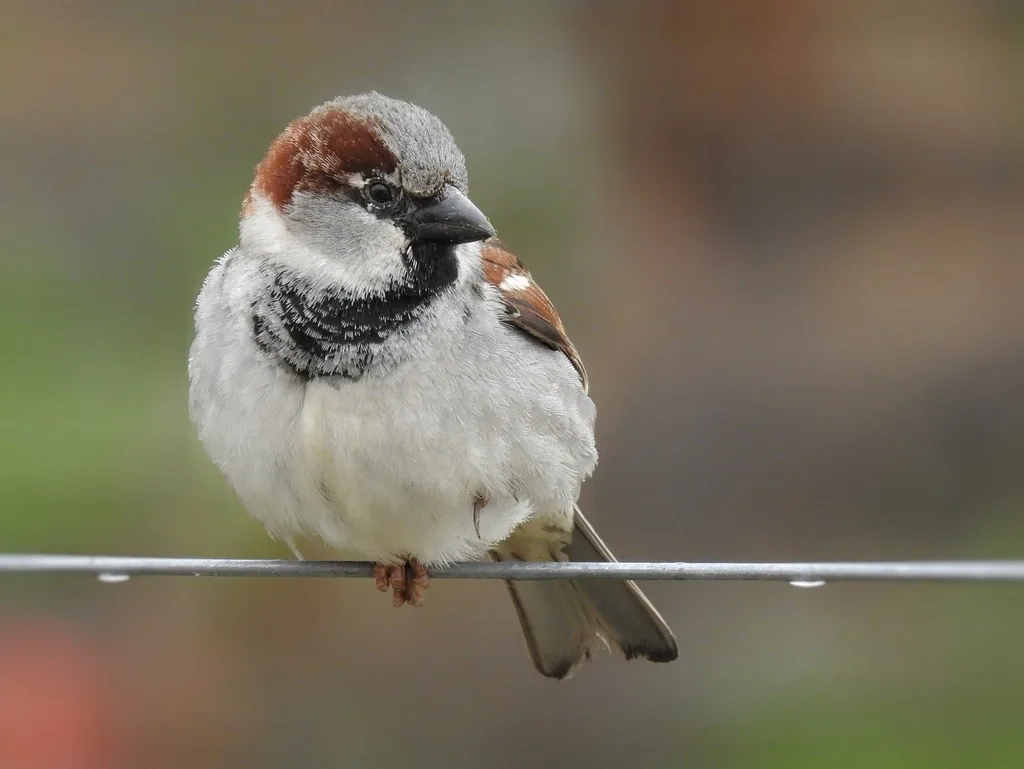
- A small, light brown bird 5 to 6 1/2 inches long, weighing less than an ounce, with a streaked back and gray breast and belly.[2]
- Males have a black throat bib flanked by white spots. Females and young males are plain streaky brown, which makes them easy to confuse with native sparrows.[2]
- The call is a sharp, repeated cheep.[2]
- Nests are untidy, bulky piles of grass, string, paper and twigs, often with feathers and plastic, that fill the whole cavity. Native songbirds in the same places build much tidier nests.[2][1]
Look-alikes
| Look-alike | How to tell them apart |
|---|---|
| Native sparrows (song, chipping, grasshopper and others) | Native sparrows are protected and beneficial, and female house sparrows are easy to mistake for them. Males are easy to spot by the black bib; confirm the species before any control.[2] |
| European starling | Starlings are robin-sized black birds about 8 inches long and about 3 ounces; house sparrows are small, streaky brown birds only 5 to 6 1/2 inches long.[2][3] |
Where it lives
Originally a bird of Europe, Asia and northern Africa, it has been carried by people to every continent except Antarctica and lives in farms, towns and cities; in North America it ranges from sea level to about 10,000 feet. GBIF's 1990-2026 U.S. records (about 13.2 million, from 50 states on the map) come mostly from New York, Texas and California.[1][8]
Biology and life cycle
They nest from mid spring to late summer in cavities of houses, barns, grain elevators, bird boxes and bridges, and sometimes in vines on walls or in a dense tree or shrub.[1]
Females lay 3 to 9 eggs per clutch and can nest up to five times a year, beginning in early April.[2]
They eat seeds all year, especially corn, and add insects and grubs in warm months; around livestock, fly larvae from dung are a summer staple. They also eat fruit and fat.[1][2]
Outside the nesting season, flocks of a few to many dozens feed on the ground and roost on buildings, vines and dense shrubs.[1]
Damage and signs
- Bulky nests tucked into vents, eaves and signs are highly flammable, a fire threat to buildings.[1]
- Droppings and feathers under roosts create unsanitary conditions around buildings and foul sidewalks and cars, and roosts are noisy morning and evening.[1][2]
- They eat and contaminate grain at farms, storage sites and nearby fields.[1]
- They compete with purple martins and eastern bluebirds for nest sites, often destroying bluebird nests and occasionally killing the adults.[2][1]
- Their nests harbor fleas, mites and lice that can spread to poultry and occasionally bite people.[1][2]
Health risk
House sparrows can get salmonellosis: in England and Wales it was the most frequent infectious cause of death in garden birds sent for examination from 1993 to 2003, with house sparrows among the two species most often affected. A Belgian survey of 364 healthy house sparrows, though, found no Salmonella Typhimurium in their droppings, so healthy birds there were not a significant reservoir. In a New Zealand lab study, an outbreak strain killed house sparrows at higher doses.[5][6][7]
Control
Keep them out
Close all openings larger than 3/4 inch on buildings, and use mesh with holes no bigger than 3/4 inch over larger openings.[1]
Screen bathroom and exhaust vents with 1/2-inch mesh (watch dryer vents, where lint can build up and catch fire), and box in gaps under dormers and porches with 1/2-inch hardware cloth or netting.[2]
Remove vines on walls or dense shrubs that draw roosting sparrows, or cover plants you want to keep with plastic mesh or nylon netting.[1]
Raise the angle of ledges to 45 degrees with sheet metal, plexiglass or wood blocks so they are poor perches.[1]
Sanitation
Limit access to grain. In Iowa, fewer open grain stores around livestock operations are a big reason house sparrows are much less numerous than 100 years ago.[1]
Traps and physical control
Remove nest material and eggs from building cavities and bird boxes and repeat about every two weeks through the nesting season. Wear gloves and bag the material to avoid nest mites and lice.[1][2]
Funnel traps and automatic 'elevator' traps catch house sparrows. Move them around so the birds don't become trap shy, and check traps regularly so native birds can be released unharmed.[1][2]
Protecting bluebird and martin houses
Remove sparrow nests from nest boxes as soon as they appear and keep removing them, from spring through fall, because the birds quickly rebuild in the same place.[2][1]
Legal status
The Migratory Bird Treaty Act protects only native migratory birds. In its 2020 notice listing birds the Act does not cover, the U.S. Fish and Wildlife Service explains that the house sparrow belongs to the Passeridae, a family that does not qualify for protection under the Act.[9]
Iowa and Nebraska also exempt house sparrows from state protection, along with pigeons and starlings. Check local ordinances before shooting, and be sure of the species, since native sparrows are protected.[1][2]
Common questions
- How do I stop sparrows from nesting in my vents and eaves?
- Remove the nest, cover exhaust vents with 1/2-inch mesh (watching dryer vents for lint), and close gaps over 3/4 inch; keep checking, since sparrows rebuild quickly.[2][1]
- Are house sparrows protected?
- Not by federal law: the U.S. Fish and Wildlife Service says the house sparrow's family, Passeridae, does not qualify under the Migratory Bird Treaty Act. Check state and local rules, and be sure it isn't a native sparrow.[9][2]
- Why are sparrows kicking bluebirds out of my nest box?
- House sparrows compete hard for nest cavities and often destroy bluebird nests, so remove their nests promptly and repeatedly.[2][1]
Sources
- Iowa State University Extension and Outreach, Natural Resource Stewardship, “Nuisance Birds: Damage Management (last reviewed July 1, 2019).” naturalresources.extension.iastate.edu/encyclopedia/nuisance-birds-damage-management (accessed 2026-11-11)
- University of Nebraska-Lincoln Extension, “G2024: Urban Pest Birds: Controlling Damage.” extensionpubs.unl.edu/publication/g2024/html/view (accessed 2026-11-11)
- University of Illinois Extension, “European Starlings (Invasive Species).” extension.illinois.edu/invasives/european-starlings (accessed 2026-11-11)
- iNaturalist, “Passer domesticus taxon page (order and family).” www.inaturalist.org/taxa/13858 (accessed 2026-11-11)
- EcoHealth, via PubMed, “Lawson B, Howard T, Kirkwood JK, et al. (2010), Epidemiology of salmonellosis in garden birds in England and Wales, 1993 to 2003, EcoHealth 7(3):294-306.” pubmed.ncbi.nlm.nih.gov/20945078/ (accessed 2026-11-11). Cited from the PubMed abstract.
- PLoS One, via PubMed, “Rouffaer LO, Lens L, Haesendonck R, et al. (2016), House sparrows do not constitute a significant Salmonella Typhimurium reservoir across urban gradients in Flanders, Belgium, PLoS One 11(5):e0155366.” pubmed.ncbi.nlm.nih.gov/27168186/ (accessed 2026-11-11). Cited from the PubMed abstract.
- New Zealand Veterinary Journal, via PubMed, “Connolly JH, Alley MR, Dutton GJ, Rogers LE (2006), Infectivity and persistence of an outbreak strain of Salmonella enterica serotype Typhimurium DT160 for house sparrows (Passer domesticus) in New Zealand, New Zealand Veterinary Journal 54(6):329-332.” pubmed.ncbi.nlm.nih.gov/17151733/ (accessed 2026-11-11). Cited from the PubMed abstract.
- Global Biodiversity Information Facility (GBIF), “Passer domesticus (house sparrow): occurrence records in the U.S., 1990-2026 (GBIF occurrence search).” api.gbif.org/v1/occurrence/search?taxonKey=5231190&country=US&hasGeospatialIssue=false&occurrenceStatus=PRESENT&year=1990%2C2026&facet=stateProvince&facetLimit=400&limit=0 (accessed 2026-11-11). State counts are records reported (iNaturalist research-grade, museum specimens, surveys), not abundance.
- U.S. Fish and Wildlife Service, “Final List of Bird Species to Which the Migratory Bird Treaty Act Does Not Apply (notice of availability, April 16, 2020; FWS-hosted copy).” www.fws.gov/sites/default/files/federal_register_document/2020-06782.pdf (accessed 2026-11-13)