The short answer
- Most likely: droppings 1/8 to 1/4 inch long with pointed ends are mouse droppings. Rat droppings are bigger, 1/2 to 3/4 inch, and cockroach droppings have ridges and squared-off ends.[1][3][5]
- Is it dangerous? Mouse droppings, urine and nests can carry germs that make people sick, mainly when dried material is stirred into the air and breathed in. The deer mouse spreads the most common hantavirus in the United States, and house mice spread lymphocytic choriomeningitis (LCM) virus.[11][12][15][16][17]
- First: don't sweep or vacuum. Wear rubber or plastic gloves, spray the droppings with a bleach solution or a disinfectant until very wet, let it soak, then wipe up with paper towels and bag them.[12][18]
- Then: look for how mice are getting in, set snap traps where you found the droppings, and seal gaps as small as 1/4 inch.[13][14][1]
Profiles on this site
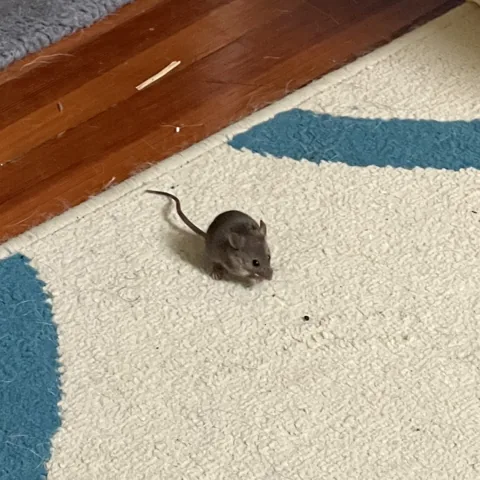 House Mouse
Mus musculus
The house mouse is a small, adaptable rodent that lives close to people in homes, schools and food businesses, eating and contaminating food, gnawing wiring and carrying disease.
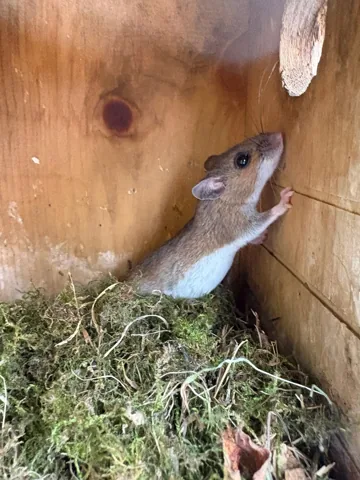 Deer Mouse
Peromyscus species (shown: P. maniculatus)
The deer mouse is a wild mouse with a white belly and a furred, two-toned tail that sometimes moves into cabins, sheds and homes. In the United States it spreads the most common hantavirus that causes hantavirus pulmonary syndrome (HPS), a severe and potentially deadly lung disease, so the droppings and nests it leaves need careful cleanup.
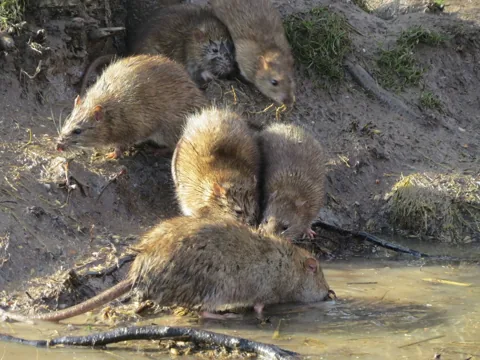 Norway Rat
Rattus norvegicus
The Norway rat, also called the brown or sewer rat, is a large, burrowing rat found throughout the contiguous United States wherever people live.
What the droppings could be
Size and shape sort most droppings. CDC adds that rodent droppings are pointed at one end and often have hair in them, and that they are common in cabinets, drawers and other spots out of plain sight.[11][1][3]
- House mouse: small, 1/8 to 1/4 inch long (the Internet Center for Wildlife Damage Management gives an average of 1/4 inch) with pointed ends, found along runways, in feeding areas and near shelter.[1][3]
- Deer mouse: the Northeastern IPM Center gives the same 1/8 to 1/4 inch size with pointed ends, so droppings alone won't separate a deer mouse from a house mouse. UC IPM says deer mice often get into vacant homes, cabins and other buildings. Our house mice vs deer mice guide covers the animals themselves.[2][7]
- Rat: much larger, 1/2 to 3/4 inch long with blunt ends. A Norway rat's droppings can be 1/4 inch across and are usually clumped in small groups, while other rodents scatter theirs. If yours are this size, see our mice or rats guide.[1][2][5]
- Cockroach: usually 1/8 to 1/4 inch, about the size of a mouse dropping, but under a magnifying glass they show lengthwise ridges and squared-off ends. UC IPM says cockroach fecal matter also shows up as dark spots or smears where roaches hide, along with cast skins and egg cases.[3][8]
- Bat: bat droppings contain bits of insects and crumble easily, and they can build up where bats roost in buildings. UC IPM says not to breathe the dust from bat droppings; cleaning them is a different job with its own guide.[3][9]
Do a few droppings mean a lot of mice?
Not necessarily. One mouse leaves a lot of droppings: ICWDM puts it at about 36,000 a year. A small pile in one drawer can come from a single mouse, and droppings alone don't tell you whether that mouse is still around.[4][11]
The reason to act now is how fast mice breed. With steady food and shelter, house mice breed year-round. UC IPM says a female may have 5 to 10 litters a year of about 5 or 6 pups each, and young mice can breed at 5 to 6 weeks old. NPIC adds that mice live only 1 to 1 1/2 years but reproduce quickly, so early detection keeps damage from getting out of control.[6][10]
To find out whether mice are active now, CDC suggests safely cleaning the area and checking again. Droppings that appear after cleaning mean mice are still there. Mice are mostly active at night, though you might see one in daylight.[11][6]
Safety first: before you touch anything
CDC lists hantavirus, LCM, leptospirosis and salmonellosis among the diseases rodents can spread directly to people. They spread by breathing contaminated air, touching contaminated surfaces and then your eyes, nose or mouth, by bites and scratches, or by eating food a rodent has contaminated.[11]
Hantavirus: MedlinePlus explains that infected rodents shed the virus in urine, droppings and saliva, and tiny droplets carrying it can get into the air. In North America the Sin Nombre virus is carried by deer mice, and Washington's health department says infected deer mice don't get sick themselves.[17][18][15]
LCM: CDC says LCM virus is spread by the common house mouse, and anyone who contacts fresh urine, droppings, saliva or nesting material of wild mice could be exposed. Most healthy people have no symptoms or mild ones, but the infection can be serious for people with weakened immune systems and for pregnant women, because it can pass to the fetus.[16]
Why no sweeping or vacuuming: CDC says sweeping or vacuuming urine, droppings or nests can put tiny droplets containing viruses into the air. Washington's health department says the same and adds that a dust mask may give some protection against dust but does not protect against viruses.[12][18]
How to clean up a few droppings (CDC's wet method)
These steps are for an ordinary find in a cabinet, drawer or along a wall. A shed, cabin or building that has been closed up, or a heavy infestation, needs extra steps; see our hantavirus safety guide.[12]
- Air it out: when cleaning a home or outbuilding, CDC says to open all doors and windows for 30 minutes before you start and stay out during that time.[12]
- Gloves on: rubber or plastic gloves.[12]
- Soak: spray the droppings and any urine with a disinfectant labeled as one, or a fresh bleach solution of 1 1/2 cups of household bleach in 1 gallon of water (1 part bleach to 9 parts water), until very wet.[12][18]
- Wait: CDC says let it soak for 5 minutes or as the disinfectant label directs. Washington's health department says to let it soak for 10 minutes before removing anything. Soaking for 10 minutes meets both.[12][18]
- Wipe and bag: wipe up the droppings with paper towels and put them in a covered garbage can that is emptied regularly.[12]
- Disinfect the area: mop or sponge the area, including floors, countertops, cabinets and drawers.[12]
- Wash: wash gloved hands with soap and water or a disinfectant, take the gloves off, then wash your hands with soap and warm water.[12]
How to confirm it's mice
Look for other signs nearby: gnaw marks, nests of finely shredded paper or other fibrous material in sheltered spots, greasy smudge marks along walls where mice run, and urine stains. UC IPM says to check behind boxes, in drawers, in garages and around woodpiles for nests. Mice tend to run along walls and use the same routes every time.[1][3][11][6]
Listen at night: activity is much more noticeable after dark, when you may hear mice moving inside walls and ceilings.[1][3]
Our guide to getting rid of mice covers the other signs in detail, including a flour test for tracks. If the droppings are in a cabin, shed or a home that has stood empty, deer mice are a real possibility, so read the hantavirus guide before cleaning a large area.[3][7]
What to do next
Find the way in first. CDC says to check inside and outside the home for how mice got in, including gaps where electrical, plumbing, cable and gas lines enter. A mouse can fit through a hole the width of a pencil, about 1/4 inch.[13][14]
Trap where the droppings are. CDC recommends traditional snap traps and says to set them where you've seen droppings, urine, nesting material, nibbled food or gnaw marks, such as behind the stove and refrigerator and at the back of cabinets. Peanut butter works as bait.[13]
Skip glue traps and live traps. CDC says they can scare rodents into urinating, which raises your chance of getting sick.[13]
Keep trapping until it stops. CDC says to keep trapping until no mice are caught for a week and no new signs appear.[13]
Pets and baits: CDC says baits and traps must be kept out of reach of children and pets and only used for infestations that persist. If a pet eats a bait, the Merck Veterinary Manual says the exact product matters for treatment and baits can't be identified by color or shape alone, so keep the package.[13][19]
When to call a pro
A few droppings in one cabinet are usually a do-it-yourself job with snap traps and sealing. CDC points to professional help in these cases:[13][14]
- Trapping isn't working: CDC says if trapping doesn't solve the problem, consider a bait station or professional help.[13]
- Mice in places you can't reach to clean: CDC suggests a pest control specialist when rodents have gotten into areas that can't be reached.[14]
- Droppings in heating or cooling ducts: CDC says to call a professional rodent removal service, and notes that duct-cleaning companies know the risks of rodents in ventilation systems.[12]
- Large or long-standing infestations: NPIC suggests considering a professional and says there's an art to managing mice. CDC says heavy infestations need extra cleanup precautions.[10][12]
Symptoms to watch for after a cleanup
Hantavirus symptoms usually start 1 to 8 weeks after contact with an infected rodent. Later symptoms include coughing and shortness of breath.[15][17]
If you've been around rodents and have fever, deep muscle aches and severe shortness of breath, MedlinePlus and Washington's health department both say to see a health care provider right away and mention the rodent exposure.[17][18]
Common questions
- Can I just vacuum up mouse droppings?
- No. CDC says vacuuming or sweeping droppings, urine or nests can put droplets containing viruses into the air. Wet them with disinfectant first and wipe them up with paper towels.[12][18]
- How do I know if droppings are old or new?
- You often can't tell by looking. CDC suggests cleaning the area safely and checking again; new droppings after cleaning mean mice are still active. ICWDM notes fresh Norway rat droppings have a soft texture.[11][5]
- Are mouse droppings the same as cockroach droppings?
- They can be the same size, 1/8 to 1/4 inch, but cockroach droppings have lengthwise ridges and squared-off ends, while mouse droppings have pointed ends.[3][1]
- Does one dropping mean an infestation?
- Not by itself. A single mouse leaves many droppings. Clean up safely, set snap traps where you found them, and watch for new droppings or gnaw marks over the next week.[4][11][13]
Photo credits
- House Mouse: (c) Carrie Seltzer, some rights reserved (CC BY) — via iNaturalist, CC BY 4.0
- Deer Mouse: (c) Derek Duplessis, some rights reserved (CC BY) — via iNaturalist, CC BY 4.0
- Norway Rat: petehawkins, public domain (CC0), via iNaturalist
Sources
- Northeastern IPM Center, “House Mouse, Mus musculus (School IPM Best Practices).” www.northeastipm.org/schools/pests/house-mouse/ (accessed 2026-11-14)
- Northeastern IPM Center, “Deer Mouse, Peromyscus maniculatus (School IPM Best Practices).” www.northeastipm.org/schools/pests/deer-mouse/ (accessed 2026-11-14)
- Internet Center for Wildlife Damage Management, “House Mice: Identification and Damage Signs.” icwdm.org/species/rodents/house-mice/ (accessed 2026-11-14)
- Internet Center for Wildlife Damage Management, “House Mouse Damage Prevention and Control Methods.” icwdm.org/species/rodents/house-mice/house-mouse-damage-prevention-and-control-methods/ (accessed 2026-11-14)
- Internet Center for Wildlife Damage Management, “Norway Rats: Identification.” icwdm.org/species/rodents/norway-rats/ (accessed 2026-11-14)
- University of California Statewide IPM Program, “House Mouse (Pest Notes, Home and Landscape).” ipm.ucanr.edu/home-and-landscape/house-mouse/ (accessed 2026-11-14)
- University of California Statewide IPM Program, “Pest Notes: Deer Mouse.” ipm.ucanr.edu/legacy_assets/PDF/PESTNOTES/pndeermouse.pdf (accessed 2026-11-14)
- University of California Statewide IPM Program, “Pest Notes: Cockroaches, Publication 7467 (revised December 2019).” ipm.ucanr.edu/legacy_assets/PDF/PESTNOTES/pncockroaches.pdf (accessed 2026-11-14)
- University of California Statewide IPM Program, “Bats (Pest Notes, Home and Landscape).” ipm.ucanr.edu/home-and-landscape/bats/ (accessed 2026-11-14)
- National Pesticide Information Center, “Mice.” npic.orst.edu/pest/mice.html (accessed 2026-11-14)
- Centers for Disease Control and Prevention, “Controlling Wild Rodent Infestations.” www.cdc.gov/healthy-pets/rodent-control/index.html (accessed 2026-11-14)
- Centers for Disease Control and Prevention, “How to Clean Up After Rodents.” www.cdc.gov/healthy-pets/rodent-control/clean-up.html (accessed 2026-11-14)
- Centers for Disease Control and Prevention, “How to Trap Up to Remove Rodents.” www.cdc.gov/healthy-pets/rodent-control/trap-up.html (accessed 2026-11-14)
- Centers for Disease Control and Prevention, “How to Seal Up to Prevent Rodents.” www.cdc.gov/healthy-pets/rodent-control/seal-up.html (accessed 2026-11-14)
- Centers for Disease Control and Prevention, “About Hantavirus.” www.cdc.gov/hantavirus/about/index.html (accessed 2026-11-14)
- Centers for Disease Control and Prevention, “About Lymphocytic Choriomeningitis.” www.cdc.gov/lymphocytic-choriomeningitis/about/index.html (accessed 2026-11-14)
- MedlinePlus, U.S. National Library of Medicine, “Hantavirus Infections.” medlineplus.gov/hantavirusinfections.html (accessed 2026-11-14)
- Washington State Department of Health, “Hantavirus.” doh.wa.gov/you-and-your-family/illness-and-disease-z/hantavirus (accessed 2026-11-14)
- Merck Veterinary Manual, “Overview of Rodenticide Poisoning in Animals.” www.merckvetmanual.com/toxicology/rodenticide-poisoning/overview-of-rodenticide-poisoning (accessed 2026-11-14)