The short answer
- It's probably a house mouse, and probably not the only one. UC IPM says house mice can breed year-round and a female may have 5 to 10 litters of about 5 or 6 pups a year. Utah State Extension says seeing mice in the daytime could mean several mice in the house.[1][15]
- Tonight, look for droppings, gnaw marks, chewed food packages and shredded nesting material near where it ran. UC IPM and CDC both name droppings and gnaw marks as the main signs, and NPIC says to check for nests near chewing because mice usually stay within 30 feet of them.[1][9][3]
- Then trap, starve and seal. CDC recommends snap traps and says not to use glue traps or live traps; seal food in containers with tight lids; and fill small holes with steel wool held in with caulk, since mice fit through a hole the width of a pencil.[7][8]
Related profiles on this site
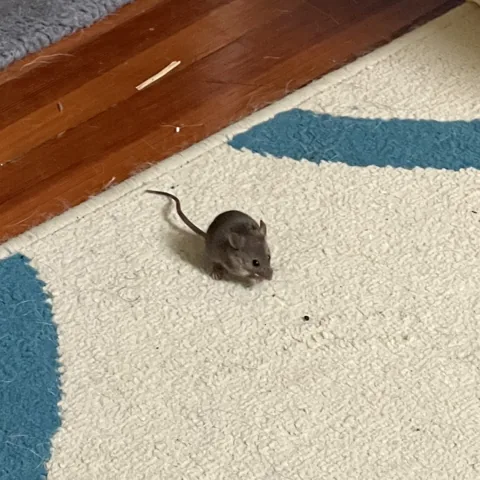 House Mouse
Mus musculus
The house mouse is a small, adaptable rodent that lives close to people in homes, schools and food businesses, eating and contaminating food, gnawing wiring and carrying disease.
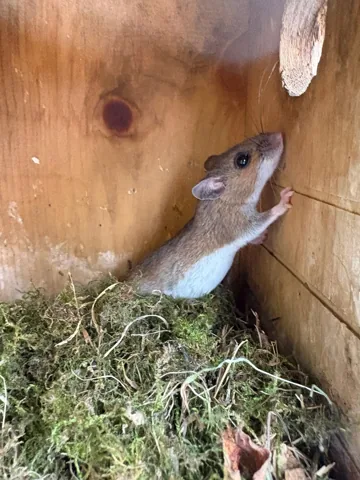 Deer Mouse
Peromyscus species (shown: P. maniculatus)
The deer mouse is a wild mouse with a white belly and a furred, two-toned tail that sometimes moves into cabins, sheds and homes. In the United States it spreads the most common hantavirus that causes hantavirus pulmonary syndrome (HPS), a severe and potentially deadly lung disease, so the droppings and nests it leaves need careful cleanup.
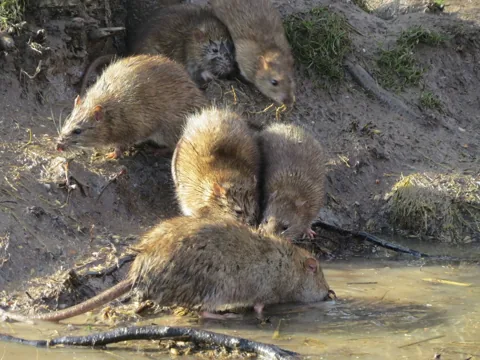 Norway Rat
Rattus norvegicus
The Norway rat, also called the brown or sewer rat, is a large, burrowing rat found throughout the contiguous United States wherever people live.
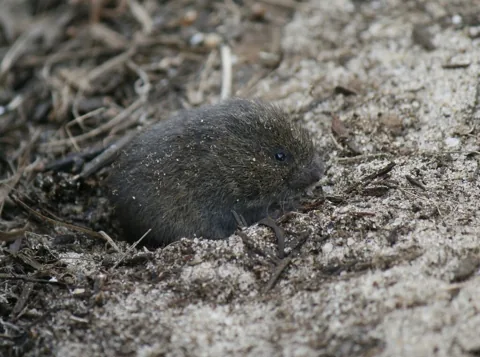 Voles (meadow mice)
Microtus species (shown: meadow vole, M. pennsylvanicus)
Voles, often called meadow mice, are small burrowing rodents that live in dense grass and ground cover. Their clearest sign is a maze of narrow surface runways, and they damage lawns, garden plants and the bark of young trees.
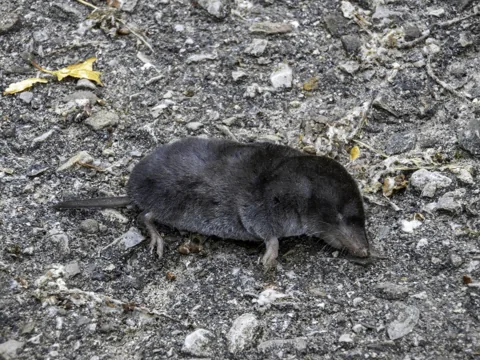 Shrews (northern short-tailed shrew)
Soricidae (e.g., Blarina brevicauda)
Shrews are small insect-eating mammals with long, pointed snouts and tiny eyes. They are mouselike but not mice, and the wildlife damage handbook notes that most species have no significant negative impact and aren't abundant enough to be pests. They eat large numbers of insects, including lawn and crop pests. This page uses the common northern short-tailed shrew as its main example.
Was it a mouse? What else it could be
You probably got a quick look. These sourced cues help sort out what ran past; the vs pages linked below go deeper.[1][4]
- House mouse: UC IPM says house mice are small, about 5 to 7 inches long including a 3- to 4-inch tail, light brownish to gray, with relatively large ears and small black eyes, and the tail has almost no fur.[1]
- Deer mouse: UC IPM says the deer mouse has larger eyes and a white underside with a sharp line between the dark top and the white belly. This matters because deer mice carry hantavirus in North America, MedlinePlus explains.[1][12]
- Young rat: UC IPM says a young rat can be confused with a mouse, but very young rats have large heads and feet for their body size, while adult mice have proportionately much smaller ones. Rats leave larger tooth marks.[4]
- Vole: UC IPM says common voles have short tails. Penn State Extension describes voles as having relatively large black eyes, small ears and a blunt face, and says meadow voles eat grasses and seeds.[1][5]
- Shrew: UC IPM says shrews have pointed snouts and tiny eyes. Missouri's conservation department describes a movable snout projecting well over the mouth, small to no external ears and very small eyes. Penn State says shrews feed mainly on insects and other invertebrates.[1][6][5]
Does one mouse mean more?
- Usually, yes, or soon. UC IPM says that with steady food, house mice reproduce year-round, young are born 18 to 21 days after conception and are sexually mature 5 to 6 weeks after birth. Utah State Extension says a pair can produce several litters within months.[1][15]
- The daytime question: Utah State Extension says mice are most active at night and often roam unseen, so if you start seeing them in the daytime you likely have an infestation. UC IPM adds that house mice are active whenever food is available, so a daytime sighting is not proof of a big problem on its own.[16][15][1]
- They stay close. UC IPM says house mice seldom go more than 30 feet from their nest and food, and NPIC says the same, so the mouse you saw is likely living near where you saw it.[1][3]
What to check tonight
- Droppings: look along walls, in cupboards, drawers and under the sink near where it ran. Our droppings page covers what they look like and how to clean them safely.[1][9]
- Gnaw marks: ICWDM says mouse gnaw marks are tiny, about 1/32 inch, and fresh piles of shavings or chewed insulation mean current activity. Rat marks are larger.[2][4]
- Food packages: check cereal, pet food, birdseed and grain. UC IPM says house mice eat about 200 small meals a night and may carry food away to eat somewhere hidden.[1]
- Nesting material: UC IPM says nests are made of finely shredded paper or other fibrous material in sheltered spots. NPIC says to check for nests near signs of chewing.[1][3]
- Smell: ICWDM says a musky odor is a positive sign mice are present, and UC IPM says it is common in large or long-term infestations.[2][1]
- Tracks: ICWDM says a smooth patch of flour left overnight in a runway will show footprints if rodents are moving through.[2]
Safety first
Don't handle mice, droppings or nests with bare hands, and don't sweep or vacuum droppings. CDC says sweeping or vacuuming urine, droppings or nests can put tiny droplets containing viruses into the air; follow the wet-cleanup steps on our hantavirus page.[10]
- Hantavirus: MedlinePlus says infected rodents shed the virus in urine, droppings and saliva, and in North America it is carried by deer mice. CDC says hantaviruses can cause serious illness and death.[12][11]
- LCM: CDC says LCM virus is spread by the common house mouse, and anyone who contacts fresh urine, droppings, saliva or nesting material of wild mice could be exposed.[13]
- Kids and pets: CDC says to keep baits and traps out of reach of children and pets. If a pet eats a rodent bait, the Merck Veterinary Manual says the exact product matters for treatment, so keep the package and call your vet.[7][14]
First steps
- Snap traps along the walls: UC IPM says to set traps close to walls so mice pass directly over the trigger, behind objects, in dark corners and where you found droppings, no more than about 10 feet apart. Utah State Extension says to plan on at least six traps per mouse seen.[1][16]
- Bait and pre-bait: Utah State Extension recommends small amounts of fresh peanut butter and baiting traps without setting them for a day or so. UC IPM says wide-trigger traps catch more and that a ball of cotton or dental floss can work as nest-building bait.[15][16][1]
- Lock up food: CDC says to keep food in thick plastic, metal or glass containers with tight lids, put pet food away after use, and don't leave food or water bowls out overnight.[8]
- Seal gaps: CDC says mice fit through a hole the width of a pencil (1/4 inch). Fill small holes with steel wool and caulk around it, and use hardware cloth, lath screen, metal sheeting or cement for larger holes. UC IPM says steel wool pads are a good temporary plug but may rust over time.[8][1]
- Keep at it: CDC says to leave baited traps out longer if you still have mice, and if trapping doesn't solve it, consider a bait station or professional help.[7]
What to skip
- Glue traps and live traps: CDC says not to use them because they can scare rodents into urinating, which can raise your chance of getting sick. UC IPM adds that adult mice often avoid glue boards, so they catch mostly young ones, and caught mice don't die quickly. An older Utah State Extension article lists glue traps as an option; we follow CDC.[7][1][15]
- Poison indoors: Utah State Extension says not to use rodenticides to control mice in homes because poisoned mice may die inside and the odor causes more problems. UC IPM says mice tend to stay within 30 feet of their nest, so poisoned mice often die inside the building. CDC says to use bait only for infestations that persist.[15][16][1][7]
- Moving them outside: UC IPM says relocating house mice is ineffective, since mice moved as far as a half mile can find their way back to their nest.[1]
When to call a pro
Common questions
- Will one mouse leave on its own?
- Don't count on it. UC IPM says house mice can reproduce year-round when food is steady and stay within about 30 feet of their nest and food.[1]
- How many traps do I need for one mouse?
- More than one. Utah State Extension says to plan on at least six traps per mouse seen, and UC IPM says to use enough traps to make trapping short and decisive.[16][1]
- Could it have been a rat?
- A young one, maybe. UC IPM says very young rats have large heads and feet for their bodies, and that mice and small juvenile rats often won't trigger a rat snap trap, so it helps to know which you have.[4]
- Can I just catch it and let it go outside?
- UC IPM says relocation is ineffective because house mice can navigate back from as far as a half mile, and released mice face aggression in new places. CDC says not to use live traps.[1][7]
Photo credits
- House Mouse: (c) Carrie Seltzer, some rights reserved (CC BY) — via iNaturalist, CC BY 4.0
- Deer Mouse: (c) Derek Duplessis, some rights reserved (CC BY) — via iNaturalist, CC BY 4.0
- Norway Rat: petehawkins, public domain (CC0), via iNaturalist
- Voles (meadow mice): (c) David LaMagna, some rights reserved (CC BY) — via iNaturalist, CC BY 4.0
- Shrews (northern short-tailed shrew): (c) Shaun Coleman, some rights reserved (CC BY) — via iNaturalist, CC BY 4.0
Sources
- University of California Statewide IPM Program, “House Mouse (Pest Notes, Home and Landscape).” ipm.ucanr.edu/home-and-landscape/house-mouse/ (accessed 2026-11-14)
- Internet Center for Wildlife Damage Management, “House Mice: Identification and Damage Signs.” icwdm.org/species/rodents/house-mice/ (accessed 2026-11-14)
- National Pesticide Information Center, “Mice.” npic.orst.edu/pest/mice.html (accessed 2026-11-14)
- University of California Statewide IPM Program, “Rats (Pest Notes, Home and Landscape).” ipm.ucanr.edu/home-and-landscape/rats/ (accessed 2026-11-14)
- Penn State Extension, “Identifying Moles, Voles, and Shrews.” extension.psu.edu/identifying-moles-voles-and-shrews (accessed 2026-11-14)
- Missouri Department of Conservation, “Shrews (field guide).” mdc.mo.gov/discover-nature/field-guide/shrews (accessed 2026-11-14)
- Centers for Disease Control and Prevention, “How to Trap Up to Remove Rodents.” www.cdc.gov/healthy-pets/rodent-control/trap-up.html (accessed 2026-11-14)
- Centers for Disease Control and Prevention, “How to Seal Up to Prevent Rodents.” www.cdc.gov/healthy-pets/rodent-control/seal-up.html (accessed 2026-11-14)
- Centers for Disease Control and Prevention, “Controlling Wild Rodent Infestations.” www.cdc.gov/healthy-pets/rodent-control/index.html (accessed 2026-11-14)
- Centers for Disease Control and Prevention, “How to Clean Up After Rodents.” www.cdc.gov/healthy-pets/rodent-control/clean-up.html (accessed 2026-11-14)
- Centers for Disease Control and Prevention, “About Hantavirus.” www.cdc.gov/hantavirus/about/index.html (accessed 2026-11-14)
- MedlinePlus, U.S. National Library of Medicine, “Hantavirus Infections.” medlineplus.gov/hantavirusinfections.html (accessed 2026-11-14)
- Centers for Disease Control and Prevention, “About Lymphocytic Choriomeningitis.” www.cdc.gov/lymphocytic-choriomeningitis/about/index.html (accessed 2026-11-14)
- Merck Veterinary Manual, “Overview of Rodenticide Poisoning in Animals.” www.merckvetmanual.com/toxicology/rodenticide-poisoning/overview-of-rodenticide-poisoning (accessed 2026-11-14)
- Utah State University Extension, “Should You Worry About Mice?.” extension.usu.edu/archive/should-you-worry-about-mice (accessed 2026-11-14)
- Utah State University Extension, “The House Mouse - Not Your Storybook Christmas Mouse.” extension.usu.edu/news_sections/agriculture_and_natural_resources/house-mouse-not-christmas-mouse (accessed 2026-11-14)