The short answer
- Look at the tail. A mouse's tail is long, nearly half its body length; a vole's tail is short. Penn State calls tail length the best way to tell them apart.[2][6]
- Look at the body and face. Voles have a compact, heavy body, short legs, small eyes and ears that barely show above the fur. House mice are slimmer, with relatively large ears.[1][2][6]
- Look at where it lives and what it damages. Voles leave narrow runways through grass, gnaw bark at the base of young trees, and rarely come indoors. House mice leave droppings and gnaw marks inside homes and other buildings.[1][4][6]
Rodents on this page
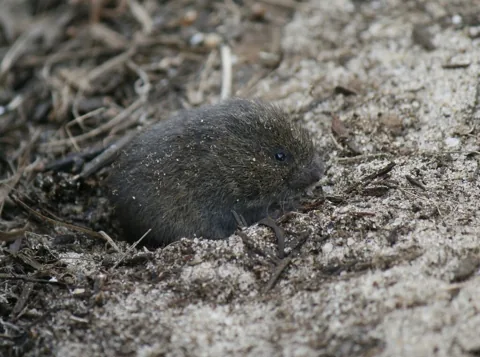 Voles (meadow mice)
Microtus species (shown: meadow vole, M. pennsylvanicus)
Voles, often called meadow mice, are small burrowing rodents that live in dense grass and ground cover. Their clearest sign is a maze of narrow surface runways, and they damage lawns, garden plants and the bark of young trees.
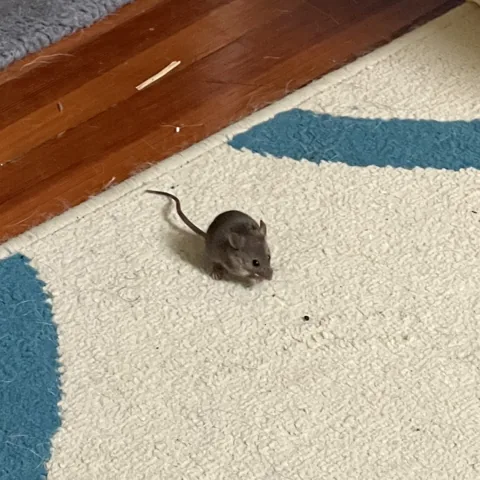 House Mouse
Mus musculus
The house mouse is a small, adaptable rodent that lives close to people in homes, schools and food businesses, eating and contaminating food, gnawing wiring and carrying disease.
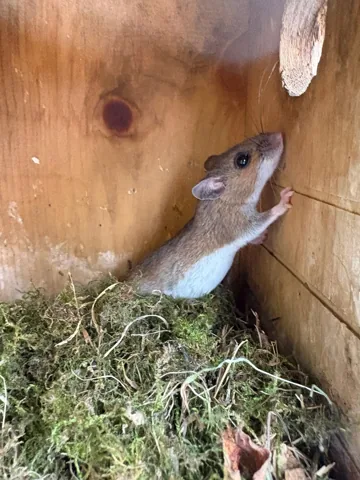 Deer Mouse
Peromyscus species (shown: P. maniculatus)
The deer mouse is a wild mouse with a white belly and a furred, two-toned tail that sometimes moves into cabins, sheds and homes. In the United States it spreads the most common hantavirus that causes hantavirus pulmonary syndrome (HPS), a severe and potentially deadly lung disease, so the droppings and nests it leaves need careful cleanup.
Side by side
Overall shape: voles are small, chunky, ground-dwelling rodents with stocky bodies, short legs and short tails. House mice are small rodents with relatively large ears and small black eyes, and they weigh about 1/2 ounce.[2][1][3][6]
- Size: UC IPM puts adult voles at 5 to 8 inches long including the tail, and Penn State at 5 to 7 inches. An adult house mouse is about 5 to 7 inches long including a 3 to 4 inch tail, so much of a mouse's length is tail.[1][2][6]
- Tail: mice have long tails that reach nearly half their body length, while voles have short tails. One species, the long-tailed vole, has a tail making up 30% or more of its total length, so in that species the tail is a weaker clue.[2][6][3]
- Ears and eyes: Penn State says voles have small black eyes and furred ears that do not project much above the hair, and UC IPM describes the ears as partially hidden. UC IPM describes house mice as having relatively large ears.[2][1][6]
- Fur and color: house mice are usually light brownish to gray, with a tail that has almost no fur. Vole fur is dense, and the thin hair on the tail is dark on top and lighter gray underneath; ICWDM describes prairie voles as gray to dark brown with a peppery look.[6][2][3]
- Where they live: voles live in grass and ground cover, in lawns, gardens, orchards, fence rows and field edges with protective cover such as vegetation, mulch or weed cloth. House mice often live near people, in and around homes, schools, restaurants and food facilities.[1][2][6]
- Coming indoors: UC IPM says voles are poor climbers that usually don't enter homes or other buildings and shouldn't be confused with the house mouse. House mice are excellent climbers and can get in through openings as small as 1/4 inch.[1][6][8]
- Signs in the yard: the clearest vole sign is a maze of well-used surface runways, 1 to 2 inches wide, connecting burrow openings about 1 1/2 to 2 inches across, often hidden under grass. Fresh grass clippings and greenish droppings about 3/16 inch long lie in the runways. Pine (woodland) voles don't use surface runways.[1][4]
- Under snow: in snowy areas voles burrow through the snow. Penn State says homeowners often first notice meadow vole damage in spring, when melting snow reveals the criss-cross network of runways they used under it.[1][2]
- Damage: voles eat grasses, bulbs, tubers, bark and roots, and gnaw bark from young trees and shrubs, usually in fall and winter. Gnawing all the way around a trunk or root (girdling) can kill the tree. House mouse damage is indoors: droppings, fresh gnaw marks and tracks, and gnawing that can damage structures and property.[1][2][4][5][6]
- Gnaw marks on trees: UC IPM and Penn State describe vole gnaw marks as about 1/8 inch wide and 3/8 inch long, in irregular patches at various angles. Rabbits also girdle trees, so gnawing alone isn't proof of voles.[1][2][4]
- Activity: voles are active day and night, year-round, with peaks at dawn and dusk. House mice can breed year-round when food and shelter are steady.[1][2][6]
How to confirm which one you have
If you have a clear look or a photo, start with the tail: short points to a vole, long and nearly hairless points to a house mouse. Then check the ears: barely showing means vole, large and obvious means mouse.[2][1][6]
- Pull back overhanging grass or ground cover. A network of trails clipped close to the ground, with fresh clippings and greenish droppings, means voles. Old runways with vegetation, small roots or mold growing in them are no longer in use.[1][4][2]
- Check the base of young trees and shrubs. Patchy gnaw marks a few inches above or below the soil line point to voles; UC IPM says you may need to pull soil away from the trunk to see damage below ground.[1][2]
- Check indoors along walls, behind objects and in dark corners for droppings and fresh gnaw marks, which show where house mice are active.[6]
- A small rodent caught in the house is far more likely to be a mouse; voles usually stay outdoors. If it has big eyes and a white belly sharply set off from a darker back, it may be a deer mouse instead (see our house mice vs deer mice guide).[1][6]
Why the difference matters
Vole control is about the yard. UC IPM says removing the protective ground cover voles rely on makes their numbers decline, and recommends regular mowing, tilling or clearing grassy areas next to gardens. Penn State recommends mowing lawns and turf regularly.[1][2]
- Young trees need guards. Penn State recommends cylinders of 1/4 inch hardware cloth, 18 to 24 inches high, buried 4 to 6 inches deep, and large enough for 5 years of growth; the Missouri Department of Conservation says to bury the wire 6 inches deep and clear mulch 3 feet or more from tree bases.[2][5][1]
- Mouse control is about the building. UC IPM and CDC say to seal gaps and holes in and around the home, since mice fit through openings about 1/4 inch wide, and to keep food and garbage in sealed containers.[6][8][7]
- Sealing your house won't stop voles in the lawn, and tree guards won't stop mice in the pantry, so a wrong ID wastes effort.[1][6]
What to do for each
Voles: mow grass short around beds and trees, keep mulch pulled back from trunks, put hardware cloth guards around young trees, and check guards often, since voles can gnaw through or dig under them and feed inside. For small numbers, set mouse-sized snap traps in runways or at burrow openings, trigger end in the runway.[1][2][5]
- House mice: seal openings with wire screen, hardware cloth or coarse steel wool, thin plants climbing up the walls, store food sealed, and set traps along walls, in dark corners and where droppings turn up.[6][7][8]
- Our full guides cover each step: how to get rid of voles, and how to get rid of mice in the house.[1][6]
Health notes from CDC
CDC says people get hantavirus from contact with rodents like rats and mice, especially their urine, droppings and saliva, and that the most common hantavirus causing illness in the US is spread by the deer mouse.[10]
- When cleaning up rodent droppings, CDC says to wear rubber or plastic gloves and disinfect with a household disinfectant or a fresh bleach solution (1 part bleach to 9 parts water).[9]
Common questions
- Are voles just mice?
- No. They are related rodents and are often called meadow mice or field mice, but voles are stockier, with short tails and small ears, and they live outdoors in grass and ground cover.[2][1][3]
- Will voles come into my house?
- Usually not. UC IPM says voles are poor climbers and usually don't enter homes or other buildings. A small rodent inside is most likely a house mouse.[1][6]
- What are the trails in my lawn after the snow melts?
- Most likely meadow vole runways. Voles travel under the snow, and Penn State says the network of runways shows up in spring as the snow melts.[2][1]
- Do mouse traps work on voles?
- Yes. Penn State and the Missouri Department of Conservation both recommend mouse-sized snap traps for small vole populations, placed in runways or at burrow openings.[2][5]
Photo credits
- Voles (meadow mice): (c) David LaMagna, some rights reserved (CC BY) — via iNaturalist, CC BY 4.0
- House Mouse: (c) Carrie Seltzer, some rights reserved (CC BY) — via iNaturalist, CC BY 4.0
- Deer Mouse: (c) Derek Duplessis, some rights reserved (CC BY) — via iNaturalist, CC BY 4.0
Sources
- University of California Statewide IPM Program, “Pest Notes: Voles (Meadow Mice).” ipm.ucanr.edu/home-and-landscape/voles/ (accessed 2026-11-14)
- Penn State Extension, “Voles.” extension.psu.edu/voles (accessed 2026-11-14)
- Internet Center for Wildlife Damage Management, “Voles: Identification.” icwdm.org/species/rodents/voles/ (accessed 2026-11-14)
- Internet Center for Wildlife Damage Management, “Vole Damage.” icwdm.org/species/rodents/voles/vole-damage/ (accessed 2026-11-14)
- Missouri Department of Conservation, “Vole Control.” mdc.mo.gov/wildlife/nuisance-problem-species/vole-control (accessed 2026-11-14)
- University of California Statewide IPM Program, “Pest Notes: House Mouse.” ipm.ucanr.edu/PMG/PESTNOTES/pn7483.html (accessed 2026-11-14)
- Internet Center for Wildlife Damage Management, “House Mouse Damage Prevention and Control Methods.” icwdm.org/species/rodents/house-mice/house-mouse-damage-prevention-and-control-methods/ (accessed 2026-11-14)
- Centers for Disease Control and Prevention, “Seal Up to Prevent Rodent Infestations.” www.cdc.gov/healthy-pets/rodent-control/seal-up.html (accessed 2026-11-14)
- Centers for Disease Control and Prevention, “Clean Up After Rodents.” www.cdc.gov/healthy-pets/rodent-control/clean-up.html (accessed 2026-11-14)
- Centers for Disease Control and Prevention, “About Hantavirus.” www.cdc.gov/hantavirus/about/index.html (accessed 2026-11-14)