The short answer
- Look at the mound. A molehill is roughly circular and volcano-shaped with the plug in the middle, often in a line over a tunnel. A pocket gopher mound is fan- or crescent-shaped, with a plugged hole off to one side.[3][6][1][10]
- No mound at all, but narrow trails through the grass and open holes? That is voles. They make surface runways about 1 to 2 inches wide connecting open burrow entrances, unlike the closed, plugged openings of pocket gophers.[9][2]
- Raised ridges of lifted turf come from moles, which tunnel just under the surface hunting worms and insects. Gophers do not make these ridges.[6][15][1]
- Chewed roots, bulbs or bark point to a rodent (a vole or gopher), not a mole. Vole gnawing on trunks is mostly above ground; gopher damage to trunks and large roots is mostly below ground.[1][2][3]
Moles, voles, gophers and other yard diggers on this site
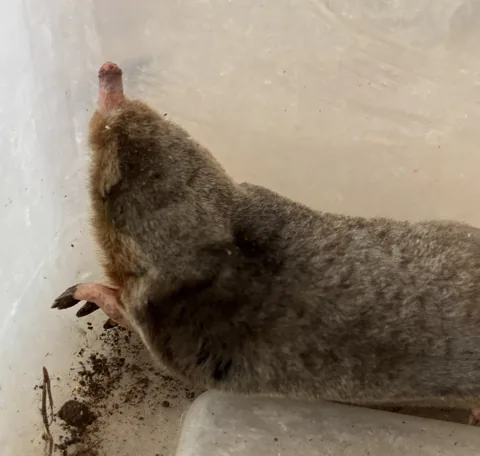 Moles
Talpidae (shown: eastern mole, Scalopus aquaticus; Scapanus species in the West)
Moles are small insect-eating mammals related to shrews, not rodents. They spend almost their whole lives underground hunting earthworms and insects, and their tunneling leaves raised ridges and mounds that disfigure lawns and gardens.
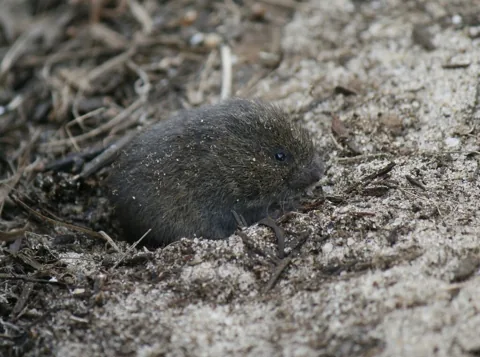 Voles (meadow mice)
Microtus species (shown: meadow vole, M. pennsylvanicus)
Voles, often called meadow mice, are small burrowing rodents that live in dense grass and ground cover. Their clearest sign is a maze of narrow surface runways, and they damage lawns, garden plants and the bark of young trees.
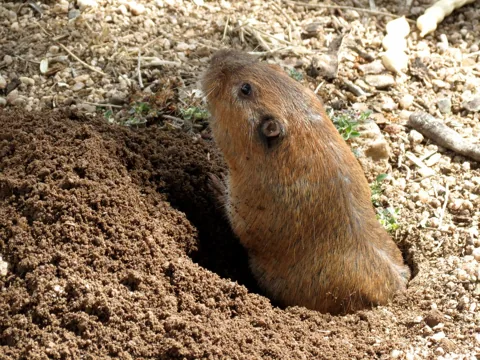 Pocket gophers
Thomomys and Geomys species (shown: Botta's pocket gopher, Thomomys bottae, listed by iNaturalist as Megascapheus bottae)
Pocket gophers are burrowing rodents named for the fur-lined cheek pouches they use to carry food. They rarely come above ground, but a single gopher can ruin a garden quickly by eating roots and pulling plants into its tunnels.
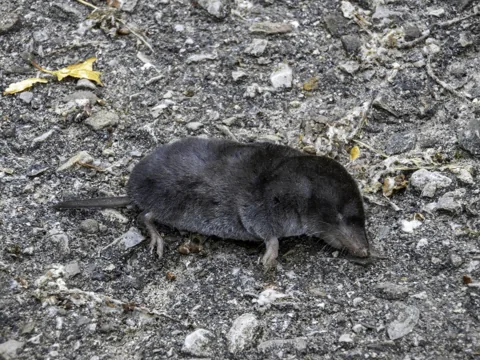 Shrews (northern short-tailed shrew)
Soricidae (e.g., Blarina brevicauda)
Shrews are small insect-eating mammals with long, pointed snouts and tiny eyes. They are mouselike but not mice, and the wildlife damage handbook notes that most species have no significant negative impact and aren't abundant enough to be pests. They eat large numbers of insects, including lawn and crop pests. This page uses the common northern short-tailed shrew as its main example.
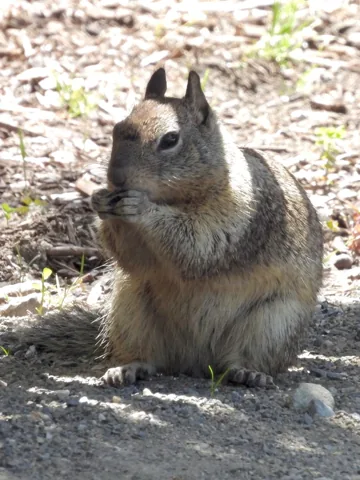 Ground Squirrels
Otospermophilus beecheyi and O. douglasii (California ground squirrel)
Ground squirrels are burrowing rodents that forage above ground near their tunnels. The California ground squirrel is the most common species around homes and gardens in the West, where its digging and feeding can do considerable damage. Los Angeles County's agricultural commissioner calls it the ground squirrel most likely to be met there; it is also known as the Beechey ground squirrel.
The animals side by side
You will rarely see any of the three, since they spend most of their lives underground or under cover. If you do see one, or find one dead, these are the marks to check.[1][3][2]
- Family: moles are insect-eaters related to shrews, not rodents. Voles (also called meadow mice) and pocket gophers are rodents.[13][1][2][3]
- Teeth: a mole's teeth are very sharp and, ICWDM says, resemble a coyote's. Voles have chisel-shaped front teeth that Penn State calls prominent and orange. Pocket gophers have four large incisors and can close their lips behind them to keep dirt out of their mouths while digging with their teeth.[5][14][3][16]
- Eyes and ears: moles have poorly developed eyes and no visible ears; ICWDM says the small eyes and ear openings are hidden in the fur. Pocket gophers have small eyes and small external ears. UC IPM describes voles as having small eyes and partly hidden ears, while Penn State says a vole's eyes and ears are readily apparent and calls the eyes relatively large next to a mole's.[1][4][3][16][10][2][14]
- Feet: moles have huge, broad front feet, with palms wider than they are long and stout claws turned outward for digging; the hind feet are small. Pocket gophers have powerful forequarters and large-clawed front paws. Voles are stocky with short legs.[4][15][3][16][2][14]
- Snout and tail: moles have a slender, pointed, hairless snout and a short, bare or sparsely haired tail. Gophers have a short, sparsely haired tail. Voles have a blunt, rounded snout and a short tail; Penn State says tail length is the easiest way to tell a vole from a mouse, whose tail is much longer.[1][13][10][16][14]
- Pockets: pocket gophers are named for the fur-lined cheek pouches on the outside of the mouth on each side of the face. Moles and voles have none.[10][16]
- Size (each publisher measures differently): moles, about 7 inches total for a male eastern mole (ICWDM) or 5 to 7 inches in body length (Penn State). Pocket gophers, 6 to 10 inches including the short tail for California species (UC IPM) or 5 to 14 inches across U.S. species (ICWDM). Voles, 5 to 8 inches including the tail (UC IPM) or 5 to 7 inches (Penn State), with the pine vole only 4 to 6 inches (ICWDM).[4][13][3][10][2][14][7]
- Diet: moles eat mainly earthworms, grubs, beetles and other soil insects; Missouri's conservation department says about 85 percent of the eastern mole's diet is animal food. Pocket gophers are strict plant eaters: roots, bulbs and the plants around their tunnel openings. Voles eat mostly grasses and forbs, and bark mainly in fall and winter.[13][4][17][11][16][14][8]
Signs side by side: mounds, ridges, runways and bark
The signs are what most people actually see. Check the shape of any mound, where the hole is, and whether there are trails above ground.[3][9]
- Molehills: volcano-shaped hills of soil pushed up from deep tunnels, 2 to 12 inches tall (ICWDM). UC IPM says mole mounds have circular margins, with the soil often in small chunks and the mounds often in a line over the connecting tunnel; Penn State notes round ripple marks from each new load of soil.[6][1][13]
- Mole ridges: shallow feeding tunnels just under the surface show up as raised ridges you can see or feel underfoot. Washington's wildlife agency describes them as 3-inch wide ridges or rips in the lawn, or puffed-up areas in mulch, 1 to 4 inches below the surface.[6][15][1]
- Gopher mounds: half circles of loose dirt with a plugged hole off to one side (UC IPM). ICWDM calls them usually fan-shaped; Washington's wildlife agency says the soil pushed out to the front, right and left makes a fan-shaped or heart-shaped mound.[3][10][16]
- Gopher soil plugs: Washington's wildlife agency describes a 1- to 3 inch circle of disturbed soil, or a small depression, where a gopher came out and plugged the hole behind it. Gophers plug any openings in the burrow system, while ground squirrel holes are left open with no mound.[16][3][10]
- Vole runways: an extensive network of surface trails 1 to 2 inches wide, with the grass clipped close to the ground, usually hidden under grass or ground cover and connecting burrow openings about 1-1/2 to 2 inches across. Pine voles are the exception: they do not use surface runways.[9][2]
- Vole droppings and clippings: fresh clippings of green grass and greenish droppings about 3/16 inch long in the runways and near the burrows.[2]
- Bark damage: vole gnaw marks are about 1/8 inch wide and 3/8 inch long, in irregular patches at various angles, usually from a few inches above to a few inches below ground. Under snow, damage can reach a foot or more up the trunk. ICWDM cautions that rabbits can leave similar marks.[2][9]
- Root and trunk damage below ground: UC IPM says vole girdling is generally above ground while similar pocket gopher damage is generally below ground. In snowy areas, Washington's wildlife agency notes gophers will also gnaw bark several feet up a tree or shrub.[2][3][16]
- Damage to bulbs and roots under a molehill: moles rarely eat plants. Penn State and UC IPM say plant damage blamed on moles usually comes from voles and mice using mole tunnels, or from gophers.[13][1][6]
Where each one lives
Moles: ICWDM lists seven North American species. The eastern mole is the most common and ranges across most of the eastern U.S. to Wyoming and Colorado; western moles (Scapanus) include Townsend's, coast and broad-footed moles. In California, UC IPM says moles live in the Sierra Nevada, coastal mountains and foothills and the whole coastal zone, but usually not the dry southeast of the state or much of the Central Valley. Molehills turn up in moist, loose soil at the edges of woods and in fields and lawns.[4][1][15]
Pocket gophers: ICWDM counts 14 species in the U.S. The plains pocket gopher lives in the central plains south through Texas and Louisiana, Botta's pocket gopher in most of the southern half of the West, the northern pocket gopher in most of the Northwest, and the southeastern pocket gopher in northern and central Florida, southern Georgia and southeastern Alabama. ICWDM says the larger gophers are restricted to sandy and silty soils east of the Rockies.[10][11]
Voles: ICWDM says 23 species live in the U.S. and the meadow vole is the most widely distributed. Penn State lists four species in Pennsylvania, including the meadow vole and the woodland (pine) vole. They favor grassy or weedy areas and dense ground cover.[7][14][2]
How to confirm which one you have
Look at the freshest mounds. A circular, volcano-like mound with no obvious hole points to a mole; a fan or crescent with the plug off to one side points to a gopher.[3][1][6]
Step on the raised lines in the lawn. Soft, raised ridges are mole feeding tunnels; gophers do not make them.[15][1]
Pull back the grass or ground cover near damaged plants. Open holes with clipped trails between them, fresh clippings and small greenish droppings mean voles.[2][9]
Check the base of damaged trees and shrubs. Gnaw marks on the trunk above the soil point to voles (or rabbits); damage you only find after digging away soil around the roots points more to gophers.[2][9][3]
Rule out shrews too. Penn State notes that moles are most often confused with shrews and voles; shrews are smaller, with long pointed snouts, and do not make surface tunnels.[13][14]
Why the difference matters
Traps differ. UC IPM says the best mole traps differ from those for pocket gophers and very few traps work for both. Mole traps are set in the deep main tunnels, gopher traps go inside the gopher's burrow, and UC IPM sets vole traps at right angles to the runways with the trigger end in the runway.[1][3][2]
Baits mostly miss moles. Missouri's conservation department says moles normally do not eat grain, so toxic grain baits such as poison peanuts are seldom effective on them.[17]
Killing grubs is not a reliable mole fix. Penn State cautions that when the food supply is removed, moles may dig more while searching for food before they leave, and Missouri calls insecticide use against mole foods an unhealthy approach for the lawn.[13][17]
Moles have an upside. Missouri's conservation department notes their tunnels let air and moisture into deeper soil and they eat pests such as white grubs, cutworms and Japanese beetle larvae; Washington's wildlife agency adds crane fly larvae and slugs.[17][15]
What works for each
- Moles: trapping is the most dependable method, according to UC IPM. Traps must catch the mole underground in an active deep tunnel, at least 18 inches from a mound. Commercial castor oil repellents have shown some effect on eastern moles but only move them elsewhere. Our mole control guide covers trap types and setting.[1]
- Pocket gophers: use traps in active burrows near fresh mounds together with underground fencing; wire baskets at planting protect individual shrubs and trees. UC IPM says no repellents currently sold successfully protect plants from gophers. ICWDM warns that gophers have very strong jaws and sharp incisors, so wear gloves when handling trapped ones. See our gopher guide.[3][12]
- Voles: remove weeds, heavy mulch and dense ground cover, keep lawns mowed, and guard young trees with cylinders of hardware cloth, sheet metal or heavy plastic, checking that voles have not dug under them. See our vole guide for trapping in runways.[2][18]
- Barriers for beds and gardens: UC IPM suggests buried hardware cloth or wire mesh for moles, and hardware cloth or 3/4-inch-mesh poultry wire under raised beds for gophers. Missouri suggests a fence of sheet metal or hardware cloth buried at least 12 inches for small areas.[1][3][17]
Check your state's rules first
Rules differ by state, and ICWDM advises contacting your state wildlife agency about codes and regulations. Two examples from state agencies:[7]
Missouri: the Wildlife Code of Missouri says damage-causing moles and voles may be trapped or shot to prevent further damage (3 CSR 10-4.130).[17][18]
Washington: moles are unclassified and may be killed on your own property when causing damage, but traditional body-gripping mole traps have been illegal since Initiative 713, with no special permits (RCW 77.15.192). Gophers may be live-trapped without a permit, but other traps need a special trapping permit, and it is unlawful to release a gopher off the property where it was trapped. The Mazama pocket gopher in Thurston, Pierce, Clark and Mason counties is state threatened, and the Thurston and Pierce subspecies are federally listed as Threatened.[15][16]
Pets and rodent baits
Some vole and gopher baits are rodenticides that can poison dogs, cats and wildlife. The Merck Veterinary Manual says pets can be exposed by eating the bait directly or by eating a poisoned rodent (relay toxicosis), and that zinc phosphide is intended for below-ground use only.[19]
With anticoagulant baits, Merck says bleeding is typically noticed 3 to 7 days after a pet eats a toxic dose, so a pet can seem fine at first. Call your veterinarian right away if a pet may have eaten bait or a dead rodent.[20]
Common questions
- Is it a mole or a vole?
- Moles push up volcano-shaped hills and raised ridges and eat worms and insects. Voles leave no mounds; look for narrow runways through the grass, open holes and gnawed bark or plants.[6][2][14]
- Is it a mole or a gopher?
- Check the mound. Mole mounds are circular with a plug in the middle; gopher mounds are fan- or crescent-shaped with a plugged hole off to one side. Moles also leave surface ridges, which gophers don't.[3][10][1]
- Do moles eat plant roots and bulbs?
- Rarely. Moles eat mainly earthworms and insects. Damage to bulbs and roots is usually from voles, mice or gophers, which sometimes use mole tunnels.[13][1][6]
- Are voles just mice?
- They are related rodents, sometimes called meadow mice, but voles are stockier, with short tails and small ears. A mouse's tail is much longer, nearly half its body length.[2][14]
- Can I use the same trap for moles and gophers?
- Usually not. UC IPM says very few traps work well for both, and the best mole traps differ from those for pocket gophers.[1]
Photo credits
- Moles: (c) Sam Kieschnick, some rights reserved (CC BY) — via iNaturalist, CC BY 4.0
- Voles (meadow mice): (c) David LaMagna, some rights reserved (CC BY) — via iNaturalist, CC BY 4.0
- Pocket gophers: (c) Katja Schulz, some rights reserved (CC BY) — via iNaturalist, CC BY 4.0
- Shrews (northern short-tailed shrew): (c) Shaun Coleman, some rights reserved (CC BY) — via iNaturalist, CC BY 4.0
- Ground Squirrels: (c) Rudyard, some rights reserved (CC BY) — via iNaturalist, CC BY 4.0
Sources
- University of California Statewide IPM Program, “Moles (Home and Landscape).” ipm.ucanr.edu/home-and-landscape/moles/ (accessed 2026-11-14)
- University of California Statewide IPM Program, “Voles (Meadow Mice) (Home and Landscape).” ipm.ucanr.edu/home-and-landscape/voles/ (accessed 2026-11-14)
- University of California Statewide IPM Program, “Pocket Gophers (Home and Landscape).” ipm.ucanr.edu/home-and-landscape/pocket-gophers/ (accessed 2026-11-14)
- Internet Center for Wildlife Damage Management, “Moles.” icwdm.org/species/other-mammals/moles/ (accessed 2026-11-14)
- Internet Center for Wildlife Damage Management, “Mole Biology.” icwdm.org/species/other-mammals/moles/mole-biology/ (accessed 2026-11-14)
- Internet Center for Wildlife Damage Management, “Mole Damage Identification.” icwdm.org/species/other-mammals/moles/mole-damage-identification/ (accessed 2026-11-14)
- Internet Center for Wildlife Damage Management, “Voles.” icwdm.org/species/rodents/voles/ (accessed 2026-11-14)
- Internet Center for Wildlife Damage Management, “Vole Biology.” icwdm.org/species/rodents/voles/vole-biology/ (accessed 2026-11-14). Text from this lane's earlier saved copy; the page served a bot check on 2026-11-14.
- Internet Center for Wildlife Damage Management, “Vole Damage.” icwdm.org/species/rodents/voles/vole-damage/ (accessed 2026-11-14)
- Internet Center for Wildlife Damage Management, “Pocket Gophers.” icwdm.org/species/rodents/pocket-gophers/ (accessed 2026-11-14)
- Internet Center for Wildlife Damage Management, “Pocket Gopher Biology.” icwdm.org/species/rodents/pocket-gophers/pocket-gopher-biology/ (accessed 2026-11-14)
- Internet Center for Wildlife Damage Management, “Pocket Gopher Damage Identification.” icwdm.org/species/rodents/pocket-gophers/pocket-gopher-damage-identification/ (accessed 2026-11-14)
- Penn State Extension, “Moles.” extension.psu.edu/moles (accessed 2026-11-14)
- Penn State Extension, “Voles.” extension.psu.edu/voles (accessed 2026-11-14)
- Washington Department of Fish and Wildlife, “Living with wildlife: Moles.” wdfw.wa.gov/species-habitats/living/species-facts/moles (accessed 2026-11-14)
- Washington Department of Fish and Wildlife, “Living with wildlife: Pocket gophers.” wdfw.wa.gov/species-habitats/living/species-facts/pocket-gophers (accessed 2026-11-14)
- Missouri Department of Conservation, “Mole Control.” mdc.mo.gov/wildlife/nuisance-problem-species/mole-control (accessed 2026-11-14)
- Missouri Department of Conservation, “Vole Control.” mdc.mo.gov/wildlife/nuisance-problem-species/vole-control (accessed 2026-11-14)
- Merck Veterinary Manual, “Overview of Rodenticide Poisoning in Animals.” www.merckvetmanual.com/toxicology/rodenticide-poisoning/overview-of-rodenticide-poisoning (accessed 2026-11-14)
- Merck Veterinary Manual, “Anticoagulant Rodenticide Poisoning in Animals.” www.merckvetmanual.com/toxicology/rodenticide-poisoning/anticoagulant-rodenticide-poisoning-in-animals (accessed 2026-11-14)