The short answer
- Holes: a pocket gopher pushes up a crescent- or fan-shaped mound of loose dirt with the hole off to one side and plugged. Ground squirrel holes are left open, with no plug and no gopher-style mound.[5][1][4][6]
- Seeing it: you will rarely see a pocket gopher, because it stays in its tunnels. Ground squirrels are active in daylight, forage above ground near their burrows and drop into an open hole when alarmed.[1][5][6][7][9]
- Body: a gopher has tiny eyes and ears, big front claws, a short, nearly bare tail and fur-lined cheek pouches that open outside the mouth. A ground squirrel has a furred tail, erect ears and cheek pouches inside the mouth.[1][4][5][7][9][8]
- Damage: gophers eat plants from below, taking roots and pulling whole plants into the tunnel. Ground squirrels feed above ground on seedlings, fruit, nuts and bark.[5][2][6][7][12]
Animals on this page
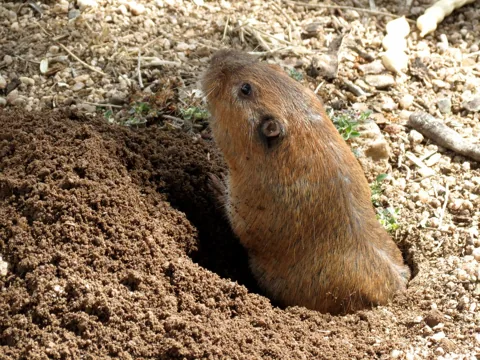 Pocket gophers
Thomomys and Geomys species (shown: Botta's pocket gopher, Thomomys bottae, listed by iNaturalist as Megascapheus bottae)
Pocket gophers are burrowing rodents named for the fur-lined cheek pouches they use to carry food. They rarely come above ground, but a single gopher can ruin a garden quickly by eating roots and pulling plants into its tunnels.
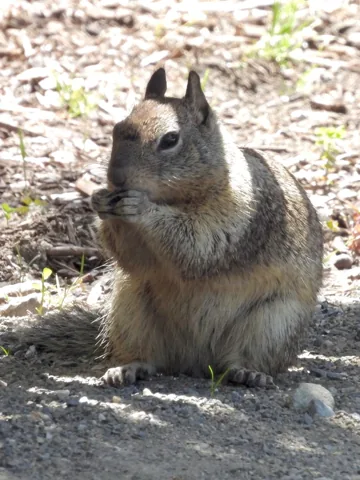 Ground Squirrels
Otospermophilus beecheyi and O. douglasii (California ground squirrel)
Ground squirrels are burrowing rodents that forage above ground near their tunnels. The California ground squirrel is the most common species around homes and gardens in the West, where its digging and feeding can do considerable damage. Los Angeles County's agricultural commissioner calls it the ground squirrel most likely to be met there; it is also known as the Beechey ground squirrel.
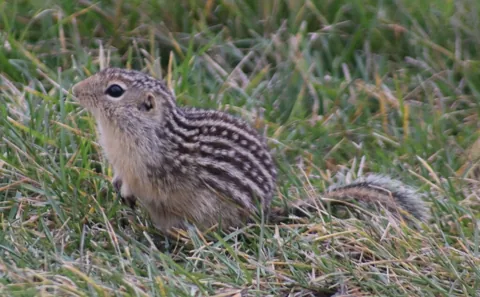 Thirteen-lined Ground Squirrel
Ictidomys tridecemlineatus (formerly Spermophilus tridecemlineatus)
The thirteen-lined ground squirrel is a small, striped ground squirrel of the Midwest and Great Plains that favors short-mown grass. It digs up newly planted seeds and raids vegetable gardens, but it also eats many crop-damaging insects.
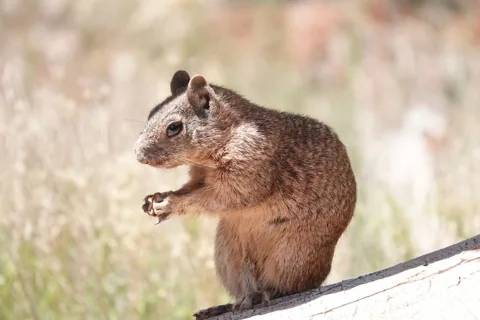 Rock Squirrel
Otospermophilus variegatus (formerly Spermophilus variegatus)
The rock squirrel is a large, heavy-bodied ground squirrel of the Southwest that digs open burrows around homes, gardens and orchards. It eats seeds, fruit and garden plants, its burrows can damage landscapes and structures, and, like other wild rodents in the West, it can carry fleas that spread plague.
Side by side
Despite the shared nickname, they are different rodents. Pocket gophers live almost entirely underground; ground squirrels are in the squirrel family and live on the ground surface, using burrows to sleep, raise young and escape danger.[6][5][7][1]
- Size of pocket gophers: ICWDM puts them at 5 to 14 inches long across US species, UC IPM at 6 to 10 inches including the short tail for California's species, and UC ANR at about 6 to 8 inches for the gophers in California farm fields. Plains pocket gophers, the largest in North America, can weigh up to 1 pound.[1][5][6]
- Size of ground squirrels: the California ground squirrel measures 14 to 20 inches including the tail and weighs 21 to 30 ounces. The thirteen-lined ground squirrel of the Midwest is much smaller, about 10 inches including a 3-inch tail and about 8 ounces by ICWDM's figures.[7][10]
- Eyes, ears and feet: gophers have small eyes, small ears and large, clawed front paws, built for digging. California ground squirrels have erect, conspicuous ears and a white ring around each eye.[4][5][1][7]
- Tail: a gopher's tail is short and sparsely haired; it works as a feeler, helping the gopher run backward through its tunnels. A ground squirrel's tail is covered with fur; the California ground squirrel's is somewhat bushy, though less so than a tree squirrel's.[1][4][7][9]
- Cheek pouches: gopher pouches are fur-lined pockets on the outside of the face that open outside the mouth and can be turned inside out to empty. Ground squirrels have internal cheek pouches.[1][4][9][8]
- Fur: gopher color varies from nearly black to pale brown to almost white and tends to match the local soil. California ground squirrels are mottled brown with white and gray flecks on the back; thirteen-lined ground squirrels are striped, and Minnesota DNR describes yellowish squares or dots in the stripes.[1][7][14]
- When you see them: gophers are active at all hours and all year but are hard to observe because they stay underground. Ground squirrels come out only in daylight, mainly from midmorning through late afternoon on warm, sunny days.[4][1][7][8][9]
- Season: gophers do not hibernate. Most ground squirrels do, and California ground squirrels also go dormant for a few days to a week or more in the hottest part of summer.[5][6][9][7]
- Behavior: an alarmed California ground squirrel gives a loud chirp and drops into a burrow. A thirteen-lined ground squirrel often stands upright to look around and runs with its tail held flat to the nearest hole.[6][11]
Mounds vs open burrow holes
Gopher mound shape: seen from above, the mound is crescent-, horseshoe- or fan-shaped, because the gopher comes up to the surface at an angle and pushes the dirt out to one side. ICWDM likens it to a teardrop. The hole sits off to one side and is usually plugged.[5][1][4][6]
- Gopher feeding holes: gophers also make small plugged holes with no mound. WDFW describes a soil plug as a 1- to 3-inch circle of disturbed soil or a small round depression, sometimes with plants clipped around it, where the gopher came out to feed and sealed the hole on the way back in.[6][4]
- Gophers keep the system closed. WDFW says a gopher will plug any opening in its burrow system within 24 hours, and ICWDM says entrances are plugged to keep intruders out.[4][1]
- Winter casts: after a snowy winter, gophers can leave hollow ropes of soil lying on the ground in spring, called casts, where they packed dirt into tunnels in the snow.[1][4]
- Ground squirrel holes: California ground squirrel entrances are open, about 4 inches across (older ones can be bigger), often several within a small area, in burrow systems 5 to 30 feet long. They are common next to trees, along fences, field edges and roadsides, and in and around buildings.[7][8][6]
- Thirteen-lined ground squirrel holes are smaller and easy to miss: about 2 inches across, often hidden in grass, and rarely with soil scattered in front.[11]
- Caution: during a summer dormancy, a California ground squirrel burrow can look open at the entrance while the squirrel has plugged it with soil deeper down, near the nest. Old, unused burrows tend to fill with leaves or straw or have cobwebs across the opening.[7]
- Not every open hole is a squirrel's. Voles leave open holes about 1 to 1.5 inches across joined by worn runways in the grass; moles push up round, volcano-shaped mounds with the plug in the middle. See the moles, voles and gophers guide linked below for those.[6][5]
Yard and garden damage: from below or from above
Gophers feed from below. They eat roots they meet while digging, venture only about a body length from an opening to clip plants, and pull plants down into the tunnel from below. UC IPM says a single gopher can ruin a garden in a short time.[2][5]
- Other gopher damage: chewing taproots weakens or kills plants, they girdle trees and vines below ground, and under snow they can clip bark up to about 10 inches above the ground. Their mounds smother plants and get in the way of mowing.[6][3][5]
- Gophers and irrigation: they gnaw flexible plastic water lines, especially drip lines, and their tunnels can divert irrigation water and cause erosion.[5][6]
- Ground squirrels feed above ground. California ground squirrels eat seedling vegetables, gnaw bark and girdle trunks of young trees, shrubs and vines, eat twigs and leaves, and damage nut and fruit trees such as almond, apple, apricot, avocado, orange, peach and walnut.[7][8]
- Other ground squirrel damage: they gnaw plastic sprinkler heads, irrigation boxes and lines; burrows around tree roots can dry them out and sometimes topple trees; and burrows under buildings can damage structures.[7]
- Thirteen-lined ground squirrels dig up newly planted seeds, eat sprouting seeds, clip emerging shoots and damage garden vegetables. In lawns, parks, golf courses and cemeteries their burrowing is the main complaint.[12][10]
How to confirm which one you have
Look at a fresh hole. Plugged hole beside a fan of loose dirt: gopher. Open hole, often one of several, with no plug: ground squirrel.[5][6][4]
- Open a suspected gopher plug and check back in a day. WDFW notes gophers seal any opening within 24 hours; UC ANR's trapping advice also starts by finding the main tunnel near the plug of a fresh mound.[4][6]
- Watch on a warm, sunny afternoon. Ground squirrels feed in the open close to their holes, typically within a 75-yard radius; a gopher only rarely shows itself, at the edge of an open hole or pushing out dirt.[7][8][5]
- Check the plants. A plant that wilts or vanishes with roots chewed off points to a gopher; seedlings bitten off at the surface, fruit and nuts taken, or bark gnawed above ground point to a ground squirrel (or another above-ground feeder).[5][6][7][12]
- Photo tips: shoot a fresh mound from directly above so the crescent shape and the side plug show, and a hole from a low angle with something for scale.[5][12]
Why it matters: different control methods
Gopher traps go underground, set inside the tunnel, so you first have to find the burrow, usually with a probe. Ground squirrel traps are set on the ground near burrows or runways, or in the burrow opening.[5][6][7]
- UC IPM says fumigating gophers with smoke or gas cartridges isn't effective because they seal off their burrows quickly. For California ground squirrels it calls burrow fumigation most effective in spring, when moist soil holds the gas, and says to read any pesticide label for restrictions first.[5][7]
- Simply filling in ground squirrel holes does not keep them out, because squirrels find and reopen old burrows.[7]
- In California, UC IPM warns that small protected ground squirrels and several endangered animals share the California ground squirrel's range, so it asks for proper identification before any control.[7][8]
If it's pocket gophers
UC IPM recommends using both traps and underground fencing. Set traps in the main tunnel; the trapping guide below covers how.[5]
- Protect beds and plantings with wire: hardware cloth or 3/4-inch mesh under raised beds before planting, and wire baskets around new trees and shrubs, sized so roots have room to grow for several years.[5][3]
- Around valuable shrubs and trees, UC IPM describes hardware cloth or 1/2- to 3/4-inch mesh at least 2 feet deep with another 6 inches bent outward at a right angle. WDFW cautions that a buried barrier only slows gophers for a time and is eventually breached.[5][4]
- UC IPM says no repellents currently sold protect plants from gophers, and owl boxes are unlikely to reduce gopher numbers enough to stop damage.[5]
- Wear gloves when handling trapped gophers; ICWDM notes their strong jaws and sharp front teeth.[3]
If it's ground squirrels
Remove brush piles and debris. Ground squirrels prefer open ground and use cover to retreat; clearing it also makes squirrels and burrows easier to find.[7]
- Traps work when squirrel numbers are low to moderate. UC IPM puts box-type traps inside a covered box with a 3-inch entrance to protect children, pets and poultry, and baits them with nuts or grain the squirrels are already eating.[7]
- For thirteen-lined ground squirrels around gardens, Wildlife Illinois uses ¼- to ½-inch hardware cloth 18 inches high and buried 6 inches below ground; ICWDM covers cage traps and rat-sized snap traps.[9][13]
- Moving them is restricted in places. UC IPM says relocating wildlife in California is illegal without a permit; live-caught ground squirrels must be released on the same property or humanely euthanized.[7]
Plague, fleas and pets
CDC says plague occurs naturally in parts of the western United States and lists ground squirrels, rock squirrels, prairie dogs, chipmunks and other rodents among the animals it affects. Sudden illness or death among wild rodents such as squirrels or prairie dogs can signal plague activity.[15][16]
- UC IPM says that if you find unusual numbers of squirrels or other rodents dead for no apparent reason, notify public health officials and do not handle the dead animals.[7]
- CDC advises gloves when handling potentially infected animals, flea control on pets, and calling your local health department about disposing of dead animals.[17]
- Pets: the Merck Veterinary Manual says dogs are less likely than cats to get sick from plague, and that pets are most often infected by eating infected rodents or being bitten by an infected flea. In plague areas it advises keeping pets from roaming and hunting, keeping them on a veterinarian-recommended flea program, and having any sick pet seen promptly.[18]
Check your state's rules first
Some gophers are protected. In Washington, the Mazama pocket gopher is state threatened, and subspecies in Thurston and Pierce counties are federally listed; WDFW also says it is unlawful to release a trapped gopher anywhere but the property where it was legally trapped without a permit.[4]
- California classifies ground squirrels as nongame mammals that an owner or tenant can control when they injure crops or property, while the Mohave ground squirrel and San Joaquin antelope squirrel are listed as threatened in California.[7][8]
- Rules on trapping, relocation and fumigants vary by state and species. Check with your state wildlife agency before you trap.[4][7]
Common questions
- Is a ground squirrel a gopher?
- No. Pocket gophers are a separate group of burrowing rodents. The confusion is partly local naming: ICWDM lists 'gophers' and 'striped gophers' among the common names of the thirteen-lined ground squirrel, the animal behind the University of Minnesota's Golden Gophers.[1][10][14]
- Do pocket gophers ever come above ground?
- Briefly. A gopher may feed at the edge of an open hole, push dirt out, or travel to a new area, and it usually goes no more than a body length from the opening before plugging it again.[5][2][4]
- Which one is eating my vegetables?
- If whole plants wilt or disappear from below and there are fresh dirt mounds, think gopher. If seedlings are bitten off or seeds dug up during the day near open holes, think ground squirrel.[5][2][7][12]
- Why are there open holes but no dirt piles?
- Open holes without mounds fit ground squirrels. Thirteen-lined ground squirrel holes are about 2 inches across and rarely have soil in front; California ground squirrel holes are about 4 inches. Small 1- to 1.5-inch holes joined by runways point to voles.[5][11][7][6]
- Can smoke bombs get rid of gophers?
- UC IPM says fumigating gophers with smoke or gas cartridges isn't effective, because they can seal off their burrows quickly.[5]
Photo credits
- Pocket gophers: (c) Katja Schulz, some rights reserved (CC BY) — via iNaturalist, CC BY 4.0
- Ground Squirrels: (c) Rudyard, some rights reserved (CC BY) — via iNaturalist, CC BY 4.0
- Thirteen-lined Ground Squirrel: (c) Sean Frey, some rights reserved (CC BY) — via iNaturalist, CC BY 4.0
- Rock Squirrel: (c) Jacob Saucier, some rights reserved (CC BY) — via iNaturalist, CC BY 4.0
Sources
- Internet Center for Wildlife Damage Management, “Pocket Gophers.” icwdm.org/species/rodents/pocket-gophers/ (accessed 2026-11-14)
- Internet Center for Wildlife Damage Management, “Pocket Gopher Biology.” icwdm.org/species/rodents/pocket-gophers/pocket-gopher-biology/ (accessed 2026-11-14)
- Internet Center for Wildlife Damage Management, “Pocket Gopher Damage Identification.” icwdm.org/species/rodents/pocket-gophers/pocket-gopher-damage-identification/ (accessed 2026-11-14)
- Washington Department of Fish and Wildlife, “Living with Wildlife: Pocket Gophers.” wdfw.wa.gov/species-habitats/living/species-facts/pocket-gophers (accessed 2026-11-14)
- University of California Statewide IPM Program, “Pest Notes: Pocket Gophers.” ipm.ucanr.edu/home-and-landscape/pocket-gophers/ (accessed 2026-11-14)
- University of California Agriculture and Natural Resources, “Burrowing Rodents: Developing a Management Plan for Organic Agriculture in California (Publication 8688).” ucanr.edu/sites/NapaCountyUCCE/files/397331.pdf (accessed 2026-11-14)
- University of California Statewide IPM Program, “Pest Notes: Ground Squirrel.” ipm.ucanr.edu/legacy_assets/PDF/PESTNOTES/pngroundsquirrel.pdf (accessed 2026-11-14)
- Los Angeles County Agricultural Commissioner/Weights and Measures, “California Ground Squirrel.” file.lacounty.gov/SDSInter/acwm/215269_g_squirrel_pdf.pdf (accessed 2026-11-14)
- Wildlife Illinois (University of Illinois Extension), “Ground Squirrels.” wildlifeillinois.org/identify-wildlife/ground-squirrels/ (accessed 2026-11-14)
- Internet Center for Wildlife Damage Management, “Thirteen-lined Ground Squirrels.” icwdm.org/species/rodents/thirteen-lined-ground-squirrels/ (accessed 2026-11-14)
- Internet Center for Wildlife Damage Management, “Thirteen-lined Ground Squirrel Biology.” icwdm.org/species/rodents/thirteen-lined-ground-squirrels/thirteen-lined-ground-squirrel-biology/ (accessed 2026-11-14)
- Internet Center for Wildlife Damage Management, “Thirteen-lined Ground Squirrel Damage Identification.” icwdm.org/species/rodents/thirteen-lined-ground-squirrels/thirteen-lined-ground-squirrel-damage-identification/ (accessed 2026-11-14)
- Internet Center for Wildlife Damage Management, “Thirteen-lined Ground Squirrel Prevention and Control Methods.” icwdm.org/species/rodents/thirteen-lined-ground-squirrels/thirteen-lined-ground-squirrel-prevention-and-control-methods/ (accessed 2026-11-14)
- Minnesota Department of Natural Resources, “Thirteen-lined ground squirrel.” www.dnr.state.mn.us/mammals/thirteenlinedgroundsquirrel.html (accessed 2026-11-14)
- Centers for Disease Control and Prevention, “About Plague.” www.cdc.gov/plague/about/index.html (accessed 2026-11-14)
- Centers for Disease Control and Prevention, “How Plague Spreads.” www.cdc.gov/plague/causes/index.html (accessed 2026-11-14)
- Centers for Disease Control and Prevention, “Preventing Plague.” www.cdc.gov/plague/prevention/index.html (accessed 2026-11-14)
- Merck Veterinary Manual, “Plague in Animals.” www.merckvetmanual.com/generalized-conditions/plague/plague-in-animals (accessed 2026-11-14)