The short answer
- Build and tail: prairie dogs are stocky, with short legs and a short tail; the black-tailed prairie dog's tail ends in a black tip. Ground squirrels are slimmer and their tails are longer and furred; the California ground squirrel's is somewhat bushy, though less so than a tree squirrel's.[1][4][5][10][13]
- Burrows: a prairie dog town is many closely spaced burrows, each main entrance ringed by a raised mound of packed soil used as a lookout. Ground squirrel entrances are open holes, about 4 inches across for the California ground squirrel and about 2 inches for the thirteen-lined, which rarely has soil scattered in front.[4][5][2][10][12][15]
- Behavior: prairie dogs sit upright on their mounds as sentinels and bark to send the whole colony underground. A frightened ground squirrel runs to its burrow.[1][3][10]
- Range: prairie dogs live on the Great Plains and in the grasslands and high desert of Colorado, Utah, Arizona and New Mexico. Ground squirrels include the California ground squirrel of the Pacific states and the thirteen-lined and Franklin's ground squirrels of Midwestern grasslands.[2][3][6][9][10][13][14]
Animals on this page
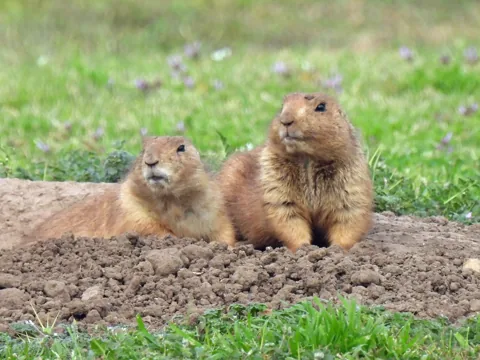 Black-tailed prairie dog
Cynomys ludovicianus
The black-tailed prairie dog is a stocky, burrowing member of the squirrel family that lives in colonies called dog towns on the Great Plains. Towns support many other kinds of wildlife, but they conflict with ranching when prairie dogs compete with livestock for grass.
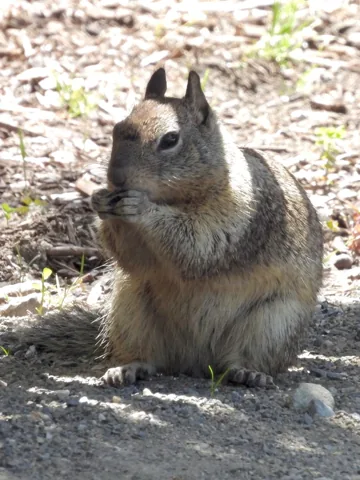 Ground Squirrels
Otospermophilus beecheyi and O. douglasii (California ground squirrel)
Ground squirrels are burrowing rodents that forage above ground near their tunnels. The California ground squirrel is the most common species around homes and gardens in the West, where its digging and feeding can do considerable damage. Los Angeles County's agricultural commissioner calls it the ground squirrel most likely to be met there; it is also known as the Beechey ground squirrel.
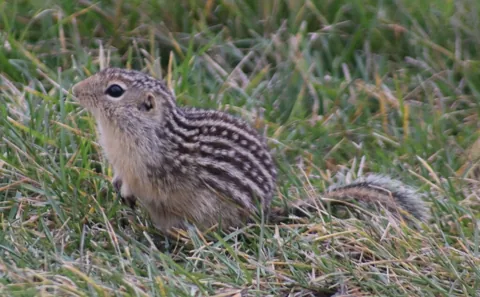 Thirteen-lined Ground Squirrel
Ictidomys tridecemlineatus (formerly Spermophilus tridecemlineatus)
The thirteen-lined ground squirrel is a small, striped ground squirrel of the Midwest and Great Plains that favors short-mown grass. It digs up newly planted seeds and raids vegetable gardens, but it also eats many crop-damaging insects.
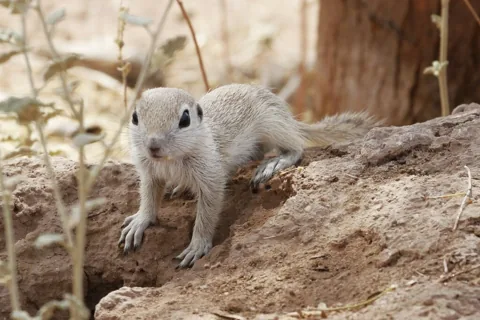 Round-tailed Ground Squirrel
Xerospermophilus tereticaudus (formerly Spermophilus tereticaudus)
The round-tailed ground squirrel is a small, social ground squirrel of the low desert that lives in colonies and digs burrows in flat, open, sandy ground, including desert yards. It can churn up gravel and plantings, and like other wild rodents in the Southwest it can carry fleas.
No photo yet
Ground squirrel flea
Oropsylla montana
This is the flea behind the handful of plague cases the western United States records each year. It lives in the nests of ground squirrels, west of the Rockies, and it only bothers people when squirrels are abundant or dying. Researchers call it a moderately effective vector, which is the useful part: a bite is unlikely to transmit anything, but a burrow full of dead squirrels and hungry fleas is a situation worth backing away from.
Side by side
Both are rodents in the squirrel family. Kansas State calls black-tailed prairie dogs large, burrowing ground squirrels; five prairie dog species live in North America.[2][4][3]
- Size, black-tailed prairie dog: sources differ. Kansas State and the National Park Service at Theodore Roosevelt National Park give 14 to 17 inches long and 1 to 3 pounds; another Park Service page gives 12 to 16 inches; Nebraska Extension gives 10 to 12 inches and 2 to 3 pounds.[2][3][5][1]
- Size, other prairie dogs: Gunnison's prairie dogs are 12 to 15 inches long and weigh 23 to 42 ounces. Adult Utah prairie dogs are 9.8 to 15.7 inches long including the tail, and adult males weigh 1.7 to 3.1 pounds.[8][6][7]
- Size, ground squirrels: the California ground squirrel measures 14 to 20 inches including its tail. The thirteen-lined ground squirrel is about 11 inches including a 4-inch tail and weighs only 8 to 9 ounces in fall. Franklin's ground squirrel weighs 1 to 1 1/2 pounds in fall.[10][14][13]
- Tail, prairie dogs: all prairie dogs have short tails. The black-tailed prairie dog is named for its black-tipped tail; the Utah prairie dog's tail is white on its outer half, and the Gunnison's has grayish-white hairs there.[4][5][1][2][7][8]
- Tail, ground squirrels: all ground squirrels have a tail covered with fur. The thirteen-lined's tail is about 4 inches of its 11-inch length; the California ground squirrel's tail is somewhat bushy, but less so than a tree squirrel's.[13][14][10]
- Body: prairie dogs have tawny or light-brown fur that blends with the dirt of their mounds, large eyes, short legs and small ears set far back on the head. Ground squirrels have internal cheek pouches; the California ground squirrel's ears are erect and conspicuous, and the thirteen-lined is striped.[1][5][3][13][10][14]
- Colonies: prairie dogs are never found singly but in towns, which today range from one acre to several hundred acres. California ground squirrels also live in colonial burrow systems, which may hold one squirrel or many.[3][4][1][10]
- Winter: black-tailed prairie dogs do not truly hibernate. Gunnison's prairie dogs hibernate, emerging around mid-March to late April. Most ground squirrels hibernate; thirteen-lined ground squirrels have been known to hibernate for 250 days.[3][2][6][13][10]
Prairie dog mounds and craters vs ground squirrel holes
Prairie dogs pack a cone-shaped mound of soil around the entrance of the main burrow. It serves as a lookout post and keeps water out. Wind Cave National Park adds that some tunnels come back to the surface with a sunken, crater-like opening, and Valles Caldera describes Gunnison's prairie dogs using crater-like mounds as observation posts.[4][5][6]
Mound size depends on the source: the Park Service gives cone-shaped mounds one to three feet in diameter, while Kansas State describes a crater-like mound 3 to 10 feet across at the burrow entrance.[5][2]
Prairie dog burrows are dense. Nebraska Extension counts 30 to 75 burrows per acre in a typical town, and Kansas State says burrows are about 10 yards apart and 3 to 14 feet deep. Most burrows have one or two entrances.[1][2]
Prairie dogs also clip the plants around their burrows to watch for predators, which is why a dog town looks like a patch of short grass and bare mounds.[2]
California ground squirrel burrows are about 4 inches in diameter, though older entrances can be larger. The entrances stay open at the surface, often several in a small area, and burrow systems usually run 5 to 30 feet.[10][12][11]
Thirteen-lined ground squirrel holes are smaller and easy to miss: about 2 inches across, often hidden in vegetation, and rarely with soil scattered in front.[15]
Where each one lives
Black-tailed prairie dogs once ranged the Great Plains from southern Saskatchewan to northern Mexico. In Kansas and Nebraska they live in the western two-thirds of each state.[3][2][1]
Gunnison's prairie dogs inhabit grasslands and high desert across Colorado, Utah, Arizona and New Mexico. Utah prairie dogs live only in southwestern Utah; Utah also has Gunnison's and white-tailed prairie dogs.[6][9]
The California ground squirrel is found through most of California, into western Nevada, western Oregon and south-central Washington. Thirteen-lined and Franklin's ground squirrels live in grasslands and prairies; in Illinois both occur in the northern two-thirds of the state.[10][13]
Damage: rangeland vs yard and orchard
Prairie dogs: the main conflict is grazing. Towns compete with livestock for grass, and Kansas State reports effects on rangeland forage ranging from none obvious to a 20 to 40 percent cut in forage, depending on site and rainfall. Prairie dogs also eat sprouting corn and soybeans near colonies.[2][1]
Nebraska Extension adds that burrows near roads or ponds can cause erosion and structural problems, and that towns near new homes may bring rattlesnakes and black widow spiders.[1]
Ground squirrels: UC IPM lists grains and nut and fruit trees such as almond, apple, apricot, avocado and orange among the plants they damage. They gnaw bark and girdle young trees, chew plastic sprinkler heads and irrigation lines, and burrowing beneath buildings and around trees can topple trees and require repair.[10]
Thirteen-lined ground squirrels dig up planted corn seed, leaving small divots in the soil.[16]
How to confirm which one you have
Watch from a distance. Prairie dogs feed and keep watch from the mounds around their open burrows, and a sentinel's barks send the colony underground. A ground squirrel that is frightened heads for its burrow.[1][2][3][10]
Look at the entrances. Raised cone or crater mounds on many holes spread across a grazed, short-grass patch point to a prairie dog town. Open holes without a big mound, about 4 inches across in the West or 2 inches across in Midwestern lawns, point to ground squirrels.[4][5][2][10][15]
Check the tail through binoculars or a photo: short with a black tip, or short with a white or grayish-white end, is a prairie dog. A longer furred tail, or a back with light and dark stripes, is a ground squirrel. The Fish and Wildlife Service notes color alone is not a reliable way to tell prairie dog species apart.[5][7][8][13][14]
For pocket gophers, which push up crescent-shaped mounds and keep their holes plugged rather than open, see our pocket gophers vs ground squirrels guide.[11]
Check protected status before you act
The Utah prairie dog is protected under the Endangered Species Act as a federally threatened species, even on private property. Utah allows limited lethal control for agriculture only with a permit from the Utah Division of Wildlife Resources, and development needs authorization.[9]
Black-footed ferrets live in prairie dog towns and feed almost entirely on prairie dogs, and they are on the federal endangered species list. Nebraska Extension advises inspecting towns for signs of ferrets before any control.[1]
Some ground squirrels are protected too: Franklin's ground squirrel is a state-threatened species in Illinois. California classes its ground squirrels as nongame mammals that may be taken when injuring property, under the Fish and Game Code.[13][10]
Rules for the other prairie dog species differ by state and change over time. Check your state wildlife agency before trapping, shooting or treating either animal.[1][9]
Plague, fleas and pets
CDC says plague occurs naturally in parts of the western United States and spreads to people through bites from infected rodent fleas or, less often, direct contact with an infected animal. Sudden illness or death among wild rodents such as squirrels or prairie dogs could indicate plague activity.[17][18]
Both animals are hit by it. The Utah Division of Wildlife Resources says Utah prairie dogs are highly vulnerable to plague, and UC IPM says plague has wiped out entire ground squirrel colonies.[9][10]
CDC advises reducing rodent habitat around the home, wearing gloves when handling potentially infected animals, using repellent where you could meet fleas outdoors, and contacting your local health department about disposing of dead animals.[18]
Pets: the Merck Veterinary Manual says plague bacteria cycle between rodents, including squirrels and prairie dogs, and their fleas, and that pets are most often infected by eating infected rodents, rabbits or hares, or by flea bites. CDC advises flea control on pets, not letting free-roaming dogs and cats in plague areas sleep on your bed, and seeing a veterinarian promptly if a pet gets sick.[19][18]
What to do for each
Prairie dogs: Nebraska Extension and Kansas State treat them as a rangeland management problem. Grazing management helps, because overgrazed pastures and spots where livestock gather, such as wells and mineral licks, favor new towns. Kansas State says visible barriers and live trapping have not proven effective at reducing prairie dog numbers.[1][2]
Ground squirrels: UC IPM says traps work when numbers are low to moderate, and that ground squirrels dislike dense vegetation. Hardware cloth set 18 inches high can keep them out of small areas.[10][13]
For either one, our live-trapping guide covers handling, and any control should start with a call to your state wildlife agency, especially in southwestern Utah, home of the federally threatened Utah prairie dog.[9][1]
Common questions
- Is a prairie dog a ground squirrel?
- In the broad sense, yes: both are burrowing members of the squirrel family, and Kansas State calls black-tailed prairie dogs large burrowing ground squirrels. In everyday use the names mean different animals, told apart by tail, build and burrow mounds.[2][1][13]
- How can I tell a prairie dog hole from a ground squirrel hole?
- Prairie dog entrances have a raised cone or crater mound of soil, and many sit close together in a town. Ground squirrel entrances are open holes, about 4 inches across for the California ground squirrel and about 2 inches for the thirteen-lined, which rarely has dirt in front.[4][5][2][10][15]
- Are prairie dogs protected?
- The Utah prairie dog is federally threatened, even on private land. For other species, check your state wildlife agency; black-footed ferrets, which are federally endangered, may live in prairie dog towns.[9][1]
- Do prairie dogs and ground squirrels carry plague?
- Their fleas can. CDC lists plague as naturally present in parts of the western U.S. and says sick or dead rodents such as squirrels or prairie dogs can signal it. Keep pets on flea control and away from colonies.[17][18][19]
Photo credits
- Black-tailed prairie dog: (c) Judy Ulrich, some rights reserved (CC BY) — via iNaturalist, CC BY 4.0
- Ground Squirrels: (c) Rudyard, some rights reserved (CC BY) — via iNaturalist, CC BY 4.0
- Thirteen-lined Ground Squirrel: (c) Sean Frey, some rights reserved (CC BY) — via iNaturalist, CC BY 4.0
- Round-tailed Ground Squirrel: (c) Xochitl Zambrano, some rights reserved (CC BY) — via iNaturalist, CC BY 4.0
Sources
- University of Nebraska-Lincoln Extension, “Prairie Dogs and Their Control (G2101).” extensionpubs.unl.edu/publication/g2101/2011/html/view (accessed 2026-11-14)
- Kansas State University Research and Extension, “Prairie Dog Management (MF2702).” bookstore.ksre.ksu.edu/download/prairie-dog-management_MF2702 (accessed 2026-11-14)
- U.S. National Park Service, “Prairie Dogs (Theodore Roosevelt National Park).” www.nps.gov/thro/learn/nature/prairie-dogs.htm (accessed 2026-11-14)
- U.S. National Park Service, “Black-tailed Prairie Dog (Wind Cave National Park).” www.nps.gov/wica/learn/nature/blacktail-prairie-dog-cynomys-ludovicianus.htm (accessed 2026-11-14)
- U.S. National Park Service, “Black-tailed Prairie Dogs.” www.nps.gov/articles/000/black-tailed-prairie-dogs.htm (accessed 2026-11-14)
- U.S. National Park Service, “Gunnison's Prairie Dog (Valles Caldera National Preserve).” www.nps.gov/vall/learn/nature/gunnison-s-prairie-dog.htm (accessed 2026-11-14)
- U.S. Fish and Wildlife Service, “Utah Prairie Dog (Cynomys parvidens).” www.fws.gov/species/utah-prairie-dog-cynomys-parvidens (accessed 2026-11-14)
- U.S. Fish and Wildlife Service, “Gunnison's Prairie Dog (Cynomys gunnisoni).” www.fws.gov/species/gunnisons-prairie-dog-cynomys-gunnisoni (accessed 2026-11-14)
- Utah Division of Wildlife Resources, “Utah prairie dogs.” wildlife.utah.gov/utah-prairie-dogs.html (accessed 2026-11-14)
- University of California Statewide IPM Program, “Ground Squirrel (Pest Notes 7438).” ipm.ucanr.edu/legacy_assets/PDF/PESTNOTES/pngroundsquirrel.pdf (accessed 2026-11-14)
- University of California Agriculture and Natural Resources, “Burrowing Rodents: Developing a Management Plan for Organic Agriculture in California (8688).” ucanr.edu/sites/NapaCountyUCCE/files/397331.pdf (accessed 2026-11-14)
- Los Angeles County Agricultural Commissioner/Weights and Measures, “Ground Squirrels.” file.lacounty.gov/SDSInter/acwm/215269_g_squirrel_pdf.pdf (accessed 2026-11-14)
- Wildlife Illinois, University of Illinois Extension, “Ground Squirrels.” wildlifeillinois.org/identify-wildlife/ground-squirrels/ (accessed 2026-11-14)
- Minnesota Department of Natural Resources, “Thirteen-lined ground squirrel.” www.dnr.state.mn.us/mammals/thirteenlinedgroundsquirrel.html (accessed 2026-11-14)
- Internet Center for Wildlife Damage Management, “Thirteen-lined Ground Squirrel Biology.” icwdm.org/species/rodents/thirteen-lined-ground-squirrels/thirteen-lined-ground-squirrel-biology/ (accessed 2026-11-14)
- Internet Center for Wildlife Damage Management, “Thirteen-lined Ground Squirrel Damage Identification.” icwdm.org/species/rodents/thirteen-lined-ground-squirrels/thirteen-lined-ground-squirrel-damage-identification/ (accessed 2026-11-14)
- Centers for Disease Control and Prevention, “About Plague.” www.cdc.gov/plague/about/index.html (accessed 2026-11-14)
- Centers for Disease Control and Prevention, “Preventing Plague.” www.cdc.gov/plague/prevention/index.html (accessed 2026-11-14)
- Merck Veterinary Manual, “Plague in Animals.” www.merckvetmanual.com/generalized-conditions/plague/plague-in-animals (accessed 2026-11-14)