The short answer
- Tail: a rattlesnake's tail ends in a rattle. Texas A&M AgriLife says a bullsnake's tail is pointed and yellow-tan with reddish bands, with no rattles. UC IPM adds that a rattle can break off, so a missing rattle alone doesn't clear a snake.[5][7][8]
- Head: rattlesnakes have a broad, triangular head on a thin neck and a heat-sensing pit between the eye and nostril. A bullsnake's head is small, somewhat pointed and rectangular, though it can flare it to look triangular.[6][2][5][7]
- Eyes: rattlesnake pupils are vertical slits or ellipses; bullsnakes have round pupils. You have to be close to see this, so use it on a photo, not in person.[6][10][2][5]
- Sound: a rattlesnake buzzes with its rattle; a bullsnake hisses loudly and may shake its tail in dry leaves. Texas A&M says the hiss can sound like a rattle, so judge by what you see, not what you hear.[5][1][10][2]
Profiles on this site
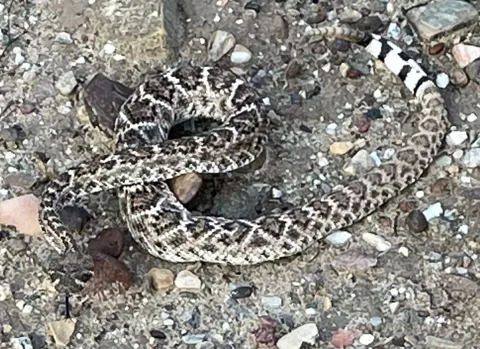 Rattlesnakes (western diamondback shown)
Crotalus species (shown: western diamond-backed rattlesnake, C. atrox)
Rattlesnakes are heavy-bodied pit vipers with a rattle on the tail and the largest venomous snakes in the United States. They eat rodents and rarely bite unless bothered, but a bite is a medical emergency.
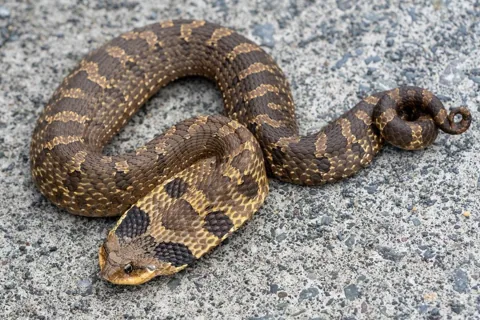 Hognose snakes
Heterodon platirhinos
The eastern hog-nosed snake is a stout, toad-eating snake with an upturned snout. When threatened it puts on a cobra-like show of hissing and neck-spreading, then plays dead. Missouri's conservation department says it rarely if ever bites people and is not considered a threat to them.
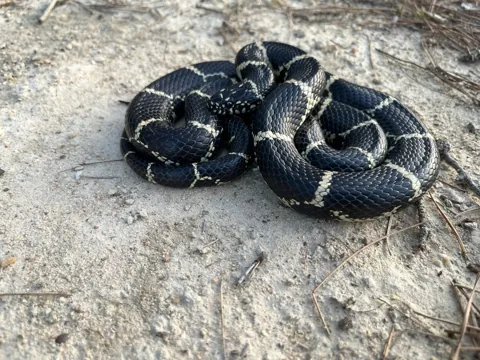 Kingsnakes
Lampropeltis getula
Kingsnakes are glossy, nonvenomous snakes that kill prey by constriction. The eastern kingsnake eats rodents, birds, lizards, turtle eggs and other snakes, and Missouri's conservation department says kingsnakes are immune to the venom of copperheads, cottonmouths and rattlesnakes.
Side by side: rattlesnake and bullsnake
Size: Poison Control says rattlesnakes range from 1 to 8 feet, most between 2 and 5 feet; the prairie rattlesnake can grow to five feet (NPS) and Missouri's timber rattlesnake is usually 36 to 60 inches. Bullsnakes run larger: 3 to 5 feet per Texas Parks and Wildlife, usually 37 to 72 inches with a record of 105 inches per Missouri, and over seven feet in Montana and Wyoming per NPS.[11][6][9][3][1][2]
Build: NPS describes the prairie rattlesnake as a fairly heavy body behind a diamond-shaped head on a relatively thin neck. Texas A&M says bullsnakes have more slender bodies than rattlesnakes, and Texas Parks and Wildlife still calls the bullsnake heavy-bodied.[6][5][3]
Color and pattern: both are tan to brown with dark blotches. NPS says the prairie rattlesnake's blotches flatten into rings on the tail and have a dark border, often edged in white. Missouri says the bullsnake carries about 40 large brown or black blotches; NPS counts 41 to 66 with rows of similar spots along the sides.[6][1][2]
Face: Missouri says the bullsnake usually has a black line from the eye down to the jaw and black bars along the upper lip; its eyes are orange or brick red with round pupils (NPS). Rattlesnakes have vertically elliptical pupils and a pit on each side of the head between the eye and the nostril.[1][2][6][10][8]
Tail: rattlesnakes end in a rattle of interlocking segments, one added each time the skin is shed; young are born with a small button. Bullsnakes have no rattle; Missouri says the tail may have light and dark bands.[7][8][6][1][5]
Belly: yellow or cream with checkering on the bullsnake (Missouri) or black spots (Texas Parks and Wildlife); light yellow to cream on the prairie rattlesnake (NPS).[1][3][6]
Scales: both have keeled scales, each with a ridge down the middle, so texture won't separate them.[6][2]
How each one acts when cornered
Bullsnake bluff: Texas A&M says a bullsnake may coil like a rattlesnake, vibrate its tail, flare the sides of its head and make a raspy hiss that sounds like a rattle. Missouri says it hisses loudly with the mouth partly open.[5][1][2]
Bullsnake bite: sources differ on temper. Texas Parks and Wildlife says bullsnakes vary, some docile, and won't strike unless severely provoked; Texas A&M says they can be aggressive and may strike and bite; Missouri says a captured one will bite to defend itself. All agree it has no venom.[3][5][1]
Rattlesnake warning: NPS says most rattlesnakes take a defensive position and rattle when cornered or provoked, but they don't always rattle before they strike. NIOSH says the same.[6][12]
Where and when you'll meet them
Bullsnakes: prairies, other grasslands, savannas, pastures and old fields, especially with sandy or loose soil they can burrow in. Texas Parks and Wildlife says they are often found around prairie dog towns.[1][3][4]
Range: Texas Parks and Wildlife says bullsnakes occur in the western, southern and southeastern US; Missouri says they are found statewide there except the southeastern quarter. Related gopher snakes cover the West; UC IPM and California Fish and Wildlife name the gopher snake as California's rattlesnake mimic.[3][1][2][7][8]
Rattlesnakes: Poison Control says they live in many areas of the US. UC IPM says they forage in brushy or tall grass, rock outcrops, rodent burrows and around surface objects; NIOSH says they are found in mountains, prairies, deserts and beaches.[11][7][12]
Season: Missouri says bullsnakes are active from late March to the middle of November, most often seen in May and June. NPS says prairie rattlesnakes leave their dens in April or May and use the same den year after year, sometimes sharing it with bullsnakes.[1][6][2]
How to confirm what you saw
Stay back and photograph: NIOSH says to take a photograph from a safe distance, and Poison Control says not to risk another bite by trying to capture or kill a snake.[12][11]
Look at the tail first: Texas A&M says that whatever the snake's posture, the tail is the best check, a dark or black-and-white banded tail with rattles versus a pointed, yellow-tan tail with no rattle.[5]
Then the head and eyes on the photo: a pit between the eye and nostril and vertical pupils mean a pit viper; round pupils and no pit mean a harmless snake. ICWDM gives these as the main checks.[10][6][2]
- If in doubt, treat it as venomous: Mississippi State Extension says that unless you are skilled at snake identification, treat every snake as venomous and avoid contact with its head.[15]
Why the difference matters
A rattlesnake bite needs a hospital. Poison Control says the most common symptoms are pain and swelling, and that many bites require hospitalization and antivenom; NIOSH says to get emergency care as soon as possible.[11][12]
A bullsnake is worth keeping. Missouri calls it the most economically beneficial snake in the state for the rodents it eats, including mice, rats, ground squirrels and pocket gophers; Texas Parks and Wildlife also calls bullsnakes beneficial.[1][3]
- UC IPM says most rattlesnake bites happen when an inexperienced person tries to pick up, move or kill one, which is also how harmless bullsnakes get killed by mistake.[7]
If someone is bitten
Get emergency help right away and don't wait for symptoms. Call 911 or your local emergency number, and Poison Control at 1-800-222-1222. NIOSH says not to drive yourself, because the bite can make you dizzy or pass out.[12][13][11]
Keep the person quiet and still, and remove rings, watches and tight items before swelling starts. On position, NIOSH says a neutral position of comfort and MedlinePlus says heart level.[11][12][13]
Dogs and cats
Merck Veterinary Manual says venomous snakebites are emergencies needing prompt veterinary attention, and owners should not spend time on first aid beyond keeping the animal quiet and limiting its activity.[14]
- Merck says bites from nonvenomous snakes, which include bullsnakes, cause only local injury, usually multiple superficial teeth marks rather than fang marks.[14]
What to do about each
Rattlesnake near the house: keep people and pets away and let it leave; Poison Control says rattlesnakes would rather leave you alone. UC IPM says to make the yard less inviting by removing heavy brush, rocks and lumber piles.[11][7]
Bullsnake: leave it alone; it moves on and eats rodents. Missouri asks rural residents to protect it.[1][3]
Keep any snake out of the house: Mississippi State Extension says to close openings larger than a quarter of an inch and caulk gaps around pipes and wires; see the snake-proofing guide below.[15]
Common questions
- Is a gopher snake the same as a bullsnake?
- Close to it. Missouri says the bullsnake's sister subspecies to the west and southwest are mostly called gopher snakes, and NPS says the bullsnake is also often called the gopher snake. Texas A&M uses both names.[1][2][5]
- Can a bullsnake rattle?
- It has no rattle, but it vibrates its tail in dry brush or leaves and hisses, which NPS and Texas A&M say can sound like a rattlesnake.[2][5]
- If a snake has no rattle, is it safe?
- Not by that alone. UC IPM says rattles can shorten or break off, so the lack of a rattle doesn't mean a snake isn't a rattlesnake. Check the head and pupils on a photo.[7][8]
- Do bullsnakes keep rattlesnakes away?
- No source we found says so. NPS says the two sometimes share winter dens, and California Fish and Wildlife says gopher snakes compete with rattlesnakes for food.[2][8]
Photo credits
- Rattlesnakes (western diamondback shown): (c) Mark Pollock, some rights reserved (CC BY) — via iNaturalist, CC BY 4.0
- Hognose snakes: (c) evangrimes, some rights reserved (CC BY) — via iNaturalist, CC BY 4.0
- Kingsnakes: (c) Matthew Lumsden, some rights reserved (CC BY) — via iNaturalist, CC BY 4.0
Sources
- Missouri Department of Conservation, “Bullsnake (Field Guide).” mdc.mo.gov/discover-nature/field-guide/bullsnake (accessed 2026-11-14)
- U.S. National Park Service, Bighorn Canyon National Recreation Area, “Bullsnake.” www.nps.gov/bica/learn/nature/bullsnake.htm (accessed 2026-11-14)
- Texas Parks and Wildlife Department, “Bullsnake (Pituophis catenifer sayi).” tpwd.texas.gov/huntwild/wild/species/bullsnake (accessed 2026-11-14)
- Iowa Department of Natural Resources, “Bullsnake (Natural Areas Inventory species sheet).” programs.iowadnr.gov/naturalareasinventory/images/elements/593.pdf (accessed 2026-11-14)
- Texas A&M AgriLife Extension Service, “Identifying Venomous and Nonvenomous Snakes in Texas (WFSC-023).” texnat.tamu.edu/files/2019/02/2019-Frank-Snake-ID-WFSC-023.pdf (accessed 2026-11-14)
- U.S. National Park Service, Bighorn Canyon National Recreation Area, “Prairie Rattlesnake.” www.nps.gov/bica/learn/nature/prairie-rattlesnake.htm (accessed 2026-11-14)
- University of California Statewide IPM Program, “Rattlesnakes (Pest Notes, Home and Landscape).” ipm.ucanr.edu/home-and-landscape/rattlesnakes/ (accessed 2026-11-14)
- California Department of Fish and Wildlife, “Rattlesnake.” wildlife.ca.gov/Conservation/Reptiles/Rattlesnake (accessed 2026-11-14)
- Missouri Department of Conservation, “Timber Rattlesnake (field guide).” mdc.mo.gov/discover-nature/field-guide/timber-rattlesnake (accessed 2026-11-14)
- Internet Center for Wildlife Damage Management, “Snakes: Identification.” icwdm.org/species/reptiles/snakes/ (accessed 2026-11-14)
- Poison Control (National Capital Poison Center), “Rattlesnake bites: What you need to know.” www.poison.org/articles/rattlesnakes (accessed 2026-11-14)
- U.S. Centers for Disease Control and Prevention, NIOSH, “Venomous Snakes at Work (reviewed September 23, 2026).” www.cdc.gov/niosh/outdoor-workers/about/venomous-snakes.html (accessed 2026-11-14)
- MedlinePlus, U.S. National Library of Medicine, “Snake bites (Medical Encyclopedia).” medlineplus.gov/ency/article/000031.htm (accessed 2026-11-14)
- Merck Veterinary Manual, “Snakebites in Animals.” www.merckvetmanual.com/toxicology/snakebite/snakebites-in-animals (accessed 2026-11-14)
- Mississippi State University Extension Service, “Reducing Snake Problems Around Homes (P2277).” extension.msstate.edu/publications/reducing-snake-problems-around-homes (accessed 2026-11-14)