The short answer
- Bands: a copperhead's dark crossbands are hourglass shaped, narrow along the spine and wide on the sides, and look like a Hershey's Kiss from the side. Watersnake bands are more rectangular, widest on top, and far more numerous.[1][3][8][2]
- Head: a copperhead's head is plain copper to reddish with no spear-point mark. A corn snake has a spear-shaped mark from the neck to between the eyes and a black-and-white checkered belly.[1][5][6]
- Face: watersnakes have dark vertical lines on the lips near the mouth and round pupils; a copperhead has no such lines. A young cottonmouth has a dark band through the eye and speckled crossbands; a copperhead's eye isn't hidden and its bands have no more than one dark spot.[2][10][15]
- Don't get close to check. Poison Control and NIOSH say to leave the snake alone and, if possible, take a photo from a safe distance.[17][18]
Profiles on this site
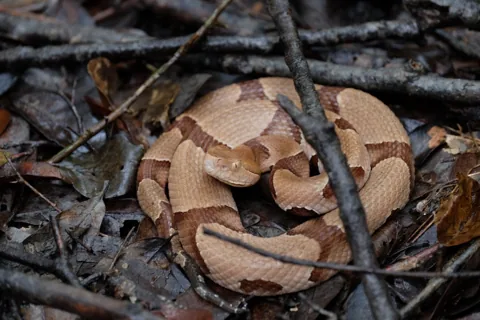 Copperhead
Agkistrodon contortrix
The copperhead is a stout, well-camouflaged pit viper and one of the venomous snakes people most often meet, even in towns. Researchers describe it as the least toxic North American pit viper, but bites still cause pain and swelling that can last weeks, and any bite needs prompt medical care.
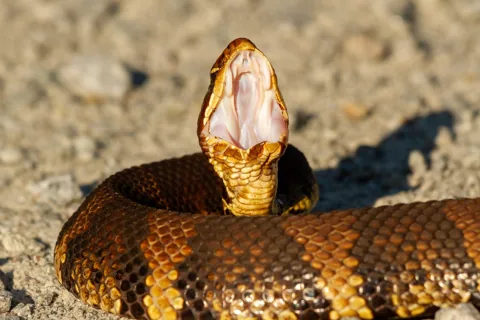 Cottonmouth
Agkistrodon piscivorus (the Florida cottonmouth, A. conanti, is now treated as a separate species)
The cottonmouth, also called the water moccasin, is a venomous pit viper of southeastern wetlands. Its bite is dangerous, but it is not aggressive: it either tries to escape or holds its ground with an open-mouthed warning display, and research indicates it rarely bites unless stepped on or picked up.
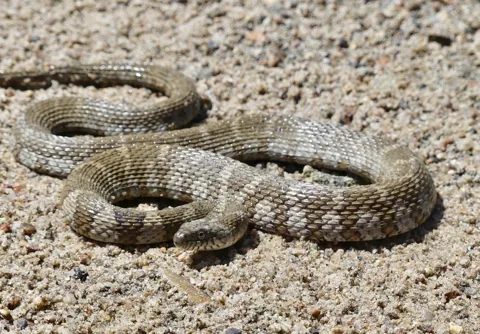 Common Watersnake
Nerodia sipedon
Water snakes are stout, nonvenomous snakes in the genus Nerodia that live in and around fresh water. This page centers on the common or northern watersnake, the most common watersnake in Missouri, and the banded watersnake of the southeastern Coastal Plain.
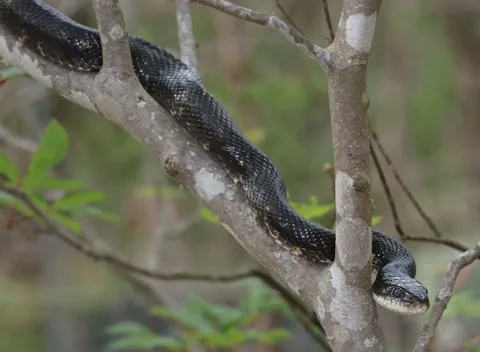 Rat snakes
Pantherophis obsoletus (western ratsnake) and P. alleghaniensis (eastern ratsnake)
Rat snakes are big, nonvenomous constrictors that Missouri's conservation department describes as common and often seen around homes and farm buildings, where they hunt rodents. Missouri calls them widely considered beneficial, though they also climb after bird eggs and chicks.
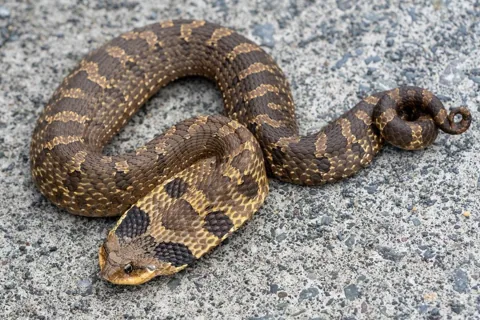 Hognose snakes
Heterodon platirhinos
The eastern hog-nosed snake is a stout, toad-eating snake with an upturned snout. When threatened it puts on a cobra-like show of hissing and neck-spreading, then plays dead. Missouri's conservation department says it rarely if ever bites people and is not considered a threat to them.
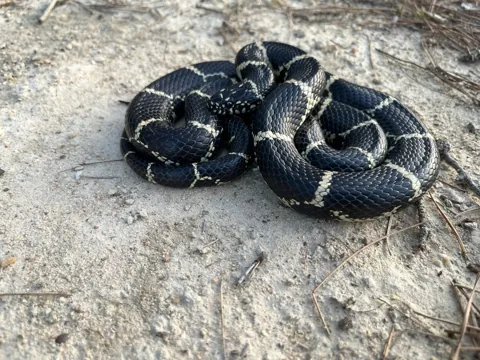 Kingsnakes
Lampropeltis getula
Kingsnakes are glossy, nonvenomous snakes that kill prey by constriction. The eastern kingsnake eats rodents, birds, lizards, turtle eggs and other snakes, and Missouri's conservation department says kingsnakes are immune to the venom of copperheads, cottonmouths and rattlesnakes.
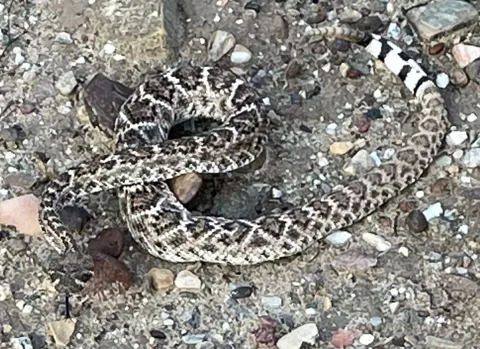 Rattlesnakes (western diamondback shown)
Crotalus species (shown: western diamond-backed rattlesnake, C. atrox)
Rattlesnakes are heavy-bodied pit vipers with a rattle on the tail and the largest venomous snakes in the United States. They eat rodents and rarely bite unless bothered, but a bite is a medical emergency.
The copperhead's own field marks
Color and bands: light brown to tan, gray, copper or pinkish tan, with 10-18 darker hourglass-shaped crossbands (SREL). Georgia DNR says there may or may not be dark spots inside the hourglasses or in the lighter areas between.[1][4][3]
Head: angular and distinct from the neck, solid golden, copper or reddish. Like other pit vipers it has a heat-sensing pit between the nostril and the eye. SREL notes the triangular head is not an identifying characteristic on its own.[3][1]
Body and scales: thick, fairly heavy body with keeled scales, each with a ridge, so the snake looks rough rather than shiny. The belly is lightly mottled brown, not boldly checkered.[3][1]
Size: Missouri gives 24 to 36 inches (2-3 feet), with a record near 53 inches; Georgia DNR says usually 24 to 30 inches with a record of 52 inches; Florida Museum gives 22-36 inches. Poison Control says babies are 7-9 inches long.[4][3][2][17]
Babies: newborns have the same hourglass pattern, sometimes duller or grayish, and a bright yellow or yellow-green tail tip they wiggle as a lure for frogs and lizards. Georgia DNR says the yellow lasts until they are about a year old; Missouri notes some adults keep a yellow tail tip.[3][1][4][17]
Side by side: copperhead and each lookalike
Corn snake (harmless): longer and slimmer, adults 3-4 ft per SREL or 30-48 inches per Florida Museum. Orange to reddish-brown with 27-40 black-edged blotches (squarish rather than hourglass), smooth or weakly keeled shiny scales, a spear-shaped mark on the head and neck, and a black-and-white checkerboard belly.[5][6][3]
Northern and midland watersnakes (harmless): 24 to 55 inches (SREL). Brown, tan, gray or reddish with dark crossbands or square blotches that are widest on the back; Florida Museum says the bands are darker, narrower and much more numerous than a copperhead's and break into alternating blotches about halfway down the body. Dark vertical lines on the lips, round pupils, and a belly with orange, red, brown or black half-moon spots. Almost always in or near water.[7][9][2][3]
Banded or southern watersnake (harmless, Coastal Plain): 24-48 inches per SREL, 22-42 inches per Florida Museum. SREL says its crossbands are more rectangular than a copperhead's hourglasses, broad across the back and narrow on the sides, the reverse of a copperhead. A dark stripe runs from the eye to the jaw, and older snakes can turn almost uniformly dark.[8][10][2]
Eastern hognose snake (harmless to people): stout, 20-33 inches (Florida Museum) or 2-3 ft (SREL), with blotches on a tan, gray, yellow, orange or reddish body, or all black. SREL says this variability causes confusion with copperheads, but the upturned, pointed snout identifies it. When threatened it flattens its head and neck, hisses and may play dead, rolling onto its back.[11][13][12]
Young rat snakes (harmless): SREL says juvenile eastern rat snakes are boldly blotched, while adults are usually black above with a checkerboard belly. Rat snakes grow long, typically 3-5 ft, and are skilled climbers seen in trees, barns and buildings.[14]
Young cottonmouth (venomous): Florida Museum says brightly colored juvenile cottonmouths are sometimes mistaken for copperheads, and both have a yellow tail tip when young. The cottonmouth's crossbands have numerous dark spots and speckles, and a dark band runs through the eye. Adult cottonmouths turn uniformly dark, while adult copperheads keep the banded pattern. Poison Control notes young cottonmouths may have a yellow-green tail.[15][2][16]
- Range check: Florida Museum says copperheads in Florida occur only in parts of the Panhandle, so a copperhead-like snake elsewhere in Florida is probably a young cottonmouth or a watersnake. SREL gives the overall range as southern New England west to Illinois and south through the Southeast; Georgia DNR extends it to west Texas.[2][1][3]
Where and when you'll meet them
Copperheads: hardwood and mixed forests, old fields, rocky hillsides and brushy creek edges. SREL says they tolerate moderate disturbance and are sometimes common in urban parks and suburban lots, hiding by day under logs, leaf litter, rocks or boards.[1][4][3]
Season: Missouri says copperheads are normally active from mid-March through early November, and young are born in August through early October. Poison Control says to be especially careful from April to September, when they are most active and bites are more likely.[4][17]
Time of day: SREL says copperheads are active by day in spring and fall but shift to night activity in hot summer months; Missouri says pit vipers are most active in late evening and at night.[1][4]
How to confirm what you saw
Photo first: NIOSH advises taking a photograph from a safe distance; it can help identify the snake and may speed treatment if someone is bitten.[18]
Stay back: Poison Control advises leaving any copperhead alone. Mississippi State Extension says that unless you are skilled at snake identification, treat every snake as venomous and avoid contact with its head.[17][22]
Check the pattern on the photo: hourglass bands narrow on the back (copperhead) versus rectangular bands wide on the back or square blotches (watersnake, corn snake); a spear mark on the head (corn snake); lip bars (watersnakes); an upturned snout (hognose); a dark band through the eye and speckled bands (young cottonmouth).[1][8][5][2][12][15]
Why the difference matters
A copperhead bite needs medical care. Poison Control lists pain, progressive swelling, redness, bruising and blood blisters as symptoms, and NIOSH says to seek emergency medical attention as soon as possible to start antivenom if needed.[17][18][19]
The lookalikes help you. Mississippi State Extension says many snakes keep rodent populations low and killing a snake usually serves little practical purpose; SREL says adult corn snakes and rat snakes eat rodents. Florida Museum says watersnakes and corn snakes are not dangerous to people or pets but will bite if handled.[22][5][14][6][10]
If someone is bitten
Call 911 or your local emergency number, and call Poison Control at 1-800-222-1222 for guidance. Keep calm and keep the bitten arm or leg still. Sources differ on position: Poison Control says to keep the bite area below the heart, MedlinePlus says at heart level.[19][18][17]
Remove rings, watches, jewelry and tight clothing before swelling starts.[18][17]
Dogs, cats and copperheads
Merck Veterinary Manual lists copperheads with rattlesnakes and cottonmouths as crotalids and says venomous snakebites are emergencies requiring prompt veterinary attention; treatment includes supportive care and antivenom where available.[23]
- Merck says fatal snakebites are more common in dogs than in other domestic animals, that small dogs are at more risk because of the venom dose relative to body size, and that bites to the chest or belly are generally more serious than bites to the head or legs.[23]
What to do about each
Copperhead in the yard: leave it alone and give it room. If it is on your property, Poison Control says to call Animal Control to remove it.[17]
Fewer copperheads: Poison Control advises removing leaves, rocks, trash, debris and tall vegetation from around the home. Mississippi State Extension adds that anything sheltering mice and rats draws the snakes that eat them, so store pet and bird food in closed containers.[17][22]
Harmless lookalikes: leave them be; they eat rodents and move on. To keep any snake out of the house, Mississippi State Extension says to close openings larger than a quarter of an inch and seal foundation cracks; see the snake-proofing guide linked below.[22]
Common questions
- Do baby copperheads look different from adults?
- They have the same hourglass bands, sometimes duller or grayish, plus a bright yellow or yellow-green tail tip. Poison Control says they are 7-9 inches long, and Missouri says they are born with working fangs and venom.[3][17][4]
- Is a snake with a triangular head always venomous?
- No. SREL says the copperhead's triangular head is not an identifying characteristic on its own, and harmless hognose snakes and watersnakes flatten their heads when threatened. Use the band shape and face markings instead.[1][12][2]
- Do copperheads smell like cucumbers?
- Georgia DNR calls that a common misconception: copperhead musk has its own scent, but it doesn't smell like cucumbers, and smelling cucumbers doesn't mean a snake is near.[3]
- Which lookalike is also venomous?
- The young cottonmouth. Florida Museum says bright juvenile cottonmouths are mistaken for copperheads; look for speckled crossbands and a dark band through the eye.[15][2]
Photo credits
- Copperhead: Brady Reed, public domain (CC0), via iNaturalist
- Cottonmouth: (c) Joshua Liverman, some rights reserved (CC BY) — via iNaturalist, CC BY 4.0
- Common Watersnake: (c) Aiva Noringseth, some rights reserved (CC BY) — via iNaturalist, CC BY 4.0
- Rat snakes: (c) hr_dragonfly, some rights reserved (CC BY) — via iNaturalist, CC BY 4.0
- Hognose snakes: (c) evangrimes, some rights reserved (CC BY) — via iNaturalist, CC BY 4.0
- Kingsnakes: (c) Matthew Lumsden, some rights reserved (CC BY) — via iNaturalist, CC BY 4.0
- Rattlesnakes (western diamondback shown): (c) Mark Pollock, some rights reserved (CC BY) — via iNaturalist, CC BY 4.0
Sources
- Savannah River Ecology Laboratory, University of Georgia, “Eastern Copperhead (Agkistrodon contortrix).” srelherp.uga.edu/snakes/copperhead/ (accessed 2026-11-14)
- Florida Museum of Natural History, “Eastern Copperhead (Florida Snake ID Guide).” www.floridamuseum.ufl.edu/florida-snake-id/snake/eastern-copperhead/ (accessed 2026-11-14)
- Georgia Department of Natural Resources, Wildlife Resources Division, “Venomous Snakes Fact Sheet: Copperhead.” gadnrle.org/sites/default/files/wrd/pdf/fact-sheets/Venomous%20Snakes%20-%20Copperhead.pdf (accessed 2026-11-14)
- Missouri Department of Conservation, “Eastern Copperhead (Field Guide).” mdc.mo.gov/discover-nature/field-guide/eastern-copperhead (accessed 2026-11-14)
- Savannah River Ecology Laboratory, University of Georgia, “Corn Snake (Pantherophis guttatus).” srelherp.uga.edu/snakes/corn-snake/ (accessed 2026-11-14)
- Florida Museum of Natural History, “Red Cornsnake (Florida Snake ID Guide).” www.floridamuseum.ufl.edu/florida-snake-id/snake/red-cornsnake/ (accessed 2026-11-14)
- Savannah River Ecology Laboratory, University of Georgia, “Northern Watersnake (Nerodia sipedon).” srelherp.uga.edu/snakes/northern-watersnake/ (accessed 2026-11-14)
- Savannah River Ecology Laboratory, University of Georgia, “Banded Watersnake (Nerodia fasciata).” srelherp.uga.edu/snakes/banded-watersnake/ (accessed 2026-11-14)
- Missouri Department of Conservation, “Northern Watersnake and Midland Watersnake (Field Guide).” mdc.mo.gov/discover-nature/field-guide/northern-watersnake (accessed 2026-11-14)
- Florida Museum of Natural History, “Southern Watersnake (Florida Snake ID Guide).” www.floridamuseum.ufl.edu/florida-snake-id/snake/southern-watersnake/ (accessed 2026-11-14)
- Savannah River Ecology Laboratory, University of Georgia, “Eastern Hognose Snake (Heterodon platirhinos).” srelherp.uga.edu/snakes/eastern-hognose-snake/ (accessed 2026-11-14)
- Missouri Department of Conservation, “Eastern Hog-Nosed Snake (Field Guide).” mdc.mo.gov/discover-nature/field-guide/eastern-hog-nosed-snake (accessed 2026-11-14)
- Florida Museum of Natural History, “Eastern Hog-nosed Snake (Florida Snake ID Guide).” www.floridamuseum.ufl.edu/florida-snake-id/snake/eastern-hog-nosed-snake/ (accessed 2026-11-14)
- Savannah River Ecology Laboratory, University of Georgia, “Rat Snake (Pantherophis obsoletus complex).” srelherp.uga.edu/snakes/rat-snake/ (accessed 2026-11-14)
- Florida Museum of Natural History, “Florida Cottonmouth (Florida Snake ID Guide).” www.floridamuseum.ufl.edu/florida-snake-id/snake/florida-cottonmouth/ (accessed 2026-11-14)
- Poison Control (National Capital Poison Center), “Cottonmouth Snakes.” www.poison.org/articles/cottonmouth-snakes (accessed 2026-11-14)
- Poison Control (National Capital Poison Center), “Copperhead Snakes.” www.poison.org/articles/copperhead-snakes (accessed 2026-11-14)
- CDC National Institute for Occupational Safety and Health (NIOSH), “Venomous Snakes.” www.cdc.gov/niosh/outdoor-workers/about/venomous-snakes.html (accessed 2026-11-14)
- MedlinePlus, U.S. National Library of Medicine, “Snake bites.” medlineplus.gov/ency/article/000031.htm (accessed 2026-11-14)
- Internet Center for Wildlife Damage Management, “Snakes.” icwdm.org/species/reptiles/snakes/ (accessed 2026-11-14)
- Texas Parks and Wildlife Department, “Snakes (Hunter Education).” tpwd.texas.gov/education/hunter-education/online-course/preparation-and-survival/snakes (accessed 2026-11-14)
- Mississippi State University Extension, “Reducing Snake Problems around Homes.” extension.msstate.edu/publications/reducing-snake-problems-around-homes (accessed 2026-11-14)
- Merck Veterinary Manual, “Snakebites in Animals.” www.merckvetmanual.com/toxicology/snakebite/snakebites-in-animals (accessed 2026-11-14)