On this page
How to identify it
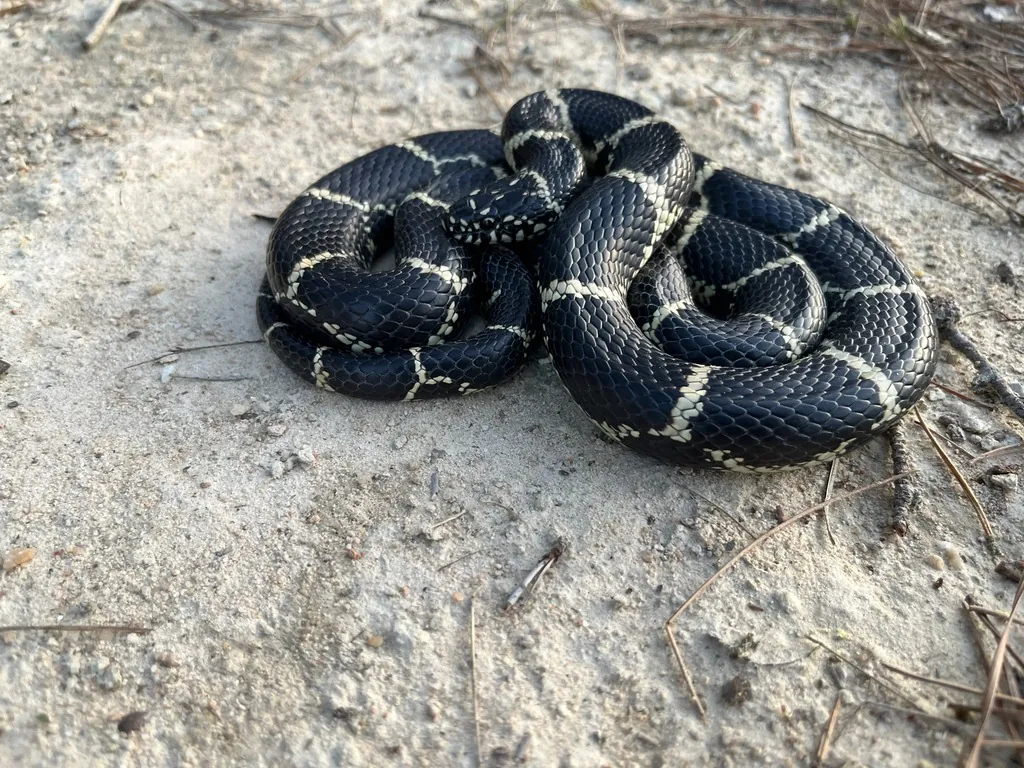
- Eastern kingsnakes are black to dark brown with narrow white to yellowish crossbands that join along the sides in a chain-like pattern; some adults are very dark. The Florida Museum counts 19 to 32 narrow crossbands and usually 21 scale rows at midbody.[5][1][6]
- The Florida Natural Areas Inventory puts adults at typically 3 to 4 feet, and Alabama's conservation department at usually 3 to 4 feet but up to 6.9; UGA's Savannah River Ecology Lab says they average about 3.5 feet and the largest reach 7 feet. Scales are smooth and glossy, and the head and eyes are relatively small. The Florida Museum puts most adults at about 36 to 48 inches, with an indistinct neck and round pupils.[5][7][1][6]
- The belly is checkered with dark and light squares. The Florida Museum adds that the belly may instead be solid black.[5][1][6]
- Missouri's speckled kingsnake is black with a small yellow or white spot on each scale, giving a salt-and-pepper look; the black kingsnake west of the Appalachians is mostly black with reduced banding.[3][1]
- The scarlet kingsnake is a small, slender relative, 14 to 20 inches long, ringed in red, black and yellow or white, with a red snout. The Florida Museum gives a record of 29.1 inches, notes that the rings completely encircle the body, and says juveniles' yellow rings may be white.[8][9][10]
Look-alikes
| Look-alike | How to tell them apart |
|---|---|
| Coral snake | The venomous coral snake has a black snout, and its red and yellow rings touch. On a scarlet kingsnake the snout is red and black rings separate the red from the yellow. The Florida Museum describes the harlequin coralsnake as having red and black rings separated by narrower yellow rings, and a black snout.[9][11][10] |
| Scarlet snake | The scarlet snake has a similar red, black and yellow or white pattern. The Savannah River Ecology Lab says it has a longer, pointed snout and a plain light belly, while the scarlet kingsnake's bands usually circle the whole body. The Florida Museum adds that the scarletsnake's rings do not completely encircle the body, its belly is creamy white and unpatterned, and its red snout is somewhat pointed.[8][9][10] |
| Rat snakes | Rat snakes reach similar sizes but have lightly keeled back scales, a larger head with bigger eyes, and a pattern dominated by gray, yellow or reddish orange.[5] |
| Eastern racer | Black racers are long, slender and mostly patternless, without the kingsnake's chain of pale crossbands.[5] |
| Copperhead | Copperheads are venomous pit vipers with a heat-sensing pit on each side of the face and vertically elliptical pupils; kingsnakes have round pupils and no pits, and they readily eat copperheads.[12][13][1] |
Where it lives
The eastern kingsnake, as now defined, ranges through the Atlantic coastal states from Florida to New Jersey. UGA's Savannah River Ecology Lab places it from southern New Jersey through peninsular Florida and west into Alabama, while the Florida Natural Areas Inventory treats peninsular Florida kingsnakes as the separate Florida kingsnake. Close relatives occur farther west, including the black kingsnake west of the Appalachians and the speckled and prairie kingsnakes, both presumed statewide in Missouri. In Florida, the Florida Museum places the eastern kingsnake north of a line from Pinellas to Flagler County and west into the Panhandle, excluding the eastern Apalachicola lowlands south of Telogia Creek, with occasional records on Gulf barrier islands such as the Cedar Keys. The scarlet kingsnake occurs in every Florida county, with two specimens from the Keys.[5][1][3][4][6][10]
Biology and life cycle
Eastern kingsnakes use sandy uplands, pine flatwoods, hardwood forests, floodplains and the edges of streams, lakes and wetlands, and they are often most abundant where logs, stumps and other cover are plentiful. In Florida, the Florida Museum lists pinelands, hardwood hammocks, cypress strands, prairies, marshes and estuaries, and says the species remains uncommon but is occasionally found in suburban neighborhoods next to good habitat.[5][1][6]
They are mainly active from April through October, mostly by day, and may become active at night in the hottest summer weather.[5][3][1]
They shelter under rocks, logs and rotten stumps and in small mammal burrows, and spend winter underground, in rock crevices, stumps, sawdust piles or the foundations of abandoned buildings.[3]
Their diet includes rodents, birds and eggs, lizards, amphibians, turtle eggs and other snakes; Missouri's conservation department says some populations eat mainly reptiles and their eggs. The Florida Museum says their preferred prey appear to be reptiles and their eggs, including other kingsnakes; larger prey are killed by constriction, while smaller prey and eggs are swallowed right away.[1][3][13][6]
Females lay eggs in early summer in rotting logs, mammal burrows or woody debris, and the young hatch in late summer. Clutch size differs by source and species: 6 to 25 eggs for eastern and black kingsnakes in Georgia and South Carolina, 3 to 29 for eastern kingsnakes in Alabama, and 2 to 23 (up to 29) for Missouri's speckled kingsnake. In Florida, the Florida Museum gives around 3 to 30 white eggs, typically hatching between June and September.[1][7][3][6]
Scarlet kingsnakes usually live in wet pinelands and mesic hammocks, hide under rocks, logs and debris, and climb well, sometimes turning up in trees and on buildings. They eat mainly lizards, especially skinks, and small snakes, appear to be mostly nocturnal, and in Florida lay about 2 to 8 eggs that hatch between July and November.[10]
Damage and signs
- Snakes do not damage buildings, landscapes or gardens; they help reduce insect and rodent numbers and are usually considered beneficial.[14]
- Missouri's conservation department calls the speckled kingsnake beneficial because it eats many rodents, and says the prairie kingsnake provides a valuable nontoxic rodent-control service.[3][4]
- Like other snakes, kingsnakes may take bird eggs. Eggs disappearing one a day is a classic sign of a snake, while most mammals break several eggs and leave the shells behind.[14][1]
Health risk
Missouri's and North Carolina's wildlife agencies call kingsnakes nonvenomous. Missouri's conservation department says a captured kingsnake may try to bite and smear foul-smelling musk but then quickly calms down, and that a prairie kingsnake's bite causes nothing more than shallow scratches. Georgia's DNR notes that many snake bites happen when a snake is cornered or captured and defending itself. The Florida Museum says eastern kingsnakes are not dangerous to people or pets, avoid contact, and that virtually all bites occur when people intentionally bother the snakes.[3][4][2][15][6]
Control
Prevention
Leave a kingsnake alone. Georgia's DNR advises not trying to handle a snake and giving it the space it needs, and notes that many bites happen when a snake is cornered or captured. The Florida Museum notes that, when approached, eastern kingsnakes typically flee for shelter.[15][6]
Keep them out
Snakes don't gnaw their way in, so sealing gaps of 1/8 inch or larger around doors, windows, pipes and foundations, as for mice, keeps them out. Penn State Extension adds that removing the rodents and closing their entrances usually solves the snake problem.[16][17]
Sanitation
Keep vegetation mowed around buildings and remove boards, rocks, brush and debris near the house that shelter snakes and the rodents they eat.[16][17]
Traps and physical control
To coax a snake out of a basement, pile damp towels or burlap where it was seen, cover with a dry one, and check underneath after a couple of days.[16]
When to call a professional
If a snake is indoors and you can't identify it or move it safely, Penn State Extension suggests contacting a local wildlife pest control operator.[17]
Why kingsnakes are worth keeping around
Kingsnakes readily eat copperheads, cottonmouths and rattlesnakes, and Missouri's conservation department says they are immune to the venom of those pit vipers. The Florida Museum says they appear to be immune to the venom and can even eat snakes longer than themselves by folding the prey as it is swallowed.[13][1][3][4][6]
They can overpower snakes larger than themselves. A lab study comparing kingsnakes with rat snakes found kingsnakes squeezed their prey with significantly higher constriction pressure, while the two groups pulled with similar force.[18]
Missouri's conservation department describes the speckled kingsnake as natural, nontoxic pest control because it eats many rodents.[3]
Georgia's Department of Natural Resources says the state's native nonvenomous snakes are protected by state law. South Carolina's DNR says all native reptiles and amphibians are protected there, though protections vary by species, and that all reptiles and amphibians are protected on state and federal lands.[15][19]
Kingsnakes have declined in parts of the Southeast. The Florida Natural Areas Inventory cites habitat loss, road deaths, fire ant predation on eggs and hatchlings, pollution and collecting for the pet trade; the Savannah River Ecology Lab recorded declines even on a protected site; and Alabama's conservation department lists the eastern kingsnake as a high conservation concern after marked declines there. The Florida Museum says numbers in Florida have declined dramatically over the past several decades.[5][1][7][6]
One species or three?
UGA's Savannah River Ecology Lab says molecular work supports treating the eastern kingsnake (Lampropeltis getula), the Florida kingsnake (L. floridana) and the Apalachicola kingsnake (L. meansi) as separate species, and that the black kingsnake (L. nigra) west of the Appalachians is now a distinct species too. The Florida Natural Areas Inventory follows the three-species split. The Florida Museum says eastern kingsnakes often interbreed with Florida kingsnakes in parts of the northern peninsula and with Apalachicola kingsnakes in parts of the Panhandle, producing hybrids with intermediate patterns. It separates Florida kingsnakes by more than 34 light crossbands and usually 23 scale rows, and Apalachicola kingsnakes by fewer than 26 wide crossbands, or no bands at all, and typically 21 scale rows.[1][5][6]
Not everyone agrees. The Florida Natural Areas Inventory notes that some still consider them subspecies because of the large zones where they interbreed, Alabama's conservation department describes the eastern kingsnake as one of three subspecies in Alabama, and the GBIF Backbone Taxonomy lists L. floridana and L. meansi as synonyms of L. getula while accepting L. nigra as a species.[5][7][20][21][22][23]
Red-and-yellow rhyme: use with care
The rhyme 'red touch yellow, kill a fellow; red touch black, venom lack' separates scarlet kingsnakes from coral snakes in the Southeast, along with the coral snake's black snout.[9][11]
Georgia's wildlife agency warns that people often misremember the rhyme, so the safest course is to leave alone any snake you can't easily identify.[9]
The Florida Museum says the rhyme holds true most of the time in Florida, but unusual color variations sometimes break it, so if you are not 100% sure of a snake's identity, leave it alone.[10]
Field studies appear to support the idea that the scarlet kingsnake's resemblance to the harlequin coralsnake in Florida is mimicry, according to the Florida Museum.[10]
Where the sources disagree
Adult size: the Florida Natural Areas Inventory gives typically 3 to 4 feet, Alabama usually 3 to 4 feet and up to 6.9, and the Savannah River Ecology Lab an average of about 3.5 feet with the largest at 7 feet. The Florida Museum puts most adults at about 36 to 48 inches.[5][7][1][6]
Clutch size: the Savannah River Ecology Lab gives 6 to 25 eggs, Alabama 3 to 29, and Missouri 2 to 23 (up to 29, average 10) for the speckled kingsnake. The Florida Museum gives around 3 to 30 for Florida.[1][7][3][6]
Daily activity: the Savannah River Ecology Lab calls kingsnakes diurnal to crepuscular, shifting to night activity in the hottest months; UGA's Bartow County Extension says they are active almost exclusively by day; Alabama reports activity peaking in mid-morning with a second peak in late afternoon and occasional snakes active after dark.[1][13][7]
One species or several: the Savannah River Ecology Lab and the Florida Natural Areas Inventory recognize the eastern, Florida and Apalachicola kingsnakes as separate species, Alabama still treats them as subspecies, and GBIF lists the Florida and Apalachicola kingsnakes as synonyms of L. getula.[1][5][7][20][21][22]
Scarlet kingsnake name: the Savannah River Ecology Lab uses Lampropeltis elapsoides, while Georgia DNR's coral snake fact sheet uses Lampropeltis triangulum elapsoides.[8][9]
Common questions
- Are kingsnakes venomous?
- No. Missouri's and North Carolina's wildlife agencies call kingsnakes nonvenomous. Missouri says a captured kingsnake may try to bite and smear musk, and that a prairie kingsnake's bite causes nothing more than shallow scratches.[3][4][2]
- Do kingsnakes really eat rattlesnakes and copperheads?
- Yes. Kingsnakes readily eat copperheads, cottonmouths and rattlesnakes, along with rodents, lizards, birds and eggs, and Missouri's conservation department says they are immune to the venom of those pit vipers.[13][1][3][4]
- Why is a kingsnake shaking its tail like a rattlesnake?
- Tail vibrating is a bluff. Missouri's conservation department says kingsnakes vibrate the tail when alarmed, which among dry leaves can sound something like a rattlesnake, but they are nonvenomous. The Florida Museum notes that in leaf litter the vibrating tail makes a buzzing sound.[3][4][6]
- Is the scarlet kingsnake mimicking a coral snake?
- Probably. The Florida Museum says field studies appear to support the idea that its resemblance to the harlequin coralsnake is mimicry, and that rhymes for telling them apart hold most of the time in Florida but are sometimes broken by unusual color variations.[10]
Sources
- Savannah River Ecology Laboratory, University of Georgia, “Eastern Kingsnake (Lampropeltis getula).” srelherp.uga.edu/snakes/eastern-kingsnake/ (accessed 2026-11-14)
- North Carolina Wildlife Resources Commission, “Eastern Kingsnake.” www.ncwildlife.gov/species/eastern-kingsnake (accessed 2026-11-14)
- Missouri Department of Conservation, “Speckled Kingsnake (Field Guide).” mdc.mo.gov/discover-nature/field-guide/speckled-kingsnake (accessed 2026-11-14)
- Missouri Department of Conservation, “Prairie Kingsnake field guide.” mdc.mo.gov/discover-nature/field-guide/prairie-kingsnake (accessed 2026-11-14)
- Florida Natural Areas Inventory, “Field Guide to the Rare Animals of Florida: Eastern Kingsnake, Lampropeltis getula (June 2021).” www.fnai.org/PDFs/FieldGuides/Lampropeltis_getula.pdf (accessed 2026-11-14). Florida Natural Areas Inventory is a nonprofit natural heritage program administered by Florida State University.
- Florida Museum of Natural History, University of Florida, “Eastern Kingsnake (Florida Snake ID Guide).” www.floridamuseum.ufl.edu/florida-snake-id/snake/eastern-kingsnake/ (accessed 2026-11-14)
- Alabama Department of Conservation and Natural Resources, “Eastern Kingsnake (Outdoor Alabama).” www.outdooralabama.com/non-venomous-snakes/eastern-kingsnake (accessed 2026-11-14)
- Savannah River Ecology Laboratory, University of Georgia, “Scarlet Kingsnake (Lampropeltis elapsoides).” srelherp.uga.edu/snakes/scarlet-kingsnake-eastern-milksnake/ (accessed 2026-11-14)
- Georgia Department of Natural Resources, Wildlife Resources Division, “Venomous Snakes of Georgia: Eastern Coral Snake (fact sheet).” gadnrle.org/sites/default/files/wrd/pdf/fact-sheets/Venomous%20Snakes%20-%20Eastern%20Coral%20Snake.pdf (accessed 2026-11-14)
- Florida Museum of Natural History, University of Florida, “Scarlet Kingsnake (Florida Snake ID Guide).” www.floridamuseum.ufl.edu/florida-snake-id/snake/scarlet-kingsnake/ (accessed 2026-11-14)
- Mississippi Department of Wildlife, Fisheries, and Parks, “Coral Snake.” www.mdwfp.com/venomous-snakes-mississippi/coral-snake (accessed 2026-11-14)
- Internet Center for Wildlife Damage Management, “Snakes: Identification.” icwdm.org/species/reptiles/snakes/ (accessed 2026-11-14). Run by university wildlife damage specialists (maintained at the University of Wisconsin-Stevens Point); species modules are based on Prevention and Control of Wildlife Damage (University of Nebraska Cooperative Extension, 1994).
- University of Georgia Cooperative Extension, “Snakes Eating Snakes (Bartow County Extension, March 2024).” site.extension.uga.edu/bartow/snakes-eating-snakes/ (accessed 2026-11-14)
- Internet Center for Wildlife Damage Management, “Snake Damage Identification.” icwdm.org/species/reptiles/snakes/snake-damage-identification/ (accessed 2026-11-14). Run by university wildlife damage specialists (maintained at the University of Wisconsin-Stevens Point); species modules are based on Prevention and Control of Wildlife Damage (University of Nebraska Cooperative Extension, 1994).
- Georgia Department of Natural Resources, Wildlife Resources Division, “What To Do When You See a Snake.” georgiawildlife.com/dnr-what-do-when-you-see-snake-3 (accessed 2026-11-14)
- Internet Center for Wildlife Damage Management, “Snake Damage Prevention and Control Methods.” icwdm.org/species/reptiles/snakes/snake-damage-prevention-and-control-methods/ (accessed 2026-11-14). Run by university wildlife damage specialists (maintained at the University of Wisconsin-Stevens Point); species modules are based on Prevention and Control of Wildlife Damage (University of Nebraska Cooperative Extension, 1994).
- Penn State Extension, “Snakes.” extension.psu.edu/snakes (accessed 2026-11-14)
- Journal of Experimental Biology, via PubMed, “The king of snakes: performance and morphology of intraguild predators (Lampropeltis) and their prey (Pantherophis) (Penning and Moon 2017).” pubmed.ncbi.nlm.nih.gov/28298469/ (accessed 2026-11-14)
- South Carolina Department of Natural Resources, “Frequently Asked Questions about Reptiles and Amphibians.” www.dnr.sc.gov/wildlife/herps/faqs.html (accessed 2026-11-14)
- Global Biodiversity Information Facility (GBIF), “Lampropeltis getula (Linnaeus, 1766) (GBIF Backbone Taxonomy).” api.gbif.org/v1/species/9799308 (accessed 2026-11-14)
- Global Biodiversity Information Facility (GBIF), “Lampropeltis floridana Blanchard, 1919 (synonym of L. getula) (GBIF Backbone Taxonomy).” api.gbif.org/v1/species/11319291 (accessed 2026-11-14)
- Global Biodiversity Information Facility (GBIF), “Lampropeltis meansi Krysko & Judd, 2006 (synonym of L. getula) (GBIF Backbone Taxonomy).” api.gbif.org/v1/species/11234292 (accessed 2026-11-14)
- Global Biodiversity Information Facility (GBIF), “Lampropeltis nigra (Yarrow, 1882) (GBIF Backbone Taxonomy).” api.gbif.org/v1/species/7721444 (accessed 2026-11-14)