On this page
How to identify it
- Adults usually measure 3 to 6 feet. Missouri gives 3-1/2 to 6 feet, occasionally more than 7, and the Savannah River Ecology Lab gives 3 to 5 feet, with some topping 6.[1][6]
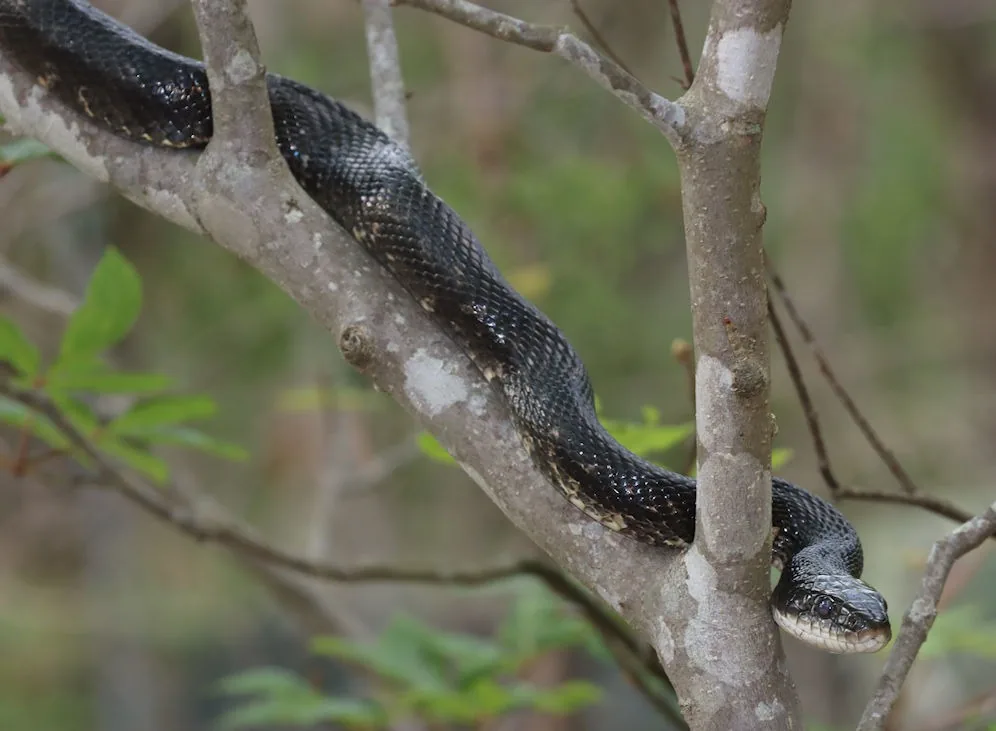
- Western ratsnakes are usually shiny black above, sometimes with red skin showing between the side scales, and have a white upper lip, chin and throat; the white belly may be checkered with black toward the front.[1]
- Young are gray or tan with bold dark blotches and a dark band running between the eyes and angling down toward the mouth. Western ratsnakes turn mostly black after a year or two.[1][6]
- On the Coastal Plain of Florida, Georgia and the Carolinas, rat snakes are often yellow to greenish with four dark stripes running down the body; Florida snakes are the brightest yellow.[6]
- Seen end-on, the body is loaf-shaped rather than round. The scales are weakly keeled and the anal plate is divided.[6]
- Like other nonvenomous snakes, they have round pupils and no heat-sensing pit between the eye and nostril. South Carolina's DNR says its pit vipers have a heat-sensing pit between the eye and nostril and elliptical pupils, like a cat's eye.[2][17]
- Excellent climbers, they bask in trees and turn up along barn beams, in attics and between the walls of houses.[1][6]
Look-alikes
| Look-alike | How to tell them apart |
|---|---|
| Copperhead | Missouri's conservation department describes the copperhead as a venomous snake with a heat-sensing pit between each nostril and eye, vertical pupils and hourglass-shaped dark bands; the Savannah River lab adds that the head is plain copper to red. Blotched young ratsnakes have round pupils and no pits.[15][8][2][1] |
| Rattlesnakes | A cornered ratsnake may vibrate its tail, which can sound like a rattle in dry leaves, but it has no rattle, round pupils and no facial pits.[1][6][2] |
| Corn snake | Corn snakes are related constrictors, orange to reddish brown with black-edged blotches, a spear-shaped mark on top of the head and a black-and-white checkerboard belly; they spend more time on the ground than eastern ratsnakes.[7] |
Where it lives
The western ratsnake is found statewide in Missouri. Its close relative P. alleghaniensis, which Missouri calls the central ratsnake, lives east of the Mississippi River; the Savannah River Ecology Lab places the black or gray eastern form from New Jersey south through the Southeast except Florida, and the striped yellow form on the Coastal Plain from Florida to the Carolinas. GBIF's public U.S. records since 1990 for the two species (about 62,000) come from 34 states and the District of Columbia, most from Texas (13,085), North Carolina (5,984) and Virginia (4,996).[1][6][11][12]
Biology and life cycle
They live mostly in woods, on rocky wooded hillsides, along streams and in swamps, and shelter in brush piles, hollow trees, farm buildings and old houses where mice are plentiful.[1][6]
Adults eat rodents, squirrels, small rabbits, bats, birds and bird eggs, killing larger prey by constriction; young ones take frogs, lizards and small mammals.[1][6][3]
They climb trees to raid bird nests and nest boxes for eggs and young.[1][6]
Clutches hold 4 to 40 eggs by Missouri's count and 4 to 44 by the Savannah River lab's. Eggs go into rotting stumps or logs, sawdust or mulch piles, or under rocks in early summer and hatch after about 42 to 84 days.[1][6]
In Missouri they are active from early April through October, hunting by day in spring and fall and mostly at night in hot weather.[1][6]
They spend two to four winter months in mammal burrows, rock outcrops, old stone wells, cisterns, building foundations and rotted stumps, and can live more than 20 years.[6][1]
A threatened rat snake may freeze in a kinked posture, vibrate its tail and smear a foul-smelling musk.[6][1]
Damage and signs
- Snakes don't harm landscapes or gardens and don't gnaw their way into buildings, but rat snakes slip into structures that aren't sealed well enough to keep them out.[4][5][1]
- Eggs vanishing one at a time, day after day, with no shells left behind, is a classic sign of a snake in a henhouse; mammals usually break several eggs and leave shells.[4]
- Their benefit is rodent control: Missouri's conservation department notes that rodents damage crops and stored grain, and ratsnakes reduce them without poisons that can harm pets or people.[1]
Health risk
Missouri's conservation department lists ratsnakes as nonvenomous, but says that when cornered or captured they bite in self-defense and release a foul-smelling musk; Georgia's DNR says many snake bites happen when a snake is cornered or captured and defending itself. MedlinePlus says to treat any snake bite as a serious event and to seek medical care rather than wait for symptoms, because even a nonvenomous snake's bite can sometimes cause significant injury, particularly to children. The Poison Help line, 1-800-222-1222, can advise.[1][16][10]
Control
Prevention
Give the snake room to leave. Georgia's DNR says not to try to handle a snake, to identify it only from a distance and to give it the space it needs.[16]
Sanitation
Cut off the food supply: keep feed, grain and pet food in secure containers and control rodents, since ICWDM says no plan for rodent-eating snakes is complete without removing the rodents.[5]
Mow close around buildings and clear brush, board piles, rock piles and junk; Mississippi State suggests keeping firewood racked at least 12 inches off the ground.[5][9]
Traps and physical control
Close gaps around doors, windows, pipes, utility lines and foundations the same way you would for mice. Sources differ on the size: ICWDM's text says seal openings 1/8 inch and larger, while its summary table and Mississippi State say 1/4 inch and larger.[5][9]
A fence of 1/4-inch hardware cloth, 36 inches tall, buried 4 to 6 inches and slanted outward, keeps out most snakes, but ICWDM warns that some nonvenomous snakes climb well, and ratsnakes are excellent climbers.[5][1]
Mississippi State reports that sticky bands 18 inches wide around supporting poles kept snakes from climbing to nest boxes, an approach practical only for pole-mounted boxes.[9]
To catch a snake indoors, lay damp towels or cloth bags where it was seen, cover them with a dry one, and check after a couple of days; the snake can then be scooped up with the whole pile.[5][9]
When to call a professional
Georgia's DNR says to use caution around any snake you cannot identify. South Carolina's DNR does not remove nuisance snakes but keeps a list of wildlife removal specialists who can.[16][17]
A helpful neighbor
Missouri's Department of Conservation calls ratsnakes valuable natural rodent control whose benefits far outweigh the occasional theft of a few eggs or chicks.[1]
The Savannah River Ecology Lab names road deaths and persecution by people as the biggest threats to rat snakes, despite their role in controlling rodents.[6]
Legal protection comes from state wildlife law. Missouri's conservation department says all snakes native to the state are protected and it is illegal to kill them, except when a venomous snake is so close to people that someone might be bitten. Georgia's DNR says native nonvenomous snakes are protected by state law, and South Carolina's DNR says all native reptiles and amphibians are protected there, with protections that vary by species, and all are protected on state and federal lands.[15][16][17]
What doesn't work
Mississippi State reports that home remedies tested against black rat snakes, including sulfur, lime, mothballs, cayenne pepper spray, artificial skunk scent and king snake musk, all failed.[9]
Snake repellents are sold, but ICWDM finds no extensive research showing they work in real-world use, and Mississippi State says none are currently registered for snake control.[5][9]
No toxicants are registered for snakes, and Mississippi State says no fumigants or toxicants are federally registered for snake control.[5][9]
Where the sources disagree
Size: Missouri gives adults 3-1/2 to 6 feet, occasionally more than 7, while the Savannah River Ecology Lab gives 3 to 5 feet, with some topping 6.[1][6]
Eggs: Missouri counts usually 4 to 40 eggs hatching after 42 to 84 days; the Savannah River lab gives 4 to 44 eggs hatching after about 60 days.[1][6]
How many species: the Savannah River lab notes that one checklist treats the eastern and yellow rat snakes as subspecies of the western ratsnake, while Missouri treats the central ratsnake, P. alleghaniensis, as a separate species, and GBIF's backbone accepts both P. obsoletus and P. alleghaniensis.[6][1][13][14]
Repellents: Mississippi State says no repellents are currently registered for snake control, while ICWDM says a sulfur and naphthalene repellent is registered for rattlesnakes and checkered garter snakes but apparently is not effective against most other species.[9][5]
Legal status: the Savannah River lab says rat snakes are not protected in most states, though Georgia protects them; ICWDM says snakes are protected as nongame wildlife in most states. State agencies are the authority for each state; Missouri, Georgia and South Carolina all protect native nonvenomous snakes.[6][2][15][16][17]
Common questions
- Is the big black snake in my barn dangerous?
- Probably not. Missouri's conservation department says the shiny black snake with a white chin often called the black snake is the western ratsnake, a nonvenomous rodent hunter, though it will bite in self-defense if cornered or captured.[1]
- Why is there a snake in my chicken coop?
- Eggs, chicks and the rodents drawn to feed bring them in, which is how ratsnakes got the nickname chicken snake. Seal the coop as you would against mice and keep feed in closed containers.[1][5]
- Is it a baby copperhead or a rat snake?
- Look from a distance and don't handle it, as Georgia's DNR advises. Young ratsnakes are gray with dark blotches but have round pupils, no facial pits and a dark band through the eyes; a copperhead has vertical pupils, a heat-sensing pit on each side of the face, a plain copper head and hourglass-shaped bands.[16][1][15][8][2]
Sources
- Missouri Department of Conservation, “Western Ratsnake (Field Guide).” mdc.mo.gov/discover-nature/field-guide/western-ratsnake (accessed 2026-11-13)
- Internet Center for Wildlife Damage Management, “Snakes: Identification.” icwdm.org/species/reptiles/snakes/ (accessed 2026-11-13). Run by university wildlife damage specialists (maintained at the University of Wisconsin-Stevens Point); species modules are based on Prevention and Control of Wildlife Damage (University of Nebraska Cooperative Extension, 1994).
- Internet Center for Wildlife Damage Management, “Snake Biology.” icwdm.org/species/reptiles/snakes/snake-biology/ (accessed 2026-11-13). Run by university wildlife damage specialists (maintained at the University of Wisconsin-Stevens Point); species modules are based on Prevention and Control of Wildlife Damage (University of Nebraska Cooperative Extension, 1994).
- Internet Center for Wildlife Damage Management, “Snake Damage Identification.” icwdm.org/species/reptiles/snakes/snake-damage-identification/ (accessed 2026-11-13). Run by university wildlife damage specialists (maintained at the University of Wisconsin-Stevens Point); species modules are based on Prevention and Control of Wildlife Damage (University of Nebraska Cooperative Extension, 1994).
- Internet Center for Wildlife Damage Management, “Snake Damage Prevention and Control Methods.” icwdm.org/species/reptiles/snakes/snake-damage-prevention-and-control-methods/ (accessed 2026-11-13). Run by university wildlife damage specialists (maintained at the University of Wisconsin-Stevens Point); species modules are based on Prevention and Control of Wildlife Damage (University of Nebraska Cooperative Extension, 1994).
- University of Georgia Savannah River Ecology Laboratory, Herpetology Program, “Rat Snake (Pantherophis alleghaniensis).” srelherp.uga.edu/snakes/rat-snake/ (accessed 2026-11-13)
- University of Georgia Savannah River Ecology Laboratory, Herpetology Program, “Corn Snake (Pantherophis guttatus).” srelherp.uga.edu/snakes/corn-snake/ (accessed 2026-11-13)
- University of Georgia Savannah River Ecology Laboratory, Herpetology Program, “Eastern Copperhead (Agkistrodon contortrix).” srelherp.uga.edu/snakes/copperhead/ (accessed 2026-11-13)
- Mississippi State University Extension Service, “Reducing Snake Problems Around Homes.” extension.msstate.edu/publications/reducing-snake-problems-around-homes (accessed 2026-11-13)
- MedlinePlus, U.S. National Library of Medicine, “Snake bites (Medical Encyclopedia).” medlineplus.gov/ency/article/000031.htm (accessed 2026-11-13)
- Global Biodiversity Information Facility (GBIF), “Pantherophis obsoletus: occurrence records in the U.S., 1990-2026 (GBIF occurrence search).” api.gbif.org/v1/occurrence/search?taxonKey=2455676&country=US&hasGeospatialIssue=false&occurrenceStatus=PRESENT&year=1990%2C2026&facet=stateProvince&facetLimit=400&limit=0 (accessed 2026-11-13). Fetched 2026-11-13: 21,820 U.S. records since 1990. State counts are records reported (community observations, museum specimens, surveys), not abundance.
- Global Biodiversity Information Facility (GBIF), “Pantherophis alleghaniensis: occurrence records in the U.S., 1990-2026 (GBIF occurrence search).” api.gbif.org/v1/occurrence/search?taxonKey=7453543&country=US&hasGeospatialIssue=false&occurrenceStatus=PRESENT&year=1990%2C2026&facet=stateProvince&facetLimit=400&limit=0 (accessed 2026-11-13). Fetched 2026-11-13: 40,567 U.S. records since 1990. State counts are records reported (community observations, museum specimens, surveys), not abundance.
- Global Biodiversity Information Facility (GBIF), “Pantherophis obsoletus (Say, 1823) (GBIF Backbone Taxonomy).” api.gbif.org/v1/species/2455676 (accessed 2026-11-13)
- Global Biodiversity Information Facility (GBIF), “Pantherophis alleghaniensis (Holbrook, 1836) (GBIF Backbone Taxonomy).” api.gbif.org/v1/species/7453543 (accessed 2026-11-13)
- Missouri Department of Conservation, “Eastern Copperhead (Field Guide).” mdc.mo.gov/discover-nature/field-guide/eastern-copperhead (accessed 2026-11-13)
- Georgia Department of Natural Resources, Wildlife Resources Division, “What To Do When You See a Snake.” georgiawildlife.com/dnr-what-do-when-you-see-snake-3 (accessed 2026-11-13)
- South Carolina Department of Natural Resources, “Reptile and Amphibian Frequently Asked Questions.” www.dnr.sc.gov/wildlife/herps/faqs.html (accessed 2026-11-13)