On this page
How to identify it
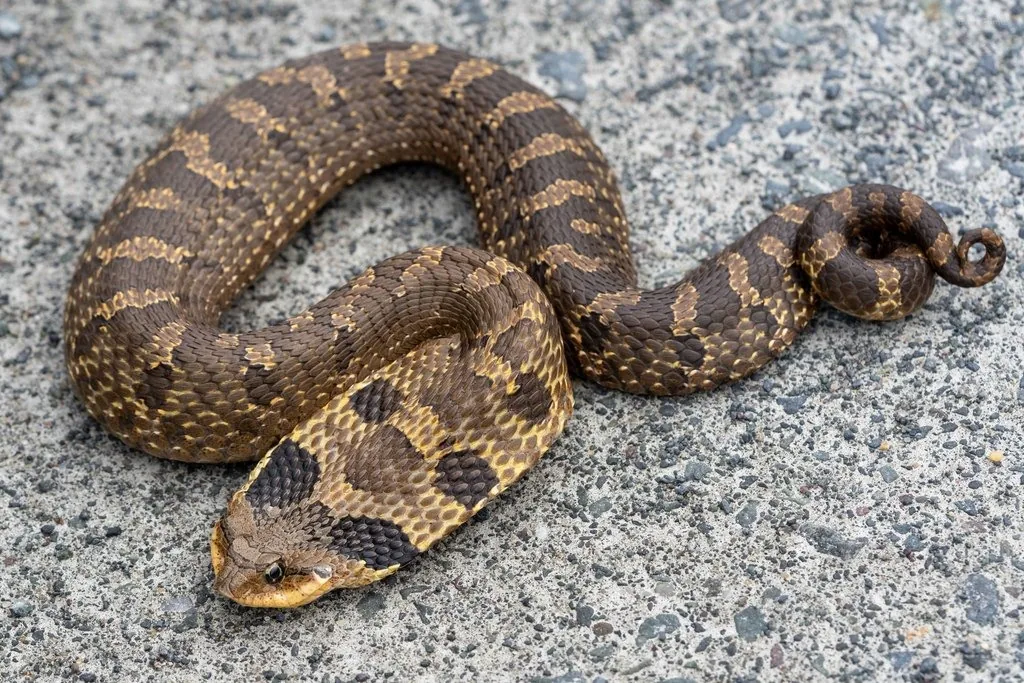
- A short, heavy-bodied snake with an upturned snout, fairly large eyes and a short tail. The Missouri Department of Conservation gives adult length as 20 to 33 inches, occasionally to 50; Connecticut DEEP gives about 21 to 32 inches, Alabama's conservation department usually 20 to 30 inches and up to 46, and UGA's Savannah River Ecology Lab 2 to 3 feet, occasionally over 4.[1][2][13][3]
- Color varies widely: gray, tan, yellow, brown, olive, orange or reddish with dark blotches, or solid black or dark gray with no pattern. The Savannah River Ecology Lab notes that in the Southeast many adults are patternless.[1][2][3]
- Even unmarked individuals have a pair of large dark blotches just behind the head. Heavily marked snakes also show a dark bar between the eyes and a diagonal dark bar from each eye to the corner of the mouth.[1]
- The back scales are keeled, giving a rough texture, and the underside of the tail is usually lighter than the belly.[1][2][3]
- Young snakes are often more colorful than adults, with brown, black, tan, yellow or orange blotches; Connecticut DEEP says its juveniles are mostly gray with deep brown blotches. The Savannah River Ecology Lab gives hatchlings as 6 to 9 inches, Missouri as about 9 inches.[1][2][3]
Look-alikes
| Look-alike | How to tell them apart |
|---|---|
| Pygmy rattlesnake | A small venomous rattlesnake with a slender tail that ends in a tiny rattle and a heat-sensing pit between each nostril and eye. The Savannah River Ecology Lab notes that patterned hognose snakes get confused with pygmy rattlesnakes and copperheads, but the upturned snout settles it.[4][3] |
| Western hog-nosed snake | Missouri says its western hog-nosed snakes have a sharply upturned snout and black pigment under the tail. Both Missouri forms are very rare: one is probably extirpated, and the other is restricted to sand prairie and savanna in the southeast of the state.[1] |
| Copperhead | Copperheads are venomous pit vipers with a deep pit on each side of the head between the eye and nostril and vertically elliptical pupils; nonvenomous snakes have round pupils and no pits.[5][3] |
Where it lives
Sources draw the range a little differently. The Missouri Department of Conservation says it covers the entire eastern half of the United States, west to southeastern South Dakota and the eastern half of Texas. UGA's Savannah River Ecology Lab gives southern New England and the Great Lakes region south to Florida, and west to Minnesota, Texas and extreme eastern Colorado.[1][3]
Biology and life cycle
It lives where soils are sandy, loose or gravelly and well drained: open woods, old fields, river floodplains, field edges and, in the Southeast, longleaf pine and coastal dunes. It is seldom found in dense woods.[1][2][3]
Active by day, it shelters in small mammal burrows, digs into loose soil, or hides under boards, tin and other objects. The Savannah River Ecology Lab finds surface activity peaks in spring and fall, highest in September and October.[1][2][3]
Toads are its main food; it digs them out with its snout. Missouri's conservation department says hog-nosed snakes are immune to toad toxins, and Connecticut DEEP says the toxins are neutralized by enzymes in the snake's digestive tract. It also takes frogs, salamanders, lizards, eggs and small mammals.[1][2][3]
A pair of enlarged teeth at the back of the upper jaw deflates puffed-up toads, and Missouri says a gland called Duvernoy's gland produces a mild venom that helps subdue prey as it is swallowed.[1][2]
Females lay one clutch a year in loose or sandy soil, in June or July. Clutch size: 4 to 61 eggs, averaging 22 (Missouri); 4 to over 50 (Connecticut); 4 to 50, commonly 15 to 25 (Savannah River Ecology Lab). Eggs hatch in about 50 to 65 days, in August or September.[1][2][3]
It overwinters from early November to April in old mole or rodent burrows, its own burrows, or rotting logs and stumps.[1]
Damage and signs
- Snakes do not damage structures, landscapes or gardens, and they help reduce insect and rodent numbers.[6]
- The hognose's dramatic bluff often gets it mistaken for a dangerous snake and killed; Connecticut DEEP lists human persecution as a serious threat to it.[1][2]
- Boards, tin, brush and rock piles near homes give it and its prey places to hide.[1][7][2]
Health risk
Missouri's conservation department says hog-nosed snakes rarely if ever bite people. Most bites in the medical literature involve pet western hognose snakes: of 35 western hognose bites reported to the California Poison Control System from January 2016 to March 2026, 89 percent were from the person's own pet and all were on the hands, typically during feeding, handling or enclosure cleaning. Local swelling followed in 91 percent, two people were hospitalized for presumed cellulitis, and the authors say rattlesnake antivenom has no role. A 2009 case report and review concluded that hognose snakes may uncommonly cause medically significant bites but should not be considered dangerous, and a 2013 evidence review placed the western hognose among snakes whose bites, often protracted ones, cause significant local effects only, managed with wound care.[1][10][8][9]
Control
Prevention
Leave it be: the hissing, hooding and strikes are a bluff, usually made with the mouth closed. Connecticut DEEP advises watching from a distance and letting it go on its way.[1][2]
If you keep a pet hognose, handle it carefully, especially when offering food: the 2009 review gives that advice for captive snakes, and the California review found most bites happened during feeding or handling and links prolonged bites to a higher risk of severe injury. Connecticut DEEP says wild snakes should never be collected as pets.[8][10][2]
Keep them out
Seal cracks and openings of 1/8 inch or larger in the foundation, and keep basement windows closed tight or screened. Snakes don't gnaw their way in, so the Internet Center for Wildlife Damage Management says closures that keep out mice also keep out snakes.[7][2]
Sanitation
Keep grass mowed short and remove boards, rocks, brush and debris near the house that shelter snakes and their prey.[7][2][11]
When to call a professional
If you can't tell what a snake is, keep your distance. Penn State Extension says local wildlife pest control operators can remove snakes, and Connecticut DEEP takes snake questions through its Wildlife Division.[11][2]
The bluff, step by step
First the snake flattens its head and neck like a cobra, may inflate its body, and hisses loudly. It may strike, but with its mouth closed, and the strike almost always falls short.[1][2][3]
If that fails, it writhes, may release musk, feces or its last meal, rolls onto its back and lies still with its mouth open and tongue out. The Savannah River Ecology Lab adds that some bleed from the mouth to complete the act.[1][2][3]
Turn it right side up and it flips onto its back again. Left alone, it lifts its head, looks around, rolls back over and crawls off.[1][2]
Puff adders, hissing vipers and other names
Local names such as puff adder, blow snake, spreadhead and hissing viper come from the hooding display, and Connecticut DEEP notes the act often convinces people the snake is venomous.[1][2]
Why it plays dead is still debated. One idea, which the Savannah River Ecology Lab calls speculative, is that the musk carries traces of its toxic toad prey, so a predator smells danger in what looks like an easy meal.[3]
Legal status varies by state
Connecticut lists the eastern hog-nosed snake as a state species of special concern. It is protected by Connecticut's Endangered Species Act, and Connecticut DEEP says killing or collecting one there is illegal.[2]
Alabama's conservation department says eastern hognose snakes are common there and not protected by state or federal regulations, while the rare southern hognose snake, which can be confused with it, is protected by Alabama's state nongame regulation.[13]
Where the sources disagree
Bite effects: Missouri says the saliva is essentially not toxic to humans and that a bite on the hand may bring a short-lived burning or tingling with a little swelling, while the 2009 case report describes marked swelling, bruising and blisters with recovery taking about five months, and the California review found swelling in 91 percent of reported bites and two hospital stays.[1][8][10]
Venomous or not: Missouri, Connecticut and North Carolina call it nonvenomous, yet Missouri also describes a mild venom from Duvernoy's gland; the California review notes it is sometimes classified as nonvenomous but produces mildly toxic saliva.[1][2][14][10]
Adult size: Missouri gives 20 to 33 inches (occasionally 50), Connecticut about 21 to 32, Alabama usually 20 to 30 and up to 46, and the Savannah River Ecology Lab 2 to 3 feet, occasionally over 4.[1][2][13][3]
Toad toxins: Missouri says hog-nosed snakes are immune to them, while Connecticut says enzymes in the snake's digestive tract neutralize them.[1][2]
Clutch size: Missouri gives 4 to 61 eggs (average 22), Connecticut 4 to over 50, the Savannah River Ecology Lab 4 to 50 (commonly 15 to 25), and Alabama 15 to 25.[1][2][3][13]
Legal protection: Connecticut protects it under its Endangered Species Act, while Alabama says it is not protected by state or federal regulations there.[2][13]
Common questions
- Is a hognose snake venomous?
- Missouri, Connecticut and North Carolina wildlife agencies call it nonvenomous. Missouri also says its Duvernoy's gland makes a mild venom for subduing prey, and the California poison-center review describes mildly toxic saliva that caused local swelling in most of the pet-snake bites reported. The 2009 case review says hognose snakes should not be considered dangerous or venomous.[1][2][14][10][8]
- Why did the snake in my yard roll over and play dead?
- Death feigning is the hognose's fallback defense after its hissing bluff fails. Back away and it will usually right itself and leave.[1][2]
- Why do hognose snakes show up on sandy ground?
- They favor loose, sandy, well-drained soil where they can burrow and dig up toads, and females choose sandy spots to lay eggs.[1][2][3]
Sources
- Missouri Department of Conservation, “Eastern Hog-Nosed Snake (Field Guide).” mdc.mo.gov/discover-nature/field-guide/eastern-hog-nosed-snake (accessed 2026-11-13)
- Connecticut Department of Energy and Environmental Protection, Wildlife Division, “Eastern Hog-nosed Snake (Wildlife in Connecticut fact sheet).” portal.ct.gov/deep/wildlife/fact-sheets/eastern-hog-nosed-snake (accessed 2026-11-13)
- Savannah River Ecology Laboratory, University of Georgia, “Eastern Hognose Snake (Heterodon platirhinos).” srelherp.uga.edu/snakes/eastern-hognose-snake/ (accessed 2026-11-13)
- Missouri Department of Conservation, “Western Pygmy Rattlesnake field guide.” mdc.mo.gov/discover-nature/field-guide/western-pygmy-rattlesnake (accessed 2026-11-13)
- Internet Center for Wildlife Damage Management, “Snakes: Identification.” icwdm.org/species/reptiles/snakes/ (accessed 2026-11-13). Run by university wildlife damage specialists (maintained at the University of Wisconsin-Stevens Point); species modules are based on Prevention and Control of Wildlife Damage (University of Nebraska Cooperative Extension, 1994).
- Internet Center for Wildlife Damage Management, “Snake Damage Identification.” icwdm.org/species/reptiles/snakes/snake-damage-identification/ (accessed 2026-11-13). Run by university wildlife damage specialists (maintained at the University of Wisconsin-Stevens Point); species modules are based on Prevention and Control of Wildlife Damage (University of Nebraska Cooperative Extension, 1994).
- Internet Center for Wildlife Damage Management, “Snake Damage Prevention and Control Methods.” icwdm.org/species/reptiles/snakes/snake-damage-prevention-and-control-methods/ (accessed 2026-11-13). Run by university wildlife damage specialists (maintained at the University of Wisconsin-Stevens Point); species modules are based on Prevention and Control of Wildlife Damage (University of Nebraska Cooperative Extension, 1994).
- Toxicon, via PubMed, “Local envenoming by the Western hognose snake (Heterodon nasicus): a case report and review of medically significant Heterodon bites (Weinstein and Keyler 2009).” pubmed.ncbi.nlm.nih.gov/19393681/ (accessed 2026-11-13)
- Toxicon, via PubMed, “Non-front-fanged colubroid snakes: a current evidence-based analysis of medical significance (Weinstein et al. 2013).” pubmed.ncbi.nlm.nih.gov/23462380/ (accessed 2026-11-13)
- Clinical Toxicology, via PubMed, “The secretory life of pets: bites from western hognose snakes reported to the California Poison Control System (Vohra et al. 2026).” pubmed.ncbi.nlm.nih.gov/42960828/ (accessed 2026-11-13)
- Penn State Extension, “Snakes.” extension.psu.edu/snakes (accessed 2026-11-13)
- Global Biodiversity Information Facility (GBIF), “Heterodon platirhinos Latreille, 1801 (GBIF Backbone Taxonomy).” api.gbif.org/v1/species/5223730 (accessed 2026-11-13)
- Alabama Department of Conservation and Natural Resources, “Eastern Hognose Snake (Outdoor Alabama).” www.outdooralabama.com/non-venomous-snakes/eastern-hognose-snake (accessed 2026-11-13)
- North Carolina Wildlife Resources Commission, “Eastern Hognose Snake.” www.ncwildlife.gov/species/eastern-hognose-snake (accessed 2026-11-13)