On this page
How to identify it
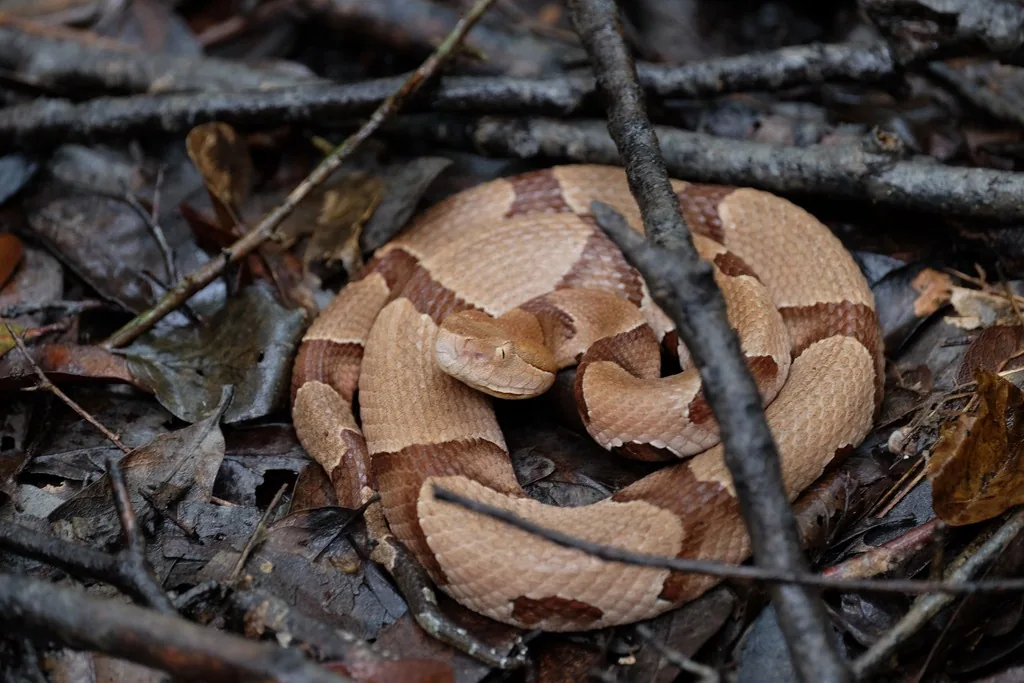
- Tan, gray, copper or pinkish-tan body crossed by dark brown hourglass-shaped bands that are wide on the sides and narrow along the back. UF/IFAS explains that constrictions along the center of the back give the dark bands their hourglass shape, and the alternating light and dark bands camouflage the snake on the forest floor.[5][1][4][6]
- A thick body with a broad, coppery head clearly wider than the neck. Adult length varies by source: CDC says about 1.5 to 3 feet, Georgia DNR usually 24 to 30 inches with a record of 52, and Missouri 24 to 36 inches, with some reaching 53. UF/IFAS says a full-grown copperhead is usually less than three feet long.[5][1][4][6]
- A deep heat-sensing pit on each side of the face between the nostril and the eye, and eyes with vertical pupils. UF/IFAS cautions that these features are hard to see unless a snake is examined closely, and that a triangular head is not proof of venom: some harmless snakes flatten their heads and flare their jaws when threatened.[5][4][6]
- Young copperheads have a bright yellow or yellow-green tail tip for about their first year, which they wiggle to lure prey.[1][5]
- It has no rattle, but an alarmed copperhead may vibrate its tail rapidly, making a buzzing noise in dry leaves.[1]
- Like other pit vipers, it has keeled scales, each with a thin ridge, which give the back a somewhat dull look.[6]
Look-alikes
| Look-alike | How to tell them apart |
|---|---|
| Corn snake | Harmless corn snakes are longer and slimmer with smooth, shiny scales, a narrow head, and squarish black-edged blotches, often red or orange.[1] |
| Northern water snake | Water snakes have a squarer pattern that is widest on the back rather than on the sides, and they stay in or near water.[1] |
| Rattlesnakes | Rattlesnakes are fellow pit vipers but most have a rattle at the tail tip; copperheads have no rattle, even though they may buzz their tails.[1][7] |
| Young cottonmouth | Young cottonmouths are brightly colored with reddish-brown crossbands and a yellow tail and look very similar to copperheads. UF/IFAS says to check range maps: in Florida, copperheads live only in parts of the Panhandle.[6] |
Where it lives
Copperheads range across most of the eastern seaboard, through the central states and west to west Texas, in wooded, rocky and brushy areas. Florida has about 50 native snake species, six of them venomous; UF/IFAS says copperheads live there only in a small area of the Panhandle just west of Tallahassee, mainly along the Apalachicola River and its tributaries, and in several of the westernmost counties.[1][8][6]
Biology and life cycle
They live on rocky wooded hillsides, in brushy creek edges and swamps, and around old farm buildings, sawmills, dumps and old fields. UF/IFAS says they prefer to stay near streams and wet areas but may be found away from them.[5][1][6]
Mice and voles make up most of the diet, along with frogs, lizards, small birds and insects, especially emerging cicadas.[5][1]
Copperheads rely on camouflage and usually stay still when approached; they seldom strike unless provoked.[5][1]
They are active from about mid-March through early November and become mostly nocturnal in the hottest summer months.[5]
Mating happens in spring and late summer, and live young are born from August to early October with working fangs and venom. Georgia DNR says litters are usually under ten; Missouri reports 3 to 11 and says many females give birth only every other year.[5][1][9]
In winter they shelter in rocky ledges, rock piles, crevices, hollow logs, stumps and woodpiles.[5][1]
Damage and signs
- Snakes do not damage buildings, lawns or gardens; the concern with copperheads is a defensive bite when someone handles, threatens or comes too close to one.[10][5]
- Most bites happen when people try to kill or handle venomous snakes.[5]
- Pets can be badly hurt. The Merck Veterinary Manual says fatal snakebites are more common in dogs than in other domestic animals, and because some dogs are small compared with the amount of venom injected, even a small snake's bite can be fatal. Horses and cattle seldom die directly from a bite, but bites on the muzzle, head or neck can swell enough to make breathing difficult.[11]
- Woodpiles, junk piles, heavy mulch, overgrown shrubs and areas where rodents are common can draw snakes close to a house.[9][12]
Health risk
CDC lists puncture marks, bleeding, redness, swelling, bruising or blistering and severe pain as bite symptoms, sometimes followed by nausea or trouble seeing or breathing. A Virginia study found blood-clotting changes after copperhead bites were fairly common but caused no clinically significant bleeding, and a Texas study found pain, swelling and loss of use usually lasted one to two weeks but sometimes months. CDC says antivenom given as soon as possible helps the limb recover faster.[4][2][3]
Control
Prevention
Wear boots and long pants in snake habitat and leather gloves when moving brush, and never reach under rocks, logs or debris you cannot see.[4][5]
Step onto a log or rock first and then over it, and look the ground over before you sit or stand near rocks or logs.[5]
Keep them out
Seal openings in foundations and around doors, windows, pipes and utility lines as you would to keep out mice. ICWDM gives two sizes: its summary says to seal openings 1/4 inch and larger, and its exclusion text says 1/8 inch and larger.[12]
For a children's play area, a snake-proof fence of 1/4-inch galvanized hardware cloth, 36 inches tall, buried 4 to 6 inches and slanted outward, keeps out venomous snakes.[12]
Sanitation
Remove woodpiles, lumber, rocks, boards and debris lying near the house, keep grass closely mowed, and store pet food and other rodent food in sealed containers.[12]
When to call a professional
Leave a copperhead alone and keep people and pets away. Texas Parks and Wildlife says to freeze until you know where the snake is, let it retreat, and back slowly away if you must move.[5][8]
If someone is bitten: what CDC says to do
Seek emergency medical attention as soon as possible to start antivenom if needed and stop irreversible damage.[4]
If you can, take a photograph of the snake from a safe distance to help identify it.[4]
Keep calm and give first aid while waiting for a ride to the hospital: lie or sit down with the bite in a neutral position of comfort.[4]
Remove rings and watches before swelling starts, wash the bite with soap and water, and cover it with a clean, dry dressing.[4]
What CDC says not to do
Do not pick up the snake or try to trap it, and never handle a venomous snake, not even a dead one or its decapitated head.[4]
Do not wait for symptoms to appear; get medical help right away.[4]
Do not apply a tourniquet, electric shock or folk therapies, and do not slash or cut the wound in any way.[4]
Do not try to suck out the venom, and do not apply ice or put the wound in water.[4]
Do not drink alcohol as a painkiller or take pain relievers.[4]
Legal status
Snakes are classed as nongame wildlife and protected in most states, and some species are listed as threatened or endangered.[7]
In Missouri, for example, all native snakes are protected, and killing one is allowed only when a venomous snake is close enough to people to risk a bite.[5]
Texas Parks and Wildlife asks people not to kill snakes, even venomous ones, since they usually retreat if given the chance.[8]
Check your state wildlife agency's rules before taking any action against a snake.[7]
What doesn't work
Snake repellents have been promoted, but none has strong research showing it works in real-world use.[12]
No toxicants are registered for snake control.[12]
Copperheads do not smell like cucumbers, and finding one does not mean its mate is nearby.[1]
Common questions
- Are baby copperheads more dangerous than adults?
- No. Georgia DNR says copperheads of any age can control how much venom they inject, and ICWDM says juveniles of venomous species are just as venomous as adults, so treat any copperhead bite the same way.[1][9]
- Should I kill a copperhead in my yard?
- No. Missouri says most bites happen when people try to kill or handle venomous snakes, snakes are protected in most states, and Missouri allows killing one only when it is close enough to people that someone might be bitten.[5][7]
- Why are copperheads in my yard?
- They follow food and cover. Rodents, leaf litter, woodpiles, rock piles and dense shrubs near the house give them places to hunt and hide.[9][5][12]
- What should I do if my dog is bitten?
- Treat it as an emergency. The Merck Veterinary Manual says venomous snakebites need prompt veterinary attention. Don't try to catch the snake; if it is already dead, bring it along without damaging its head, which helps the veterinarian identify it.[11]
Sources
- Georgia Department of Natural Resources, Wildlife Resources Division, “Venomous Snakes Fact Sheet Series: Copperhead.” gadnrle.org/sites/default/files/wrd/pdf/fact-sheets/Venomous%20Snakes%20-%20Copperhead.pdf (accessed 2026-11-14)
- Clinical Toxicology (via PubMed), “Wills BK et al. Prevalence of hematologic toxicity from copperhead envenomation: an observational study. Clin Toxicol 2019 (abstract).” pubmed.ncbi.nlm.nih.gov/31342795/ (accessed 2026-11-14)
- Clinical Toxicology (via PubMed), “Roth B et al. Prospective evaluation of pain, swelling, and disability from copperhead envenomation. Clin Toxicol 2016 (abstract).” pubmed.ncbi.nlm.nih.gov/26795406/ (accessed 2026-11-14)
- U.S. Centers for Disease Control and Prevention, NIOSH, “Venomous Snakes at Work (reviewed September 23, 2026).” www.cdc.gov/niosh/outdoor-workers/about/venomous-snakes.html (accessed 2026-11-14)
- Missouri Department of Conservation, “Eastern Copperhead (Field Guide).” mdc.mo.gov/discover-nature/field-guide/eastern-copperhead (accessed 2026-11-14)
- University of Florida/IFAS Extension, Department of Wildlife Ecology and Conservation (EDIS), “Recognizing Florida's Venomous Snakes, WEC 202/UW229 (Steve Johnson and Martin Main).” ask.ifas.ufl.edu/publication/UW229 (accessed 2026-11-14). Used for identification and Florida range only.
- Internet Center for Wildlife Damage Management, “Snakes: Identification.” icwdm.org/species/reptiles/snakes/ (accessed 2026-11-14). Run by university wildlife damage specialists (maintained at the University of Wisconsin-Stevens Point); species modules are based on Prevention and Control of Wildlife Damage (University of Nebraska Cooperative Extension, 1994).
- Texas Parks and Wildlife Department, “Hunter Education: Snakes.” tpwd.texas.gov/education/hunter-education/online-course/preparation-and-survival/snakes (accessed 2026-11-14)
- Internet Center for Wildlife Damage Management, “Snake Biology.” icwdm.org/species/reptiles/snakes/snake-biology/ (accessed 2026-11-14). Run by university wildlife damage specialists (maintained at the University of Wisconsin-Stevens Point); species modules are based on Prevention and Control of Wildlife Damage (University of Nebraska Cooperative Extension, 1994).
- Internet Center for Wildlife Damage Management, “Snake Damage Identification.” icwdm.org/species/reptiles/snakes/snake-damage-identification/ (accessed 2026-11-14). Run by university wildlife damage specialists (maintained at the University of Wisconsin-Stevens Point); species modules are based on Prevention and Control of Wildlife Damage (University of Nebraska Cooperative Extension, 1994).
- Merck Veterinary Manual, “Snakebites in Animals (modified September 2024).” www.merckvetmanual.com/toxicology/snakebite/snakebites-in-animals (accessed 2026-11-14)
- Internet Center for Wildlife Damage Management, “Snake Damage Prevention and Control Methods.” icwdm.org/species/reptiles/snakes/snake-damage-prevention-and-control-methods/ (accessed 2026-11-14). Run by university wildlife damage specialists (maintained at the University of Wisconsin-Stevens Point); species modules are based on Prevention and Control of Wildlife Damage (University of Nebraska Cooperative Extension, 1994).
- iNaturalist, “Agkistrodon contortrix taxon page (order and family).” www.inaturalist.org/taxa/912622 (accessed 2026-11-14)