On this page
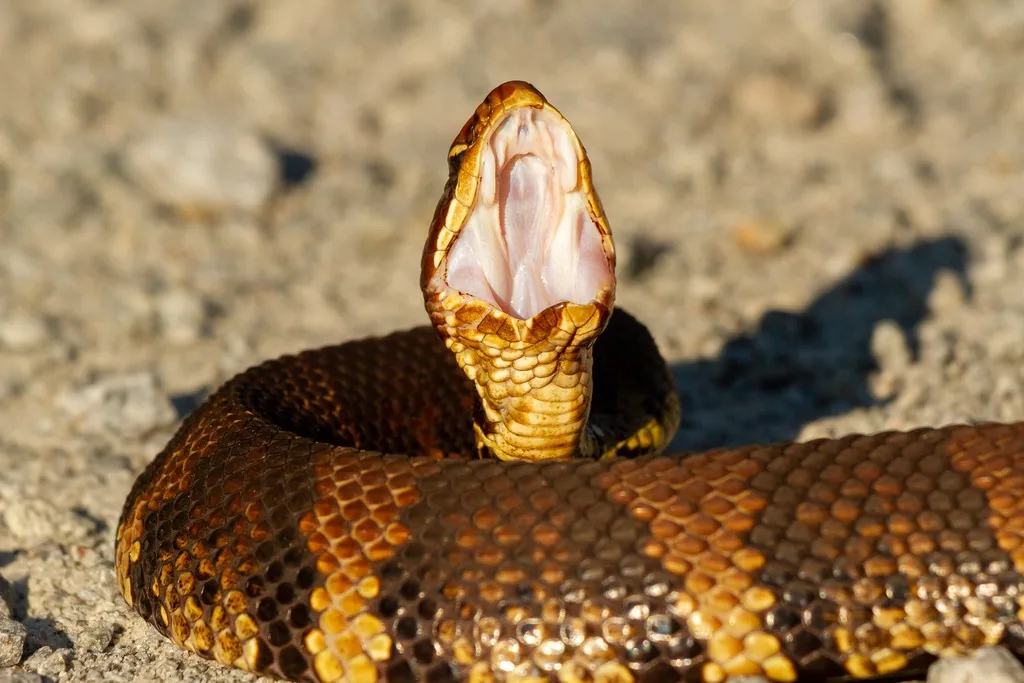
How to identify it
- A thick, heavy-bodied snake, typically 2 to 4 feet long, with a broad, blocky head clearly wider than the neck. For the Florida cottonmouth, the Florida Museum gives an average adult length of 30 to 48 inches (76 to 122 cm), with a record of 74.5 inches (189 cm).[2][6][7][17]
- Adults are dark olive, brown or nearly black with dark crossbands that are often faint; in some populations they lose the pattern and darken with age. In Florida cottonmouths, the Florida Museum says the light and dark brown crossbands contain many dark spots and speckles, and the pattern darkens with age until some adults are uniformly black.[2][6][7][10][17]
- A dark stripe often runs from the snout through the eye toward the corner of the mouth, hiding the eye, and in Missouri most have a white upper lip. The Florida Museum adds that the eyes can't be seen when the head is viewed from directly above, and the tip of the snout has two dark vertical lines.[2][7][17]
- Like other pit vipers it has a heat-sensing pit between the nostril and the eye, and its pupils are vertical, though a dark eye can make them hard to see.[2][7][11]
- The scales are keeled, giving the body a rough, matte look.[6][2]
- When threatened it often coils, vibrates its tail and gapes, showing the white lining of the mouth that gives it its name, and it releases a strong-smelling musk. The Florida Museum says a threatened cottonmouth usually tries to retreat first, that the gape is a display meant to scare off a threat rather than a strike, and that if provoked further it may also vibrate its tail to make a buzzing sound, though it is not a rattlesnake.[6][7][2][17]
- Young cottonmouths are boldly banded in brown over a lighter gray, tan or reddish background, with a bright yellow-green tail tip they use to lure prey. Newborns have a sulfur-yellow tail tip that they raise and wiggle like a caterpillar; the Florida Museum says the color fades and the luring typically stops after about a year.[6][2][11][17]
Look-alikes
| Look-alike | How to tell them apart |
|---|---|
| Water snakes (Nerodia species) | These harmless snakes have round pupils and no facial pit. On land or in a tree a water snake usually flees at once, often diving underwater, while a cottonmouth tends to stand its ground and gape. The Florida Museum adds that seen from directly above, a water snake's eyes are visible while a cottonmouth's are hidden, and that Florida alone has eight species of harmless water snakes that overlap with cottonmouths in range and habitat.[11][6][7][17] |
| Brown water snake | A harmless snake with a comparatively slender body, a less blocky head and clean square blotches down the middle of the back instead of jagged bands. The Florida Museum says brown water snakes often bask on limbs over the water and drop in when frightened, occasionally landing in a passing boat by accident.[2][17] |
| Banded (southern) water snake | Its bands are wider on the back than on the sides, and its lips are marked with dark stripes, while the cottonmouth's lips are plain.[2] |
| Copperhead | Young cottonmouths and copperheads are both brown and banded with yellow tail tips, and people confuse them often: in a Mississippi poison center study, only 21% of the cottonmouths that bit people were identified correctly, and 74% were called copperheads. The Florida Museum says the dark crossbands of young cottonmouths carry numerous dark spots and speckles, while a copperhead's have none or at most one; adult copperheads keep their juvenile pattern, and a copperhead's eye isn't hidden by a dark facial band. In Florida, copperheads occur only in the Panhandle.[11][13][17] |
Where it lives
Cottonmouths range from southeastern Virginia through the coastal plain to Florida and west to central Texas, Oklahoma and Missouri, which is the northwestern limit; they live in or near water. GBIF holds about 23,000 US records since 1990, counting the Florida cottonmouth, from 15 states, most from Texas, Florida, Illinois and Louisiana. In Florida, the Florida Museum says cottonmouths occur in every county and on many nearshore islands, including the Upper Florida Keys and Gulf islands in Levy and Franklin counties, and data suggest the Panhandle is a hybridization zone between the Florida and northern cottonmouths.[2][6][7][15][17]
Biology and life cycle
They live mainly in swamps, sloughs and along slow-moving rivers, vegetated lakes, farm ponds, creeks and drainage ditches, and in the Missouri Ozarks along cool, spring-fed rocky creeks. They sometimes move into nearby uplands, especially when dispersing or during drought. In Florida they can turn up in or near any wetland or waterway, including springs, saltmarshes, reservoirs, retention pools, canals and roadside ditches; they often wander far from water and have occasionally been found in bushes and trees.[2][7][6][17]
They eat fish, frogs, salamanders, small turtles, other snakes, rodents and birds, and they scavenge carrion, including animals killed on roads. They hunt both by ambush and by actively searching. The Florida Museum calls them opportunistic generalists whose prey also includes insects, lizards, baby alligators and other cottonmouths, and says cottonmouths on islands in the Cedar Keys feed mainly by scavenging marine fish dropped by colonial nesting waterbirds.[2][6][7][17]
They prefer slow water with fallen logs and heavy cover over open water, and they swim with the head held above the surface.[2][7]
Females give birth to live young in late summer or early fall. Georgia DNR gives a typical litter as 8 to 10, the Savannah River Ecology Lab 3 to 15, and Missouri 2 to 15 with an average of 6 or 7; Missouri females apparently give birth only every other year. In Florida, the Florida Museum says females typically give birth to about 1 to 20 young between August and October, and competing males perform combat dances while trailing females in the breeding season.[2][6][7][17]
They are mostly nocturnal in hot weather and more active by day in cooler seasons, and in Georgia they are often seen basking on sunny winter days. In Missouri they are active from late April through October. The Florida Museum describes them as typically nocturnal, becoming active shortly before dark, though they are occasionally active by day.[2][6][7][17]
Stump holes, root masses, piles of limbs, hollow logs and animal burrows serve as shelter. Some Missouri cottonmouths move to rocky bluffs to overwinter, sharing dens with racers, rat snakes, copperheads and timber rattlesnakes.[2][7]
They are long-lived: at least 21 years by Missouri's account, and captives are known to live over 15 years.[7][2]
Damage and signs
- Cottonmouths don't damage property; the risk is a bite from a snake that is stepped on, handled or cornered.[6][7]
- Snakes near ponds and homes follow food and cover, so rodents, fish, firewood and debris piles can draw them in.[5][4]
- Harmless water snakes are often killed by people who mistake them for cottonmouths, and killing driven by fear and misidentification has contributed to local cottonmouth declines. The Florida Museum says many water snakes are killed every year by Florida residents who mistake them for cottonmouths.[7][6][17]
Health risk
A cottonmouth bite is a medical emergency. MedlinePlus lists pain right away, swelling, bleeding, skin color changes, nausea and vomiting, numbness and tingling, weakness, breathing difficulty, low blood pressure and shock. In two bite registry studies, swelling occurred in 93 to 100 percent of cases, vomiting or other stomach symptoms and blood-clotting abnormalities in about one in six to one in five, and most patients received antivenom.[8][9][12][14]
Control
Prevention
Wear boots and long pants outdoors, and rubber boots when fishing or wading in swampy areas. Stay away from tall grass and leaf piles when you can, and never touch or handle any snake.[1][7]
Watch where you step, sit and reach around logs and rocks, and step onto a log before stepping over it. CDC notes that snakes are most active at dawn, at dusk and in warm weather, and Missouri says pit vipers are most active in late evening and at night.[7][1]
Keep them out
Seal openings 1/8 inch and larger around foundations, doors, pipes and utility lines; a snake-proof fence of 1/4-inch hardware cloth can protect a small area such as a play yard.[5]
Sanitation
Keep vegetation closely mowed, clear brush and debris piles near the house, and reduce rodents and other food sources that attract snakes.[5]
When to call a professional
Snakes are protected nongame wildlife in most states, and all of Missouri's snakes are protected by law. ICWDM's removal guidance says venomous snakes are never grabbed by hand, only moved with snake tongs.[3][5][7]
Cottonmouth or water snake? What to look at
Harmless water snakes vastly outnumber cottonmouths, and Missouri says most semiaquatic snakes seen or killed there are water snakes.[7]
Behavior: a water snake on land or in a tree usually flees right away, while a cottonmouth often stays put, coils and gapes.[6][7]
Perch: water snakes commonly bask on branches over the water and drop in when disturbed; cottonmouths seldom climb and prefer the ground at the water's edge.[6][7][2]
Face: cottonmouths have a pit between the nostril and eye and vertical pupils, while water snakes have round pupils, and banded water snakes have dark stripes on the lips, which cottonmouths lack.[11][2]
Pattern: MU Extension notes that most solid-colored snakes are harmless, except the adult cottonmouth, whose dark crossbands are often indistinct.[11]
Tail vibration proves nothing: many harmless snakes, including black racers and rat snakes, vibrate their tails when threatened too.[11]
If you can't be sure what a snake is, leave it alone and keep your distance.[7][1]
Eyes from above: seen from directly above, a cottonmouth's eyes are hidden, while a water snake's are visible.[17]
Posture: cottonmouths typically rest with the head raised off the ground and tilted upward at an angle, which water snakes typically don't do.[17]
Head shape alone isn't reliable: many harmless snakes flatten and widen their heads to look triangular when threatened.[17]
If someone is bitten
Get emergency medical care right away so antivenom can be started if needed; don't wait for symptoms, and don't drive yourself, because a bite can make you dizzy or pass out.[1][8]
Keep the person calm and still, keep the bitten area at about heart level, and take off rings, watches and tight clothing before swelling begins.[8][1]
Wash the bite with soap and water and cover it with a clean, dry dressing.[1]
Don't pick up or try to trap the snake. If it is safe, take a photo from a distance, which can help with treatment.[1][8]
Don't use a tourniquet, cut the wound, try to suck out venom, apply ice or soak the wound in water.[1][8]
Myths about cottonmouths
Cottonmouths are not aggressive; the open-mouth display is a defensive warning, and they rarely bite unless stepped on or picked up. The Florida Museum says striking is used only in defense as a last resort, and that despite folklore cottonmouths do not chase people.[6][2][7][17]
A snake fleeing toward a person may simply be heading for its nearest escape route, which can look like a chase.[2]
Snakes that drop from branches into boats are almost always harmless water snakes; cottonmouths seldom climb trees. The Florida Museum explains that brown water snakes basking on overhanging limbs sometimes fall into a boat by accident while trying to drop into the water.[2][7][6][17]
Where sources disagree
Flee or stand firm: Georgia DNR says a cottonmouth will try to escape if given the chance, and Missouri says one near cover usually does, but the Savannah River Ecology Lab says cottonmouths typically rely on camouflage and defensive displays rather than fleeing, and Missouri says one caught in the open stands its ground. The Florida Museum sides with retreat: it says a threatened cottonmouth usually tries to retreat and coils and gapes only if further agitated.[2][7][6][17]
How bites happen: the Savannah River Ecology Lab and Missouri say most bites happen when people try to handle or kill the snake, but in a North American registry of 31 cottonmouth bites, only 3 involved deliberate contact with the snake, 72 percent were on the leg or foot, and children aged 7 to 12 were the largest group.[6][7][12]
Litter size: Georgia DNR gives a typical litter as 8 to 10, the Savannah River Ecology Lab 3 to 15, Missouri 2 to 15, and the Florida Museum about 1 to 20 for Florida cottonmouths.[2][6][7][17]
Common questions
- Will a cottonmouth chase me?
- No. Georgia DNR says cottonmouths are not aggressive and that chase stories usually involve a snake fleeing past a person toward its escape route. The Florida Museum agrees: the open-mouth display is entirely defensive, and these snakes only want to be left alone and allowed to escape.[2][6][17]
- Is every dark snake in my pond a cottonmouth?
- Probably not. Harmless water snakes vastly outnumber cottonmouths; a snake basking on a branch over the water that drops in and swims off is most likely a water snake. Round pupils also mean a harmless snake.[7][6][11]
- Is that young brown snake a copperhead or a cottonmouth?
- It can be hard to tell: both are brown and banded with yellow tail tips when young, and in a Mississippi study 74% of cottonmouths that bit people were reported as copperheads. Treat either as venomous and leave it alone.[11][13][7]
- Are snake repellents worth using?
- ICWDM reports that no snake repellent has strong research showing it works in real-world use, and no toxicants are registered for snakes.[5]
Sources
- U.S. Centers for Disease Control and Prevention, NIOSH, “Venomous Snakes at Work (reviewed September 23, 2026).” www.cdc.gov/niosh/outdoor-workers/about/venomous-snakes.html (accessed 2026-11-11)
- Georgia Department of Natural Resources, Wildlife Resources Division, “Venomous Snakes Fact Sheet Series: Cottonmouth.” gadnrle.org/sites/default/files/wrd/pdf/fact-sheets/Venomous%20Snakes%20-%20Cottonmouth.pdf (accessed 2026-11-11)
- Internet Center for Wildlife Damage Management, “Snakes: Identification.” icwdm.org/species/reptiles/snakes/ (accessed 2026-11-11). Run by university wildlife damage specialists (maintained at the University of Wisconsin-Stevens Point); species modules are based on Prevention and Control of Wildlife Damage (University of Nebraska Cooperative Extension, 1994).
- Internet Center for Wildlife Damage Management, “Snake Biology.” icwdm.org/species/reptiles/snakes/snake-biology/ (accessed 2026-11-11). Run by university wildlife damage specialists (maintained at the University of Wisconsin-Stevens Point); species modules are based on Prevention and Control of Wildlife Damage (University of Nebraska Cooperative Extension, 1994).
- Internet Center for Wildlife Damage Management, “Snake Damage Prevention and Control Methods.” icwdm.org/species/reptiles/snakes/snake-damage-prevention-and-control-methods/ (accessed 2026-11-11). Run by university wildlife damage specialists (maintained at the University of Wisconsin-Stevens Point); species modules are based on Prevention and Control of Wildlife Damage (University of Nebraska Cooperative Extension, 1994).
- University of Georgia Savannah River Ecology Laboratory, Herpetology Program, “Cottonmouth / Water Moccasin (Agkistrodon piscivorus).” srelherp.uga.edu/snakes/cottonmouth-water-moccasin/ (accessed 2026-11-11)
- Missouri Department of Conservation, “Northern Cottonmouth (Field Guide).” mdc.mo.gov/discover-nature/field-guide/northern-cottonmouth (accessed 2026-11-11)
- MedlinePlus, U.S. National Library of Medicine, “Snake bites (Medical Encyclopedia).” medlineplus.gov/ency/article/000031.htm (accessed 2026-11-11)
- Poison Control (National Capital Poison Center), “Everything you need to know about snakebites.” www.poison.org/articles/snakebites-in-march (accessed 2026-11-11)
- Texas Parks and Wildlife Department, “Hunter Education: Snakes.” tpwd.texas.gov/education/hunter-education/online-course/preparation-and-survival/snakes (accessed 2026-11-11)
- University of Missouri Extension, “Snakes: Information for Missouri Homeowners, G9450 (reviewed May 2025).” extension.missouri.edu/publications/g9450 (accessed 2026-11-11)
- Clinical Toxicology, via PubMed, “Cottonmouth snake bites reported to the ToxIC North American snakebite registry 2013-2017 (Domanski et al. 2020).” pubmed.ncbi.nlm.nih.gov/31190571/ (accessed 2026-11-11)
- Clinical Toxicology, via PubMed, “Misidentification of copperhead and cottonmouth snakes following snakebites (Cox et al. 2018).” pubmed.ncbi.nlm.nih.gov/29792342/ (accessed 2026-11-11)
- Wilderness and Environmental Medicine, via PubMed, “Clinical Features and Antivenom Usage in Northern Cottonmouth (Agkistrodon piscivorus) Envenomations in Texas (Greene et al. 2026).” pubmed.ncbi.nlm.nih.gov/42053252/ (accessed 2026-11-11)
- Global Biodiversity Information Facility (GBIF), “Agkistrodon piscivorus and A. conanti: US occurrence records since 1990 by state (GBIF occurrence search API).” api.gbif.org/v1/occurrence/search?taxonKey=9105722&country=US&hasGeospatialIssue=false&occurrenceStatus=PRESENT&year=1990%2C2026&facet=stateProvince&facetLimit=400&limit=0 (accessed 2026-11-11)
- iNaturalist, “Agkistrodon piscivorus taxon page (order and family).” www.inaturalist.org/taxa/904170 (accessed 2026-11-11)
- Florida Museum of Natural History, University of Florida, “Florida Cottonmouth (Agkistrodon conanti), Florida Snake ID Guide.” www.floridamuseum.ufl.edu/florida-snake-id/snake/florida-cottonmouth/ (accessed 2026-11-14)