On this page
How to identify it
- Medium-sized, heavy-bodied snakes with keeled scales that feel rough. Adults are mostly 2 to 3-1/2 feet long: Missouri gives 22 to 42 inches, occasionally 59, and the Savannah River Ecology Lab gives 24 to 55 inches for the northern and 24 to 48 for the banded watersnake.[1][2][3]
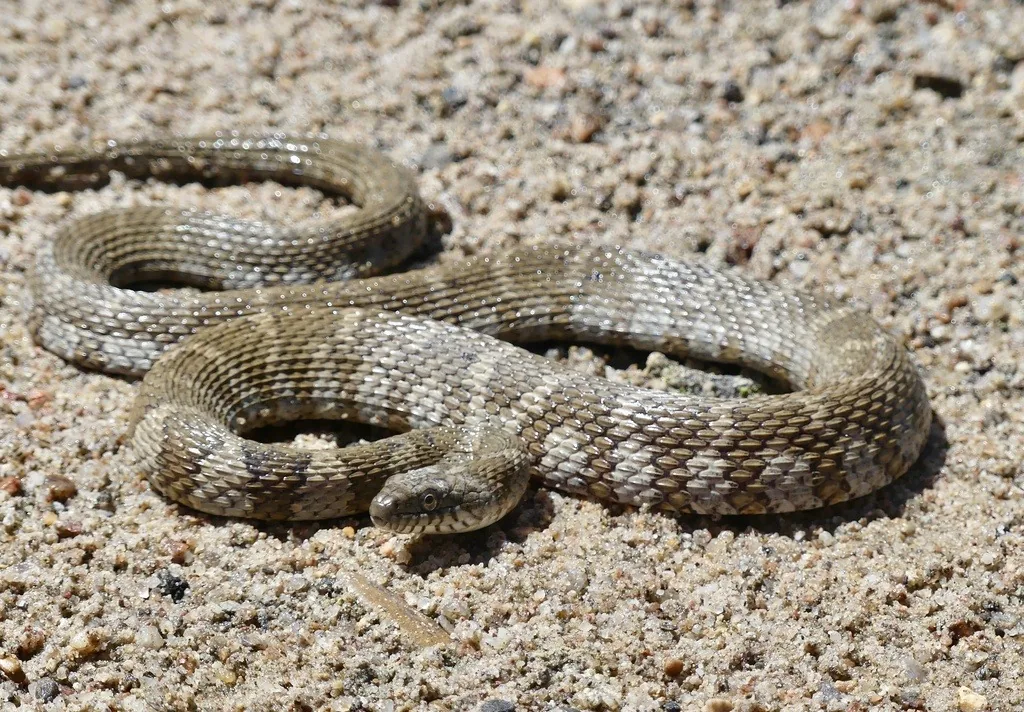
- Northern watersnakes are gray, tan or reddish brown with dark crossbands on the front third of the body that break into alternating blotches farther back; the cream or yellow belly carries orange or red half-moon marks.[1][2]
- Banded watersnakes have dark crossbands that are broad across the back and narrow on the sides, square spots on the belly and a dark stripe from the eye to the corner of the jaw; older snakes often darken until the pattern nearly disappears.[3]
- Like other nonvenomous snakes, water snakes have round pupils and no heat-sensing pit between the nostril and eye.[4]
Look-alikes
| Look-alike | How to tell them apart |
|---|---|
| Cottonmouth | Cottonmouths are heavier, with a chunky head much wider than the neck, a heat-sensing pit between nostril and eye, vertical pupils and a light line from each eye to the corner of the mouth. Cornered, a cottonmouth often coils and gapes to show the white lining of its mouth, and it swims with its back out of the water; a water snake usually flees, often into the water.[1][8][9][4] |
| Copperhead | A copperhead's crossbands are hourglass-shaped, narrow on the spine and wide toward the belly, while a banded watersnake's are more rectangular; copperheads also have a plain copper to red head.[3][11] |
| Other water snakes | Several other Nerodia share the same waters. The brown watersnake, for example, has rows of large dark square blotches, eyes set high on the head, and basks on branches up to 20 feet above the water; Missouri's broad-banded watersnake has no more than 20 bands or blotches.[10][1] |
Where it lives
The common watersnake ranges across eastern and central North America and is found statewide in Missouri. The banded watersnake follows the Coastal Plain from southwest Alabama to North Carolina; in Georgia and South Carolina it gives way to the northern watersnake in the Piedmont and mountains. Both species have also been introduced to California. GBIF's public U.S. records since 1990 for the common watersnake (about 55,000) come from 34 states on the map, most from North Carolina, Virginia and Ohio.[2][1][3][14][16]
Biology and life cycle
They live in nearly any freshwater habitat, including creeks, rivers, sloughs, ponds, lakes, swamps and marshes, and rock riprap along banks and levees gives them places to bask and hide.[1][3]
They bask on logs, rocks and branches over the water; Missouri's watersnakes turn nocturnal in hot weather, and banded watersnakes are active both day and night.[1][3]
They eat small fish, frogs, tadpoles, toads and salamanders.[1][3]
They give birth to live young in late summer. Missouri litters range from 6 to 99, averaging 27, while the Savannah River lab gives 15 to 20 for banded watersnakes.[1][3]
Missouri's watersnakes are active from early April into October and overwinter in rock dams, levees, bank and crayfish burrows, old logs and stumps, and rock crevices.[1]
They can be extremely abundant: Lake Erie watersnakes on the islands averaged about 520 adults per kilometer of shoreline over a 20-year study.[15]
Damage and signs
- Water snakes don't damage structures, lawns or gardens; ICWDM notes that nonvenomous snakes cause no damage, and the concern is a defensive bite if one is grabbed.[5][6][1]
- Missouri's conservation department notes that game fish are too quick for water snakes unless the fish are injured or diseased.[1]
- Northern watersnakes readily feed on discarded carcasses where anglers clean their catch.[1]
Health risk
Water snakes are nonvenomous, but if captured they bite viciously and smear a foul-smelling musk. MedlinePlus advises calling 911 or the local emergency number after any snake bite rather than waiting for symptoms, noting that even a nonvenomous bite can sometimes cause significant injury in children; Poison Help (1-800-222-1222) also gives advice.[1][13]
Control
Prevention
Leave water snakes alone. The Savannah River lab says they typically flee when approached, usually into the water, and ICWDM says bites usually follow handling, threats or a close approach.[9][5]
Sanitation
Keep grass mowed short and remove rock piles, boards, firewood and debris near the house, which give snakes cover and basking spots.[6][12]
Dispose of fish scraps rather than leaving them at the shore, and control rodents, which draw many snakes.[1][6]
Traps and physical control
Seal gaps in foundations and around doors, pipes and utility lines as you would for mice; ICWDM's text says 1/8 inch and larger, while Mississippi State says close all openings larger than 1/4 inch.[6][12]
When to call a professional
If you can't tell a water snake from a cottonmouth, keep your distance; MedlinePlus advises against picking up any snake unless you've been trained, and the Savannah River lab notes most cottonmouth bites happen when people try to handle, kill or harass the snake.[13][9]
How to tell a water snake from a cottonmouth
Look from a safe distance. A pit between the nostril and eye and vertically egg-shaped pupils mark a cottonmouth; water snakes have round pupils and no pit.[4][8]
Cottonmouths are heavier bodied, darker and chunky headed, with a light line from each eye to the corner of the mouth, and most have a white upper lip.[1][8]
Behavior is a strong clue. Disturbed on land, water snakes usually flee, while a cottonmouth often stands its ground in a loose coil and gapes its white mouth.[9][8]
A snake resting on a branch over the water is most likely a water snake: Missouri says cottonmouths rarely if ever climb trees, and the Savannah River lab says they seldom climb high, unlike watersnakes that bask several feet up.[8][9]
Pattern alone can mislead. The Savannah River lab separates the northern watersnake from the banded cottonmouth by its blotches, but banded watersnakes have crossbands too, and old ones can darken to nearly black.[2][3]
Harmless watersnakes vastly outnumber cottonmouths in Missouri, and the conservation department says most semiaquatic snakes seen or killed there are watersnakes.[8]
Legal status
ICWDM says snakes are nongame wildlife protected by law in most states, and some species are federally or state listed as threatened or endangered.[4]
Rules differ widely: Missouri protects all its snakes by law, the Savannah River lab says northern and banded watersnakes are not protected in most states but are protected throughout Georgia, and Mississippi State says most Mississippi snakes are not legally protected.[8][2][3][12]
One subspecies, the Lake Erie watersnake, was listed as threatened under the federal Endangered Species Act, recovered and was removed from the list.[15]
What doesn't work
Research on snake repellents is lacking or inconsistent, ICWDM says, and Mississippi State calls repellents questionable at best, with none currently registered.[6][12]
No toxicants are registered for snake control.[6]
Common questions
- Are water snakes venomous?
- No. Water snakes are nonvenomous, though they bite hard and smear a foul musk if grabbed.[1]
- Do water snakes ruin fishing?
- No. Missouri's conservation department says they mostly catch injured or diseased fish and actually help fishing by reducing fish disease and overpopulation, and large game fish eat young watersnakes.[1]
- Why are so many water snakes killed?
- People mistake them for venomous cottonmouths and kill them out of fear; the Savannah River lab says this needlessly kills many watersnakes every year. Leaving any snake alone is safest for everyone.[1][10][8]
Sources
- Missouri Department of Conservation, “Northern Watersnake and Midland Watersnake (Field Guide).” mdc.mo.gov/discover-nature/field-guide/northern-watersnake-midland-watersnake (accessed 2026-11-11)
- University of Georgia Savannah River Ecology Laboratory, Herpetology Program, “Northern Watersnake (Nerodia sipedon).” srelherp.uga.edu/snakes/northern-watersnake/ (accessed 2026-11-11). Species account from the Herpetology Program of the Savannah River Ecology Laboratory, a University of Georgia research unit.
- University of Georgia Savannah River Ecology Laboratory, Herpetology Program, “Banded Watersnake (Nerodia fasciata).” srelherp.uga.edu/snakes/banded-watersnake/ (accessed 2026-11-11). Species account from the Herpetology Program of the Savannah River Ecology Laboratory, a University of Georgia research unit.
- Internet Center for Wildlife Damage Management, “Snakes: Identification.” icwdm.org/species/reptiles/snakes/ (accessed 2026-11-11). Run by university wildlife damage specialists (maintained at the University of Wisconsin-Stevens Point); species modules are based on Prevention and Control of Wildlife Damage (University of Nebraska Cooperative Extension, 1994).
- Internet Center for Wildlife Damage Management, “Snake Damage Identification.” icwdm.org/species/reptiles/snakes/snake-damage-identification/ (accessed 2026-11-11). Run by university wildlife damage specialists (maintained at the University of Wisconsin-Stevens Point); species modules are based on Prevention and Control of Wildlife Damage (University of Nebraska Cooperative Extension, 1994).
- Internet Center for Wildlife Damage Management, “Snake Damage Prevention and Control Methods.” icwdm.org/species/reptiles/snakes/snake-damage-prevention-and-control-methods/ (accessed 2026-11-11). Run by university wildlife damage specialists (maintained at the University of Wisconsin-Stevens Point); species modules are based on Prevention and Control of Wildlife Damage (University of Nebraska Cooperative Extension, 1994).
- iNaturalist, “Nerodia sipedon taxon page (order and family).” www.inaturalist.org/taxa/29305 (accessed 2026-11-11)
- Missouri Department of Conservation, “Northern Cottonmouth (Field Guide).” mdc.mo.gov/discover-nature/field-guide/northern-cottonmouth (accessed 2026-11-11)
- University of Georgia Savannah River Ecology Laboratory, Herpetology Program, “Cottonmouth / Water Moccasin (Agkistrodon piscivorus).” srelherp.uga.edu/snakes/cottonmouth-water-moccasin/ (accessed 2026-11-11)
- University of Georgia Savannah River Ecology Laboratory, Herpetology Program, “Brown Watersnake (Nerodia taxispilota).” srelherp.uga.edu/snakes/brown-watersnake/ (accessed 2026-11-11)
- University of Georgia Savannah River Ecology Laboratory, Herpetology Program, “Eastern Copperhead (Agkistrodon contortrix).” srelherp.uga.edu/snakes/copperhead/ (accessed 2026-11-11)
- Mississippi State University Extension Service, “Reducing Snake Problems Around Homes.” extension.msstate.edu/publications/reducing-snake-problems-around-homes (accessed 2026-11-11)
- MedlinePlus, U.S. National Library of Medicine, “Snake bites (Medical Encyclopedia).” medlineplus.gov/ency/article/000031.htm (accessed 2026-11-11)
- PLoS One, via PubMed, “Traditional trapping methods outperform eDNA sampling for introduced semi-aquatic snakes (Rose et al. 2019).” pubmed.ncbi.nlm.nih.gov/31265475/ (accessed 2026-11-11). Cited from the PubMed abstract.
- Ecology and Evolution, via PubMed, “Sunning themselves in heaps, knots, and snarls: the extraordinary abundance and demography of island watersnakes (King et al. 2018).” pubmed.ncbi.nlm.nih.gov/30151166/ (accessed 2026-11-11). Cited from the PubMed abstract.
- Global Biodiversity Information Facility (GBIF), “Nerodia sipedon: occurrence records in the U.S., 1990-2026 (GBIF occurrence search).” api.gbif.org/v1/occurrence/search?taxonKey=5223334&country=US&hasGeospatialIssue=false&occurrenceStatus=PRESENT&year=1990%2C2026&facet=stateProvince&facetLimit=400&limit=0 (accessed 2026-11-11). State counts are records reported (iNaturalist research-grade, museum specimens, surveys), not abundance.