On this page
How to identify it
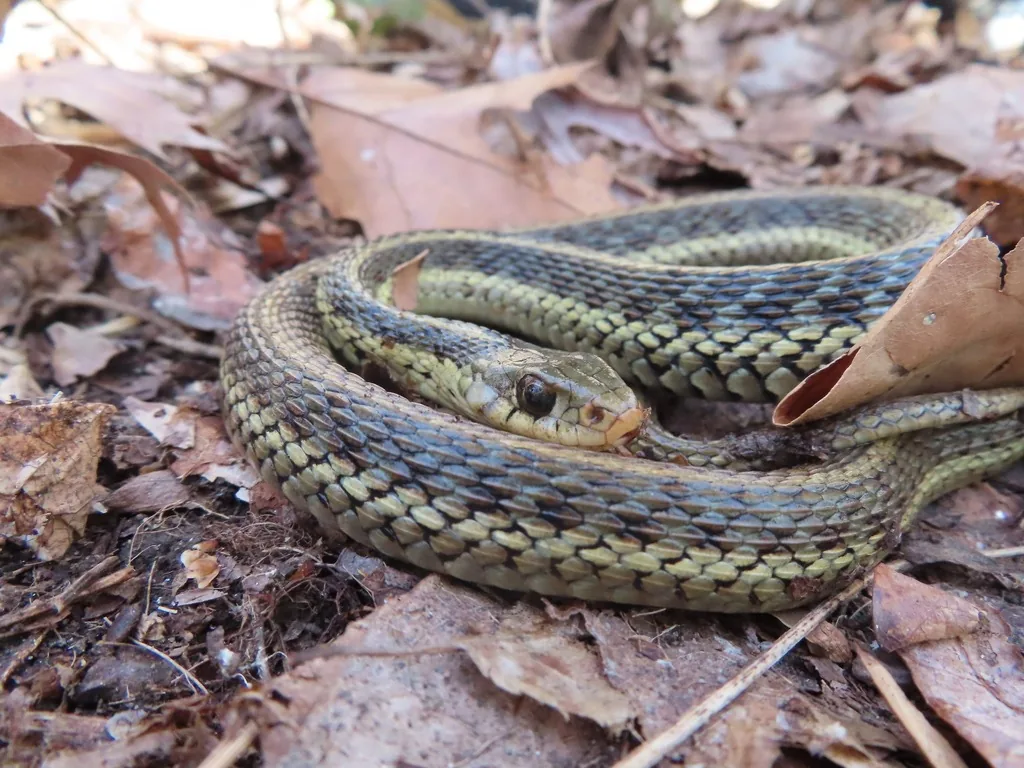
- A medium-sized snake, usually 18 to 26 inches long as an adult and occasionally up to 54 inches, with three light stripes: one down the back and one along each side.[1]
- The body may be black, brown or olive; the stripes are yellow, brown, green or blue, and a double row of alternating dark spots usually runs between them on each side.[1]
- Narrow black bars mark the edges of the upper lip scales.[1]
- Like other nonvenomous snakes, it has round pupils and no pit between the eye and nostril.[2]
- In the red-sided gartersnake of the Great Plains, red or orange-red skin shows between the side scales; where the two subspecies meet they interbreed and show variable red.[1]
Look-alikes
| Look-alike | How to tell them apart |
|---|---|
| Ribbonsnakes | Close striped relatives; Missouri's orange-striped ribbonsnake has plain white or pale green upper lip scales with no black bars, contrasting with its dark head.[1] |
| Plains gartersnake | Plains gartersnakes have boldly marked black bars on the upper lip scales, rather than narrow ones.[1] |
| Copperhead | Copperheads are venomous pit vipers with a deep pit on each side of the head between eye and nostril and vertically egg-shaped pupils; gartersnakes have round pupils, no pits and lengthwise stripes.[2] |
Where it lives
The common gartersnake is widespread in the eastern half of the United States, and because it tolerates cold better than most snakes its range extends well into Canada, southeastern Alaska and southern parts of the Northwest Territories. GBIF's public U.S. records since 1990 (about 110,000) come from 45 states on the map, most from New York, Ohio and Pennsylvania.[1][11]
Biology and life cycle
They live in many habitats but favor damp spots near ponds, marshes, creeks and ditches, and they hide under boards, rocks and other objects in city lots and near farm buildings.[1][3]
They are active mainly by day, from March into early November, and may come out on mild winter days.[1]
Amphibians make up most of the diet: earthworms, frogs, tadpoles, toads and salamanders, plus occasional snails, slugs, insects, minnows and small mice.[1]
Females give birth to live young from midsummer into early fall; a litter may hold 4 to 85 young but usually about 24.[1]
In winter they shelter in animal burrows, mole tunnels, crayfish burrows, rock crevices, old wells, cisterns and the foundations of abandoned homes.[1]
Damage and signs
- Snakes don't harm landscapes or gardens; most people simply don't want them around.[4]
- As predators, gartersnakes help keep populations of other animals in check.[1]
- Brush, boards, rocks, firewood and debris lying close to the ground, and tall vegetation near the house, give snakes and their prey places to hide.[5][3]
Health risk
Gartersnakes are not dangerous to people or pets in normal contact, but they are not entirely venomless: they have a Duvernoy's gland whose secretions contain several toxin families, and a 1985 case report describes a 13-year-old in Delaware hospitalized with coolness, swelling and bruising of the hand after a prolonged bite, followed by rapid recovery. MedlinePlus notes that most snakes are harmless and their bites not life threatening, but advises getting medical attention right away after any snake bite rather than waiting for symptoms; the Poison Help line is 1-800-222-1222.[1][10][9][7]
Control
Prevention
Leave the snake alone; most snakes move away when approached, and gartersnakes bite mainly when cornered or captured.[3][1]
Keep them out
Seal openings of 1/4 inch and larger around doors, windows, water pipes, utility lines and foundations with mortar, 1/8-inch hardware cloth or sheet metal.[5]
A fence of 1/4-inch galvanized hardware cloth, 36 inches tall, buried 4 to 6 inches and slanted outward keeps most snakes out of a small area such as a play yard.[5]
Sanitation
Keep grass mowed and remove bushes, rocks, boards, firewood and debris lying near the house that shelter snakes and their prey.[5]
Traps and physical control
To move a snake out of a basement, ICWDM suggests piling damp towels or burlap bags where it was seen, covering each pile with a dry one, and checking later.[5]
When to call a professional
If a snake is indoors and you can't identify it, treat it as venomous and keep away from its head; Mississippi State points residents with questions to the state wildlife department's natural science museum.[8]
Why gartersnakes are worth keeping around
Snakes don't harm landscapes or gardens, and they help reduce insect and rodent populations.[4][8]
ICWDM notes that spending money to control nonvenomous snakes is seldom justified.[5]
Rules differ by state: ICWDM says snakes are protected as nongame wildlife in most states and should never be killed indiscriminately, while Mississippi State notes most snakes in Mississippi are not legally protected but are better left alone when they cause no problem.[2][8]
What doesn't work
Several snake repellents are sold, but none has extensive research showing it works in real-world use.[5]
No toxicants are registered for snake control, and fumigating burrows isn't practical because most snakes don't dig them.[5]
Common questions
- Are garter snakes poisonous?
- They are treated as harmless and nonvenomous for practical purposes, though they bite and smear a foul-smelling musk if picked up, and rare prolonged bites have caused local swelling.[1][9]
- Why are garter snakes in my yard?
- They follow food and cover: earthworms, frogs and slugs in damp spots, plus shelter under boards, rocks and debris near buildings.[1][5]
- Why do I see so many garter snakes in early spring?
- Gartersnakes tolerate cold better than most snakes, so they are among the first to emerge, and they court and mate soon after leaving their winter shelters.[1]
Sources
- Missouri Department of Conservation, “Eastern Gartersnake and Red-Sided Gartersnake (Field Guide).” mdc.mo.gov/discover-nature/field-guide/eastern-gartersnake-red-sided-gartersnake (accessed 2026-11-11)
- Internet Center for Wildlife Damage Management, “Snakes: Identification.” icwdm.org/species/reptiles/snakes/ (accessed 2026-11-11). Run by university wildlife damage specialists (maintained at the University of Wisconsin-Stevens Point); species modules are based on Prevention and Control of Wildlife Damage (University of Nebraska Cooperative Extension, 1994).
- Internet Center for Wildlife Damage Management, “Snake Biology.” icwdm.org/species/reptiles/snakes/snake-biology/ (accessed 2026-11-11). Run by university wildlife damage specialists (maintained at the University of Wisconsin-Stevens Point); species modules are based on Prevention and Control of Wildlife Damage (University of Nebraska Cooperative Extension, 1994).
- Internet Center for Wildlife Damage Management, “Snake Damage Identification.” icwdm.org/species/reptiles/snakes/snake-damage-identification/ (accessed 2026-11-11). Run by university wildlife damage specialists (maintained at the University of Wisconsin-Stevens Point); species modules are based on Prevention and Control of Wildlife Damage (University of Nebraska Cooperative Extension, 1994).
- Internet Center for Wildlife Damage Management, “Snake Damage Prevention and Control Methods.” icwdm.org/species/reptiles/snakes/snake-damage-prevention-and-control-methods/ (accessed 2026-11-11). Run by university wildlife damage specialists (maintained at the University of Wisconsin-Stevens Point); species modules are based on Prevention and Control of Wildlife Damage (University of Nebraska Cooperative Extension, 1994).
- iNaturalist, “Thamnophis sirtalis taxon page (order and family).” www.inaturalist.org/taxa/28362 (accessed 2026-11-11)
- MedlinePlus, U.S. National Library of Medicine, “Snake bites (Medical Encyclopedia).” medlineplus.gov/ency/article/000031.htm (accessed 2026-11-11)
- Mississippi State University Extension Service, “Reducing Snake Problems Around Homes.” extension.msstate.edu/publications/reducing-snake-problems-around-homes (accessed 2026-11-11)
- Toxicon, via PubMed, “Human envenomation from the bite of the eastern garter snake, Thamnophis s. sirtalis (Hayes & Hayes 1985).” pubmed.ncbi.nlm.nih.gov/4060180/ (accessed 2026-11-11). Cited from the PubMed abstract.
- Toxicon, via PubMed, “Thamnophis sirtalis and their toxic relationship: testing for intraspecific venom variation in common garter snakes (Coppinger et al. 2025).” pubmed.ncbi.nlm.nih.gov/39615846/ (accessed 2026-11-11). Cited from the PubMed abstract.
- Global Biodiversity Information Facility (GBIF), “Thamnophis sirtalis: occurrence records in the U.S., 1990-2026 (GBIF occurrence search).” api.gbif.org/v1/occurrence/search?taxonKey=2457522&country=US&hasGeospatialIssue=false&occurrenceStatus=PRESENT&year=1990%2C2026&facet=stateProvince&facetLimit=400&limit=0 (accessed 2026-11-11). State counts are records reported (iNaturalist research-grade, museum specimens, surveys), not abundance.