On this page
How to identify it
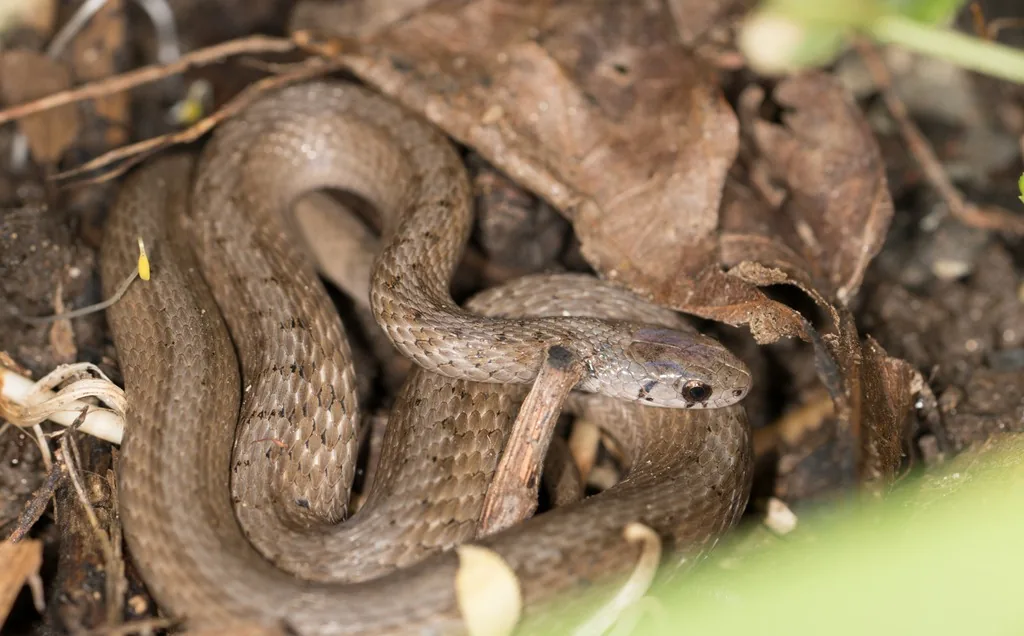
- A small, slender snake. Sources give slightly different adult lengths: 9 to 13 inches and occasionally up to 20 (Missouri), 9 to 15 inches (Connecticut), and 6 to 13 inches (Savannah River Ecology Lab).[2][3][1]
- Gray-brown to reddish brown, usually with a paler stripe down the back bordered by two rows of small dark spots that may be linked across the back.[2][3][1]
- The head is dark on top, with a dark mark below or behind each eye and on each side of the neck.[2][3][1]
- The scales are keeled, each with a raised ridge. The belly is cream, yellow, pink or gray, often with tiny black dots along the edges.[3][2][1]
- Young brownsnakes are darker overall with little pattern and a pale collar across the back of the head, which Connecticut describes as white and the Savannah River lab as yellowish.[3][1]
Look-alikes
| Look-alike | How to tell them apart |
|---|---|
| Copperhead (young) | Brownsnakes are often killed by mistake for copperheads, but copperheads have bold hourglass-shaped crossbands and young ones have a bright yellow tail tip.[1] |
| Garter snakes | Missouri lists the plains gartersnake as a similar species; the brownsnake's tan back stripe is bordered by two rows of small brown spots, usually joined by a narrow line.[2] |
| Red-bellied snake | The closely related red-bellied snake is a bit smaller and has a bright red or orange belly; it is more common in forests, while brownsnakes favor disturbed ground.[3][1] |
| Earthsnakes | Earthsnakes look similar but lack the brownsnake's spots on the back and head.[1] |
Where it lives
Found throughout the eastern United States and into adjacent Canada, throughout Connecticut and presumed statewide in Missouri, but absent from high mountain elevations. In extreme southern Georgia and Florida it is replaced by the closely related Florida brownsnake, which some authorities treat as the same species. Missouri notes that the former Texas and midland brownsnake subspecies are no longer recognized. GBIF holds about 42,700 U.S. records since 1990, the most from Texas and North Carolina, and about 6,200 from Canada.[1][3][2][4][5]
Biology and life cycle
Brownsnakes live in woods, wetlands and grasslands but thrive in developed areas, including yards, parks, cemeteries and vacant city lots.[3][2][1]
They hide under logs, rocks, boards, leaf litter and other debris and are rarely noticed until yard work or heavy rain uncovers them.[2][3][1]
Their diet is mostly slugs and earthworms, plus snails and soft-bodied insects; one study cited by Missouri found 75 percent slugs and 25 percent earthworms. Missouri biologists suspect the blunt head and long teeth help them tug snails out of their shells.[2][1][3]
They are active from about March to November and may move at night in hot weather.[3][2]
They spend winter below the frost line in rodent burrows, rock crevices or under buildings, often sharing dens with garter snakes and other species.[3]
Females give birth to live young from mid-July into early fall. Litter sizes differ by source: 3 to 41 (Missouri) or 3 to 31 (Connecticut and the Savannah River lab). Newborns are about 3.5 inches long, and the snakes probably mature at 2 to 3 years.[2][3][1]
When captured or handled, it flattens its head and neck and releases a strong-smelling musk.[2][3]
Damage and signs
Health risk
Missouri's and Connecticut's wildlife agencies list it as nonvenomous. MedlinePlus says most snakes are harmless and their bites are not life threatening, but all snakes will bite as a last resort when threatened or surprised, and even a non-venomous snake's bite can sometimes cause significant injury, particularly to children. It advises treating any snake bite as serious and getting medical help; in the U.S., Poison Help is 1-800-222-1222. No cited source describes a risk to pets.[2][3][11]
Control
Prevention
Connecticut's wildlife agency says brownsnakes and other wild snakes should never be collected as pets and strongly discourages killing snakes.[3]
Keep them out
Seal foundation cracks and keep basement windows closed or screened. ICWDM advises checking door and window corners, water pipes and utility entries and sealing openings 1/8 inch and larger; its summary table gives 1/4 inch and larger.[3][7]
Sanitation
To make a yard less inviting, keep grass short, trim shrubs off the ground, and remove brush piles, rock piles, boards and other debris that give cover.[3][7]
Pesticides
ICWDM says several snake repellents are on the market but research on their effectiveness is lacking or inconsistent.[7]
City snakes
Brownsnakes are often the most abundant snake in urban habitats, and Connecticut reports the largest populations in its more developed areas, even in vacant lots in big cities. Connecticut expects the species may become more common in southern New England as rural land is developed.[1][3]
A study of six populations along a rural-to-urban gradient in New Jersey and New York found more head-shape differences between urban populations and less difference between males and females in the cities, which the authors read as a possible adaptive shift to urban life.[8]
A genetic study of 162 brownsnakes from 11 New Jersey sites found that urban populations kept most of their genetic diversity but were more separated from one another, especially in the most urbanized areas.[9]
Where the sources disagree
Adult length: Missouri gives 9 to 13 inches and occasionally up to 20, Connecticut 9 to 15 inches, and the Savannah River lab 6 to 13 inches.[2][3][1]
Litter size: Missouri gives 3 to 41 young, Connecticut and the Savannah River lab 3 to 31.[2][3][1]
Birth timing: Missouri says mid-July through September, Connecticut mid-July through August, and the Savannah River lab late summer.[2][3][1]
Diet: Missouri cites a study finding 75 percent slugs and 25 percent earthworms, the Savannah River lab says it eats soft-bodied invertebrates, and Connecticut adds fish and, rarely, small amphibians.[2][1][3]
Young snakes' collar: Connecticut describes it as white and the Savannah River lab as yellowish.[3][1]
Range: Connecticut describes most of the northeastern U.S. from southwestern Maine to North Carolina, the Savannah River lab throughout the eastern U.S., and GBIF's largest U.S. record count since 1990 is from Texas.[3][1][4]
Opening size for exclusion: ICWDM's text says to seal openings 1/8 inch and larger, while its summary table gives 1/4 inch and larger.[7]
Common questions
- Is the little brown snake in my garden venomous?
- If it is a DeKay's brownsnake, no: Missouri's and Connecticut's wildlife agencies list it as nonvenomous. MedlinePlus notes that even a non-venomous snake's bite can sometimes cause significant injury, particularly to children, so treat any snake bite as serious and get medical help.[2][3][11]
- Is it a baby copperhead?
- Probably not. Young copperheads have bold hourglass bands and a bright yellow tail tip, while brownsnakes have small rows of spots and no yellow tail.[1]
- Why do I keep finding brownsnakes after it rains?
- They usually stay hidden under cover, but heavy rain and yard work flush them out, and they often cross trails and roads in spring and fall.[2][1]
Sources
- Savannah River Ecology Laboratory, University of Georgia, “Brown Snake (Storeria dekayi).” srelherp.uga.edu/snakes/brown-snake/ (accessed 2026-11-13). University of Georgia research unit's herpetology guide to snakes of the Southeast.
- Missouri Department of Conservation, “Dekay's Brownsnake (Field Guide).” mdc.mo.gov/discover-nature/field-guide/dekays-brownsnake (accessed 2026-11-13)
- Connecticut Department of Energy and Environmental Protection, “Dekay's Brownsnake (Wildlife Fact Sheet, updated August 2022).” portal.ct.gov/deep/wildlife/fact-sheets/dekays-brownsnake (accessed 2026-11-13)
- Global Biodiversity Information Facility (GBIF), “Storeria dekayi: U.S. occurrence records since 1990 by state (GBIF occurrence search).” api.gbif.org/v1/occurrence/search?taxonKey=9056579&country=US&hasGeospatialIssue=false&occurrenceStatus=PRESENT&year=1990%2C2026&facet=stateProvince&facetLimit=400&limit=0 (accessed 2026-11-13). Exact count at access: 42,654 U.S. records since 1990 (Texas 5,292; North Carolina 4,713; Ohio 3,469).
- Global Biodiversity Information Facility (GBIF), “Storeria dekayi: occurrence records since 1990 by country (GBIF occurrence search).” api.gbif.org/v1/occurrence/search?taxonKey=9056579&hasGeospatialIssue=false&occurrenceStatus=PRESENT&year=1990%2C2026&facet=country&limit=0 (accessed 2026-11-13). Exact count at access: 49,520 records worldwide since 1990 (United States 42,654; Canada 6,218; Mexico 70).
- Internet Center for Wildlife Damage Management, “Snake Damage Identification.” icwdm.org/species/reptiles/snakes/snake-damage-identification/ (accessed 2026-11-13). Run by university wildlife damage specialists (maintained at the University of Wisconsin-Stevens Point); species modules are based on Prevention and Control of Wildlife Damage (University of Nebraska Cooperative Extension, 1994).
- Internet Center for Wildlife Damage Management, “Snake Damage Prevention and Control Methods.” icwdm.org/species/reptiles/snakes/snake-damage-prevention-and-control-methods/ (accessed 2026-11-13). Run by university wildlife damage specialists (maintained at the University of Wisconsin-Stevens Point); species modules are based on Prevention and Control of Wildlife Damage (University of Nebraska Cooperative Extension, 1994).
- PeerJ, via PubMed, “Interpopulation morphological differences and sexual dimorphism of Dekay's brownsnake (Storeria dekayi) along a rural-urban gradient (Huang et al. 2025).” pubmed.ncbi.nlm.nih.gov/40520645/ (accessed 2026-11-13)
- Journal of Heredity, via PubMed, “Small snakes, big cities: population genetics of urban Dekay's brown snake (Storeria dekayi) in New Jersey (Huang et al. 2026).” pubmed.ncbi.nlm.nih.gov/40556260/ (accessed 2026-11-13)
- Global Biodiversity Information Facility (GBIF), “Storeria dekayi (Holbrook, 1839) (GBIF Backbone Taxonomy).” api.gbif.org/v1/species/9056579 (accessed 2026-11-13)
- MedlinePlus, U.S. National Library of Medicine, “Snake bites (Medical Encyclopedia).” medlineplus.gov/ency/article/000031.htm (accessed 2026-11-13). Health information from the National Library of Medicine.