The short answer
- What it is: the old outer layer a snake crawls out of as it grows. Washington's wildlife department describes it as thin, clear plastic that keeps every scale detail, even the eye cover.[1][3]
- Is it dangerous? The skin isn't. Georgia's DNR says 40 of its snake species are nonvenomous and seven are dangerously venomous, and you can't tell from the skin alone whether the snake that left it is venomous, so treat any snake you then find as unidentified and keep your distance.[12][4][8]
- Does a snake live here? Maybe. Penn State Extension says a shed only means a snake was nearby at one time, while Washington's wildlife department says shed skin in a house usually means a snake has been living there for some time.[2][1]
- First: wash your hands if you picked it up, then look for what a snake would come for, mainly rodents and cover, and close gaps where mice or snakes could get in.[13][6][7]
Profiles on this site
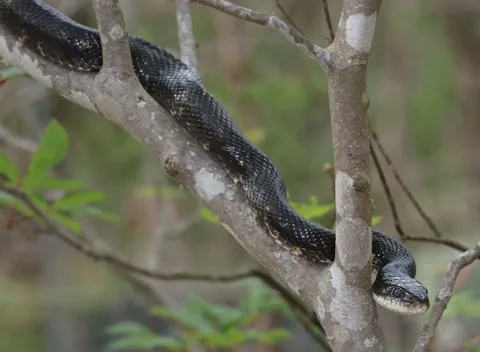 Rat snakes
Pantherophis obsoletus (western ratsnake) and P. alleghaniensis (eastern ratsnake)
Rat snakes are big, nonvenomous constrictors that Missouri's conservation department describes as common and often seen around homes and farm buildings, where they hunt rodents. Missouri calls them widely considered beneficial, though they also climb after bird eggs and chicks.
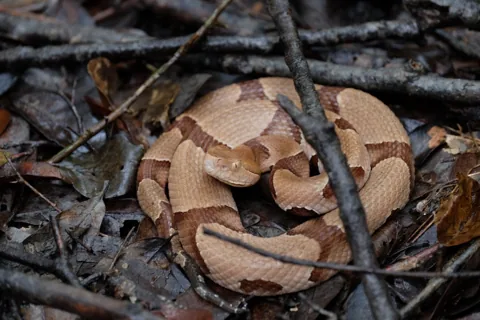 Copperhead
Agkistrodon contortrix
The copperhead is a stout, well-camouflaged pit viper and one of the venomous snakes people most often meet, even in towns. Researchers describe it as the least toxic North American pit viper, but bites still cause pain and swelling that can last weeks, and any bite needs prompt medical care.
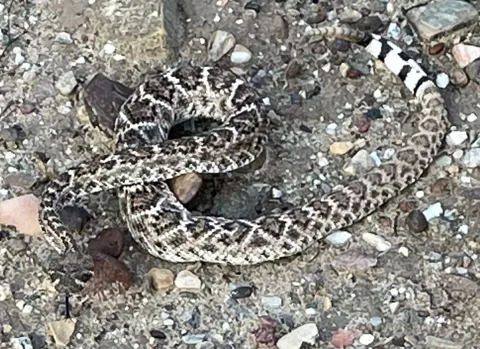 Rattlesnakes (western diamondback shown)
Crotalus species (shown: western diamond-backed rattlesnake, C. atrox)
Rattlesnakes are heavy-bodied pit vipers with a rattle on the tail and the largest venomous snakes in the United States. They eat rodents and rarely bite unless bothered, but a bite is a medical emergency.
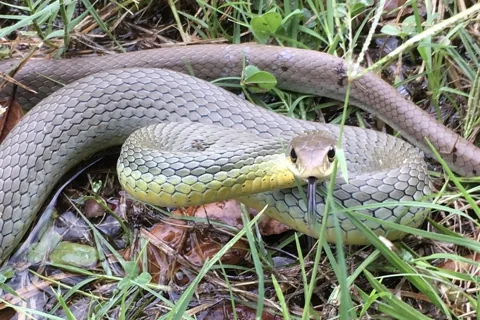 North American Racer
Coluber constrictor
The racer is a long, slim, nonvenomous snake known for its speed and keen eyesight. It is active by day and often seen streaking across roads and yards; in the Southeast the familiar form is the glossy black southern black racer.
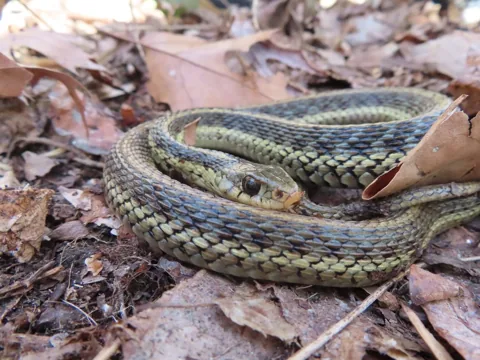 Garter snakes
Thamnophis sirtalis
The common gartersnake is a slender, striped snake that the Missouri Department of Conservation calls harmless, and it is one of the snakes people meet most often in yards and gardens. It may bite and smear a foul-smelling musk if grabbed, but it moves away when left alone.
What a shed skin tells you
Snakes shed their skin as they grow. Washington's wildlife department says a growing snake sheds every four to five weeks, and Colorado State University Extension says the skin is often shed more than once a year. So one snake can leave several skins in a season.[1][3]
Before a shed, the scales over the eyes turn cloudy and the snake sees poorly. Penn State says this is why a snake about to shed looks for a dark, secure spot, which is why skins turn up in garages, barns, rock walls, attics and crawl spaces.[2][1][4]
- Size: don't judge the snake by the skin. ICWDM says a shed skin is, on average, longer than the snake that left it.[4][5]
- Scales on the tail: turn the skin over and find the vent, the opening near the start of the tail. ICWDM says the underside of a pit viper's tail usually has one row of scales running all the way across, while most harmless snakes have two rows from the vent to the tail tip, and a shed skin shows the same pattern. Penn State and Colorado State University Extension give the same test.[4][2][3]
- The vent scale itself: ICWDM also suggests checking whether the scale that covers the vent is single or divided. The Missouri Department of Conservation describes a single one on the copperhead, and the Savannah River Ecology Laboratory a divided one on the rat snake.[4][16][14]
- Keeled or smooth: some snakes have a ridge, or keel, down the middle of each scale. ICWDM suggests rubbing a finger across the skin to feel for it. Rat snakes and copperheads have weakly keeled scales, while black racers have smooth ones.[4][14][16][15]
- Eye caps: the shed keeps the clear cover from each eye. Washington's wildlife department notes the eyeball cover is still visible in a shed skin.[1]
Why the skin isn't proof either way
ICWDM says the tail-scale rule has exceptions, so use it as one clue and not as the deciding test. It also only applies to pit vipers (copperheads, cottonmouths and rattlesnakes). Georgia's Department of Natural Resources points out that coral snakes are venomous but are not pit vipers.[4][12]
Penn State and Colorado State also list a pit between the eye and nostril and a vertical, elliptical pupil as pit viper marks, and Clemson notes the catlike pupils, but those are features of a live snake. Our venomous snakes guide and the copperhead lookalikes guide go through those marks in detail.[2][3][18]
Is the snake still around?
Penn State says that once a snake has shed, it moves on in search of food. A skin by the woodpile or in a barn may be all you ever see of that snake.[2]
Inside a house the picture can be different. Washington's wildlife department says snakes indoors either got in by accident and are trying to get out, or came in for prey or shelter and would stay if allowed, and that a shed skin in the house usually means a snake has been living there for some time. Some snakes hibernate in older houses with leaky cellars or dirt-floor crawl spaces.[1]
Penn State adds that rat snakes, kingsnakes and other rodent-eating snakes stay in houses because of a steady food supply, while small snakes such as garter and ringneck snakes may simply get trapped.[2]
What draws snakes in
Food and cover. ICWDM says the main foods of most snakes, especially larger ones, are birds, bird eggs and rodents such as rats, mice and chipmunks, and that snakes are drawn to rodents, insects and the cool, damp, dark spots around outbuildings and basements.[6]
Mississippi State University Extension says anything that gives mice and rats a home is attractive to the snakes that eat them. If you've also found mouse droppings, deal with the mice first.[7][6]
Safety first
Don't touch or try to catch a snake you can't identify. CDC's workplace safety page says not to touch or handle any snake, and Georgia's DNR says to identify a snake only from a distance and use caution around any unidentified one.[8][12]
The skin: CDC advises washing your hands after handling reptiles or items in their environment, because reptiles can carry Salmonella. Children younger than 5 should not touch reptiles or their environments.[13]
- If someone is bitten: call 911 or your local emergency number, keep the person calm, and take off rings and watches before swelling starts. Get medical help right away rather than waiting for symptoms.[9][8]
- Don't: use a tourniquet, cut the wound, suck out venom, put ice on it or soak it, or try to trap or pick up the snake. A photo taken from a safe distance is enough.[9][8]
- Poison Control says experts can help by phone if someone is bitten: 1-800-222-1222.[10]
- Pets: the Merck Veterinary Manual says a venomous snakebite is an emergency that needs prompt veterinary attention, and that owners should not spend time on first aid beyond keeping the animal quiet and limiting its activity. Fatal bites are more common in dogs than in other domestic animals.[11]
What to do next
A shed skin is a nudge to make the place less inviting. Penn State says removing the food supply and closing the entrances that rodents and snakes have been using usually solves the problem.[2]
- Clear cover near the house: ICWDM says to remove bushes, shrubs, rocks, boards and debris lying close to the ground, since they shelter both rodents and snakes.[6]
- Cut off rodent food: keep pet food, bird seed and other rodent food in closed containers, and clean up pet food after each feeding.[6][7]
- Seal the house: ICWDM says snakes don't gnaw their way in, so the same sealing that keeps mice out will keep snakes out. Mississippi State says to check the foundation and around walkways and porches for cracks and openings, and to seal masonry cracks with mortar.[6][7]
- Check garage doors: Washington's wildlife department says snakes can get into garages through open doors or under poorly fitting ones, and that weather-stripping on garage and outside doors should fit tightly.[1]
- Skip the home remedies: ICWDM says no snake repellent has much research showing it works in real-world use, and NPIC says chemical snake repellents can pose risks to people, pets or the environment if misused. Our snake-proofing guide covers the details.[6][17]
When to call for help
Washington's wildlife department says to leave a snake alone unless it is a rattlesnake or is inside a building where it isn't wanted. If a snake is in the house and you can't safely remove it, Penn State and Washington's wildlife department both say a wildlife control operator can do it.[1][2]
Know the rules first. Georgia's DNR says its native nonvenomous snakes are protected by state law and the eastern indigo snake is federally protected as threatened. Washington's wildlife department says it is unlawful there to hold, sell or release snakes into the wild without the proper license. Check your own state's wildlife agency before you kill or move a snake.[12][1]
Common questions
- Can a snake skin tell me if the snake was venomous?
- It can give a hint. A single row of scales under the tail points toward a pit viper and two rows toward a harmless snake, but ICWDM says there are exceptions, and coral snakes are venomous without being pit vipers.[4][2][12]
- How big was the snake that left this skin?
- Smaller than the skin. ICWDM says a shed skin is on average longer than the snake that shed it.[4][5]
- Does a snake skin mean there's a nest?
- Not by itself. Penn State says a shed means a snake was there at one time and moves on after shedding, though Washington's wildlife department says a skin inside a house usually means a snake has been living there a while.[2][1]
- Is it safe to pick up a snake skin?
- The skin can't bite, but CDC advises washing your hands after touching reptiles or items from their environment, since reptiles can carry Salmonella.[13]
Photo credits
- Rat snakes: (c) hr_dragonfly, some rights reserved (CC BY) — via iNaturalist, CC BY 4.0
- Copperhead: Brady Reed, public domain (CC0), via iNaturalist
- Rattlesnakes (western diamondback shown): (c) Mark Pollock, some rights reserved (CC BY) — via iNaturalist, CC BY 4.0
- North American Racer: Brady Reed, public domain (CC0), via iNaturalist
- Garter snakes: (c) Mila C., some rights reserved (CC BY) — via iNaturalist, CC BY 4.0
Sources
- Washington Department of Fish & Wildlife, “Living with wildlife: Snakes.” wdfw.wa.gov/species-habitats/living/snakes (accessed 2026-11-14)
- Penn State Extension, “Snakes.” extension.psu.edu/snakes (accessed 2026-11-14)
- Colorado State University Extension, “Coping With Snakes.” extension.colostate.edu/topic-areas/natural-resources/coping-with-snakes-6-501/ (accessed 2026-11-14)
- Internet Center for Wildlife Damage Management, “Snakes.” icwdm.org/species/reptiles/snakes/ (accessed 2026-11-14)
- Internet Center for Wildlife Damage Management, “Snake Damage Identification.” icwdm.org/species/reptiles/snakes/snake-damage-identification/ (accessed 2026-11-14)
- Internet Center for Wildlife Damage Management, “Snake Damage Prevention and Control Methods.” icwdm.org/species/reptiles/snakes/snake-damage-prevention-and-control-methods/ (accessed 2026-11-14)
- Mississippi State University Extension, “Reducing Snake Problems Around Homes.” extension.msstate.edu/publications/reducing-snake-problems-around-homes (accessed 2026-11-14)
- U.S. Centers for Disease Control and Prevention, NIOSH, “Venomous Snakes at Work.” www.cdc.gov/niosh/outdoor-workers/about/venomous-snakes.html (accessed 2026-11-14)
- MedlinePlus, U.S. National Library of Medicine, “Snake bites.” medlineplus.gov/ency/article/000031.htm (accessed 2026-11-14)
- Poison Control (National Capital Poison Center), “Everything you need to know about snakebites.” www.poison.org/articles/snakebites-in-march (accessed 2026-11-14)
- Merck Veterinary Manual, “Snakebites in Animals.” www.merckvetmanual.com/toxicology/snakebite/snakebites-in-animals (accessed 2026-11-14)
- Georgia Department of Natural Resources, Wildlife Resources Division, “DNR: What To Do When You See a Snake.” georgiawildlife.com/dnr-what-do-when-you-see-snake-3 (accessed 2026-11-14)
- Centers for Disease Control and Prevention, “Reptiles and Amphibians.” www.cdc.gov/healthy-pets/about/reptiles-and-amphibians.html (accessed 2026-11-14)
- University of Georgia Savannah River Ecology Laboratory, Herpetology Program, “Rat Snake.” srelherp.uga.edu/snakes/rat-snake/ (accessed 2026-11-14)
- University of Georgia Savannah River Ecology Laboratory, Herpetology Program, “Black Racer.” srelherp.uga.edu/snakes/black-racer/ (accessed 2026-11-14)
- Missouri Department of Conservation, “Eastern Copperhead.” mdc.mo.gov/discover-nature/field-guide/eastern-copperhead (accessed 2026-11-14)
- National Pesticide Information Center, “Snakes.” www.npic.orst.edu/pest/snake.html (accessed 2026-11-14)
- Clemson Cooperative Extension, Home & Garden Information Center, “Living with Snakes.” hgic.clemson.edu/living-with-snakes/ (accessed 2026-11-14)