The short answer
- Stay calm and keep your distance. Georgia's wildlife agency says not to try to handle a snake and to identify it, if you want to, from a distance. Mississippi State Extension says that unless you are skilled at snake identification, treat every snake as venomous, and never grab one by the tail.[10][5]
- Keep kids and pets out and close off the room. Wildlife damage specialists advise asking people to leave the area and securing rooms by wedging towels under the doors. Washington's wildlife department says to stay calm so you don't drive the snake into hiding.[4][1]
- Get it out or get help. Wildlife agencies and extension say a broom can sweep or herd a nonvenomous snake out an open door or into a bucket, box or wastebasket to carry outside. If you aren't sure what it is, or don't want to do it, NPIC suggests calling your county extension office, animal control officer or state wildlife agency.[1][3][13][11]
Related profiles on this site
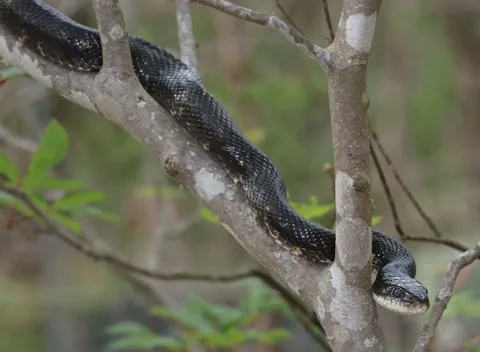 Rat snakes
Pantherophis obsoletus (western ratsnake) and P. alleghaniensis (eastern ratsnake)
Rat snakes are big, nonvenomous constrictors that Missouri's conservation department describes as common and often seen around homes and farm buildings, where they hunt rodents. Missouri calls them widely considered beneficial, though they also climb after bird eggs and chicks.
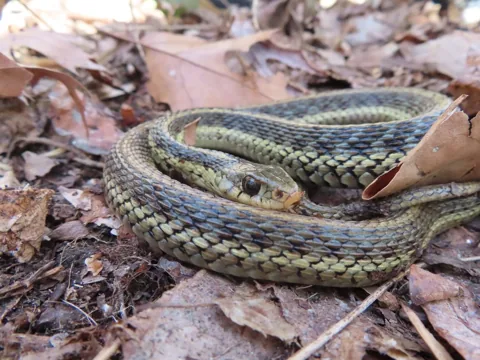 Garter snakes
Thamnophis sirtalis
The common gartersnake is a slender, striped snake that the Missouri Department of Conservation calls harmless, and it is one of the snakes people meet most often in yards and gardens. It may bite and smear a foul-smelling musk if grabbed, but it moves away when left alone.
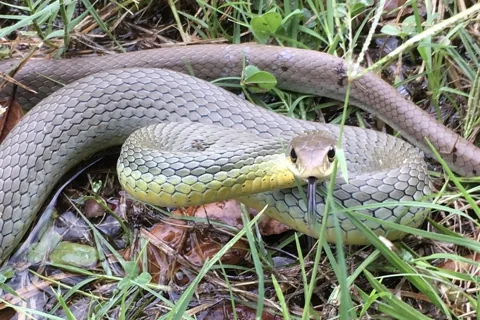 North American Racer
Coluber constrictor
The racer is a long, slim, nonvenomous snake known for its speed and keen eyesight. It is active by day and often seen streaking across roads and yards; in the Southeast the familiar form is the glossy black southern black racer.
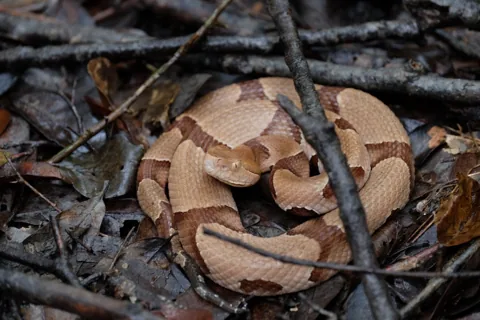 Copperhead
Agkistrodon contortrix
The copperhead is a stout, well-camouflaged pit viper and one of the venomous snakes people most often meet, even in towns. Researchers describe it as the least toxic North American pit viper, but bites still cause pain and swelling that can last weeks, and any bite needs prompt medical care.
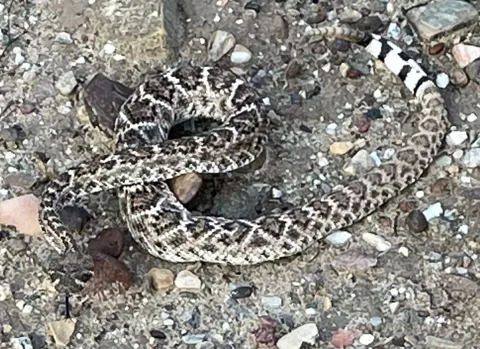 Rattlesnakes (western diamondback shown)
Crotalus species (shown: western diamond-backed rattlesnake, C. atrox)
Rattlesnakes are heavy-bodied pit vipers with a rattle on the tail and the largest venomous snakes in the United States. They eat rodents and rarely bite unless bothered, but a bite is a medical emergency.
Safety first: the first few minutes
Snakes bite in self-defense. Wildlife damage specialists say snakes usually strike in self-defense and bite when grabbed, and CDC NIOSH says never to handle a venomous snake, not even a dead one.[4][6]
- Don't touch it: Georgia's wildlife agency says do not attempt to handle the snake and give it the space it needs. Clemson Extension says not to pick a snake up, especially if you don't know what kind it is.[10][12]
- Don't try to kill it: Mississippi State Extension says killing a snake usually serves very little practical purpose, and Washington's wildlife department says no snake should ever be killed except a rattlesnake that poses an immediate danger to people or pets.[5][1]
- Keep others back: ask children and other people to leave the area, and keep pets away too; Merck says a venomous snakebite in a pet is an emergency that needs prompt veterinary attention.[4][9]
- Keep track of it: Washington's wildlife department says to remain calm to avoid disturbing the snake and forcing it into hiding. Wedging towels under the doors keeps it in one room and, as wildlife damage specialists note, can also ease the stress.[1][4]
- Get a look from a safe distance: a photo or a note of its color, shape and size helps with identification. MedlinePlus says to do this only if it is safe, and not to trap or pick up the snake.[7][6]
What kind of snake is it likely to be?
Most are harmless. Virginia's wildlife agency says most snakes are harmless and that the copperhead, Virginia's most common venomous snake, is usually not found inside homes. Georgia's wildlife agency says seven of Georgia's snake species can be dangerously venomous while the 40 other species are nonvenomous.[13][10]
- Small snakes that wandered in: Penn State Extension says small snakes such as garter and ringneck snakes may become trapped in a house and need to be removed before they die.[2]
- Rodent hunters: Penn State says rat snakes, king snakes and other rodent-eating species occupy houses because of a steady supply of food.[2]
- Telling them apart: the venomous snakes, copperhead and rat snake vs racer pages linked below cover field marks. If you can't tell, treat it as venomous and call for help.[5]
How to get a harmless snake out
Only do this if you are sure the snake is not venomous and you are comfortable doing it. Virginia's wildlife agency says to identify the snake first, and only once it is known to be nonvenomous, move it yourself.[13]
- Herd it out: Washington's wildlife department says to try opening a nearby door and using a broom to gently herd the snake out.[1]
- Sweep it into a container: Colorado State Extension says a good way to remove a nonvenomous snake is to sweep it into a large bucket with a broom and release it outdoors. Mississippi State Extension says to sweep it into a box that can be sealed.[3][5]
- Cover it: Virginia's wildlife agency says to carefully place a bucket or wastebasket over the snake, slip a board under it, then carry the snake outside and release it.[13]
- Use a long tool, not your hands: Washington's wildlife department says a long pole, stick or golf club can lift a snake into a box or wastebasket, and Clemson Extension says to use a golf club head like a hook or a long sturdy branch to support the snake's body.[1][12]
If the snake hid and you can't find it
Mississippi State Extension says that if you can't find the snake but think one is in your home, you can use damp cloths or glue traps to catch it.[5]
- Damp cloth trick: Mississippi State says to place rumpled damp cloths, such as pillowcases, on the floor where the snake is likely to be and cover them with a dry cloth. Check them periodically, and if the snake has curled up inside, scoop up the whole pile with a shovel, put it in a large box and carry it away. Wildlife damage specialists describe the same method with damp burlap bags or towels.[5][4]
- Glue boards: Mississippi State and Washington's wildlife department say rodent glue boards can catch snakes indoors and that cooking or vegetable oil frees a captured snake, but use them only where children, pets and other animals can't reach them.[5][1]
Who to call
NPIC says to call your local county extension office, animal control officer or state wildlife agency for help identifying or removing a snake.[11]
- Wildlife control operators: Penn State says local wildlife pest control operators can remove snakes so you never have to come into contact with the animal, and suggests your county extension office for names.[2]
- Check what your state agency does: Virginia's wildlife agency says its staff do not come to homes to remove snakes and points people to a pest control company that advertises snake handling and holds a permit from the agency.[13]
- Venomous snake indoors: Colorado State Extension says venomous snakes may be a health hazard to people and pets and should be excluded and, if necessary, removed; for a venomous snake indoors, call one of the contacts above instead of doing it yourself.[3]
Why it got in, and could there be more?
Snakes come in for food and shelter. Wildlife damage specialists say snakes are attracted to rodents and insects and to cool, damp, dark places like basements, and Colorado State says snakes may seek shelter in basements, sheds or crawl spaces in cold weather.[4][3]
- Ways in: Penn State says snakes enter through torn screens, open basement windows and cracks in foundations. Washington's wildlife department says they also slip in through open garage doors or under poorly fitting doors, and Virginia's wildlife agency says snakes can climb in through the attic where trees or shrubs touch the roof.[2][1][13]
- One-time visitor or resident: Washington's wildlife department says snakes that entered by accident try to escape, while snakes that came for prey or shelter would stay if allowed, and that some snakes hibernate in older houses with leaky cellars or dirt-floor crawl spaces.[1]
- Signs of a resident: Washington's wildlife department says a shed skin usually means a snake has been living in the house for some time. The snake skin guide covers what a shed tells you.[1]
- Rodents: Virginia's wildlife agency says to have your house checked for rodents, because once the food is gone the snakes will go elsewhere, and Penn State says removing the food supply and closing the entrances usually solves the problem.[13][2]
Snakes and the law
Many states protect native snakes, so check your state wildlife agency before killing or keeping one. Georgia's wildlife agency says native nonvenomous snakes are protected by state law, and Colorado State Extension says Colorado classifies all nonvenomous snakes as nongame wildlife protected by state law.[10][3]
- Pennsylvania: Penn State says all snakes in the state are protected by Fish and Boat Commission regulations.[2]
- Virginia: the state wildlife agency says it is unlawful to take or possess any wild animal unless specifically permitted by law or regulation.[13]
- Mississippi: Mississippi State Extension says most snakes there are not protected, but recommends leaving them alone when they aren't causing a problem.[5]
- Federally listed: Georgia's wildlife agency says the eastern indigo snake is federally protected as threatened.[10]
If someone gets bitten
Call 911 or your local emergency number. MedlinePlus says not to wait for symptoms, and the Poison Help line at 1-800-222-1222 gives free, confidential expert guidance around the clock.[7][8]
- Do: CDC NIOSH says keep calm, don't drive yourself, remove rings and watches before swelling starts, wash the bite with soap and water and cover it with a clean, dry dressing.[6][7]
- Don't: CDC NIOSH and MedlinePlus say not to use a tourniquet, cut the wound, suck out venom, apply ice or soak it in water, or take pain relievers or alcohol.[6][7]
- Don't chase the snake: MedlinePlus says not to waste time hunting for it or try to trap it, and CDC NIOSH says never to handle a venomous snake, even a dead one.[7][6]
- Pets: Merck says venomous snakebites in animals are emergencies requiring prompt veterinary attention, so call your veterinarian or an emergency clinic right away.[9]
Common questions
- Will the snake leave on its own?
- Sometimes. Washington's wildlife department says snakes that got in by accident try to escape, but small ones may die from lack of food or moisture if they aren't removed, and Penn State says trapped small snakes need to be removed before they die.[1][2]
- Should I just kill it?
- No. Mississippi State says it usually serves very little practical purpose, Colorado State warns that trying to kill a snake that has bitten someone can lead to more bites, and many states protect native snakes.[5][3][10]
- Can I grab it by the tail?
- No. Mississippi State Extension says a snake can quickly strike the hand that is holding its tail.[5]
- Will mothballs drive it out?
- Don't count on it. Wildlife damage specialists say the naphthalene repellent is registered for rattlesnakes and checkered garter snakes but apparently isn't effective against most other species. The mothballs page has more.[4]
Photo credits
- Rat snakes: (c) hr_dragonfly, some rights reserved (CC BY) — via iNaturalist, CC BY 4.0
- Garter snakes: (c) Mila C., some rights reserved (CC BY) — via iNaturalist, CC BY 4.0
- North American Racer: Brady Reed, public domain (CC0), via iNaturalist
- Copperhead: Brady Reed, public domain (CC0), via iNaturalist
- Rattlesnakes (western diamondback shown): (c) Mark Pollock, some rights reserved (CC BY) — via iNaturalist, CC BY 4.0
Sources
- Washington Department of Fish & Wildlife, “Living with wildlife: Snakes.” wdfw.wa.gov/species-habitats/living/snakes (accessed 2026-11-14)
- Penn State Extension, “Snakes.” extension.psu.edu/snakes (accessed 2026-11-14)
- Colorado State University Extension, “Coping With Snakes.” extension.colostate.edu/topic-areas/natural-resources/coping-with-snakes-6-501/ (accessed 2026-11-14)
- Internet Center for Wildlife Damage Management, “Snake Damage Prevention and Control Methods.” icwdm.org/species/reptiles/snakes/snake-damage-prevention-and-control-methods/ (accessed 2026-11-14)
- Mississippi State University Extension, “Reducing Snake Problems Around Homes.” extension.msstate.edu/publications/reducing-snake-problems-around-homes (accessed 2026-11-14)
- U.S. Centers for Disease Control and Prevention, NIOSH, “Venomous Snakes at Work.” www.cdc.gov/niosh/outdoor-workers/about/venomous-snakes.html (accessed 2026-11-14)
- MedlinePlus, U.S. National Library of Medicine, “Snake bites.” medlineplus.gov/ency/article/000031.htm (accessed 2026-11-14)
- Poison Control (National Capital Poison Center), “Everything you need to know about snakebites.” www.poison.org/articles/snakebites-in-march (accessed 2026-11-14)
- Merck Veterinary Manual, “Snakebites in Animals.” www.merckvetmanual.com/toxicology/snakebite/snakebites-in-animals (accessed 2026-11-14)
- Georgia Department of Natural Resources, Wildlife Resources Division, “DNR: What To Do When You See a Snake.” georgiawildlife.com/dnr-what-do-when-you-see-snake-3 (accessed 2026-11-14)
- National Pesticide Information Center, “Snakes.” www.npic.orst.edu/pest/snake.html (accessed 2026-11-14)
- Clemson Cooperative Extension, Home & Garden Information Center, “Living with Snakes.” hgic.clemson.edu/living-with-snakes/ (accessed 2026-11-14)
- Virginia Department of Wildlife Resources, “Problems with Snakes.” dwr.virginia.gov/wildlife/nuisance/snakes/ (accessed 2026-11-14)