The short answer
- Most likely it's a house gecko (pale, bumpy, big lidless eyes, out at night near lights) or an anole (slim, green or brown, out by day). Both eat insects and spiders. Texas A&M AgriLife calls house geckos beneficial insect predators that become a nuisance when they move indoors.[1][3][4][5]
- It isn't going to hurt you, but don't handle it bare-handed and then touch food. CDC says reptiles often carry Salmonella in their gut even when they look healthy; wash your hands with soap and running water after touching one or anything it touched.[8][10]
- To get it out, cover it with a plastic tub or jar, slide a lid under, and let it go outdoors, which is what Texas A&M suggests. Don't grab the tail: lizards drop their tails when they're held.[1][6][7]
- Then seal the way in. No pesticides are registered for gecko control, so Texas A&M says management should focus on keeping them out: weather stripping on doors and windows, and caulk or foam around soffits, pipes and wires.[1]
Related pest profiles
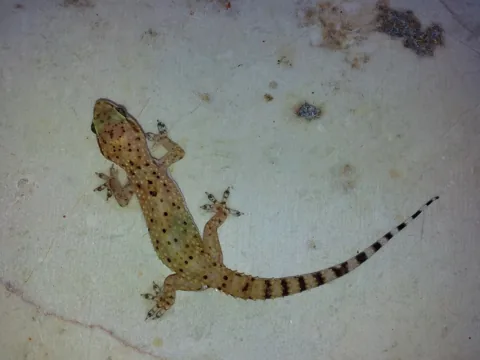 House Geckos
Hemidactylus turcicus
House geckos are small, introduced lizards that live around buildings and hunt insects near lights at night. Many people welcome them as insect predators; they become a nuisance mainly when they move indoors and leave droppings.
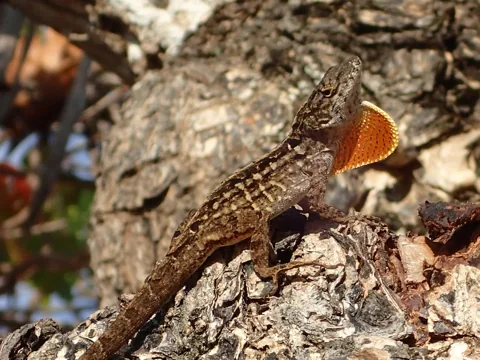 Brown Anole
Anolis sagrei
The brown anole is a small, quick lizard from the Caribbean that has become one of the most abundant lizards in Florida and is firmly established in coastal and southern Georgia. It crowds the native green anole, pushing it higher into the trees.
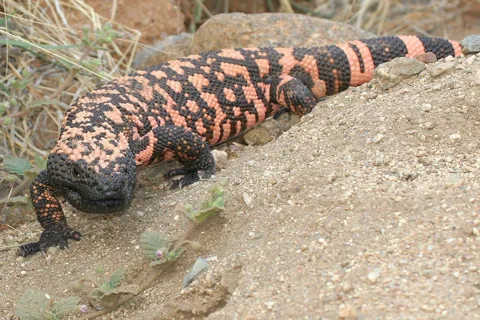 Gila monster
Heloderma suspectum
The Gila monster is a heavy-bodied, venomous lizard of the Sonoran and Mojave deserts. It is shy, spends most of its life underground, and is protected by state law everywhere it lives, so the right response to one in the yard is to leave it alone. Its bite is very painful and needs medical care, but bites almost always happen when people handle it.
What it could be
The lizards in this list are the ones extension and wildlife sources describe living on and around houses in the southern US. Size is total length, tail included. For full profiles see the links below the list.[1][3][2]
Geckos are the ones to expect at night, on walls near lights. SREL says introduced geckos are almost completely nocturnal, and unlike most lizards they can make squeaking or barking calls, so a chirp in the evening often belongs to one.[3][1]
In the desert Southwest, a heavy, beaded-skinned lizard with a yellow or coral pattern is a different matter: see the Gila monster note under Safety.[14][15]
- Mediterranean house gecko: 4 to 5 inches, very light tan, gray or whitish with spots, bumpy skin, sticky toe pads, and large lidless eyes with vertical pupils. Illinois DNR says it is nearly always tied to human dwellings and often lives in homes, much as mice do. It is spreading north and has turned up in southern Illinois.[2][3][1]
- Common (Indo-Pacific) house gecko: 3 to 6 inches, pinkish to grayish and sometimes marbled, with an elongated snout and tapering tail. Texas has both species, Texas A&M says; SREL says the Mediterranean gecko is told from the Indo-Pacific one by its bumpy, warty skin.[1][3]
- Green anole: 5 to 8 inches, green or brown (it can change), with a pinkish throat fan on males. Active by day; SREL says anoles are common in suburbs and towns, perch on fences and rooftops, and in cool weather hide under bark and shingles.[5]
- Brown anole: 5 to 8.5 inches, brown to grayish with whitish or yellowish patterns on the back; males have an orange or red throat fan with a white edge. Introduced to southern Florida from the Caribbean, it is now one of Florida's most abundant lizards and has spread into coastal and southern Georgia.[4]
- Skinks: short-legged lizards with streamlined bodies. The five-lined skink is 5 to 8.5 inches with five light stripes, and the young have a bright blue tail. The ground skink is a small coppery-brown lizard, 3 to 5.5 inches, that wriggles through leaf litter and almost never climbs. SREL says both mostly live under logs, bark and leaf litter, so one indoors has most likely wandered in.[6][7]
Is one lizard a sign of more?
With house geckos, often yes. Illinois DNR says the Mediterranean gecko lives in homes, hiding in cracks and crevices, and that females lay a clutch of two eggs and may do so several times a year, sometimes nesting communally in crevices.[2]
Lizards follow food. Texas A&M says house geckos wait near porch lights at night for moths, cockroaches and other insects, and SREL describes geckos perched on walls around outdoor lights grabbing insects drawn to them. More insects around your lights means more food for geckos.[1][3]
Texas A&M also says geckos are mostly active from spring through fall, shelter by day in cracks and crevices around buildings, and get inside through cracks and crevices or around doors. A lizard indoors usually points to a gap near a light, a door or a window.[1]
Anoles and skinks are different. They hunt by day outdoors and shelter under bark, shingles, logs or leaf litter, so one in the house has most likely wandered in.[5][4][6][7]
Signs that geckos are living in the house: small elongated brownish droppings tipped with white, which Texas A&M says can stain carpets, rugs, walls and curtains.[1]
Safety first
The small lizards that get indoors are not venomous. The blue-tailed young of five-lined skinks are widely called "scorpions" and believed to sting; SREL says that belief is completely false.[6]
Treat any reptile as a Salmonella carrier. CDC says reptiles often carry Salmonella in their digestive tracts even when healthy, and that you don't have to touch the animal to get sick because the places it has been can be contaminated. CDC's advice is written for pet reptiles, but the same habits apply to a wild lizard in the house: wash your hands with soap and running water after touching it, and keep it away from the kitchen and anywhere food is prepared. MedlinePlus advises reptile owners to wear gloves when handling the animal or its feces.[8][9][10]
Children under 5, adults over 65 and people with weakened immune systems are more likely to get sick from these germs, CDC says, and children under 5 should not handle reptiles. MedlinePlus advises wearing gloves when handling a reptile or its feces, which applies to cleaning up gecko droppings too.[8][10]
If it bites or scratches, wash the wound right away with warm soapy water, CDC says, and see a doctor if it becomes red, painful, warm or swollen.[8]
Salmonella illness usually starts 8 to 72 hours after infection, with symptoms including diarrhea, MedlinePlus says. It lists when to call a provider, including diarrhea with a fever above 101°F (38.3°C), diarrhea that doesn't improve in 5 days, or being unable to keep fluids down.[10]
The one dangerous lizard in the US is the Gila monster, a desert lizard of the Southwest. The National Park Service says it is the only venomous lizard found in the United States and that a bite always calls for a trip to the emergency room. The Arizona Poison and Drug Information Center says to call 1-800-222-1222 after any bite, and that there is no antivenom. Leave one alone and keep people and pets away.[15][14]
If your cat or dog eats a lizard
The main worry is a liver fluke, not venom. The Merck Veterinary Manual says Platynosomum concinnum, the most common fluke in cats, uses lizards and toads in its life cycle, and cats pick it up by catching and eating them. It occurs in the southeastern US, Hawaii, Puerto Rico and the Caribbean.[11][12]
Most infected cats show no signs, Merck says, but in others the flukes block the bile duct. Severe cases cause what Merck calls "lizard poisoning": poor appetite, lethargy, persistent vomiting, diarrhea, jaundice and an enlarged belly. Merck's professional manual says dogs are infected less often than cats.[11][12][13]
If your pet hunts lizards and shows any of those signs, tell your veterinarian it eats lizards.[11]
How to get it out
Texas A&M says a gecko can be caught indoors and released outside, as long as you also stop it getting back in.[1]
If you'd rather keep a gecko or two, that is an option Texas A&M mentions: many people let geckos stay indoors because they eat insects.[1]
- Place a plastic tub, margarine container or jar over it, slide a stiff card or lid underneath, and carry it outside. Texas A&M describes this as the humane way to catch and relocate a gecko.[1]
- Don't pick it up by the tail. SREL says lizards break off their tails when restrained, so hold the container, not the lizard.[6][7]
- Release it outdoors, then wash your hands with soap and running water.[1][8]
- Skip the glue boards. Texas A&M says they catch and kill geckos but don't kill quickly or allow a humane release; see our guide to glue traps for more.[1]
- Don't spray it. No pesticides are registered for gecko control, Texas A&M says, and spraying for insects has at most a minimal effect on gecko numbers.[1]
Keeping them out
Texas A&M's gecko advice is all about exclusion. Check and replace weather stripping around doors and windows, and seal cracks around soffits and where plumbing and electrical lines go through walls. Geckos hide by day in poorly sealed gaps on the outside of the house, so caulk or expanding foam in those gaps removes both shelter and entry points.[1]
Release a caught gecko only after you've sealed the way it came in, Texas A&M says, or it may move right back.[1]
Cut the food supply too. Fewer insects near doors and windows means fewer geckos waiting there, since they gather at lights to hunt; check for cockroaches or other insects indoors that could be feeding a lizard.[1][3]
When to call for help
Most single lizards need no professional. If geckos keep getting in after you've sealed the obvious gaps, hire for exclusion rather than spraying: Texas A&M says no pesticides are registered for gecko control and that management should focus on sealing gaps around doors, windows, soffits and plumbing or electrical penetrations.[1]
For a Gila monster in or near the house in the Southwest, keep everyone away from it; for a bite, go to the emergency room or call Poison Control at 1-800-222-1222.[15][14]
Common questions
- Can a house gecko hurt me?
- No. House geckos are small insect-eaters; Texas A&M calls them a nuisance indoors mainly because their droppings stain fabrics and carpets. The real issue is Salmonella, so wash your hands after touching one or its droppings.[1][8]
- Why is there a lizard chirping in my house at night?
- That is likely a gecko. SREL says geckos, unlike most lizards, make squeaking or barking calls, and Texas A&M says house geckos squeak when alarmed.[3][1]
- Is a blue-tailed lizard poisonous?
- No. The blue tail marks a young five-lined skink or a close relative. SREL says the belief that they sting like scorpions is completely false.[6]
- My cat ate a lizard. Should I worry?
- Usually not right away, but in the southeastern US, Hawaii and the Caribbean cats can pick up a liver fluke from lizards. Merck says most infected cats show no signs; call your vet if your cat vomits, stops eating, looks yellow or has a swollen belly.[11][12]
- Will bug spray get rid of lizards?
- No pesticide is registered for gecko control, Texas A&M says, and spraying for insects has at most a minimal effect on geckos. Sealing gaps is what works.[1]
Photo credits
- House Geckos: (c) Dr. Nasser Halaweh, some rights reserved (CC BY) — via iNaturalist, CC BY 4.0
- Brown Anole: Zygy, public domain (CC0), via iNaturalist
- Gila monster: (c) Dan Vickers, some rights reserved (CC BY) — via iNaturalist, CC BY 4.0
Sources
- Texas A&M AgriLife Extension, “House geckos (ENT-2006).” citybugs.tamu.edu/factsheets/household/misc-house/ent-2006/ (accessed 2026-11-14)
- Illinois Department of Natural Resources, “Mediterranean gecko.” dnr.illinois.gov/education/wildaboutpages/wildaboutlizards/walzmediterraneangecko.html (accessed 2026-11-14)
- Savannah River Ecology Laboratory, University of Georgia, “Mediterranean Gecko (Hemidactylus turcicus).” srelherp.uga.edu/lizards/mediterranean-gecko/ (accessed 2026-11-14)
- Savannah River Ecology Laboratory, University of Georgia, “Brown Anole (Anolis sagrei).” srelherp.uga.edu/lizards/brown-anole/ (accessed 2026-11-14)
- Savannah River Ecology Laboratory, University of Georgia, “Green Anole (Anolis carolinensis).” srelherp.uga.edu/lizards/green-anole/ (accessed 2026-11-14)
- Savannah River Ecology Laboratory, University of Georgia, “Five-lined Skink (Plestiodon fasciatus).” srelherp.uga.edu/lizards/five-lined-skink/ (accessed 2026-11-14)
- Savannah River Ecology Laboratory, University of Georgia, “Ground Skink (Scincella lateralis).” srelherp.uga.edu/lizards/ground-skink/ (accessed 2026-11-14)
- Centers for Disease Control and Prevention, “Reptiles and Amphibians (Healthy Pets, Healthy People).” www.cdc.gov/healthy-pets/about/reptiles-and-amphibians.html (accessed 2026-11-14)
- Centers for Disease Control and Prevention, “About Salmonella Infection.” www.cdc.gov/salmonella/about/index.html (accessed 2026-11-14)
- MedlinePlus (U.S. National Library of Medicine), “Salmonella enterocolitis.” medlineplus.gov/ency/article/000294.htm (accessed 2026-11-14)
- Merck Veterinary Manual, “Disorders of the Liver and Gallbladder in Cats.” www.merckvetmanual.com/cat-owners/digestive-disorders-of-cats/disorders-of-the-liver-and-gallbladder-in-cats (accessed 2026-11-14)
- Merck Veterinary Manual, “Flukes in Small Animals.” www.merckvetmanual.com/digestive-system/gastrointestinal-parasites-of-small-animals/flukes-in-small-animals (accessed 2026-11-14)
- Merck Veterinary Manual, “Hepatobiliary Fluke Infection in Small Animals.” www.merckvetmanual.com/digestive-system/hepatic-diseases-of-small-animals/hepatobiliary-fluke-infection-in-small-animals (accessed 2026-11-14)
- Arizona Poison and Drug Information Center, “Gila Monster.” azpoison.com/venom/gila-monster (accessed 2026-11-14)
- National Park Service, Saguaro National Park, “Gila Monster.” www.nps.gov/sagu/learn/nature/gila-monster.htm (accessed 2026-11-14)