On this page
How to identify it
- The largest lizard in the United States. The National Park Service gives up to 22 inches and over a pound; Nevada Wildlife lists 18 to 24 inches and 2 to 4 pounds.[4][5]
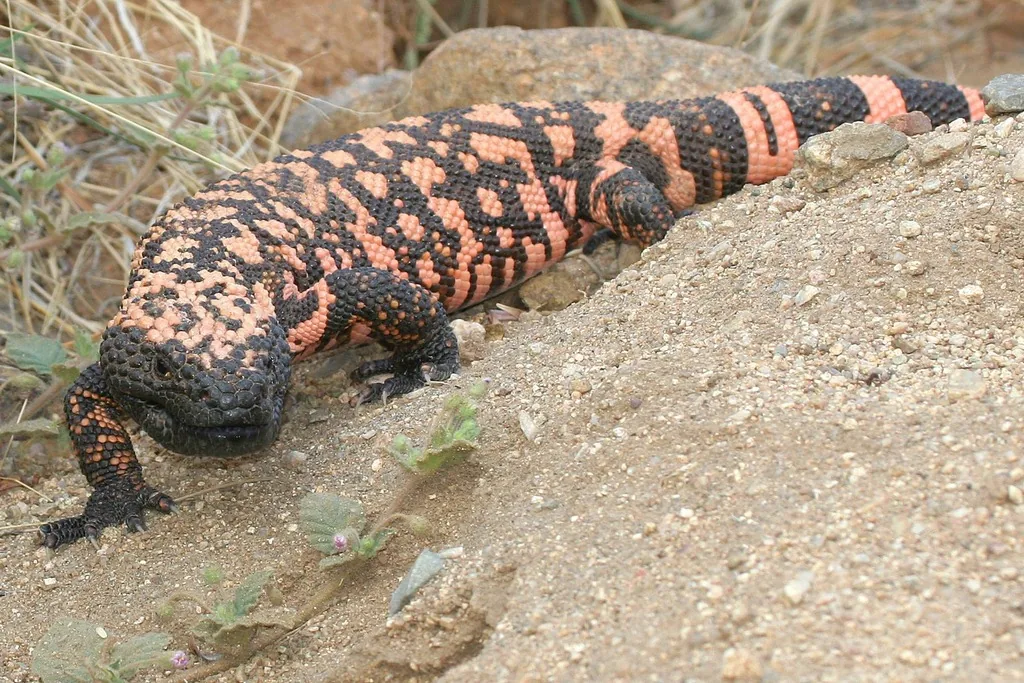
- Pink, salmon, orange or yellowish and black skin, usually in a netlike (reticulated) pattern, banded in some populations.[1][4][5][2]
- The skin looks beaded because small bones called osteoderms sit under the scales.[1][5]
- A large head with small, beady eyes, a solid black snout, short stout legs with long claws, and a short, fat tail where it stores fat.[1][4][5]
Where it lives
Found mainly in western and southern Arizona south into Sonora, Mexico, and also in extreme southeastern California, southern Nevada, extreme southwestern Utah and southwestern New Mexico. Its distribution is spotty, clumped mostly around mountain ranges.[1][4]
Biology and life cycle
Most common in desert foothills with saguaros and palo verde, it also uses rocky desert scrub, semi-desert grassland and desert washes, sheltering in rock crevices, burrows and packrat middens.[1][5]
It spends most of its time underground; some estimates put it at up to 98 percent. It digs its own burrows with its claws or moves into burrows dug by other animals.[1][4][5]
It is active mainly from March through November and hibernates from late November through February. It is often seen outside its burrow during spring or summer rainstorms.[1][5]
It eats newborn rodents and rabbits, eggs, nestling birds and lizards. A young Gila monster may eat over half its body weight at once and an adult about 35 percent, and the fat it stores in its tail lets it go months between meals. It kills prey with its strong jaws, not its venom.[1][4][5]
Eggs are laid underground in summer and develop over the winter; the young appear the following spring.[1][4]
Fun fact: in 1992 researchers isolated a peptide called exendin-4 from Gila monster venom. Exenatide (sold as Byetta), a diabetes medicine, is a synthetic form of this protein from the lizard's saliva.[9][10]
Damage and signs
- The concern with a Gila monster is a defensive bite, not damage to property. It has no fangs and can't strike, so a bite happens when someone puts a hand or foot near its mouth.[4][2]
- It is shy and not prone to attacking people unless significantly agitated; before biting it hisses, gapes and backs away.[2][1]
Health risk
The bite is extremely painful, and the lizard may hang on for several minutes, chewing venom in through grooved teeth. Swelling, nausea, vomiting, high blood pressure, weakness, faintness, sweating, chills and fever can follow, and some people have had breathing difficulties. A study of U.S. poison center calls from 2000 to 2011 found 105 human exposures and no deaths, but 6 of 70 Arizona patients had airway swelling. In 2026, Colorado and Arizona poison specialists reported a fatal case after a Gila monster bite.[2][6][7][8]
Control
Prevention
Do not touch, pick up, move or bother a Gila monster. It is illegal to possess or relocate one, dead or alive, or to harass, injure or kill it.[4][1]
Watch where you put your hands and feet in its habitat; the Park Service says reasonably cautious people will not be bitten. If you see one, enjoy it from a distance and take photos.[4]
If it hisses or gapes, back away and give it room; it uses its venom for defense.[1][2]
Legal protection
In 1952 the Gila monster became the first venomous animal in North America given legal protection; it is illegal to collect, kill or sell one in Arizona.[1]
Arizona law protects Gila monsters from being captured or held in any manner.[2]
The National Park Service says it is protected by state law in every state where it occurs: Arizona, California, Nevada, Utah and New Mexico, and in Mexico. Nevada lists it as state protected and a priority species.[4][5]
If someone is bitten
Remove the lizard as quickly as possible; the poison center suggests prying the jaws open with a strong stick while the lizard keeps a foothold on the ground.[2]
First aid in the field may include rinsing the wound with plenty of water, keeping the limb still at heart level, and reassuring the person. Call Poison Control at 1-800-222-1222; every Gila monster bite caller is referred to a medical facility.[2]
A bite is a medical emergency. Rare severe effects include swelling of the throat and airway, heavy fluid loss and heart rhythm problems, so get medical care right away.[2][8][6]
There is no antivenom; doctors check the wound for broken-off teeth, update tetanus shots and watch for infection.[2]
Where sources disagree
Size: the National Park Service gives up to 22 inches and over a pound, the Desert Museum a little over 1-1/4 feet, and Nevada Wildlife 18 to 24 inches and 2 to 4 pounds.[4][1][5]
Eggs: the Desert Museum gives an average of 5 and as many as 12, the National Park Service usually 4 to 5, and Nevada Wildlife clutches of about 12.[1][4][5]
Daily timing: the Desert Museum says it is active mainly by day, while the Park Service says it is mostly out in the morning and evening in spring and fall and at night in summer.[1][4]
Deaths: a 2015 poison center study found no deaths and a 2026 report describes a fatal case; the report notes earlier claims of deadly bites were inconclusive.[6][7]
Common questions
- Is a Gila monster dangerous?
- Its bite is venomous and very painful, and some bites are severe, but most are not life-threatening; medical reviews describe Heloderma bites as rare and generally mild. Bites almost always happen when people handle or harass the lizard.[2][6][8][4]
- Can I kill or relocate a Gila monster in my yard?
- No. Gila monsters are protected by state law in Arizona, California, Nevada, Utah and New Mexico; it is illegal to possess, relocate, harass, injure or kill one.[4][1]
- When are Gila monsters most likely to be seen?
- From March through November, mostly in spring. They are often out during spring or summer rainstorms.[1][5][4]
- Is there an antivenom for Gila monster bites?
- No. Treatment is symptomatic and supportive, and the Arizona Poison and Drug Information Center refers every bite caller to a medical facility.[2][8]
Sources
- Arizona-Sonora Desert Museum, “Gila Monster (Heloderma suspectum), from A Natural History of the Sonoran Desert.” desertmuseum.org/books/nhsd_gila.php (accessed 2026-11-12)
- Arizona Poison and Drug Information Center, University of Arizona College of Pharmacy, “Gila Monster (venomous creatures).” azpoison.com/venom/gila-monster (accessed 2026-11-12). Regional poison control center operated by the University of Arizona.
- iNaturalist, “Heloderma suspectum taxon page (order and family).” www.inaturalist.org/taxa/35003 (accessed 2026-11-12)
- Saguaro National Park, U.S. National Park Service, “Gila Monster.” www.nps.gov/sagu/learn/nature/gila-monster.htm (accessed 2026-11-12)
- Nevada Department of Wildlife, “Gila Monster.” www.ndow.org/species/gila-monster/ (accessed 2026-11-12)
- Clinical Toxicology (2015), via PubMed, “Gila monster (Heloderma suspectum) envenomation: Descriptive analysis of calls to United States Poison Centers with focus on Arizona cases.” pubmed.ncbi.nlm.nih.gov/25511795/ (accessed 2026-11-12). Cited from the PubMed abstract.
- Wilderness & Environmental Medicine (2026), via PubMed, “Fatality Following Gila Monster Envenomation.” pubmed.ncbi.nlm.nih.gov/42101458/ (accessed 2026-11-12). Cited from the PubMed abstract.
- Clinical Toxicology (2021), via PubMed, “Severe Heloderma spp. envenomation: a review of the literature.” pubmed.ncbi.nlm.nih.gov/33263449/ (accessed 2026-11-12). Cited from the PubMed abstract.
- Journal of Biological Chemistry (1992), via PubMed, “Isolation and characterization of exendin-4, an exendin-3 analogue, from Heloderma suspectum venom.” pubmed.ncbi.nlm.nih.gov/1313797/ (accessed 2026-11-12). Cited from the PubMed abstract.
- Journal of the American Pharmacists Association (2006), via PubMed, “Exenatide: from the Gila monster to the pharmacy.” pubmed.ncbi.nlm.nih.gov/16529340/ (accessed 2026-11-12). Cited from the PubMed abstract.