On this page
How to identify it
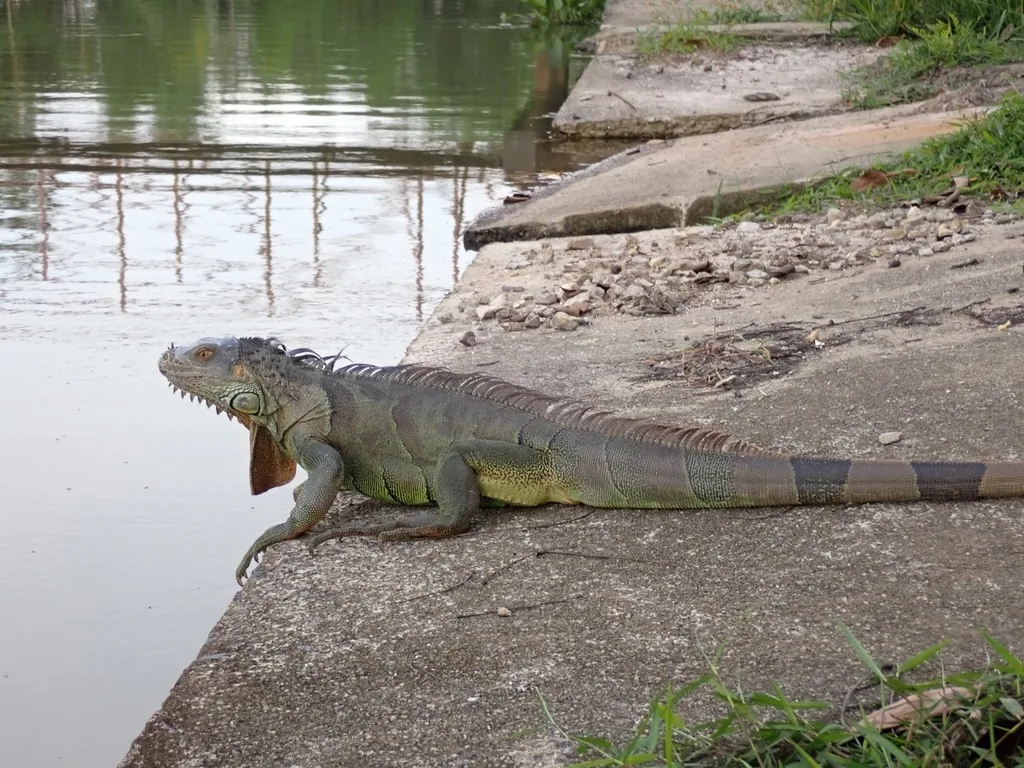
- A large lizard, usually green but sometimes brown or nearly black; some adults turn orange or pink at certain times of year, and hatchlings are bright green.[1]
- A row of spikes runs down the center of the neck, back and upper tail, and the tail has dark black rings.[1]
- Mature males grow heavy jowls and a large throat fan, or dewlap, that is much bigger than a female's.[1]
- Males can top five feet long and weigh up to 17 pounds; females can also reach five feet but usually stay under seven pounds.[1]
Look-alikes
| Look-alike | How to tell them apart |
|---|---|
| Spiny-tailed iguanas (black and Mexican) | Two other members of the iguana family, the black spiny-tailed iguana and the Mexican spiny-tailed iguana, are also established in mainland South Florida. Black spiny-tailed iguana males reach nearly 4 feet; these mostly ground-dwelling lizards are very wary of people and dash to their burrows, climbing only when they can't reach one. UF/IFAS says startled homeowners often mistake large male spiny-tailed iguanas for alligators because of their reduced back spines and dark color, and that spiny-tailed iguanas retreat into burrows when frightened, while green iguanas dive into water.[3][4] |
| Brown basilisk | UF/IFAS says this large lizard, up to 2 feet long, is often mistaken for an iguana and lives in the same areas. Like green iguanas it dives into water when frightened, but basilisks mostly eat insects and small animals rather than plants. Males are larger and brighter than females, with a much larger crest on the back of the head.[4] |
| Knight anole and Jamaican giant anole | People in South Florida often call these large green anoles "iguanas" or "iguanitos." UF/IFAS says knight anoles commonly reach 12–18 inches and Jamaican giant anole males 12 inches. They eat mainly insects and small animals, though knight anoles occasionally eat small fruits and flowers.[4] |
Where it lives
Native from Central America to tropical South America and some eastern Caribbean islands. In Florida, populations stretch along the Atlantic coast in Miami-Dade, Broward, Palm Beach, Martin and Monroe counties and along the Gulf coast in Collier and Lee counties. Iguanas reported farther north, as far as Alachua and Hillsborough counties, are likely escaped or released pets and unlikely to establish because the species is not cold hardy. Nearly all of GBIF's US records since 1990 (18,548 of 18,548... ) come from Florida.[1][5]
Biology and life cycle
Iguanas live on the ground, in shrubs and in trees, including suburban neighborhoods, towns and farm areas, and they swim well in both salt and fresh water.[1]
Adults eat mainly shoots, leaves, flowers and fruit, and FWC says they can also feed on bird eggs and dead animals. Juveniles eat plants, insects and tree snails. UF/IFAS adds that hatchlings eat adult iguanas' droppings to pick up the gut bacteria that help them digest plants, and that males are territorial toward other males but not toward females and juveniles.[1][3][4]
In Florida they crowd urban canals and the land around them, especially where trees form dense canopies near water. They are mainly tree dwellers, but when startled they drop from the branches and escape by swimming or running; they can stay underwater for up to four hours. UF/IFAS says they like to bask in open spots such as sidewalks, docks, seawalls, landscape timbers and mowed areas, and their habit of diving into water to escape makes them very hard to catch.[3][1][4]
Females typically mature at two to four years and dig nest chambers in riverbanks, beaches and other sandy areas, sometimes with nearly 80 feet of connected tunnels and several entrances. FWC gives clutches of 14 to 76 eggs.[1][2]
Along canal banks and vacant lots they shelter in burrows, culverts, drainage pipes and rock or debris piles, and canals help them spread to new areas.[1]
Iguanas are not cold hardy, so temperature limits how far north they can spread. The 2010 winter cut their numbers in some areas, but the population appears to have recovered. UF/IFAS says freezes keep them limited to the southern half of peninsular Florida, and during winter cold fronts cold-stunned iguanas fall from trees.[3][1][4]
Green iguanas live up to 10 years in the wild and 19 years in captivity.[1]
They bring parasites with them: wild-caught green iguanas in Florida have carried the lizard scale mite Hirstiella stamii and the Neotropical tick Amblyomma dissimile, both reported for the first time from wild-caught green iguanas in the United States.[6]
UF/IFAS lists raccoons, fish, crows, vultures and feral pigs among the animals that dig up iguana nests, and raccoons, snakes, hawks, owls, egrets, herons, cats and dogs as the main killers of hatchlings and young iguanas. Once young iguanas reach about two feet long they have fewer natural enemies; cars and people are the main cause of death for adults, and alligators occasionally take adults in the water.[4]
Damage and signs
- They eat landscape trees, shrubs and flowers, most fruits except citrus, and almost any vegetable. FWC names nickerbean, firebush, jasmine, orchids, roses, Washington fan palms, hibiscus, garden greens, squash and melons among their foods. UF/IFAS also lists dooryard fruit such as berries, figs, mangos, tomatoes, bananas and lychees, and notes that iguanas do not eat citrus.[1][4]
- Burrows can erode and collapse sidewalks, foundations, seawalls, berms and canal banks, and FWC says iguanas have badly damaged water control structures and roadways.[1][3]
- Droppings pile up on docks, moored boats, seawalls, porches, decks, pool platforms and even inside swimming pools. UF/IFAS says the droppings are unsightly and lead to odor complaints where iguanas bask.[1][2][4]
- In parks, green iguanas have eaten tree snails and nickerbean, a host plant of the endangered Miami blue butterfly.[1][3]
- They may also move into burrows of state-listed burrowing owls and gopher tortoises, competing with those native animals.[3]
Health risk
Like other reptiles, green iguanas can carry Salmonella. CDC says reptiles often carry it in their gut even when they look healthy, and people can get sick from touching the animals or water and surfaces they have contaminated. In a study of 12 captive green iguanas, all shed Salmonella at least once and 83% of fecal samples were positive; in Grenada, 55% of 62 wild and pet green iguanas carried it.[7][8][9]
Control
Prevention
Never feed iguanas, on purpose or by leaving fruit or pet food outside. Food draws dense groups of them, along with rats and raccoons, and causes problems for your neighbors too.[3]
Avoid planting iguana favorites such as hibiscus, orchids, roses, nasturtiums, impatiens and garden greens. FWC suggests resistant plants like milkweed, pentas, oleander, citrus, crotons and other tough, thick-leaved or waxy-leaved species.[3]
Keep them out
Protect prized plants with cages or screen enclosures, and wrap trees, palms and dock pilings with sheet metal guards (about 18 inches up from the base) so iguanas can't climb. Bury wire fencing several inches deep where they dig, and trim branches that hang over the house. UF/IFAS also suggests an L-shaped wire barrier to stop digging, and says electric fences on seawalls and docks may keep iguanas from climbing onto them.[3][4]
Sanitation
Remove dense thickets, brush and rock or landscape-material piles where they shelter, and fill empty burrows with concrete and sand during the day, when the animals are likely out. Make sure no iguana is inside first.[3][1]
Traps and physical control
Harass basking iguanas by spraying them with a hose or a water scarecrow sprinkler, making loud noises, hanging wind chimes, or hanging reflective CDs that you move often so they don't get used to them. UF/IFAS says persistent harassment encourages iguanas to move elsewhere.[1][3][4]
FWC recommends large, raccoon-sized cage traps baited with ripe, brightly colored non-citrus fruit such as strawberries, bananas, watermelon, grapes or mangos. Set traps in shade during the day to avoid catching raccoons, opossums and cats, cover them with breathable material, and check them at least once every 24 hours, as state law requires. UF/IFAS treats trapping as a last resort and recommends prebaiting: wire the door open with food inside until iguanas enter regularly, then set the trap. It says covering the trap with a burlap bag or old blanket may reduce the cuts and scrapes iguanas get trying to escape.[3][4]
Some property owners pile sand or mulch near seawalls to give iguanas a place to nest away from homes and seawalls, then destroy the eggs by freezing or crushing and throw them out in a sealed plastic bag.[3]
When to call a professional
If you can't remove iguanas safely, FWC suggests hiring a professional nuisance wildlife trapper, who can also do the killing if you don't want to. UF/IFAS also recommends a nuisance wildlife professional, because the public usually has difficulty performing humane euthanasia, and it does not recommend euthanasia by homeowners.[1][3][4]
What Florida law allows
Green iguanas are not protected in Florida except by anti-cruelty law, and FWC encourages landowners to remove them from private property.[1]
They can be humanely killed on private property year-round with the landowner's permission, and on 32 FWC-managed lands without a license or permit.[1]
Captured iguanas cannot be relocated and released anywhere else in Florida. Unless you are a trapper with an eradication and control permit, a captured iguana must be killed humanely on site.[1][3]
A permit is required to keep live captured green iguanas, and since April 29, 2021, they have been on Florida's Prohibited species list.[1]
No poisons are legal for use on iguanas or any other reptile in Florida. State rule also bans leg-hold and steel body-gripping traps, and driving wildlife out of burrows with gasoline, smoke, poisons or other chemicals.[3]
Check with your local waste authority about rules for disposing of carcasses.[3]
Humane killing standards
FWC says there is an ethical and legal obligation to kill nonnative reptiles humanely.[10]
FWC follows the American Veterinary Medical Association's two-step approach: first cause immediate loss of consciousness, then destroy the brain so the animal cannot recover.[10]
For the first step FWC lists a captive bolt, or a firearm or pre-charged pneumatic air gun aimed at the brain. The second step is pithing: driving a rigid metal tool such as a screwdriver or spike into the skull to destroy the whole brain. Follow local firearm rules wherever you are.[10]
Inhumane treatment, including poisoning, is prohibited and punishable under state law. Homeowners who don't want to kill an iguana themselves can call a wildlife removal professional.[3]
UF/IFAS adds that decapitation alone is inhumane, because a reptile's brain may remain active for up to a minute afterward.[4]
UF/IFAS does not recommend shooting, saying it is not safe to fire guns or pellet rifles in the suburban South Florida neighborhoods where iguanas usually cause problems.[4]
Droppings, bites and scratches
You don't have to touch a reptile to pick up its germs: CDC says water and surfaces can be contaminated with Salmonella. Wash your hands with soap and running water after cleaning up droppings or anything they have touched; CDC says children under 5, adults over 65 and people with weakened immune systems are more likely to get sick, and children under 5 shouldn't handle reptiles at all.[7]
Iguanas can bite and scratch when provoked, and FWC has several records of wild iguanas injuring people in Florida.[2]
UF/IFAS says adults are large, powerful animals that can bite, cause severe scratch wounds with their very sharp claws and deliver a painful slap with the tail. They normally avoid people but will defend themselves against people and pets that try to catch or corner them.[4]
Pet iguanas
It is illegal to release nonnative animals in Florida, yet escaped or released pets remain a main source of introduced species.[1][3]
Owners who can no longer care for a pet iguana can surrender it through FWC's Exotic Pet Amnesty Program with no penalty, whether or not it was kept legally. The program holds Amnesty Day events and offers year-round help through the Exotic Species Hotline (888-Ive-Got1). FWC does not rehome wild-caught iguanas.[1][3]
People who already had pet green iguanas before the 2021 rule need a permit to keep them as personal pets.[1]
Where sources disagree
Size: FWC's species page says males can top 5 feet and 17 pounds, while its homeowner workshop slides say males may reach over 6 feet.[1][3]
Clutch size: the species page and risk summary give 14 to 76 eggs, while the workshop slides give an average of 35 and up to 70.[1][2][3]
Public lands open to iguana removal: FWC's current species page lists 32 Commission-managed lands under Executive Order 23-16, while the older workshop slides list 25 under Executive Order 20-17. Use the current page.[1][3]
Keeping captured iguanas: UF/IFAS's homeowner guide says captured iguanas must be kept in captivity or destroyed and that babies can go to pet stores, but FWC has listed green iguanas as Prohibited since April 29, 2021, and keeping a live one now requires a permit. Follow FWC.[4][1]
Common questions
- Is it legal to kill an iguana in my yard in Florida?
- FWC says green iguanas can be humanely killed on private property year-round with landowner permission, but anti-cruelty law still applies and the method must be humane.[1][10]
- Can I trap an iguana and release it somewhere else?
- No. Captured iguanas cannot be released elsewhere in Florida, and keeping one alive requires a permit; only trappers with an eradication and control permit may move live iguanas off site.[1][3]
- Do repellents or poisons work on iguanas?
- No poisons are legal for use on iguanas or any reptile in Florida. Habitat changes, plant guards, barriers and persistent harassment are the deterrents FWC describes.[3][1]
- Can iguana droppings make you sick?
- They can carry Salmonella. CDC says reptiles often carry it even when healthy, and people can get sick from contaminated water or surfaces, so wash your hands after cleaning up droppings.[7][8]
- What eats iguanas in Florida?
- UF/IFAS says raccoons, snakes, hawks, owls, egrets, herons, cats and dogs kill most hatchlings and young iguanas, and raccoons, crows, vultures and other animals dig up nests. After about two feet long they have fewer natural enemies, and cars and people kill most adults.[4]
Sources
- Florida Fish and Wildlife Conservation Commission, “Green Iguana (Iguana iguana) species profile.” myfwc.com/wildlifehabitats/profiles/reptiles/lizards/green-iguana/ (accessed 2026-11-14)
- Florida Fish and Wildlife Conservation Commission, “Green Iguana Risk Summary.” myfwc.com/media/25281/green-iguana-risk.pdf (accessed 2026-11-14)
- Florida Fish and Wildlife Conservation Commission, “Iguana Technical Assistance Workshop (homeowner presentation).” myfwc.com/media/3womoike/iguana-presentation.pdf (accessed 2026-11-14)
- University of Florida/IFAS Extension, “Dealing with Iguanas in the South Florida Landscape, ENY-714/IN528.” ask.ifas.ufl.edu/publication/IN528 (accessed 2026-11-14). Used for identification, biology, damage and deterrents. Its legal, euthanasia-drug, Salmonella and pet-keeping lines are not used; current FWC rules govern.
- Global Biodiversity Information Facility (GBIF), “Iguana iguana: US occurrence records since 1990 by state (GBIF occurrence search API).” api.gbif.org/v1/occurrence/search?taxonKey=2459658&country=US&hasGeospatialIssue=false&occurrenceStatus=PRESENT&year=1990%2C2026&facet=stateProvince&facetLimit=400&limit=0 (accessed 2026-11-14)
- Journal of Medical Entomology, via PubMed, “First reports of ectoparasites collected from wild-caught exotic reptiles in Florida (Corn et al. 2011).” pubmed.ncbi.nlm.nih.gov/21337954/ (accessed 2026-11-14)
- Centers for Disease Control and Prevention, “Reptiles and Amphibians (Healthy Pets, Healthy People).” www.cdc.gov/healthy-pets/about/reptiles-and-amphibians.html (accessed 2026-11-14)
- Journal of the American Veterinary Medical Association, via PubMed, “Prevalence of fecal shedding of Salmonella organisms among captive green iguanas and potential public health implications (Burnham et al. 1998).” pubmed.ncbi.nlm.nih.gov/9656023/ (accessed 2026-11-14)
- Zoonoses and Public Health, via PubMed, “Prevalence, serovars and antimicrobial susceptibility of Salmonella spp. from wild and domestic green iguanas in Grenada, West Indies (Sylvester et al. 2014).” pubmed.ncbi.nlm.nih.gov/24325463/ (accessed 2026-11-14)
- Florida Fish and Wildlife Conservation Commission, “Humane Killing Methods for Nonnative Reptiles.” myfwc.com/wildlifehabitats/nonnatives/python/humane-killing-methods/ (accessed 2026-11-14)
- iNaturalist, “Iguana iguana taxon page (order and family).” www.inaturalist.org/taxa/35342 (accessed 2026-11-14)