On this page
How to identify it
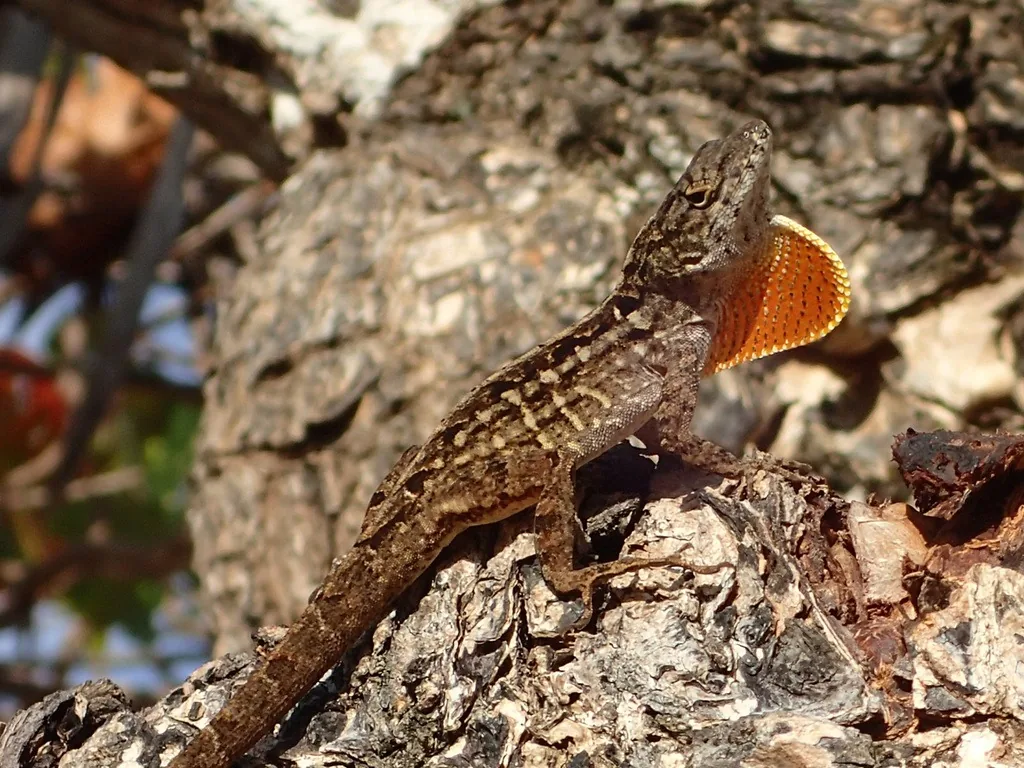
- A small lizard about 5 to 9 inches long from snout to tail tip. Males usually weigh about twice as much as females, roughly 8 grams to 4. UF/IFAS says mature females are slightly smaller than males, and hatchlings are about 1.5 inches long and patterned like adult females.[1][2][8]
- Brown to gray, and males can even turn black. The back usually carries whitish or yellowish spots, triangles or lines. UF/IFAS says they lighten or darken from brown to gray to black, some are red or have a reddish head, and brown anoles are never green.[1][2][8]
- Females are lighter and have a dark diamond-back or scalloped pattern down the back. UF/IFAS says females almost always have a light stripe down the middle of the back and are more boldly patterned than males, while males can raise a smooth-edged crest on the neck, back and tail.[2][8]
- Males flash an orange or red throat fan (dewlap) with a white edge; folded, it shows as a pale streak along the neck. Females have a smaller dewlap they rarely extend.[1][2]
- Like all of Florida's anoles, it has expanded toe tips with a small claw that make it an excellent climber.[8]
Look-alikes
| Look-alike | How to tell them apart |
|---|---|
| Green anole (native) | The native green anole is usually green or lightly patterned brown and has a longer snout. Brown anoles have a shorter head and bolder back markings, and are usually seen on the ground or low perches. UF/IFAS says green anoles can quickly turn brown or gray but lack the extensive markings of brown anoles. Males in most of Florida have a pink dewlap (gray or dull green in southwestern Florida), and females have a thin light stripe down the back.[1][2][8] |
| Crested anole (introduced) | Males are brown with a thin, jagged crest along the back or tail and an orange dewlap with a yellow center. UF/IFAS says it occurs mainly in Miami-Dade County.[8] |
| Bark anole (introduced) | Much smaller, with mottled light and dark patterns instead of bold markings; males have pale yellow to pale green dewlaps that may carry a light orange spot. UF/IFAS says it lives only near the coast in southern Florida.[8] |
Where it lives
Native to Cuba and the Bahamas. Established throughout South Florida since the 1940s, spreading north into coastal and southern Georgia, and collected in Houston since 1987; GBIF records also come from Hawaii and Louisiana. UF/IFAS says it was the first nonnative reptile documented in Florida, reaching Key West in the late 1800s, probably as a stowaway in cargo from Cuba. It was in every county of the peninsula by the early 2000s and is now established along much of the Panhandle coast and around Tallahassee.[2][1][6][8]
Biology and life cycle
Brown anoles are less tree-dwelling than green anoles, living on the ground and in low vegetation. They thrive in almost any habitat and are often abundant in suburbs and cities. UF/IFAS calls it a trunk-ground anole and says it is most common in suburban yards, school yards, golf courses and planted strips of parking lots, and is the most commonly seen lizard in much of Florida.[1][2][8]
Active by day in warm weather, they bask in vegetation and dart out to grab insects or chase rivals. In cool weather they hide under bark, shingles or in rotten logs, sometimes many together. UF/IFAS adds that some are active at night, feeding on insects drawn to lights, and that they sleep stretched out on the limbs of small trees and shrubs or shelter behind storm shutters and in rain gutters.[1][8]
They eat insects, spiders and other invertebrates, including worms, snails and slugs, and in Florida they have been seen eating green anole eggs. UF/IFAS says they also eat vegetation and small lizards, including their own kind and native green anoles.[1][2][8]
Females lay single round eggs in moist soil or rotten wood through the warm months. Eggs hatch in about four weeks, and the young mature in under a year. UF/IFAS says Florida females lay one brittle-shelled egg every 4 to 6 days in spring and summer, hidden under leaf litter, rocks and debris; eggs hatch in 30 to 45 days, and wild brown anoles usually live less than two years.[1][2][8]
They spread mostly by hitchhiking: in vehicles and, especially as eggs, in shipments of live plants. Pet-store sales add to the spread. UF/IFAS adds that people move them in ornamental plants, vehicles, canoes, kayaks and yard debris, and eggs can travel in potted plants.[2][8]
Every invasive brown anole population studied in the southeastern U.S. shows hybrid ancestry from several native-range lineages, and that genetic makeup has stayed stable over 15 years of sampling.[4]
Males advertise territories and court females by flashing the dewlap, bobbing the head and doing push-ups.[8]
Predators include larger lizards, outdoor cats, snakes such as black racers and corn snakes, and birds; UF/IFAS says egrets often stalk them in shopping-center parking lots.[8]
Damage and signs
- On small islands in Florida, green anoles moved to higher perches after brown anoles invaded and evolved larger toepads within about 20 generations.[3]
- The Texas Invasive Species Institute says brown anoles compete with green anoles for food and territory and can carry parasites into new areas, as they did to Hawaii.[2]
- Since July 2019, brown anoles in Florida have been found with large, soft lumps under the skin and swollen faces, caused by the bacterium Enterococcus lacertideformus, raising concern about spread to native lizards.[5]
- UF/IFAS says green anoles move higher where brown anoles live, both to avoid competing for food and because brown anoles drive them upward, and in a controlled experiment adult brown anoles were much more likely to eat juvenile green anoles than the reverse. Where there is no tree canopy to retreat to, green anoles could decline and disappear locally.[8]
- They can get into homes, sheds, garages and screened rooms and are hard to catch once inside, and pet cats often catch them and may leave partly eaten lizards indoors.[8]
Health risk
None of the sources here reports a health risk to people; the concerns are ecological, for native lizards.[1][2][5]
Control
Prevention
Check potted and landscape plants before moving them, since eggs traveling in live plants are a suspected route of spread.[2]
Don't buy brown anoles as pets or release them: the Texas Invasive Species Institute says limiting pet-store sales could reduce their spread.[2]
Inspect ornamental plants before moving them, and check storage compartments of canoes, kayaks and other boats so you don't carry brown anoles into natural areas such as state parks.[8]
To help native green anoles, keep areas of dense vegetation for food and hiding places for hatchlings, and keep or plant trees that give green anoles higher perches.[8]
If you see a brown anole in the Florida Panhandle outside its mapped range, take a photo and report it to EDDMapS or iNaturalist.[8]
Traps and physical control
Hand-capture can keep numbers down around a yard. UF/IFAS describes humane euthanasia: seal the lizard in a container or plastic bag, refrigerate it for 2 to 3 hours, then freeze it for 24 hours.[8]
When to call a professional
No real management strategies have emerged in the states where they live; with established populations across the Southeast, prevention is the main tool. UF/IFAS likewise says there is little chance of eradicating them from Florida, but spread can be slowed, especially in the Panhandle and beyond.[2][8]
Where it lives
Native to Cuba and the Bahamas; the Texas Invasive Species Institute also lists Honduras and the Cayman Islands. It was first documented in the Florida Keys in the 1880s and was established in South Florida by the 1940s.[2]
It has been slowly spreading north from Florida and is firmly established in parts of coastal and southern Georgia; specimens have been collected in Houston since 1987.[1][2]
Most GBIF US records since 1990 come from Florida, followed by Texas, Hawaii, Louisiana and Georgia.[6]
UF/IFAS says genetic analyses show brown anoles were introduced to Florida at least eight times from different parts of the native range, and Florida is the likely source of those introduced to Hawaii and Taiwan.[8]
Where sources disagree
Effect on green anoles: the Texas Invasive Species Institute says brown anoles cause a significant reduction in green anole populations wherever they occur, while a field study on Florida islands documented green anoles moving higher into the trees and adapting rather than disappearing. UF/IFAS says some studies have shown or suggested green anole declines where brown anoles live, but none concluded that brown anoles caused local extinction of green anoles.[2][3][8]
How often females lay: the Savannah River Ecology Lab says roughly every 14 days, while the Texas Invasive Species Institute says a female can lay an egg every week. UF/IFAS says every 4 to 6 days.[1][2][8]
Size: the Savannah River Ecology Lab gives 5 to 8.5 inches in total length; the Texas Invasive Species Institute says about 5 to 9 inches. UF/IFAS also gives 5 to 9 inches.[1][2][8]
Dewlap edge: the Savannah River Ecology Lab and the Texas Invasive Species Institute describe a white edge; UF/IFAS describes the dewlap as orange with a yellow border.[1][2][8]
Common questions
- Is the brown anole the same as a chameleon?
- No. It is an anole from Cuba and the Bahamas. The native green anole is the one usually green; brown anoles are brown to gray or nearly black. UF/IFAS says the native green anole is sometimes called a chameleon because it changes color, but true chameleons are an entirely different group of lizards, and brown anoles are never green.[2][1][8]
- Are brown anoles dangerous to people or pets?
- None of the sources here reports a hazard to people; the worries are about native lizards.[1][2]
- Did brown anoles wipe out green anoles?
- Sources differ. One institute says green anole numbers drop sharply where brown anoles live, but a Florida island study found green anoles moved to higher perches and adapted. UF/IFAS says green anoles often move up into tree canopies, where they are harder to see, which gives the impression they are gone.[2][3][8]
- Why does the anole in my yard have lumps on its face?
- In Florida, brown anoles with soft lumps and facial swelling have been found infected with the bacterium Enterococcus lacertideformus since 2019.[5]
Sources
- University of Georgia Savannah River Ecology Laboratory, Herpetology Program, “Brown Anole (Anolis sagrei) - Introduced.” srelherp.uga.edu/lizards/brown-anole/ (accessed 2026-11-11). Species account from the Herpetology Program of the Savannah River Ecology Laboratory, a University of Georgia research unit.
- Texas Invasive Species Institute (Texas State University System), “Brown Anole (Anolis sagrei).” tsusinvasives.org/home/database/anolis-sagrei (accessed 2026-11-11). Invasive species database run by the Texas Invasive Species Institute (Texas State University System).
- Science, via PubMed, “Rapid evolution of a native species following invasion by a congener (Stuart et al. 2014).” pubmed.ncbi.nlm.nih.gov/25342801/ (accessed 2026-11-11)
- Proceedings of the National Academy of Sciences, via PubMed, “Changes in selection pressure can facilitate hybridization during biological invasion in a Cuban lizard (Bock et al. 2021).” pubmed.ncbi.nlm.nih.gov/34654747/ (accessed 2026-11-11)
- Journal of Wildlife Diseases, via PubMed, “Multisystemic enterococcosis in brown anoles (Anolis sagrei) from Florida, USA (Caudill et al. 2023).” pubmed.ncbi.nlm.nih.gov/36989509/ (accessed 2026-11-11)
- Global Biodiversity Information Facility (GBIF), “Anolis sagrei: US occurrence records since 1990 by state (GBIF occurrence search API).” api.gbif.org/v1/occurrence/search?taxonKey=4287413&country=US&hasGeospatialIssue=false&occurrenceStatus=PRESENT&year=1990%2C2026&facet=stateProvince&facetLimit=400&limit=0 (accessed 2026-11-11)
- iNaturalist, “Anolis sagrei taxon page (order and family).” www.inaturalist.org/taxa/116461 (accessed 2026-11-11)
- University of Florida IFAS Extension, EDIS, “Florida's Introduced Reptiles: Brown Anole (Anolis sagrei), WEC441/UW486.” ask.ifas.ufl.edu/publication/UW486 (accessed 2026-11-14)