On this page
How to identify it
- House geckos have large, bulging eyes without eyelids, vertical pupils, and sticky toe pads that let them climb walls and windows.[1][2]
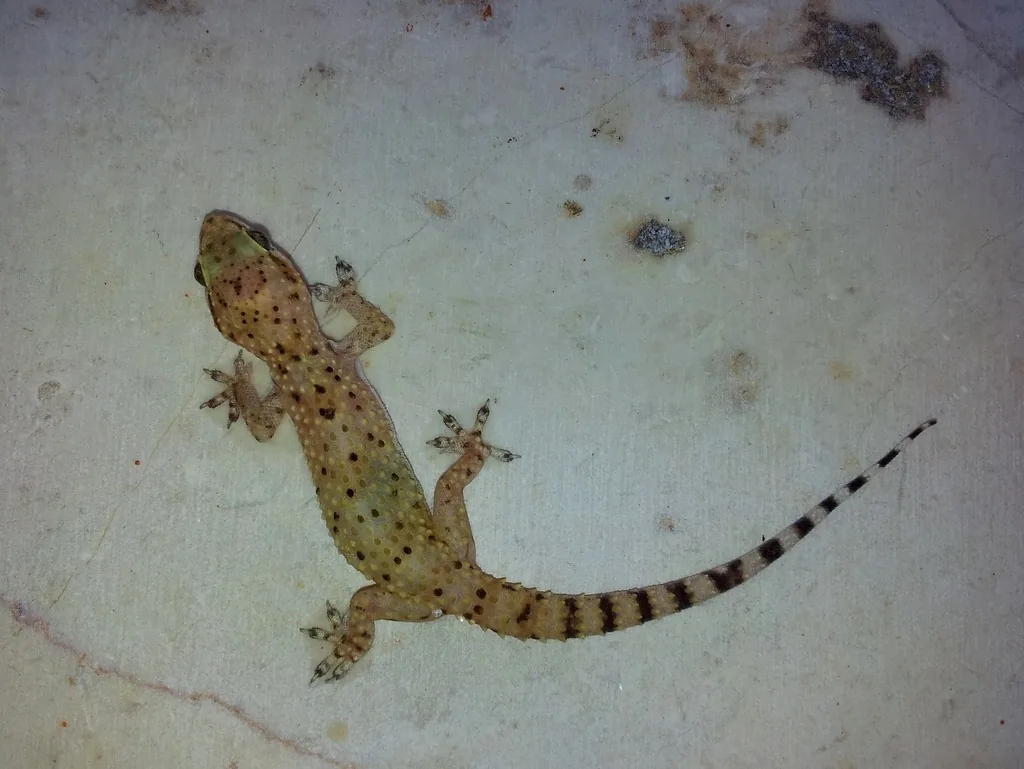
- The Mediterranean house gecko reaches about 4 to 5 inches including the tail, with a rounded snout and small bumps over the head, body, legs and tail. Animal Diversity Web gives 10 to 13 cm for adults, up to 15 cm.[1][2][3]
- It is pale tan, light gray or whitish with darker mottling, and its tapering tail is banded with brown. Animal Diversity Web adds a dark line from the nostril through the eye toward the ear.[1][2][3]
- They may squeak or give a high-pitched call when alarmed.[1][2]
- A broken tail grows back; juveniles regrow it faster than adults.[3]
Look-alikes
| Look-alike | How to tell them apart |
|---|---|
| Common house gecko | The other introduced house gecko in Texas grows 3 to 6 inches, has a longer snout, and is pinkish to grayish with darker marbling and a creamy-white underside.[1] |
Where it lives
Native to the Mediterranean region, northern Africa and the western Middle East, and introduced by people to many other areas. It is common in suburban and urban parts of Texas and is spreading north from the southern U.S., with records in several places in southern Illinois.[3][1][2]
Biology and life cycle
They are nocturnal and gather at porch lights, lit windows and window screens to catch moths, cockroaches and other insects. Animal Diversity Web adds pillbugs, spiders and other small arthropods to the diet.[1][2][3]
By day they shelter in cracks and crevices on and around buildings; the Mediterranean gecko is nearly always found around human structures.[1][2]
Females lay several clutches of two white, oval eggs over the summer in crevices, under bark or in soil, sometimes sharing a nest site with other females.[1][2]
Animal Diversity Web gives a breeding season of April to August, egg-laying from mid-May to August, and incubation of about 40 days at around 31 degrees Celsius.[3]
They are most active from spring through fall.[1]
Known predators include cats, bats, Cuban tree frogs, whip scorpions and large spiders. Juveniles wag their banded tails to draw attacks away from the body.[3]
Damage and signs
- Geckos that move indoors leave elongated brown droppings, often tipped with white, that can stain carpets, rugs, walls and curtains.[1]
Health risk
Texas A&M AgriLife Extension treats house geckos as beneficial insect predators whose problems are nuisance and staining. CDC warns that reptiles, lizards included, often carry Salmonella even when they look healthy, so wash your hands with soap and water after handling one or anything it has touched, and keep children under 5 from handling reptiles.[1][4]
Control
Keep them out
Replace worn weatherstripping on doors and windows and seal cracks around soffits and plumbing or electrical openings with silicone caulk or expanding foam.[1]
Seal the poorly closed gaps on the outside of the house where geckos hide during the day.[1]
Traps and physical control
Catch an indoor gecko with a plastic tub or jar and release it outside, after sealing the gaps that let it in.[1]
Glue boards near lights and windows will catch geckos, but Texas A&M notes they kill slowly and don't allow humane release.[1]
Pesticides
No pesticides are registered for gecko control; general insect sprays may slightly reduce their food, but the effect on geckos is probably minimal.[1]
Moving north
Illinois DNR reports the Mediterranean gecko spreading northward from the southern United States. Animal Diversity Web describes it as tolerant of both heat and cold and says its non-native range is expected to expand with climate change.[2][3]
A study of a population at the northern edge of its U.S. invasion found body temperatures spread over a wide range and sprinting and immune responses that worked well across that range, which may help it invade cooler climates.[5]
Common questions
- Should I get rid of geckos around my house?
- Many people leave them alone because they eat insects; the usual goal is just to keep them out of the house by sealing gaps.[1]
- What do gecko droppings look like?
- They are elongated and brownish, often with a white tip, and are found near where geckos rest or enter.[1]
- Can house geckos make people sick?
- Like other reptiles they can carry Salmonella. CDC advises washing hands with soap and water after touching reptiles or anything in their environment.[4]
- Is there a spray that kills geckos?
- No pesticide is registered for geckos, so management relies on exclusion and removal.[1]
Sources
- Texas A&M AgriLife Extension Service, “House geckos (Insects in the City fact sheet ENT-2006).” citybugs.tamu.edu/factsheets/household/misc-house/ent-2006/ (accessed 2026-11-11)
- Illinois Department of Natural Resources, “Mediterranean gecko (Hemidactylus turcicus).” dnr.illinois.gov/education/wildaboutpages/wildaboutlizards/walzmediterraneangecko.html (accessed 2026-11-11)
- Animal Diversity Web, University of Michigan Museum of Zoology, “Hemidactylus turcicus (Mediterranean house gecko), species account.” animaldiversity.org/accounts/Hemidactylus_turcicus/ (accessed 2026-11-11)
- Centers for Disease Control and Prevention, “Reptiles and Amphibians (Healthy Pets, Healthy People).” www.cdc.gov/healthy-pets/about/reptiles-and-amphibians.html (accessed 2026-11-11)
- Physiological and Biochemical Zoology, via PubMed, “Eurythermic sprint and immune thermal performance and ecology of an exotic lizard at its northern invasion front (Dallas et al. 2021).” pubmed.ncbi.nlm.nih.gov/33275543/ (accessed 2026-11-11)
- iNaturalist, “Hemidactylus turcicus taxon page (order and family).” www.inaturalist.org/taxa/34435 (accessed 2026-10-06)